
48V Lithium Golf Cart Battery Replacement & Performance Guide
August 7, 2026 / Battery Expert Team / Battery Basics
Introduction
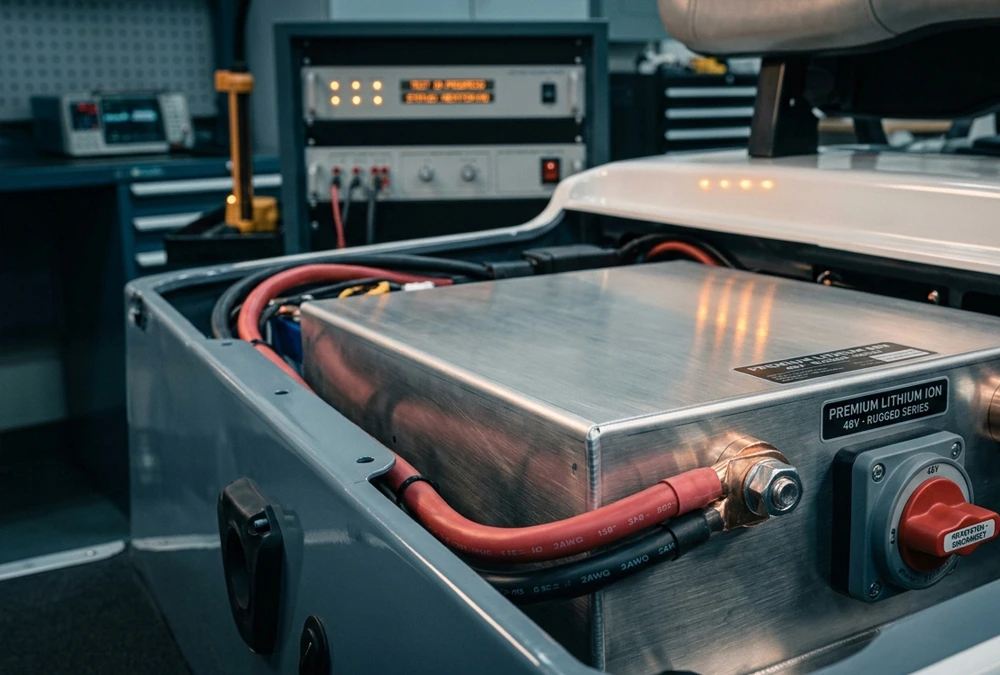
I have spent years building high-voltage power systems and troubleshooting fleet issues in the field. When a resort manager or fleet distributor calls me about poor range, nine times out of ten the culprit is an aging lead-acid pack. Upgrading to a 48v lithium golf cart battery completely transforms how your vehicle performs on the turf and hills. You drop hundreds of pounds instantly while gaining crisp, immediate acceleration that lead-acid simply cannot match.
Replacing an old battery setup involves more than pulling out heavy lead bricks and dropping in new cells. You must understand discharge rates, continuous amperage limits, and exact tray dimensions to avoid costly mistakes. A poorly integrated 48v lithium golf cart battery setup can trip under heavy torque or leave you stranded on a steep incline. This comprehensive guide walks you through the exact technical details, procurement logic, and installation steps required for a seamless conversion.
Understanding 48V Lithium Golf Cart Battery Technology
Modern electric vehicles rely on stable, low-maintenance energy storage systems. Switching to a 48V lithium golf cart battery system replaces legacy flooded or AGM battery banks with high-density lithium iron phosphate chemistry. Understanding how these packs are built ensures you pick the right power output for your specific terrain.
What Is a 48V Lithium Golf Cart Battery?
A standard 48V LiFePO4 golf cart battery does not run at a static 48.0 volts. Instead, it uses 16 individual lithium iron phosphate cells wired in series. Each cell has a nominal rating of 3.2V, which gives the pack a true nominal rating of 51.2V.
This 51.2V nominal setup operates safely across a well-defined voltage window:
- Full Charge Voltage: Approximately 58.4V under active charge.
- Nominal Resting Voltage: Around 51.2V during normal operation.
- Low-Voltage Protection Cut-off: Triggers between 40.0V and 44.0V to shield cells from damage.
Why does the industry call it a 48V pack? It simply keeps nomenclature clear for fleet buyers. The pack drops directly into existing 48V motor controllers, DC-DC converters, and stock drivetrains without requiring expensive custom rewiring.
48V Lithium Battery vs 36V Golf Cart Battery: What Is the Difference?
Choosing between a 36V drivetrain and a 48V system depends on vehicle speed, passenger load, and terrain. Older utility carts relied on 36V banks, but modern high-performance vehicles almost exclusively use 48V architectures.
| Feature Metric | Legacy 36V Battery System | Modern 48V Lithium System | User Benefit & Decision Value |
|---|---|---|---|
| Torque & Power Output | Moderate torque, slows down on hills | High torque, handles steep inclines easily | Maintains top cruising speed up steep hills without motor strain. |
| Current Draw (Amperes) | Higher amp draw for same power | Lower amp draw, runs cooler | Less thermal stress extends motor and controller lifespan. |
| Top Speed Capability | Typically capped at 12–15 mph | Reaches 20–25+ mph easily | Cuts transit time across large resorts, campuses, and courses. |
| Energy Efficiency | Standard efficiency, higher heat loss | Up to 95% energy transfer efficiency | Delivers lower utility bills and longer runtime per charge cycle. |
The 48V configuration excels at carrying four to six passengers, hauling cargo across industrial parks, and negotiating hilly terrain. It delivers cooler wire operating temperatures and far better acceleration.
48V Lithium Golf Cart Battery Configuration, Compatibility and LiFePO4 Technology
Getting your battery setup right means matching capacity to your daily mileage demands. Choosing the proper golf cart lithium battery replacement pack prevents range anxiety and stops premature power cut-offs under heavy load.
How Is a 48V Lithium Golf Cart Battery Configured?
Lithium replacement packs come in several standard capacity tiers. Selecting the right Amp-hour (Ah) rating depends on how many miles your cart travels every day:
- 48V 50Ah Pack (~2.56kWh): Ideal for flat, short-distance courses, light two-passenger carts, and quick neighborhood runs (15–25 miles range).
- 48V 100Ah Pack (~5.12kWh): The industry gold standard. Fits four-passenger lifted carts, full 36-hole golf days, and heavy resort use (40–60 miles range).
- 48V 150Ah–200Ah Pack (~7.68kWh–10.24kWh): Built for commercial shuttle buses, multi-shift sightseeing vehicles, and utility haulers (70–100+ miles range).
You can calculate total stored energy using this simple equation:
A standard 48V 100Ah lithium golf cart battery yields 51.2V × 100Ah = 5,120Wh (or 5.12kWh) of usable energy. That provides plenty of sustained power for demanding daily routes.
Why LiFePO4 Is the Preferred Chemistry for 48V Golf Cart Batteries
Not all lithium batteries use the same internal chemistry. Electric cars often use Nickel Manganese Cobalt (NMC) for extreme energy density, but lithium iron phosphate (LiFePO4) is the undisputed king for low-speed electric vehicles and golf carts.
According to the BloombergNEF Lithium-Ion Battery Survey, global adoption of lower-cost, highly stable LiFePO4 cells pushed stationary and heavy-duty pack prices down significantly. That shift brings three main operational advantages to fleet owners:
- Superior Thermal Stability: LiFePO4 chemistry will not enter thermal runaway even if punctured or subjected to high ambient heat. That makes it exceptionally safe for passenger transport.
- Extended Cycle Life: While lead-acid batteries fail after 300 to 500 cycles, a high-quality deep cycle lithium battery delivers 3,500 to 5,000 full cycles before dropping to 80% original capacity.
- Deep Usable Capacity: You can safely discharge LiFePO4 down to 80%–100% Depth of Discharge (DoD) without damaging the internal structure. Lead-acid batteries suffer rapid plate degradation if pulled below 50% DoD.
Key Benefits of 48V Lithium Golf Cart Battery Performance
Upgrading to a modern 48V LiFePO4 golf cart battery transforms everyday vehicle handling. The benefits extend far beyond simply eliminating water top-offs.
Longer Driving Range and Stable Power Output
Lead-acid batteries suffer from significant voltage sag. As charge drains, terminal voltage drops rapidly. That causes your golf cart to crawl sluggishly up hills near the end of the day.
Lithium iron phosphate features a flat discharge curve. Terminal voltage stays stable at around 51.2V through 85% of the discharge cycle. Your cart delivers full speed and high climbing torque until the pack is almost empty.
Replacing a heavy lead-acid array drops 250 to 350 pounds off your vehicle frame. That mass reduction directly improves your overall golf cart battery range, cuts tire wear, and prevents turf compaction on wet fairways.
Faster Charging and Higher Energy Efficiency
Charging speed directly impacts operational uptime for commercial fleets and rental vehicles:
| Performance Metric | Standard Lead-Acid Pack | 48V LiFePO4 Battery System | User Benefit & Decision Value |
|---|---|---|---|
| Full Charge Duration | 8 to 10 hours continuous | 2.5 to 4 hours rapid charge | Enables quick opportunity charging between morning and afternoon rentals. |
| Energy Transfer Efficiency | 70% to 75% (25% lost as heat) | 95% to 98% charge efficiency | Lowers facility power costs by converting almost all grid power into runtime. |
| Opportunity Charging | Damages cells due to heat buildup | Completely safe, no memory effect | Top up during lunch breaks without reducing overall battery lifespan. |
Reduced Maintenance Requirements
Managing flooded lead-acid batteries requires tedious, mess-prone weekly service routines. Technicians must top off distilled water, neutralize acid spills, clean corrosion off terminals, and ensure proper gas ventilation during charge cycles.
A sealed 48V lithium golf cart battery requires zero fluid maintenance. There is no acid to spill, no corrosion to scrape, and no hazardous hydrogen gas emitted during fast charging. You install it once and run it worry-free for years.
48V Lithium Golf Cart Battery vs Lead Acid Battery Comparison
Comparing initial purchase cost against long-term operational expense reveals the true financial advantage of switching chemistries. A modern lithium vs lead acid golf cart battery comparison proves that initial price tags can be deceiving.
Performance Comparison Between Lithium and Lead Acid Golf Cart Batteries
| Evaluation Factor | Lead-Acid (Flooded / AGM) | 48V LiFePO4 Lithium Pack | User Benefit & Decision Value |
|---|---|---|---|
| Operational Lifespan | 2 to 4 years max | 8 to 10+ years continuous | Eliminates frequent replacement cycles and cut down on labor costs. |
| Total Weight | 320 lbs to 450 lbs | 95 lbs to 140 lbs total | Reduces chassis strain, improves handling, and preserves turf quality. |
| Depth of Discharge (DoD) | 50% recommended limit | 80% to 100% usable capacity | Delivers double the practical runtime per charge from the same size battery. |
| Monthly Self-Discharge | 15% to 20% loss per month | 1% to 3% loss per month | Carts sit through off-season winter storage without dying or freezing. |
| Life Cycle Count | 300 to 500 cycles | 3,500 to 5,000+ cycles | Provides a far lower total cost per mile over the life of the vehicle. |
Is Upgrading to a 48V Lithium Battery Worth It?
A premium best 48V lithium battery for golf cart retrofit costs more upfront than a fresh set of lead-acid batteries. However, looking at the total cost of ownership over five years shows clear savings:
- Lead-acid batteries require two to three full set replacements over an eight-year window.
- Technician labor costs for fluid checks, terminal cleaning, and replacement add up fast over time.
- Efficiency losses burn up to 30% more electricity during every single charge cycle.
For golf courses, fleet operators, and daily drivers, upgrading to a 48V lithium golf cart battery replacement pays for itself within three years while delivering far superior day-to-day performance.
Choosing the Right 48V Lithium Golf Cart Battery for Your Application
Picking the ideal pack requires evaluating daily usage, motor controller amperage, and physical battery bay dimensions.
Check Battery Capacity and Driving Requirements
Calculate your mileage needs before placing an order:
- Light Duty (<15 miles/day): Neighborhood errands, flat pavement → 48V 50Ah.
- Standard Fleet Use (25–45 miles/day): 36 holes of golf, hilly terrain, 4 passengers → 48V 100Ah.
- Heavy Commercial Duty (50+ miles/day): Resort shuttles, cargo towing, continuous shifts → 48V 150Ah–200Ah or two parallel 100Ah packs.
Verify Golf Cart Battery Compatibility
Before buying a new battery pack, inspect your vehicle’s electrical setup to confirm these key specs:
- System Voltage: Confirm your motor controller operates at 48V (or 51.2V nominal).
- Peak BMS Discharge Rating: Match the BMS continuous rating (e.g., 100A or 200A) and pulse rating (e.g., 350A for 5 seconds) to your motor controller specs (EZGO, Club Car, Yamaha, Evolution, or ICON).
- Physical Tray Dimensions: Measure your under-seat battery compartment. Choose a single drop-in metal box or modular units that fit your original hold-down brackets.
Why Is the Battery Management System (BMS) Important?
A lithium pack is only as good as its electronic control board. The integrated BMS continuously monitors internal conditions to keep your battery operating safely:
- Over-Charge & Over-Discharge Protection: Instantly disconnects power if charging voltage spikes or if cell voltage drops dangerously low.
- Thermal Safeguards: Disables charge cycles when temperatures drop below freezing (0°C) or climb above 55°C, preventing permanent cell plating.
- Active Cell Balancing: Equalizes voltage across all 16 internal cells to preserve maximum usable capacity over thousands of charge cycles.
48V Lithium Golf Cart Battery Charger Requirements and Charging Guide
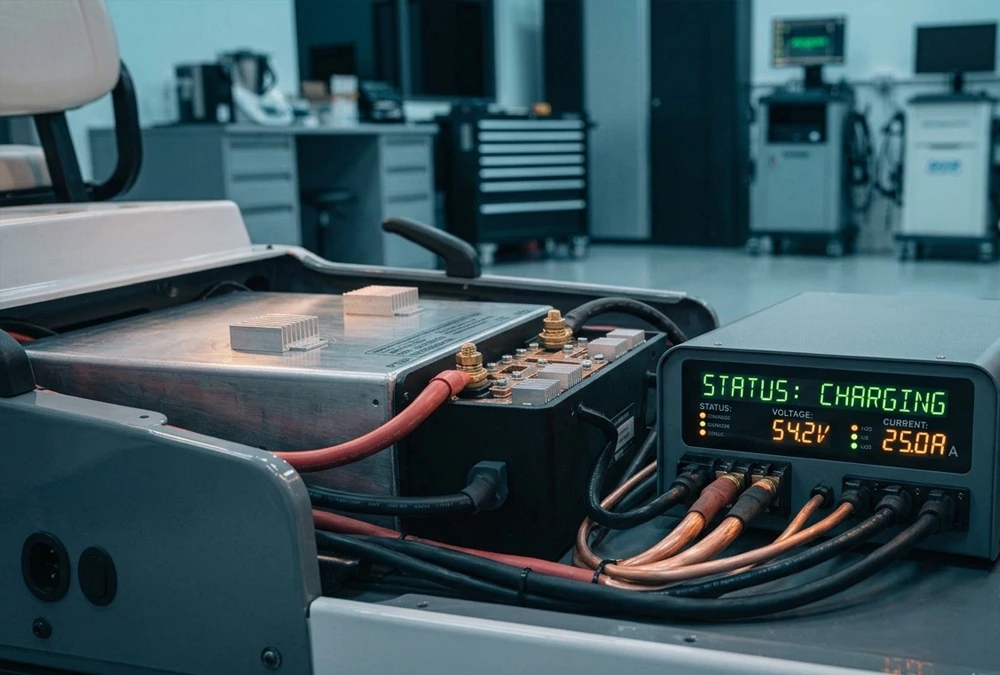
Proper charging habits keep your high-performance battery running safely for years. Using incorrect charging equipment can ruin high-grade lithium cells prematurely.
Why Does a 48V Lithium Battery Need a Dedicated Charger?
Lead-acid chargers use desulfation profiles that push high voltage spikes to break up lead sulfate deposits. Applying those high-voltage spikes to a 48V golf cart battery pack will trigger the internal BMS over-voltage safety lock, cutting off power to protect the cells.
Always source a dedicated 48V LiFePO4 golf cart battery with charger bundle. Proper chargers use a precise Constant Current / Constant Voltage (CC/CV) charging profile engineered specifically for lithium iron phosphate chemistry.
Recommended Charging Parameters for 48V LiFePO4 Battery
Configure your charger output to match these exact industry specs:
- Recommended Charge Profile: CC/CV (Constant Current / Constant Voltage).
- Bulk Charge Cut-off Voltage: Set to 58.4V (3.65V per cell).
- Float Voltage Setting: Set to 54.4V (or turn off float entirely).
- Recommended Charge Current: 20A to 30A charger output for a 100Ah pack (delivers full recharge in 3 to 4 hours).
Installation Tips for 48V Lithium Golf Cart Battery Replacement
Retrofitting your golf cart with a high-capacity lithium battery is a straightforward afternoon project if you follow proper safety steps.
Use Manufacturer Recommended Components
Dropping hundreds of pounds off your cart chassis means you need proper hardware to secure the new, smaller battery pack:
- Use robust physical mounting brackets or drop-in tray spacers so the light battery doesn’t bounce around in the bay.
- Install heavy-gauge copper wiring (at least 4AWG or 2AWG) with tin-plated ring terminals to handle high continuous amperage without heating up.
- Add an inline high-amperage fuse or DC circuit breaker (200A to 250A) near the positive terminal for extra short-circuit protection.
Wiring and Safety Considerations During Installation
- Turn the tow/run switch under your seat to TOW mode before disconnecting any wires.
- Disconnect the main negative lead first, followed by the main positive lead. Remove all old lead-acid jumper cables.
- Clean out the battery bay completely. Neutralize any acid residue using baking soda and water before dropping in the clean lithium pack.
- Wire the new battery leads carefully. Double-check positive and negative polarity using a multimeter before switching the breaker back on.
- Torque all terminal bolts firmly to factory specifications to prevent loose high-resistance contacts that can melt terminals under load.
Does a Lithium Golf Cart Battery Need Ventilation?
Unlike flooded lead-acid batteries, sealed LiFePO4 cells produce zero explosive hydrogen gas during charge cycles. That means you don’t need heavy open-air compartment venting. However, keeping the battery bay clean and dry allows heat to dissipate properly during long, heavy runs.
Maintaining a 48V Lithium Golf Cart Battery for Maximum Lifespan
A high-grade 48V lithium golf cart battery requires almost no daily maintenance, but following a few smart operational habits will extend its working life well past ten years.
Best Charging Practices
- Top off your battery whenever convenient—you don’t need to drain it down to 0% first.
- Unplug the charger once the cycle finishes. Avoid leaving it connected for months on end during long winter breaks.
- Never attempt to charge your lithium battery if the pack temperature drops below freezing (32°F / 0°C), unless your pack features built-in self-heating technology.
Temperature and Storage Management
Extreme temperatures shorten the life of any chemical energy storage system:
- Operating Window: Runs efficiently between -20°C and 55°C (-4°F to 131°F).
- Winter Storage Protocol: Charge the battery to roughly 50%–60% State of Charge (SOC), turn off the main circuit breaker or switch the cart to TOW mode, and store it in a cool, dry place.
- Seasonal Checkup: Inspect stored batteries every 3 to 6 months and top them up if SOC drops below 30%.
Monitor Battery Health with BMS Data
Modern premium replacement packs feature integrated Bluetooth telemetry. You can sync your smartphone directly to the internal BMS to monitor real-time operating metrics:
- Track exact State of Charge percentage rather than relying on inaccurate analog dash meters.
- View real-time cell voltage balance across all 16 series cells.
- Check active current draw, internal pack temperatures, and cumulative lifetime cycle counts instantly.
Common Mistakes When Buying a 48V Lithium Golf Cart Battery
Avoid these three costly pitfalls when sourcing a replacement 48V golf cart battery pack:
Choosing Only Based on Price
Bargain-bin batteries online often cut costs by using second-grade (Grade-B) surplus cells or low-quality BMS boards that lack proper thermal protection. These cheap packs suffer from early capacity loss, cell imbalance, and frequent cut-offs when climbing steep hills.
Ignoring Battery Capacity Requirements
Putting a small 50Ah battery into a heavy four-passenger lifted cart will cause rapid voltage sag and force the battery to run near its maximum thermal limits continuously. Always size your capacity to match your vehicle’s total weight and terrain demands.
Buying Without Checking Warranty and Technical Support
Always verify the manufacturer’s warranty terms before making a purchase. Look for a full non-prorated 5-to-10-year warranty backed by real technical support teams who can assist with installation and troubleshooting.
Why Choose ENERGYSPLENDOR as Your 48V Lithium Golf Cart Battery Supplier
Partnering with an experienced 48V lithium golf cart battery manufacturer ensures you get industrial-grade quality, reliable supply chains, and custom engineering support for commercial fleets.
Customized 48V LiFePO4 Battery Solutions
ENERGYSPLENDOR builds custom lithium iron phosphate battery systems tailored to meet demanding global equipment standards. We supply power solutions across multiple voltage tiers and commercial applications:
- 12V, 24V, 36V, 48V, 60V, and 72V customized high-density power packs.
- Custom applications: Golf Carts, Utility Vehicles (UTV), Sightseeing Trams, Low-Speed EVs, AGVs, Automated Warehouse Pallet Jacks, and Floor Scrubbers.
Engineering Expertise and Quality Control
Our manufacturing process emphasizes structural durability and safety:
- Automated Laser Welding: Precision internal busbar welds prevent high-resistance contact points under heavy vibration.
- Smart BMS Architecture: Proprietary CANbus and RS485 communication protocols integrate smoothly with commercial motor controllers.
- Comprehensive Factory Testing: Every pack undergoes rigorous vibration testing, thermal chamber cycling, short-circuit testing, and full capacity cycle validation before leaving the factory floor.
OEM/ODM Battery Manufacturing Capability
We partner directly with fleet operators, golf cart manufacturers (OEMs), and regional distributors worldwide:
- Custom sheet metal casing and drop-in tray dimensions built to your exact specs.
- Private label branding, custom logo laser engraving, and custom packaging.
- Flexible production capacity engineered to support both small custom orders and large commercial fleet rollouts.
Conclusion: Is a 48V Lithium Golf Cart Battery the Right Upgrade?
Upgrading to a high-capacity 48V lithium golf cart battery is the single most effective performance upgrade you can make for your vehicle. You eliminate tedious acid maintenance, drop hundreds of pounds of unnecessary weight, charge up in a fraction of the time, and enjoy smooth, hill-climbing power for over a decade.
While the initial purchase cost is higher than lead-acid, the long cycle life and maintenance-free design deliver a far lower total cost of ownership over the life of your cart.
Related Article
- How Long Does a 48V Lithium Ion Battery Last in Golf Carts?
- 48V LiFePO4 Charger Guide: Choose the Right 58.4V Charger
- LiFePO4 Battery Charger Guide: How to Choose the Right Lithium Charger
- 48V Battery System vs 12V: The Ultimate Upgrade Guide for 2026
- Low Speed Electric Vehicle Battery | 48V 60V 72V Guide
Related Posts
 https://anengjibattery.com/wp-content/uploads/2026/09/anengjiBattery-How-to-Choose-the-Right-Forklift-Battery-A-Practical-Selection-Guide.webp
675
1000
Battery Expert Team
https://anengjibattery.com/wp-content/uploads/2025/06/logo2-300x138.png
Battery Expert Team2026-09-20 07:31:262026-09-20 07:31:41How to Choose the Right Forklift Battery: A Practical Selection Guide
https://anengjibattery.com/wp-content/uploads/2026/09/anengjiBattery-How-to-Choose-the-Right-Forklift-Battery-A-Practical-Selection-Guide.webp
675
1000
Battery Expert Team
https://anengjibattery.com/wp-content/uploads/2025/06/logo2-300x138.png
Battery Expert Team2026-09-20 07:31:262026-09-20 07:31:41How to Choose the Right Forklift Battery: A Practical Selection Guide https://anengjibattery.com/wp-content/uploads/2026/09/AnengJIBattery-Best-LiFePO4-Battery-How-to-Choose-the-Right-One.webp
675
1000
Battery Expert Team
https://anengjibattery.com/wp-content/uploads/2025/06/logo2-300x138.png
Battery Expert Team2026-09-17 08:52:142026-09-18 09:19:29How to Choose the Best LiFePO4 Battery
https://anengjibattery.com/wp-content/uploads/2026/09/AnengJIBattery-Best-LiFePO4-Battery-How-to-Choose-the-Right-One.webp
675
1000
Battery Expert Team
https://anengjibattery.com/wp-content/uploads/2025/06/logo2-300x138.png
Battery Expert Team2026-09-17 08:52:142026-09-18 09:19:29How to Choose the Best LiFePO4 Battery https://anengjibattery.com/wp-content/uploads/2026/09/anengjiBattery-lifepo4-battery-cell-packaging-wholesale.webp
675
1000
Battery Expert Team
https://anengjibattery.com/wp-content/uploads/2025/06/logo2-300x138.png
Battery Expert Team2026-09-16 09:52:342026-09-18 09:20:12LiFePO4 Battery Wholesale Guide: Best Suppliers in Spain
https://anengjibattery.com/wp-content/uploads/2026/09/anengjiBattery-lifepo4-battery-cell-packaging-wholesale.webp
675
1000
Battery Expert Team
https://anengjibattery.com/wp-content/uploads/2025/06/logo2-300x138.png
Battery Expert Team2026-09-16 09:52:342026-09-18 09:20:12LiFePO4 Battery Wholesale Guide: Best Suppliers in Spain https://anengjibattery.com/wp-content/uploads/2026/09/anengjibattery-Top-Lithium-Ion-Battery-Producers-for-Spain-Market-Growth.webp
675
1000
Battery Expert Team
https://anengjibattery.com/wp-content/uploads/2025/06/logo2-300x138.png
Battery Expert Team2026-09-16 01:13:392026-09-16 01:14:05Top Lithium Ion Battery Producers for Spain’s Market Growth
https://anengjibattery.com/wp-content/uploads/2026/09/anengjibattery-Top-Lithium-Ion-Battery-Producers-for-Spain-Market-Growth.webp
675
1000
Battery Expert Team
https://anengjibattery.com/wp-content/uploads/2025/06/logo2-300x138.png
Battery Expert Team2026-09-16 01:13:392026-09-16 01:14:05Top Lithium Ion Battery Producers for Spain’s Market Growth


Leave a Reply
Want to join the discussion?Feel free to contribute!