
What Happens When You Neglect Forklift Battery Maintenance?
November 22, 2026 / Battery Expert Team / Battery Basics
Introduction
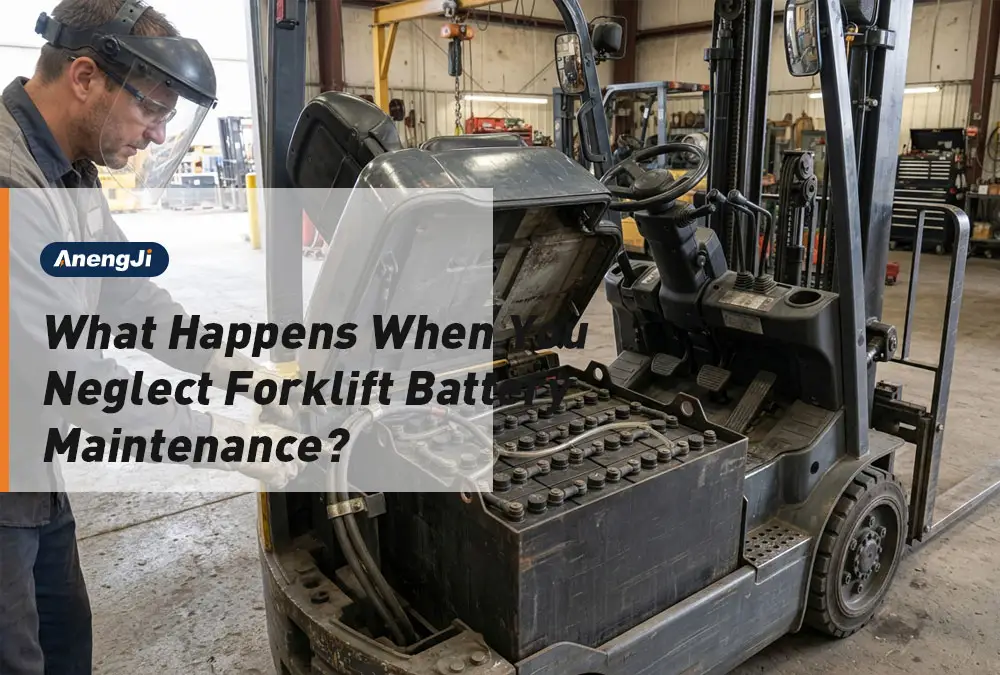
The forklift battery has just been charged, yet the truck already says it needs charging again. A maintenance worker described that complaint in a public account. During the service, they found the battery needed a substantial water top-up. Their question was simple: had the earlier lack of water already shortened its working time?
Neglected maintenance can turn a small, manageable task into lost capacity, damaged connections, unexpected downtime and, in documented cases, a charging fire or explosion. Adding water later cannot be assumed to undo plate damage. Replacing the pack will not fix a faulty charger. And a battery that still moves the forklift may no longer be fit for the job.
If you are the person who has to get deliveries unloaded, arrange the repair or approve another battery, that uncertainty is part of the cost. The account above is a self-reported experience, not a capacity test. Manufacturer guidance and the incident reports below help separate a recognisable complaint from a diagnosis.
When the same fault keeps coming back, the workaround has become part of the shift. Another charging stop, another reset or another borrowed truck may get today’s delivery away. The next shift still inherits the problem unless someone finds and corrects the cause.
The First Cost of Neglected Forklift Battery Maintenance Is Lost Working Time
A battery can continue moving a truck while gradually becoming less useful. Operators compensate with extra breaks, shorter routes or a spare vehicle. That makes the problem easy to postpone: the forklift still works, so replacement feels premature and maintenance feels interruptive.
The cost emerges when those workarounds become routine. A charging queue delays the next operator. An unexpected stop occupies the only spare truck. A connector problem returns after every reset because the damaged contact has never been repaired.
Crown’s Forklift Battery and Charger Maintenance guidance connects weak cells, corrosion, damaged cables and improper charging with reduced performance and avoidable downtime. Its service scope includes both the battery and charger. That matters when a battery complaint is actually a charging or connection fault.
Start by recording when the interruption occurs, what the truck was doing, which battery and charger were involved, and what fault appeared. A repeatable pattern is more useful than the general complaint that “the battery is getting old.” There is no universal number of missed maintenance days that proves a battery is beyond repair.
What Reported Battery Incidents Reveal About Missed Maintenance
A worn cable or a missed water check can look easy to put off. Published incident reports show what can happen when those defects remain, and why a charging problem can affect much more than one truck.
Dry cells, corrosion and poor venting preceded a charging explosion
In September 2020, the Communication Workers Union published a Royal Mail Group battery-charging safety flash describing an electric tow-tractor battery that exploded and caught fire in a mail centre. The notice attributed the event to failures in routine maintenance: the wet-cell battery had not been regularly inspected and watered, liquid levels ran dry, the cover had not been raised for venting, and cables and securing clamps were badly corroded.
This was a tow tractor, not a forklift, but the reported failures concern flooded traction-battery care. The lesson is concrete: a water check, cable inspection and documented charging procedure protect more than runtime. The notice does not provide a financial loss total or evidence that a single missed inspection would produce the same outcome.
A taped cable arrangement became a forklift fire investigation
France’s government accident database, ARIA, records a September 2016 forklift-battery fire at Rochefort-sur-Nenon. The operator’s investigation identified cables whose condition was not regularly monitored, taped-together cable routing that obstructed normal movement, and cable guides removed from some batteries. Contact between bare wires and the metal truck body was described as the likely initiating mechanism.
That is why a cable that has been “made to reach” deserves attention. The plug may still connect, yet insulation can rub, bend or become trapped as the compartment closes. A replacement cable needs the correct length, support and movement clearance; tape alone does not establish a sound repair.
Other reports put numbers to the consequences:
- Eight battery explosions investigated; four during charging. HSE’s 2003 Safety of Industrial Lift Trucks survey, covering April 1997–March 2001, recorded charging events involving ignition associated with metal objects, loose connections or exposed cables. This small historical sample explains failure mechanisms; it does not measure today’s accident rate.
- Losses in the tens of millions of euros. Generali GC&C’s Forklift Management report describes a 2022 fire at a French agricultural-machinery facility. A likely electrical fault in the forklift charging area was followed by structural damage and widespread smoke contamination. The account establishes the scale of loss, not neglected maintenance as its confirmed cause.
- Nearly 30 minutes to extinguish, followed by several days of downtime. The same Generali report recounts a 2025 forklift fire on a Norwegian fishing vessel, with cargo loss and smoke exposure to one crew member. A battery or charger-connection short circuit was considered likely; a maintenance omission was not confirmed.
The Royal Mail and ARIA accounts identify specific inspection or maintenance failures. The insurer’s examples show how a charging incident can spread to stock, buildings and the work schedule. For a warehouse manager, the question is whether a known defect is being repaired before it reaches that point.
What Happens Inside a Lead-Acid Forklift Battery When Maintenance Is Missed?
The watering discussion below applies to flooded lead-acid batteries. AGM, gel and other sealed designs have different instructions; lithium batteries do not receive electrolyte top-ups.
Low electrolyte can leave plate areas exposed
Water is lost during normal use and charging. If the electrolyte falls too far, parts of the plates can become exposed instead of remaining immersed in the liquid needed for the electrochemical reaction. Performance suffers, and prolonged neglect can leave damage that normal topping-up will not reverse.
Toyota Material Handling UK’s battery topping-up guidance specifically links insufficient electrolyte with plate damage, impaired performance and reduced battery life. This is why a missed watering task should be investigated before the next breakdown rather than treated only as a housekeeping issue.
That makes the maintenance worker’s opening question worth taking seriously. A low water level could help explain the complaint, but finding it does not settle the battery’s remaining condition. If runtime stays short after correct servicing and charging, a trained assessment of the individual cells and delivered capacity can establish what is still usable.
Think of the difference as filling a smaller tank: restoring the level does not prove the original amount of usable energy is still available. If the battery can now complete only the morning work, record that limitation and obtain a test result before promising it will cover another full shift. Repeatedly asking the operator to “charge it at lunch” can hide a permanent capacity loss.
The Canadian Centre for Occupational Health and Safety’s forklift battery guidance places manufacturer instructions and trained personnel at the centre of battery servicing. Final watering is generally performed after charging and cooling. If plates are already exposed before charging, follow the exact product’s corrective procedure rather than blindly applying a normal topping-up routine.
Overfilling can move the problem outside the cells
More water does not provide more protection. Electrolyte rises during charging, so excessive filling can cause overflow. That can remove electrolyte from the cells and leave corrosive residue on connections, the tray and surrounding equipment.
If the same battery repeatedly needs cleaning after a charge, investigate the filling level, timing, water system and charging behaviour. Cleaning the residue without correcting the overflow leaves the next spill waiting to happen. Routine maintenance replaces water lost in operation; adding acid is not an operator remedy.
There is also a practical cost beyond the battery. A wet tray, contaminated floor or corroded hold-down adds cleaning, containment and service work to the shift. Identify what escaped and follow the site’s spill procedure; do not treat an unknown puddle beneath the truck as ordinary water.
Incomplete charging and discharged storage can leave lasting damage
Sulfation describes lead-sulfate deposits that become difficult to reverse when a lead-acid battery remains insufficiently charged. That is different from the direct damage caused by exposed plates, even though both can produce short runtime.
Johnston Equipment’s guidance for motive power after extended downtime explains that a battery stored at low charge can develop sulfation or fall to a voltage the charger will not recognise. An idle forklift therefore still needs a storage plan. A charger that will not start calls for qualified diagnosis, not improvised jump-starting or bypassing protection.
Before blaming the battery, preserve the charger model, completion status, interruptions and any returned Ah or kWh data. Those records help distinguish a battery that cannot accept or deliver its expected charge from one that was never properly recharged.
One buyer’s public account shows how quickly that uncertainty becomes a spending decision. A used reach truck worked after being charged before collection, then produced a charging-timeout warning after delivery. The buyer was unsure whether to trust the battery, replace the charger or pay for more diagnosis. The account did not verify the failed component. It shows why a service visit needs to leave the owner with a finding and supporting measurements, rather than another part to buy on suspicion.
A quiet week can make this problem easy to miss. The forklift is parked because deliveries are slow; its battery is left in the condition of the last shift; nobody owns the storage check. When a delivery finally arrives, the charger will not start. Assign the parked truck a responsible person and a model-specific storage routine before the shutdown, not when the first pallet is waiting.
Surface contamination and damaged contacts cause different losses
Conductive contamination can allow unwanted current across a battery surface; corrosion and damaged contacts can interfere with the intended current path. A clean-looking battery can still have a poor connection, and a recently cleaned battery can still contain a weak cell.
The following comparison helps a fleet manager describe the problem to a service provider. It is a diagnostic starting point, not proof of a particular fault.
| Missed task | Possible consequence | What the user notices | Evidence for trained service |
|---|---|---|---|
| Electrolyte checks | Exposed plate areas and potential permanent damage | Short runtime after charging | Cell-by-cell condition, level history and capacity test |
| Correct filling procedure | Overflow, electrolyte loss and corrosion | Wet tray or recurring residue after charge | Filling-system condition, timing and charger behaviour |
| Charge and storage management | Persistent undercharge, sulfation or low-voltage start failure | Frequent charging or refusal to charge after shutdown | Storage condition, charger events and cell measurements |
| Connector and cable inspection | Resistance, local heat and intermittent connection | Faults during heavy work, discolouration or damaged insulation | Connector condition and controlled electrical checks |
Use the matching row to describe what has changed, then ask the service provider how they will distinguish the possible causes. A new battery behind the same damaged connector can leave you paying for a replacement and still facing the original interruption.
Why a Green Water-Level Light Can Miss a Forklift Battery Problem
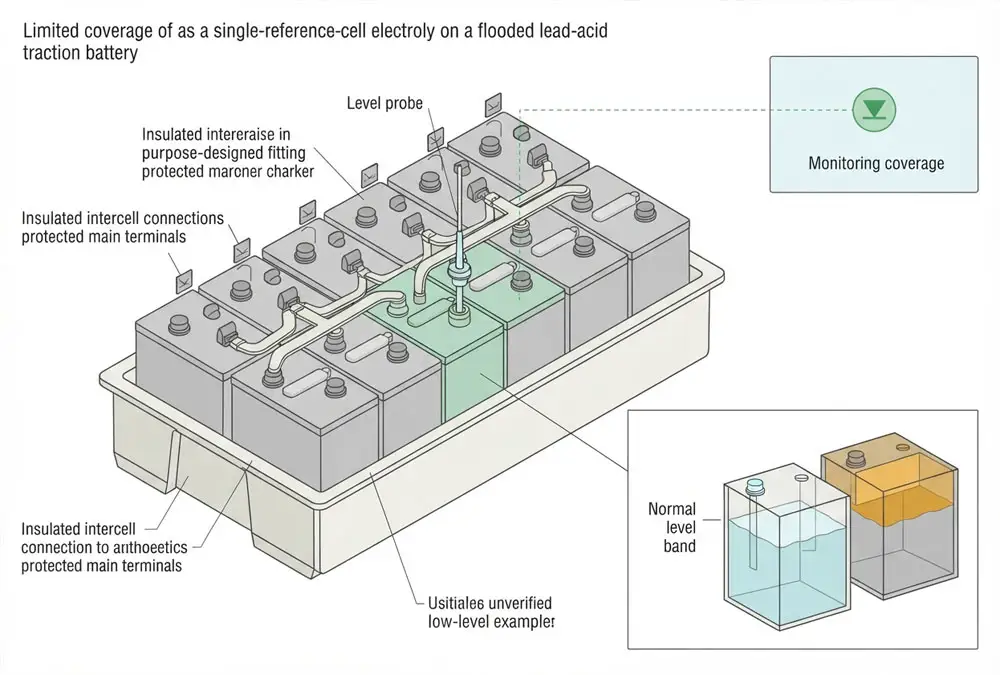
A reach-truck operator described following a manager’s instruction to water only when the green indicator turned red. The light stayed green for weeks, leaving the operator unsure whether the routine was appropriate. Before changing the schedule, there is a more useful question to answer: what does the light actually monitor?
For the filling-level sensor arrangement described in the EnerSys Perfect Plus Owner’s Manual, the display refers to a selected reference cell. The manual also calls for additional checks across the cells. This is a specific monitoring arrangement, not a statement that all indicators work identically.
Ask the service provider to show which cell or cells the installed indicator monitors and how the rest are checked. Include the automatic filling equipment in that conversation. An operator should not have to choose between a supervisor’s instruction and a different routine remembered from a previous workplace.
Why service measurements need context
The same EnerSys manual gives a specific-gravity correction example: 1.28kg/L at 45°C corresponds to approximately 1.29kg/L at 30°C. Specific gravity measures electrolyte density. Comparing readings without their temperature and charging condition can therefore create a misleading trend. These are source-specific reference values, not universal pass/fail limits for every forklift battery.
How a Small Forklift Battery Connection Fault Creates Significant Heat
A connector can look like a minor accessory until it interrupts the whole truck. Resistive heating follows P = I²R: current squared multiplied by resistance. Small resistance increases matter when traction current is high.
This engineering illustration holds current at an assumed 200A and changes the resistance of one connection. It is not a measurement of an AnengJi product or an acceptable connector specification.
| Illustrative connection resistance | Voltage loss at 200A | Local heat generation |
|---|---|---|
| 1 milliohm (0.001Ω) | 0.2V | 40W |
| 5 milliohms (0.005Ω) | 1.0V | 200W |
A fivefold resistance increase produces five times the local heating at the same current. This does not predict connector temperature: duration, cooling and construction also matter. It does explain why recurring discolouration or heat should not be dismissed as cosmetic. Report the affected connection and operating condition; have authorised personnel assess and repair it using the specified components and assembly instructions.
Does a Lithium Forklift Battery Still Need Maintenance?
Lithium removes routine watering and the conventional flooded lead-acid equalisation process. It does not remove connector wear, enclosure damage, mounting problems or unsuitable charging conditions.
A missed inspection can allow cable abrasion or impact damage to remain unnoticed. A fault log that is repeatedly cleared can hide the pattern needed to understand a shutdown. A battery management system, or BMS, monitors selected electrical and temperature conditions; a protective stop is a diagnostic event to investigate.
Operators should report damage, abnormal temperature, failed charging and repeated warnings. Specialist service should follow the exact product instructions for connections, protection, diagnostics and any heating or cooling equipment actually fitted. Avoid inventing a universal cell-voltage difference or temperature threshold for every lithium pack.
Consider a truck that clips a rack but keeps driving. With no immediate alarm, it can feel reasonable to finish the shift. Yet continued operation does not establish that the battery enclosure, cable glands or cells escaped damage. Hyster’s 2026 Guide to Lift Truck Use and Maintenance requires lithium batteries exposed to water, fire or physical damage, including potential impact damage, to be inspected by appropriately trained and certified service personnel before return to service. Use the instructions applicable to your own battery and truck.
Repeated charge interruption creates a quieter problem. The operator reconnects the charger and sees the display come on, but the charging session never restores the energy used in the previous shift. By morning, the forklift is available for a shorter working period. Preserve the BMS and charger events, temperature history and actual charging current so the service team can distinguish an environmental limit, connection problem or battery fault. The benefit of electronic monitoring is lost if the useful evidence is deleted at each reset.
If recurring maintenance demands are prompting a change, our forklift lithium battery options provide a starting point. First identify which tasks and faults the new system must address. A different chemistry cannot correct damaged vehicle wiring or an unworkable service process.
How Much Can a Recurring Forklift Battery Fault Cost in a Working Year?
A maintenance budget is easier to judge when the interruption is counted. Consider an illustrative fleet of four trucks, each suffering three battery-related interruptions per week, lasting 20 minutes each, over 48 operating weeks.
Lost truck availability
4 trucks × 3 interruptions × 20 minutes ÷ 60 × 48 weeks = 192 truck-hours/year
Illustrative financial exposure
If each unavailable truck-hour creates €35 of genuinely unrecoverable operating cost:
192 × €35 = €6,720/year
These are assumed inputs, not a customer case, market average or promised saving. Some waiting time can be reassigned to other work; a spare truck may protect output. Count only the cost that remains, and avoid charging the same loss twice through labour, rental and missed production.
For a small business with one forklift, the immediate consequence may be simpler than an annual spreadsheet: the driver cannot unload the arriving delivery until a replacement truck or service technician is available. For a larger fleet, spare vehicles may hide the same loss until the busiest day. Record both the stopped truck and the borrowed truck so the interruption does not disappear from the maintenance history.
Record actual interruptions before comparing service, repair or replacement quotations. Our battery cost guide explains how to compare a purchase with its installed and ongoing costs.
Before requesting a replacement quote: send the battery and charger labels, fault history and interruption log. Request a Battery Requirements Review
Can You Recover a Neglected Forklift Battery?
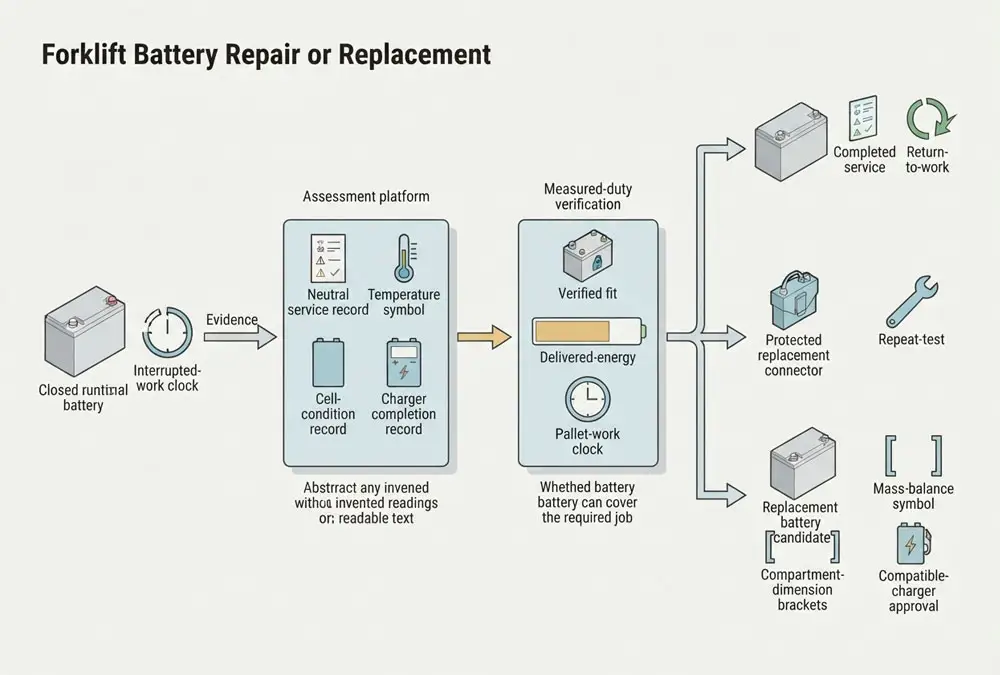
You need to know whether the next delivery can be unloaded, not just whether the charger will finish another cycle. Correcting a filling procedure can prevent further damage without recovering lost capacity. Repairing a connection may restore performance without changing the cells. The repair decision therefore needs three answers:
- Correct the identified maintenance or system fault. Obtain a service finding covering the battery, charger and relevant connections.
- Measure the result under defined conditions. A capacity or load test should record the method, temperature, charge preparation and stopping criteria. Trained personnel decide which tests are appropriate.
- Compare the result with the real job. The battery must supply the required work until the next dependable charging window, with the agreed reserve.
Do not approve a repair solely because the truck moves again. Conversely, do not condemn the battery solely because a dashboard percentage drops quickly. Use the measured result and the remaining truck condition to evaluate remaining service life.
Ask for a service result you can act on: which component or cells failed, what was corrected, what measured performance remains, and which limitation is still unresolved. A report that only says “battery charged” leaves procurement unable to distinguish a successful repair from temporary recovery. If the service provider recommends a whole-pack replacement, ask how that recommendation follows from the test results and required duty.
For a repaired battery, agree on a representative return-to-work check. Use comparable loads, routes, temperatures and charging preparation, and record whether the original fault returns. A short demonstration without load does not establish that the next full working period is covered. This verification also protects the next purchase: if the charging window or damaged truck connection caused the original complaint, it must be addressed before a replacement enters service.
Abnormal heat, leakage, a cracked or swollen enclosure, damaged insulation, venting or repeated safety trips require escalation under the product and site procedures. Active smoke or fire requires the emergency response plan. Production urgency is not a reason to keep resetting protection or to attempt an improvised repair.
How to Prevent the Same Forklift Battery Failure From Returning
The next operator should not have to discover yesterday’s fault again. Keep the battery and charger IDs together, and make the handover short enough to use during a busy shift:
- Operator record: asset ID, symptom, time, task, warning and charging interruption.
- Service record: identified cause, measurements with conditions, work completed and return-to-service decision.
- Follow-up record: whether the same duty is completed reliably and whether the warning or abnormal water loss returns.
Use manufacturer instructions and destination-country requirements to set the inspection programme. In Britain, the HSE’s work-equipment maintenance guidance explains the need for equipment to remain in efficient working order and for existing maintenance logs to stay current. This is a British reference, not a single rule for every European country.
For covered US workplaces, OSHA’s powered-industrial-truck requirements call for examinations before service, at least daily, and after each shift for round-the-clock operation. Those are truck examination requirements, not an instruction to dismantle or electrically test every battery cell each day.
For operations in Central Asia, Africa or remote locations, adapt the plan to the actual country, heat, dust, water quality, power supply and technician access. A maintenance interval copied from another site may miss the conditions causing the local problem.
When Should You Consider a Different Forklift Battery System?
If service corrects the fault and the battery reliably meets the job, keeping it may be sensible. If watering access, battery handling and recurring interruptions remain difficult to manage, compare a different system against those measured problems.
AnengJi’s forklift configurations include 51.2V 277Ah and 412Ah options, representing approximately 14.18kWh and 21.09kWh of nominal energy respectively. The calculation is voltage × Ah ÷ 1,000. The larger configuration contains about 6.91kWh more nominal energy; it does not automatically solve a charger fault or guarantee a particular shift length.
When evaluating our LiFePO4 forklift battery range, compare standard-format candidates and application-specific enclosures against the truck’s voltage window, peak and regenerative current, permitted battery mass, compartment, restraint, connector and charger interface. AnengJi also offers custom-pack discussions covering casing, wiring and BMS protocols. The final design and documentation must match the offered model and destination.
Before approving the proposal, ask what will change on the floor: which maintenance jobs disappear, which inspections remain, where charging happens and who can help when a fault stops the truck. Those answers make the specification useful to the people who will live with it every day.
Turn Your Maintenance History Into a Battery Specification
Share the truck, battery and charger labels, compartment details, required battery mass, duty pattern and recurring faults. Request a configuration assessment that identifies the missing fit, charging and support information.
Forklift Battery Maintenance FAQs
Can adding water restore lost forklift battery capacity?
Correct watering restores the required liquid level in a flooded battery. It does not prove that damaged plates or lost capacity have recovered. If runtime remains short, request a controlled assessment before approving repair or replacement.
Why does a forklift battery suddenly need more water?
Changed temperature, use, charging behaviour or a battery fault can alter water consumption. Compare the pattern with charging records and cell condition. More frequent topping-up alone may hide the underlying cause.
Can an unused forklift battery become damaged?
Yes. Storage condition and maintenance charging still matter. Follow the exact model’s storage instructions, assign a responsible person and arrange inspection before restart when the battery’s condition is uncertain.
Can lead-acid and lithium batteries share one maintenance schedule?
They can share a reporting system for damage and charging faults, but their maintenance tasks and limits differ. Flooded-battery watering procedures must never be applied to sealed lead-acid or lithium packs.
What evidence should I request before replacing a forklift battery?
Ask for the identified fault, relevant battery and charger test results, the remaining duty requirement, repair scope and replacement compatibility. The decision should explain why the proposed remedy addresses the cause and how performance will be verified.
Related Articles
[post_navigation]
Related Posts
 https://anengjibattery.com/wp-content/uploads/2026/11/AnengjiBattery-The-Battery-Cable-Fault-Behind-Repeated-Downtime.webp
675
1000
Battery Expert Team
https://anengjibattery.com/wp-content/uploads/2025/06/logo2-300x138.png
Battery Expert Team2026-11-22 03:28:592026-11-22 03:29:24What Happens When You Neglect Forklift Battery Maintenance?
 https://anengjibattery.com/wp-content/uploads/2026/11/AnengJIBattery-Post-Impact-Battery-Safety-Isolation.webp
675
1000
Battery Expert Team
https://anengjibattery.com/wp-content/uploads/2025/06/logo2-300x138.png
Battery Expert Team2026-11-18 02:40:582026-11-18 02:41:12How Does Lithium-Ion vs Lead-Acid Battery Safety Compare?
 https://anengjibattery.com/wp-content/uploads/2026/11/AnengjiBattery-Reviewing-Two-Battery-Quotations.webp
675
1000
Battery Expert Team
https://anengjibattery.com/wp-content/uploads/2025/06/logo2-300x138.png
Battery Expert Team2026-11-17 09:26:542026-11-17 09:27:09Lithium-Ion vs Lead-Acid Battery Price: Which Costs Less?
 https://anengjibattery.com/wp-content/uploads/2026/11/AnengjiBattery-Comparing-Battery-Performance-in-the-Test-Lab.webp
675
1000
Battery Expert Team
https://anengjibattery.com/wp-content/uploads/2025/06/logo2-300x138.png
Battery Expert Team2026-11-13 07:37:312026-11-13 07:37:53Lead Acid Battery vs Lithium Ion Battery: Which Would You Choose Today?



Leave a Reply
Want to join the discussion?Feel free to contribute!