
LiFePO4 Battery Charger Guide: How to Choose the Right Lithium Charger
July 28, 2026 / Battery Expert Team / Battery Basics
Introduction
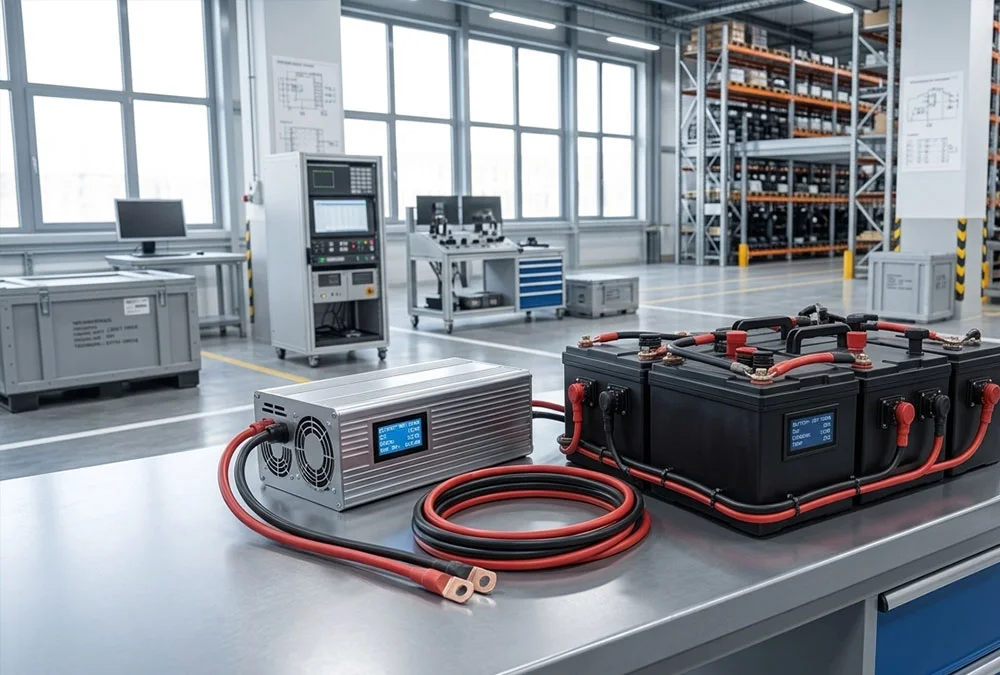
Every commercial battery deployment eventually hits a snag when charging protocols get overlooked. If you are retrofitting industrial equipment or upgrading fleet vehicles, buying a dedicated lifepo4 battery charger is not an optional accessory. It is the core guardian of your power system. A proper charger guarantees accurate charging voltage. It delivers optimized charging speed. It triggers essential battery safety protection. Most importantly, it secures longer cycle life for your expensive pack. Whether you manage a high-speed golf cart, an off-grid RV, a marine vessel, an automated AGV, a solar energy storage bank, or an industrial electric vehicle, picking the exact right charger dictates whether your investment lasts ten years or dies in ten months.
I hear fleet owners ask the same question every week. “Can’t I just tweak my old lead-acid charger or use a cheap bench supply to save cash?” Members on the DIY Solar Forum often call this the “poor man’s charger” setup. Sure, it pumps current into the battery at first. But standard chargers miss critical lithium termination stages. They often trigger unexpected BMS cutoffs. Over time, uncalibrated float voltages degrade your cells silently. To protect your bottom line, you need a charging solution engineered specifically for lithium iron phosphate chemistry.
What Is a LiFePO4 Battery? Understanding Lithium Iron Phosphate Battery Technology
Before matching charging specs, you must understand what happens inside the casing. Lithium iron phosphate cells differ fundamentally from older lead-acid or alternative lithium chemistries. Their internal structure demands strict voltage control during charge cycles.
What Is LiFePO4 Battery Chemistry?
LiFePO4 stands for Lithium Iron Phosphate. It is a specialized variation of lithium-ion technology known for extreme thermal stability. The physical construction consists of four primary internal components:
- Lithium Iron Phosphate Cathode: Provides robust crystal structure during chemical reactions.
- Graphite Anode: Stores lithium ions safely during the charging phase.
- Liquid or Polymer Electrolyte: Facilitates rapid ion movement between electrodes.
- Battery Management System (BMS): Regulates cell voltage, current limits, and temperature thresholds.
How Does a LiFePO4 Battery Work?
Energy transfer relies on reversible lithium-ion movement through the internal separator.
During the Charging Process:
Electrical Energy Input → Lithium Ion Movement to Anode → Chemical Energy Storage
During the Discharging Process:
Chemical Energy Storage → Lithium Ion Movement to Cathode → Electrical Energy Output
Key Advantages of LiFePO4 Batteries
Commercial equipment builders choose this chemistry over lead-acid for several distinct reasons:
- Long Cycle Life: Typically delivers 2,000 to 5,000 full discharge cycles before reaching 80% capacity.
- High Thermal Safety: Excellent structural stability resists thermal runaway risks under high ambient temperatures.
- High Operational Efficiency: High charging efficiency with over 95% usable depth of discharge (DoD).
- Low Maintenance Requirements: Requires no watering, no acid balance checks, and zero regular equalization charges.
Common Applications of LiFePO4 Batteries
Selecting the right power supply depends entirely on how your equipment operates in the field. Here is how applications line up with system requirements:
| Application | Typical Voltage | Charging Requirement | User & Business Advantage |
|---|---|---|---|
| Golf Cart | 36V / 48V | Dedicated LiFePO4 Charger | Restores top speed faster and eliminates hill-climbing power drop. |
| RV | 12V / 24V | Marine / RV Smart Charger | Unlocks full off-grid power without requiring noisy diesel generators. |
| Marine | 12V / 24V / 36V | Waterproof Sealed Charger | Resists harsh saltwater corrosion while keeping trolling motors reliable. |
| AGV & Forklift | 24V / 48V | Industrial Smart Charger | Enables rapid opportunity charging during scheduled shift breaks. |
| Solar ESS | 48V | High Efficiency Charger | Maximizes daily solar intake and stabilizes overnight energy reserves. |
| Electric Vehicle | 48V / 72V | Fast High-Power Charger | Cuts charging downtime so delivery fleets complete more daily routes. |
Why Do LiFePO4 Batteries Need a Special Battery Charger?
A common buyer misconception is thinking any power supply with copper clamps can charge a lithium pack. This assumption destroys battery packs prematurely. Lithium iron phosphate cells require a dedicated lithium iron phosphate battery charger built around precise chemical profiles.
Different Battery Chemistry Requires Different Charging Methods
Lead-acid chargers were designed decades ago for flooded or AGM batteries. Their main design goals focus on overcharge tolerance and prolonged float charging. They push high trickle voltages to prevent plate sulfation.
In contrast, a smart lifepo4 battery charger with BMS protection follows strict CC/CV algorithms. It supplies a constant current until the pack reaches max voltage. Then it holds constant voltage until current drops near zero. After that, it cuts off power completely. It never applies high continuous float voltages that bake lithium electrolytes.
Risks of Using the Wrong Charger for LiFePO4 Battery
Plugging an uncalibrated charger into your lithium system causes immediate operational hazards:
- Incorrect Charging Voltage: Overcharges individual cells or fails to fully charge the pack.
- BMS High-Voltage Shutdown: Triggers protection boards, causing sudden charger disconnects and error codes.
- Reduced Battery Lifespan: Accelerates cathode degradation, shortening expected cycle count by half.
- Critical Safety Risks: Causes excessive thermal stress across internal copper busbars.
LiFePO4 Battery Charger vs Lead Acid Charger: What Are the Differences?
Comparing these two power profiles highlights why cross-using equipment leads to failure. Recent 2025/2026 fleet electrification reports show that 14% of early lithium conversion failures stem directly from improper charging hardware.
Charging Algorithm Comparison: Lead Acid vs LiFePO4
| Charging Stage | Lead Acid Charger | LiFePO4 Charger | Business Impact |
|---|---|---|---|
| Stage 1 | Constant Current (Bulk) | Constant Current (CC) | Lithium accepts higher initial current, cutting total charging time. |
| Stage 2 | Absorption (Decreasing Current) | Constant Voltage (CV) | Precision voltage limits prevent cell over-saturation. |
| Stage 3 | Float Charging (Continuous Voltage) | Complete Charge Termination | Full shutoff prevents continuous trickle heating and extends pack life. |
Voltage Limit Comparison Between Lead Acid and LiFePO4 Charger
Voltage thresholds must match exact chemical specifications. Below are standard operational limits:
| Battery Type | Nominal Voltage | Target Charging Voltage | Operational Benefit |
|---|---|---|---|
| 12V Lead Acid | 12.0V | 14.4V – 14.8V | Standard legacy profile with broad legacy compatibility. |
| 12V LiFePO4 | 12.8V | 14.6V | Reaches full 100% capacity without over-stressing internal cells. |
| 24V LiFePO4 | 25.6V | 29.2V | Maintains tight balance for 8-cell series configurations. |
| 48V LiFePO4 | 51.2V | 58.4V | Delivers maximum power density for heavy industrial utility fleets. |
Temperature Compensation Differences
Lead-acid units adjust output voltage based on temperature sensors to prevent gassing. Lithium chargers operate differently. They communicate directly with internal BMS temperature sensors. If ambient temperatures drop below freezing (0°C), a quality lithium charger stops current flow entirely. This prevents irreversible lithium plating on the anode.
Self-Discharge and Maintenance Comparison
| Feature | Lead Acid System | LiFePO4 System | Value to Fleet Operators |
|---|---|---|---|
| Self-Discharge Rate | High (5% to 15% per month) | Low (1% to 3% per month) | Vehicles sit idle for weeks without needing trickling maintenance. |
| Regular Maintenance | Fluid topping & equalizing | Zero liquid maintenance | Saves labor costs and eliminates corrosive acid spill cleanup. |
| Off-Season Storage | Must stay plugged in | Store at 50% charge state | Reduces facility grid draw and warehouse fire insurance risks. |
How to Choose the Right LiFePO4 Battery Charger?
If you want to know how to choose a lifepo4 battery charger, follow a systematic engineering checklist. Skipping step one or two leads directly to return hassles or blown fuses.
Step 1: Identify Your Battery Voltage
Your charger’s output rating must match your battery pack’s nominal setup. Never guess system voltage.
- For a 12V Pack (4 cells in series) → Select a 12V lifepo4 battery charger (Output: 14.6V).
- For a 24V Pack (8 cells in series) → Select a 24V lifepo4 battery charger (Output: 29.2V).
- For a 36V Pack (12 cells in series) → Select a 36V Charger (Output: 43.8V).
- For a 48V Pack (16 cells in series) → Select a 48V lifepo4 charger (Output: 58.4V).
- For a 72V Pack (24 cells in series) → Select a 72V lithium battery charger (Output: 87.6V).
Step 2: Select the Correct Charger Current (Amp)
Determining your lifepo4 battery charger voltage and amp requirements comes down to evaluating C-ratings. Calculate your ideal target current using this straightforward formula:
Recommended Charger Current (Amps) = Battery Capacity (Ah) × Target Charge Rate (0.2C to 0.5C)
For example, if you manage a 100Ah battery pack:
- A 20A charger (0.2C rate) charges the pack safely in roughly 5 hours.
- A 50A charger (0.5C rate) delivers a rapid charge in about 2 hours.
Step 3: Balance Charging Speed and Battery Lifespan
Fast charging reduces machine downtime during work hours. However, pushing excessive amperage generates internal heat. Heavy thermal load accelerates degradation. Keeping continuous charge rates around 0.2C to 0.3C gives you the best balance between fast turnarounds and long cell life.
Step 4: Consider Your Application Environment
Hardware placement dictates durability requirements:
- Indoor Warehouses: Standard fan-cooled aluminum enclosures work reliably.
- Outdoor / Marine Use: Look for IP67 waterproof sealed cast-aluminum housings.
- High-Vibration AGVs: Choose fully potted internal electronics that resist mechanical shaking.
How Long Does a LiFePO4 Battery Charger Take to Charge a Battery?
Calculating downtime is essential for scheduling operational shifts. Calculating lifepo4 charging time is straightforward once you know your total capacity and current ratings.
LiFePO4 Battery Charging Time Formula
Charging Time (Hours) = [ Battery Capacity (Ah) ÷ Charger Output (Amps) ] × 1.15
(Note: The 1.15 multiplier accounts for real-world energy conversion losses during the CV absorption phase.)
LiFePO4 Charging Time Examples
| Battery Capacity | Charger Amperage | Estimated Time (0% to 100%) | Fleet Productivity Result |
|---|---|---|---|
| 100Ah Pack | 20A Output | ~ 5.5 Hours | Ideal for overnight charging during non-operational hours. |
| 100Ah Pack | 40A Output | ~ 2.8 Hours | Great for quick mid-day turnarounds between shifts. |
| 200Ah Pack | 50A Output | ~ 4.5 Hours | Restores heavy-duty commercial packs within half a work shift. |
Factors Affecting Charging Speed
Several real-world variables alter calculated charge times:
- Initial State of Charge (SOC): Charging from 20% to 80% is much faster than topping off the last 10%.
- Ambient Temperature: Cold cells force smart chargers to taper current to preserve safety.
- BMS Balancing Limits: Passive cell balancing slows down final top-off speeds.
- AC Line Voltage: Low input wall voltage reduces max charger output wattage.
Fast Charging vs Battery Lifespan
Fast charging gets machines back into service quickly. But balance is key. Continuous ultra-fast charging raises cell temperatures. Standard charging runs cooler, keeping cell wear low and maximizing lifetime cycle counts.
LiFePO4 Battery Charger Types Explained
Selecting the proper physical charger platform ensures easy mounting and reliable power conversion.
AC/DC LiFePO4 Battery Charger
This is the workhorse platform for fleet garages and industrial shops. It converts standard AC wall power (110V or 220V) into stable DC output voltage. It is built for daily plugin use in maintenance bays.
Smart LiFePO4 Charger
A smart battery charger uses integrated microcontrollers. It continuously monitors charging current, pack voltage, and internal thermal levels. It automatically transitions through CC/CV stages and turns off completely when charging finishes.
Solar LiFePO4 Battery Charger
These units use Maximum Power Point Tracking (MPPT) technology. They convert fluctuating DC solar panel power into regulated charging profiles. They are perfect for remote cabins, off-grid RVs, and stationary energy storage.
Portable Charger vs Wall Mounted Charger
| Charger Style | Best Application | Key Benefit to Operator |
|---|---|---|
| Portable Charger | Mobile utility equipment & service trucks | Easy to transport anywhere for flexible on-site power. |
| Wall Mounted / On-Board | Dedicated fleet bays & industrial AGVs | Stays wired permanently to eliminate cord clutter and plug damage. |
LiFePO4 Battery Charger Compatibility With BMS and Battery Systems
For B2B buyers and equipment manufacturers, charging hardware must work seamlessly with your battery management system BMS. Mismatched components cause operational errors and nuisance cutoffs.
Why BMS Compatibility Matters
The BMS acts as the battery’s electronic brain. It monitors four primary parameters:
- Over-voltage protection on individual cell series.
- Under-voltage cutoffs during heavy usage.
- Thermal monitoring during charge and discharge cycles.
- Passive or active cell voltage balancing.
If your charger’s voltage setpoint exceeds the BMS protection limit, the BMS trips instantly. That leaves your battery half-charged and flags an error.
Charger Communication Requirements for OEM Applications
Commercial AGV and EV deployments demand smart BMS communication profiles:
- CANbus Communication: Allows the battery and charger to exchange real-time voltage, current, and temperature data.
- RS485 Protocol: Enables remote system monitoring, parameter adjustments, and fleet diagnostics.
Battery + Charger System Integration
Sourcing integrated battery and charger packages eliminates compatibility headaches. Matched components work together right out of the box, ensuring reliable performance and faster installation.
How to Choose a LiFePO4 Charger for Different Applications
Different commercial industries require specialized hardware features to handle tough working environments.
48V LiFePO4 Battery Charger for Golf Cart
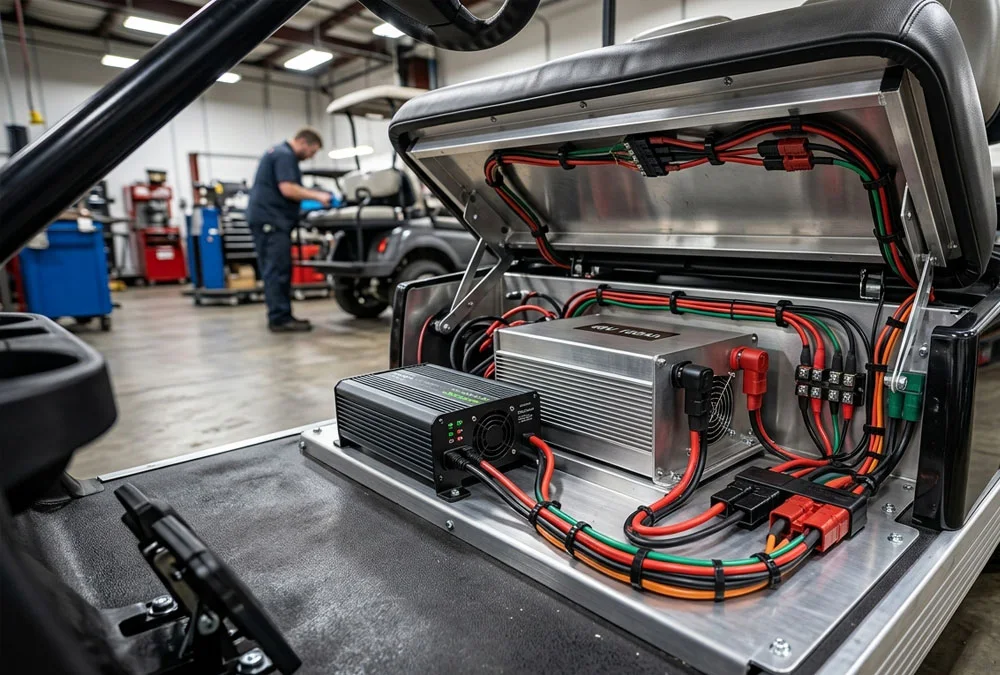
Upgrading golf cart fleets to lithium demands robust hardware. A quality 48V lifepo4 battery charger for golf cart applications must deliver high output current (15A to 30A). It needs a rugged, vibration-proof housing to handle rough terrain without breaking internal solders.
LiFePO4 Charger for RV and Marine Applications
Marine environments demand strict corrosion resistance. Chargers must carry IP67 waterproof ratings. They should feature quiet fanless cooling so they operate silently in living spaces.
Industrial LiFePO4 Charger for AGV and Forklift
Automated guided vehicles run demanding, multi-shift schedules. Industrial chargers must support automated opportunity charging. They need fast plug activation, heavy-duty contactors, and high thermal endurance for continuous operation.
LiFePO4 Charger for Solar Energy Storage
Stationary storage installations need top electrical efficiency. Look for high-efficiency power conversion (above 94%) to cut energy waste and keep operating costs low.
Safety Features of a High Quality LiFePO4 Battery Charger
Never sacrifice safety to save a few dollars on charging hardware. Unregulated current causes premature cell failure and expensive equipment downtime.
Essential Protection Functions
Always verify your charger includes these five built-in protections:
- Over-Voltage Protection: Prevents excessive voltage from reaching sensitive cell arrays.
- Over-Current Protection: Caps output amperage to prevent thermal buildup.
- Short-Circuit Protection: Instantly cuts power if terminals short out accidentally.
- Over-Temperature Protection: Tapers or stops charging if internal heat spikes.
- Reverse Polarity Protection: Prevents board damage if cable leads are connected backward.
Safety Certifications and Compliance
High-quality industrial equipment must display recognized safety marks:
- CE Certification: Ensures compliance with European health and safety standards.
- UL Compliance (UL 1564 / UL 2580): Validates rigorous electrical safety testing.
- IEC Standards: Guarantees international industrial reliability.
Charging LiFePO4 Batteries With Vehicle Alternator
Charging auxiliary lithium banks directly from an alternator requires specialized interface hardware. Connecting lithium batteries directly to standard alternators causes serious mechanical issues.
Why Alternator Charging Requires a DC-DC Charger
Lithium iron phosphate batteries have very low internal resistance. They pull maximum amperage continuously. This heavy draw can overheat and burn out standard engine alternators. Installing a dedicated DC DC Charger for Lithium Battery systems regulates current flow and protects your alternator.
Benefits of DC-DC Charging
- Delivers stable, multi-stage CC/CV charging voltage to auxiliary battery banks.
- Prevents starter battery drain by isolating systems when the engine stops.
- Optimizes charging rates on modern smart alternator setups.
Common Mistakes When Choosing a LiFePO4 Battery Charger
Avoid these common procurement mistakes to keep your operational costs low:
Choosing Charger Only Based on Voltage
Matching nominal voltage is not enough. You must verify exact DC output voltage, amperage limits, and termination stages. Ignoring these factors leads to constant BMS cutoffs.
Ignoring Safety Protection Features
Inexpensive chargers often skip reverse polarity protection and thermal sensors. A single short circuit can ruin your charger and down your equipment.
Selecting the Cheapest Charger Without Considering Quality
Low-cost chargers use cheap components that fail under daily commercial use. Investing in reliable hardware protects your high-value battery packs and cuts long-term replacement costs.
LiFePO4 Battery Charger Maintenance and Cost Guide
Protecting your charging hardware ensures long-term operational reliability.
Proper Charging Practices Extend Battery Life
- Keep chargers in clean, well-ventilated areas to prevent dust accumulation.
- Check charging cables regularly for worn insulation or loose connectors.
- Never force fast charging on frozen battery packs.
Warranty and Supplier Support
Partner with established manufacturers who offer clear 2- to 5-year warranties, responsive engineering support, and reliable component supply chains.
Choose Anengji LiFePO4 Battery Charger Solutions
When engineering high-performance commercial battery systems, pairing your pack with a certified, precision-engineered power supply is essential. ENERGYSPLENDOR supplies high-efficiency charging solutions built for demanding commercial applications.
Customized LiFePO4 Charger Solutions
We design custom chargers tailored to your technical requirements:
- Custom output voltages (12V up to 96V+) and adjustable amperage settings.
- Custom connectors, heavy-duty harnesses, and rugged enclosures.
- Integrated CANbus and RS485 communication protocols for smart fleet management.
Charging Solutions for Golf Cart, AGV and Energy Storage
Our chargers power commercial fleets around the globe. Whether you need a 48V lifepo4 charger for golf carts, high-efficiency industrial units for AGVs, or stationary chargers for energy storage, our hardware delivers reliable daily performance.
OEM/ODM Manufacturing Capability
We support original equipment manufacturers with comprehensive design assistance, rapid prototyping, and scalable bulk production. Our engineering support ensures your battery systems operate smoothly and pass all compliance checks.
Frequently Asked Questions
What charger do I need for a 48V LiFePO4 battery?
You need a dedicated 48V lithium iron phosphate charger with a preset output voltage of 58.4V. Ensure the amperage rating matches your pack capacity, typically between 15A and 30A for standard golf carts and utility vehicles.
Can I use a normal charger for LiFePO4 battery?
No, standard lead-acid chargers use improper float voltages and equalizing stages. Over time, these damage lithium cells and trip BMS safety cutoffs. Always use a dedicated lithium charger with CC/CV charging profiles.
How long does it take to charge a 100Ah LiFePO4 battery?
Charging time depends on charger amperage. A 20A charger takes about 5.5 hours, while a 50A charger charges the pack in roughly 2.5 hours.
Can LiFePO4 batteries stay connected to chargers?
Yes, if you use a smart charger designed for lithium batteries. These units cut power completely when charging finishes, preventing overcharging during long storage periods.
What is the best charging voltage for LiFePO4 battery?
The ideal charging voltage is 3.65V per cell. For a 12V pack (4 cells), target 14.6V. For a 24V pack (8 cells), target 29.2V. For a 48V pack (16 cells), set target voltage to 58.4V.
Related Posts
 https://anengjibattery.com/wp-content/uploads/2026/09/AnengJIBattery-Best-LiFePO4-Battery-How-to-Choose-the-Right-One.webp
675
1000
Battery Expert Team
https://anengjibattery.com/wp-content/uploads/2025/06/logo2-300x138.png
Battery Expert Team2026-09-17 08:52:142026-09-17 08:52:31How to Choose the Best LiFePO4 Battery
https://anengjibattery.com/wp-content/uploads/2026/09/AnengJIBattery-Best-LiFePO4-Battery-How-to-Choose-the-Right-One.webp
675
1000
Battery Expert Team
https://anengjibattery.com/wp-content/uploads/2025/06/logo2-300x138.png
Battery Expert Team2026-09-17 08:52:142026-09-17 08:52:31How to Choose the Best LiFePO4 Battery https://anengjibattery.com/wp-content/uploads/2026/09/anengjiBattery-lifepo4-battery-cell-packaging-wholesale.webp
675
1000
Battery Expert Team
https://anengjibattery.com/wp-content/uploads/2025/06/logo2-300x138.png
Battery Expert Team2026-09-16 09:52:342026-09-16 09:52:57LiFePO4 Battery Wholesale Guide: Best Suppliers in Spain
https://anengjibattery.com/wp-content/uploads/2026/09/anengjiBattery-lifepo4-battery-cell-packaging-wholesale.webp
675
1000
Battery Expert Team
https://anengjibattery.com/wp-content/uploads/2025/06/logo2-300x138.png
Battery Expert Team2026-09-16 09:52:342026-09-16 09:52:57LiFePO4 Battery Wholesale Guide: Best Suppliers in Spain https://anengjibattery.com/wp-content/uploads/2026/09/anengjibattery-Top-Lithium-Ion-Battery-Producers-for-Spain-Market-Growth.webp
675
1000
Battery Expert Team
https://anengjibattery.com/wp-content/uploads/2025/06/logo2-300x138.png
Battery Expert Team2026-09-16 01:13:392026-09-16 01:14:05Top Lithium Ion Battery Producers for Spain’s Market Growth
https://anengjibattery.com/wp-content/uploads/2026/09/anengjibattery-Top-Lithium-Ion-Battery-Producers-for-Spain-Market-Growth.webp
675
1000
Battery Expert Team
https://anengjibattery.com/wp-content/uploads/2025/06/logo2-300x138.png
Battery Expert Team2026-09-16 01:13:392026-09-16 01:14:05Top Lithium Ion Battery Producers for Spain’s Market Growth https://anengjibattery.com/wp-content/uploads/2026/09/Bulk-Lithium-Ion-Battery-Cells-Procurement-Guide-B2B-Sourcing.webp
675
1000
Battery Expert Team
https://anengjibattery.com/wp-content/uploads/2025/06/logo2-300x138.png
Battery Expert Team2026-09-14 09:47:322026-09-14 09:47:48Bulk Lithium-Ion Battery Cells Procurement Guide | B2B Sourcing
https://anengjibattery.com/wp-content/uploads/2026/09/Bulk-Lithium-Ion-Battery-Cells-Procurement-Guide-B2B-Sourcing.webp
675
1000
Battery Expert Team
https://anengjibattery.com/wp-content/uploads/2025/06/logo2-300x138.png
Battery Expert Team2026-09-14 09:47:322026-09-14 09:47:48Bulk Lithium-Ion Battery Cells Procurement Guide | B2B Sourcing


Leave a Reply
Want to join the discussion?Feel free to contribute!