
How Long Does a 48V Lithium Ion Battery Last in Golf Carts?
August 4, 2026 / Battery Expert Team / Battery Basics
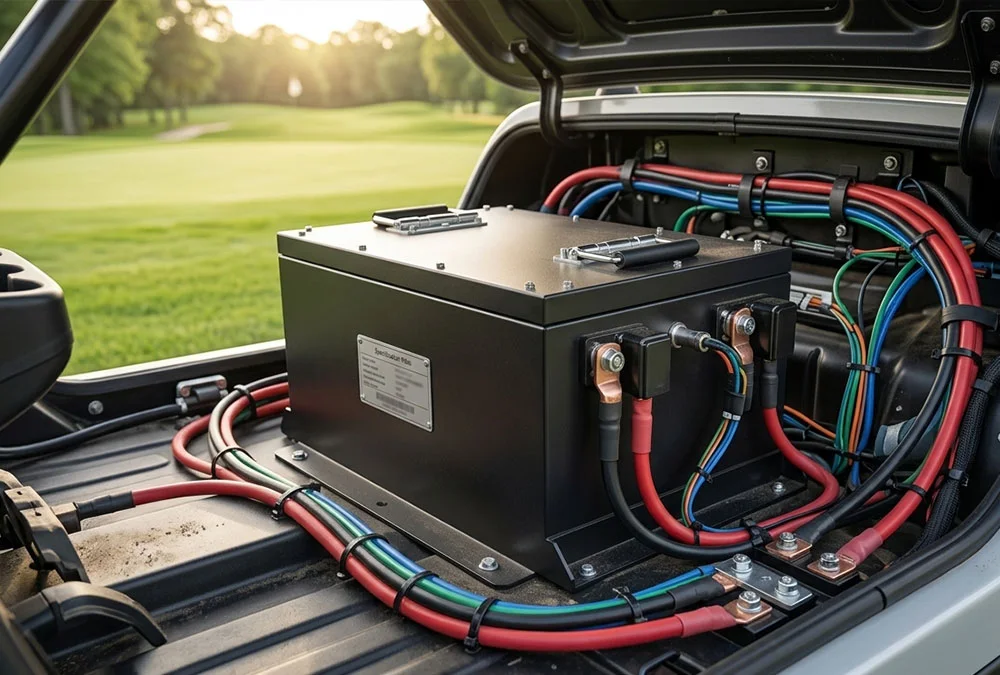
Introduction
If you are sick of watering corroded lead-acid batteries every weekend or getting stranded on the 14th hole, upgrading to a premium 48v lithium ion battery is the most significant performance modification you can make to your cart. But before dropping fifteen hundred dollars, you need to know what you are actually getting. Under real-world driving conditions—not perfect laboratory environments—a high-grade 48v lithium ion battery built on Lithium Iron Phosphate (LiFePO4) chemistry delivers 8 to 12 years of operational service, or roughly 3,000 to 6,000 full charge-discharge cycles before hitting its 80% end-of-life capacity threshold. That translates to over 45,000 miles of driving. Compare that to traditional flooded batteries, which routinely die after 3 years of heavy use. In this deep-dive engineering guide, we break down cycle metrics, discharge curves, BMS peak current limits, winter storage physics, and total cost models so you can make an airtight purchasing decision.
Whether you manage an industrial fleet of material handling tugs, operate resort shuttles, or just want to cruise your residential golf community without severe voltage sag, a 48v lithium ion battery provides sustained speed and zero acid maintenance. Below, we dissect the electrochemical reality, real-world discharge data, and field engineering factors that dictate how long your battery system will last.
Field Engineer Note on Buying Pitfalls: A major issue on forums like Reddit (r/golfcarts) involves cart owners buying budget, unbranded packs that claim “100Ah capacity.” When accelerating up a steep hill with four passengers, their cart suddenly cuts out completely. The battery cells are not dead; rather, the cheap internal Battery Management System (BMS) tripped because its peak current rating is capped at 50A or 100A. A modified cart motor draws 200A to 300A in bursts. Never buy based on raw Ah figures alone—always check continuous and peak BMS discharge current limits.
How Long Does a 48V Lithium Ion Battery Last in a Golf Cart?
Evaluating 48V Golf Cart Battery Lifespan requires separating calendar aging (natural degradation over time) from Lithium Battery Cycle Life (the mechanical stress of charging and discharging). Traditional flooded batteries begin sulfating the moment they drop below 100% charge. In contrast, a modern 48v lithium ion battery relies on intercalation, moving lithium ions smoothly between a synthetic graphite anode and a phosphate cathode without degrading internal physical structures.
If you drive 20 miles a day, five days a week, you log roughly 260 charge cycles per year. A tier-1 LiFePO4 pack rated at 3,500 cycles to 80% Depth of Discharge (DoD) will take over 13 years of continuous operation to hit that partial capacity fade line. Even then, the battery is not dead; it simply acts like an 80Ah pack instead of a 100Ah pack.
Average Lifespan of Different 48V Golf Cart Battery Types
To understand the value proposition, compare the electrochemical realities across all major battery technologies currently installed in 48V electric carts and low-speed utility vehicles:
| Battery Chemistry Type | Cycle Life (80% DoD) | Expected Lifespan | Usable Energy Ratio | Direct Buyer Advantage & Impact |
|---|---|---|---|---|
| Flooded Lead-Acid (Deep Cycle) | 300 – 500 cycles | 2 – 4 Years | 50% Max DoD | Low initial cost, but requires monthly distilled water additions, terminal rust scraping, and frequent complete replacement sets. |
| AGM (Absorbed Glass Mat) | 500 – 800 cycles | 3 – 5 Years | 50% Max DoD | Eliminates water maintenance, but suffers from extreme weight (~380 lbs per set) and massive voltage sag under hill-climbing loads. |
| NMC Lithium-Ion (Ternary) | 1,200 – 2,000 cycles | 5 – 7 Years | 80% – 90% DoD | High energy density in small spaces, but presents thermal runaway risks if punctured and degraded faster in high temperatures. |
| 48V LiFePO4 (LFP Lithium) | 3,000 – 6,000+ cycles | 8 – 12+ Years | 80% – 100% DoD | Maximum thermal safety, 1/4 the weight of lead-acid, zero maintenance, flat discharge voltage curve, and lowest total cost per mile. |
According to the Global Energy Storage Market Report, LFP cell adoption in utility and light electric vehicles grew by over 32% year-over-year, surpassing ternary NMC options due to its chemical stability and structural safety under heavy mechanical shock and vibration.
Why LiFePO4 Chemistry Provides Longer Service Life for Golf Carts
Why does a 48V LiFePO4 battery outperform all other options in heavy-duty cart applications? It comes down to crystal lattice physics. The phosphorus-oxygen covalent bond in Lithium Iron Phosphate forms an extremely stable three-dimensional tetrahedral lattice. Unlike lithium cobalt or NMC structures, which expand and contract significantly during aggressive charge-discharge cycles, LiFePO4 experiences minimal micro-structural deformation.
This stability means the battery withstands high thermal stress (up to 500°C without thermal runaway breakdown) and rapid acceleration currents. If you drive an industrial AGV, a resort sightseeing cart, or an off-road utility cart carrying cargo, the structural integrity of a 48v lithium ion battery guarantees safe operation year after year without risk of internal short circuits.
How Long Can a 48V Lithium Ion Battery Run After a Full Charge?
Runtime is where most buyers get confused by generic marketing claims. You need precise distance estimates based on actual electrical storage metrics. Evaluating your real-world 48V Lithium Battery Runtime and Golf Cart Battery Range depends directly on the pack’s usable capacity, measured in Amp-hours (Ah) or Kilowatt-hours (kWh).
Because a lead-acid battery suffers from the Peukert Effect—where high current draw drastically reduces usable capacity—a 100Ah lead-acid battery only yields roughly 50Ah of usable power. A 48v lithium ion battery delivers virtually 100% of its rated capacity regardless of how fast you drive, providing up to double the operational range on a single charge.
Typical Driving Range of 48V Golf Cart Lithium Batteries
| Pack Specification | Total Stored Energy | Typical Driving Distance | Practical Application & Value |
|---|---|---|---|
| 48V 50Ah Lithium | 2.56 kWh | 18 – 25 miles (29 – 40 km) | Light neighborhood cruising and 18 holes of standard golf on flat courses. |
| 48V 100Ah Lithium | 5.12 kWh | 40 – 55 miles (64 – 88 km) | The industry sweet spot. Easily covers 36+ holes, lifted carts, and all-day resort transport. |
| 48V 150Ah Lithium | 7.68 kWh | 60 – 80 miles (96 – 128 km) | Heavy-duty utility vehicles, 6-passenger lifted carts, and continuous commercial shuttle runs. |
| 48V 200Ah Lithium | 10.24 kWh | 80 – 110 miles (128 – 177 km) | Industrial AGVs, warehouse tugs, and high-intensity multi-shift commercial fleets. |
Factors That Affect 48V Golf Cart Battery Runtime
Calculating a precise lithium battery runtime calculation involves factoring in several real-world energy drains that laboratory range numbers ignore:
- Battery Capacity (Ah) Explained: Stored energy is calculated via $E = V \times I \times t$. A 48V 100Ah lithium battery contains $48\text{V} \times 100\text{Ah} = 4,800\text{Wh}$ (or $4.8\text{kWh}$) of total energy. Higher Ah ratings provide proportional runtime increases under identical driving conditions.
- Motor Efficiency & Controller Amperage: Stock 3kW DC motors draw roughly 40A to 60A during flat cruising. Upgrade to a high-performance 5kW or 7kW AC motor with a 440A controller, and stomping the accelerator draws up to 300A instantaneous current, draining stored kWh significantly faster.
- Vehicle Weight and Tires: Aggressive 23-inch off-road tires increase rolling resistance by up to 25% compared to smooth 18-inch turf tires. Carrying four adults plus heavy golf gear forces the motor to draw extra continuous amperage.
- Terrain Conditions: Driving on flat asphalt requires minimal torque. Climbing steep 15-degree concrete inclines or powering through deep fairway grass doubles electrical consumption per mile.
- Ambient Temperature Impact: At sub-freezing temperatures ($0^\circ\text{C}$ / $32^\circ\text{F}$), electrolyte viscosity increases, temporarily reducing usable capacity by roughly 10% to 15%.
Real-World Range vs Laboratory Testing Range
Manufacturer lab tests run cart dynos at a fixed speed of 12 mph with a light driver on smooth rollers at 25°C. Real life is far more demanding. In real-world driving with mixed speeds, occasional stops, and hilly terrain, expect about 80% to 85% of theoretical lab range. However, unlike lead-acid carts that suffer from severe performance drop-offs below 50% charge, a 48v lithium ion battery maintains a rock-solid 51.2V nominal output until the last 5% of energy, ensuring top speed on hills from start to finish.
Are 48V Lithium Ion Batteries Worth the Investment for Golf Carts?
The initial purchase price of a lithium golf cart battery upgrade often gives buyers pause. A premium 48V single-pack lithium system costs between $1,300 and $2,200, whereas six 8V flooded lead-acid batteries cost around $900 to $1,200. Is the upgrade worth it? The answer becomes clear when analyzing total operational costs over a 10-year ownership window.
User Perspective: Why Golf Cart Owners Upgrade to Lithium Batteries
If you browse real-world discussions on golf cart forums, users who converted to a 48v lithium ion battery consistently highlight four primary benefits:
- Zero Weekly Maintenance: No checking fluid levels with distilled water, no acid boiling onto steel frame trays, no cleaning corroded terminals, and no ruined garage floors.
- Massive Weight Reduction: Six 8V flooded batteries weigh around 380 lbs. A single 48V 100Ah LiFePO4 battery weighs roughly 95 lbs. Shedding nearly 300 lbs improves cart acceleration, increases braking efficiency, and reduces wear on shock absorbers and bushings.
- Fast, Efficient Charging: Using a dedicated 48V lithium battery charger recharges a pack in 2 to 4 hours, whereas lead-acid requires 8 to 10 hours of slow charging.
- Constant Torque Output: No sluggish crawling up hills when the battery gauge drops to 30%. Voltage remains steady throughout the discharge cycle.
Long-Term Cost Comparison: Lithium vs Lead Acid Golf Cart Batteries
| Financial Metric (10-Year Timeline) | Flooded Lead-Acid System | 48V LiFePO4 Single Pack | Direct Buyer Savings & Advantage |
|---|---|---|---|
| Initial Purchase Price | $1,000 | $1,600 | Lead-acid appears cheaper upfront, but hides heavy future replacement costs. |
| Replacement Sets (10 Years) | 2 Replacements ($2,000) | 0 Replacements ($0) | Saves $2,000+ by eliminating repetitive battery set purchases every 3 years. |
| Maintenance & Supplies | $200 (Watering kits, cleaner) | $0 | Saves maintenance labor and recurring supply purchases over 10 years. |
| Charging Efficiency Loss | 25% Energy wasted as heat | Under 4% Energy wasted | Lower internal resistance reduces home electricity bills during charging cycles. |
| Total 10-Year Cost of Ownership | $3,200+ | $1,600 | Cuts lifetime power costs in half while delivering a vastly superior driving experience. |
Real User Experiences and Common Concerns About 48V Lithium Golf Cart Batteries
Real community feedback provides invaluable insights into practical battery retrofits. Across platforms like Reddit, buyers consistently debate specific technical aspects before making the switch.
What Golf Cart Owners Care About Before Switching to Lithium
According to discussions on Golf Cart Lithium Battery Reviews and real user forums:
- “Will a single 48V pack fit my tray?” Users prefer single drop-in metal metal cases with mounting brackets over connecting three or four 12V lithium batteries in series, which increases wiring points and potential balance issues.
- “How do I bypass the OBC?” Club Car owners frequently ask about bypassing the stock On-Board Computer (OBC) to allow direct charging with an external smart charger.
- “Will my battery cut out on hills?” Lifted carts require high peak discharge ratings. Buyers emphasize sourcing packs with at least 200A peak BMS ratings to handle heavy motor draw without tripping thermal protections.
Key Factors That Affect the Lifespan of a 48V Lithium Ion Battery
While LiFePO4 cells are exceptionally tough, proper care ensures your 48v lithium ion battery reaches its full potential lifespan of 12+ years. Following core maintenance guidelines protects your investment:
Proper Charging Habits
Always use a charger explicitly configured for LiFePO4 charging profiles (typically 58.4V max charge voltage for a 16S battery configuration). Never use a standard lead-acid charger; its equalization mode deliberately spikes voltage to 60V+ to boil acid, which will destroy a lithium BMS.
Temperature Management
Never charge a lithium pack in sub-freezing temperatures ($0^\circ\text{C}$ / $32^\circ\text{F}$) unless the pack features internal heating film. Charging frozen lithium cells causes permanent lithium plating on the anode, creating metallic dendrites that permanently damage capacity and short-circuit the cell. Discharge is safe down to $-20^\circ\text{C}$, but charging must occur above freezing.
Long-Term Winter Storage Protocol
If you store your cart for winter, do not leave your 48v lithium ion battery plugged in at 100% full charge or drained at 0%. Instead, discharge or charge the pack to roughly 50% to 70% State of Charge (SOC), turn off the main switch on the BMS, and disconnect the main terminal lead. Lithium self-discharges at under 2% per month, meaning your pack will sit safely all winter without degrading.
How Battery Monitoring Systems (BMS) Improve 48V Lithium Battery Lifespan
A premium 48V LiFePO4 battery is only as reliable as its internal Battery Management System (BMS). The BMS acts as an electronic supervisor, constantly inspecting internal operating conditions to ensure long cell life.
BMS Technical Functions: A high-grade industrial BMS performs active cell balancing during charge phases, correcting tiny voltage variations between individual cells. It also includes short-circuit protection, over-voltage disconnects (at 3.65V per cell), under-voltage cutoffs (at 2.5V per cell), and thermal sensors that shut down operation if cell temperatures exceed 65°C.
48V Lithium Ion Battery vs 48V Lead Acid Battery for Golf Carts
Comparing a 48V Lithium Battery Replacement against traditional lead-acid options highlights key operational performance upgrades:
| Performance Parameter | 6x 8V Flooded Lead-Acid Bank | 1x 48V 100Ah LiFePO4 Single Pack | Direct Practical User Advantage |
|---|---|---|---|
| System Weight | 360 – 420 lbs | 88 – 98 lbs | Shedding ~300 lbs increases cart top speed, improves braking distance, and prevents frame sagging. |
| Voltage Curve Under Load | Sags from 50V down to 42V on hills | Holds steady at 51.2V continuously | Eliminates slow crawling up steep hills; full acceleration torque maintained at all charge levels. |
| Recharge Duration | 8 to 12 Hours | 2 to 4 Hours | Allows rapid mid-day opportunity charging for multi-round golfing or double-shift resort work. |
| Hazardous Gas & Spills | Emits explosive hydrogen & acid mist | Completely sealed dry cell, zero gas | Safe indoor charging in closed garages; protects steel cart chassis from acid rust corrosion. |
How Many Charging Cycles Can a 48V LiFePO4 Golf Cart Battery Handle?
Understanding LiFePO4 Battery Cycle Life metrics helps you project total years of service based on daily driving habits:
| Depth of Discharge (DoD) | Expected Total Cycles | Estimated Operational Lifespan | User Application Value |
|---|---|---|---|
| 100% Discharge (Flat to Full) | 2,500 – 3,000 Cycles | 7 – 8 Years | Heavy commercial usage draining full capacity daily. |
| 80% Discharge (Standard Usage) | 3,500 – 4,500 Cycles | 10 – 12 Years | Typical recreational golfing and community driving profile. |
| 50% Discharge (Shallow Usage) | 5,500 – 7,000+ Cycles | 14+ Years | Short daily neighborhood trips with frequent top-off charging. |
How to Choose the Right 48V Lithium Ion Battery for Your Golf Cart
To choose the Best 48V Golf Cart Lithium Battery for your setup, evaluate three key criteria:
- Match Capacity (Ah) to Daily Mileage Requirements: For 18 holes of golf, a 50Ah pack is sufficient. For 36+ holes, lifted carts, or passenger shuttles, select a 48V 100Ah lithium battery or 150Ah pack.
- Verify BMS Continuous and Peak Discharge Amperage: Standard motors need 100A continuous current. Modified 400A or 500A controllers demand 200A continuous and 300A peak current (for 10 seconds) to prevent hill cutout.
- Check International Safety Certifications: Ensure your battery system carries legitimate UN38.3 (transport safety), UL1973 (battery energy storage safety), and CE certifications. Cheap uncertified packs use low-grade recycled cells that fail prematurely.
Need Custom 48V LiFePO4 Battery Engineering for Fleet or OEM Applications?
ENERGYSPLENDOR delivers factory-tested 48V lithium battery solutions designed for golf carts, AGVs, sightseeing shuttles, and electric tricycles. Get high-peak BMS integration, custom metal enclosures, and CANbus communication support.
ENERGYSPLENDOR 48V LiFePO4 Battery Solutions for Golf Carts and Low-Speed EVs
ENERGYSPLENDOR specializes in designing high-reliability 48V LiFePO4 golf cart battery systems for commercial fleet operators, low-speed EV manufacturers, and aftermarket distributors.
Customized 48V Lithium Battery Options
Our commercial product lines cover diverse electrical specs and physical footprints:
- 48V 50Ah Module: Lightweight solution for standard 2-seater personal golf carts.
- 48V 100Ah Single Pack: Drop-in replacement for EzGo, Club Car, and Yamaha chassis trays.
- 48V 150Ah & 200Ah Industrial Series: Heavy-duty energy storage engineered for automated guided vehicles (AGVs), burden carriers, and multi-shift commercial shuttles.
Frequently Asked Questions About 48V Lithium Ion Batteries
How many years does a 48V lithium golf cart battery last?
A premium 48V LiFePO4 lithium battery lasts 8 to 12 years (or 3,000 to 6,000 charge cycles) under normal operating conditions. This is roughly 3 times longer than traditional flooded lead-acid batteries.
How far can a 48V 100Ah lithium battery go on a full charge?
On a standard golf cart, a 48V 100Ah lithium battery provides an average driving range of 40 to 55 miles (64 to 88 km), easily covering 36 to 54 holes of golf on a single charge.
Is LiFePO4 better than lead-acid for golf carts?
Yes. LiFePO4 chemistry is safer, weighs 70% less, requires zero water maintenance, charges twice as fast, and maintains full acceleration voltage throughout the discharge cycle.
Can I replace lead-acid batteries with a single 48V lithium battery?
Yes. A single 48V drop-in lithium pack replaces six 8V or four 12V lead-acid batteries. You simply remove the old batteries, place the single lithium pack in the tray, secure hold-down brackets, and connect the main leads.
How do I extend the lifespan of my 48V lithium battery?
Use a dedicated LiFePO4 charger, avoid charging below 0°C (32°F), store the pack at 50% to 70% SOC during long winter storage, and ensure terminal bolts remain torqued to spec.
Related Posts
 https://anengjibattery.com/wp-content/uploads/2026/08/anengji-battery-48v-lithium-ion-battery-golf-cart.webp
675
1000
Battery Expert Team
https://anengjibattery.com/wp-content/uploads/2025/06/logo2-300x138.png
Battery Expert Team2026-08-04 08:34:382026-08-04 08:35:03How Long Does a 48V Lithium Ion Battery Last in Golf Carts?
https://anengjibattery.com/wp-content/uploads/2026/08/anengji-battery-48v-lithium-ion-battery-golf-cart.webp
675
1000
Battery Expert Team
https://anengjibattery.com/wp-content/uploads/2025/06/logo2-300x138.png
Battery Expert Team2026-08-04 08:34:382026-08-04 08:35:03How Long Does a 48V Lithium Ion Battery Last in Golf Carts? https://anengjibattery.com/wp-content/uploads/2026/08/anengji-battery-100ah-vs-200ah-lithium-battery-solar-storage.webp
675
1000
Battery Expert Team
https://anengjibattery.com/wp-content/uploads/2025/06/logo2-300x138.png
Battery Expert Team2026-08-03 15:39:172026-08-03 15:39:57100Ah vs 200Ah Lithium Battery: Complete Capacity & Runtime Guide
https://anengjibattery.com/wp-content/uploads/2026/08/anengji-battery-100ah-vs-200ah-lithium-battery-solar-storage.webp
675
1000
Battery Expert Team
https://anengjibattery.com/wp-content/uploads/2025/06/logo2-300x138.png
Battery Expert Team2026-08-03 15:39:172026-08-03 15:39:57100Ah vs 200Ah Lithium Battery: Complete Capacity & Runtime Guide https://anengjibattery.com/wp-content/uploads/2026/08/anengji-battery-custom-lifepo4-battery-manufacturer-assembly-line.webp
675
1000
Battery Expert Team
https://anengjibattery.com/wp-content/uploads/2025/06/logo2-300x138.png
Battery Expert Team2026-08-01 11:49:062026-08-01 11:49:21How to Choose a LiFePO4 Battery Manufacturer (Buyer Guide)
https://anengjibattery.com/wp-content/uploads/2026/08/anengji-battery-custom-lifepo4-battery-manufacturer-assembly-line.webp
675
1000
Battery Expert Team
https://anengjibattery.com/wp-content/uploads/2025/06/logo2-300x138.png
Battery Expert Team2026-08-01 11:49:062026-08-01 11:49:21How to Choose a LiFePO4 Battery Manufacturer (Buyer Guide) https://anengjibattery.com/wp-content/uploads/2026/07/Top-10-LiFePO4-Battery-Manufacturers-in-2026-Custom-LFP-Solutions.webp
675
1000
Battery Expert Team
https://anengjibattery.com/wp-content/uploads/2025/06/logo2-300x138.png
Battery Expert Team2026-07-31 07:58:402026-07-31 07:59:03Top 10 LiFePO4 Battery Manufacturers in 2026 | Custom LFP Solutions
https://anengjibattery.com/wp-content/uploads/2026/07/Top-10-LiFePO4-Battery-Manufacturers-in-2026-Custom-LFP-Solutions.webp
675
1000
Battery Expert Team
https://anengjibattery.com/wp-content/uploads/2025/06/logo2-300x138.png
Battery Expert Team2026-07-31 07:58:402026-07-31 07:59:03Top 10 LiFePO4 Battery Manufacturers in 2026 | Custom LFP Solutions


Leave a Reply
Want to join the discussion?Feel free to contribute!