
Lithium-Ion vs Lead-Acid Battery Price: Which Costs Less?
November 17, 2026 / Battery Expert Team / Battery Basics
Introduction
Lead-acid normally costs less to buy, but lithium-ion can cost less for each unit of energy or productive work delivered. In one World Bank Nigeria mini-grid model, lithium-ion started at US$479/kWh versus US$282/kWh for lead-acid; lifecycle cost reversed to US$0.538/kWh versus US$0.572/kWh. This scenario shows why sticker price cannot answer the lithium ion battery vs lead acid battery price question.
Data and source links reviewed: November 17, 2026. Published figures below are reference scenarios, not live supplier quotations.
Short answer: if the equipment is lightly used, the existing lead-acid infrastructure is serviceable, and the asset has a short remaining life, lead-acid can remain the economical choice. If the battery cycles frequently and maintenance, downtime, charging losses, or replacement labour are expensive, lithium-ion can recover a higher initial price. Never approve either option until both quotations have been reduced to the same four figures: battery-only price, landed-and-installed cost, cost per usable kWh, and lifecycle cost per delivered kWh or productive hour.
If two quotations are on your desk now, take these four actions before debating chemistry:
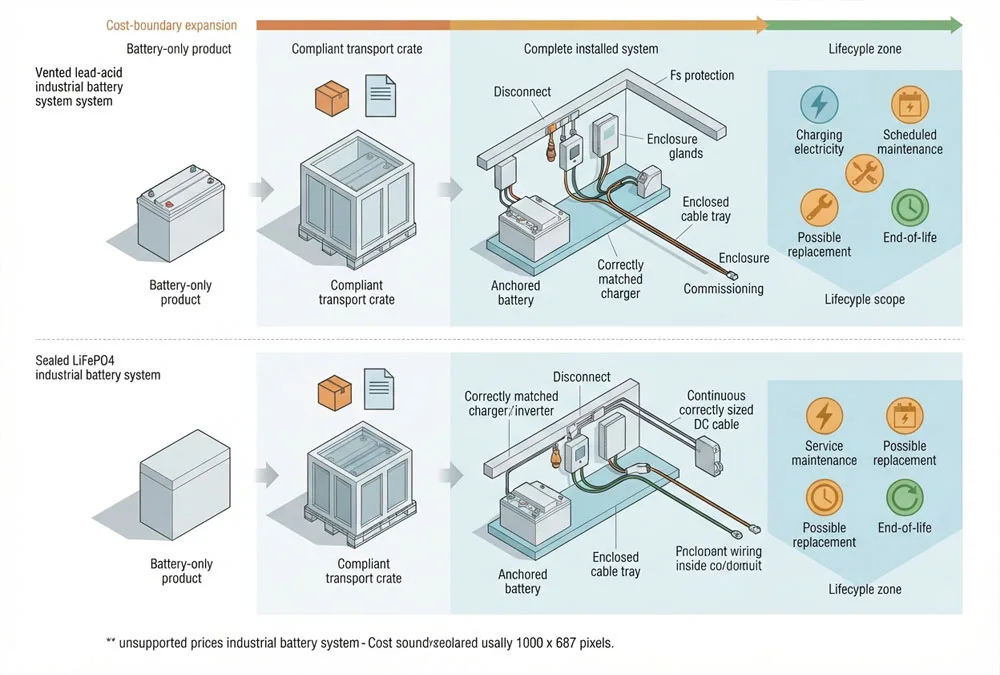
- Circle everything included in each price: charger or inverter, enclosure, BMS, cables, freight, tax, commissioning, and warranty labour.
- Convert both batteries to usable kWh under the quoted duty—not merely Ah or nameplate kWh.
- Estimate annual cycles or productive hours from operating records, not from the supplier’s maximum cycle claim.
- Reject the comparison if either supplier will not state cycle conditions, end-of-life threshold, exclusions, or charger compatibility.
Lithium-Ion vs Lead-Acid Battery Price: Which Number Should You Compare?
| Price measure | What it includes | Best use | Common buying error |
|---|---|---|---|
| Battery-only price | Cells or pack, as defined by the supplier | Early supplier screening | Treating it as the final project cost |
| Landed cost | Battery plus freight, insurance, customs, and destination charges | Importer and distributor comparison | Comparing EXW with DDP or local-stock pricing |
| Installed cost | Landed cost plus charger/inverter, protection, cabling, case or rack, commissioning, and required site work | Capital approval | Ignoring conversion or compatibility work |
| Lifecycle cost | Installed cost plus energy losses, maintenance, downtime, replacements, and financing over a defined duty | Final chemistry decision | Assuming every application cycles enough to justify lithium |
A buyer often sees a low lead-acid quote and a much higher lithium quote, then feels the decision should be obvious. The problem appears several weeks later: the lithium quote included a BMS, communication interface, matched charger, enclosure, and commissioning support, while the lead-acid quote excluded watering equipment, ventilation work, battery-handling equipment, and replacement labour. The lower number was real, but it was not the price of the same solution.
This is why online claims such as “lithium costs twice as much” or “lithium saves 50%” should be treated as hypotheses, not quotations. They may describe a particular country, year, chemistry, capacity, or cycle assumption. They do not tell you what your project will cost.
Quotation rejection rule: if a supplier quotes only voltage, Ah, and price, the offer is not ready for commercial comparison. Those three fields do not establish usable energy, power capability, integration cost, service life, or warranty value.
How to Compare Lead-Acid and Lithium Battery Quotes on the Same Basis
Before comparing price, make both suppliers answer the same specification sheet. At minimum, request:
- Exact chemistry and construction: for example, LFP lithium-ion, flooded lead-acid, AGM, gel, OPzV, or OPzS—not simply “lithium” and “lead-acid.”
- Nominal voltage and capacity: include both volts and amp-hours, plus nominal kWh.
- Approved usable range: supplier-approved depth of discharge under your intended power, temperature, and warranty conditions.
- Power requirement: continuous and peak current, peak duration, and the load profile.
- Cycle-life test conditions: DoD, charge/discharge rate, temperature, end-of-life threshold, and whether partial cycles are counted.
- Included hardware: BMS, display, communication, charger or inverter, cables, connector, case, rack, ballast, protection, and monitoring.
- Commercial scope: Incoterm, freight, dangerous-goods documents, tax, installation, commissioning, training, and local service.
- Warranty boundary: years, cycles or throughput, end-of-life capacity, labour, freight, exclusions, and claim process.
Industry detail that prevents expensive mistakes:
A warranty that says “five years” is not yet an economic specification. If the warranty also limits annual throughput, operating temperature, DoD, charge current, or remaining capacity, the useful warranty for a high-cycle site may be much shorter than five calendar years. Ask the supplier to write the warranted energy throughput—or the exact cycle conditions—into the quotation.
Four Calculations That Make Battery Price Transparent
1. Nominal energy
Voltage × Ah ÷ 1,000 = nominal kWh
2. Usable energy
Nominal kWh × approved DoD = usable kWh
3. Installed cost per usable kWh
Installed cost ÷ usable kWh
4. Lifecycle cost per delivered kWh
Lifecycle cost ÷ verified delivered energy
For stationary storage, delivered energy should reflect approved usable energy, cycle count, degradation, and system efficiency. For a forklift or another material-handling vehicle, cost per productive operating hour may be more useful because battery changes, watering, charging queues, and unplanned downtime directly affect warehouse output. The denominator must match the work the business buys.
Use this five-line quote normalizer
A. Nominal kWh = V × Ah ÷ 1,000
B. Usable kWh = A × approved DoD
C. Landed-and-installed cost = battery + required hardware + logistics + labour
D. Installed cost per usable kWh = C ÷ B
E. Lifetime unit cost = total ownership cost ÷ verified delivered kWh or productive hours
Enter a low, base, and high value for annual use and service life. A purchasing team can then see whether lithium wins under normal operations or only after optimistic assumptions. If the supplier provides a cycle count without DoD, temperature, charge/discharge rate, and end-of-life capacity, leave the lifetime field blank instead of converting the claim into false precision.
Do not multiply a brochure cycle number by nominal kWh without checking test conditions. The European Commission’s Joint Research Centre (JRC) notes that depth of discharge, C-rate, temperature, system auxiliaries, and the stated end-of-life threshold influence performance and durability. Its methodology reinforces a central purchasing lesson: a cycle figure without its conditions is not a bankable lifetime forecast.
What Independent Data Says—and What It Does Not Say
The 2024 JRC report Performance and Durability Requirements in the Batteries Regulation reviewed commercial specifications, standards, and scientific data for rechargeable industrial batteries. Its stationary-battery reference ranges are useful for setting expectations, but they are not retail quotations and should not be transferred directly to a forklift, UPS, or vehicle.
| JRC stationary reference | Lithium-ion | Lead-acid | Buyer interpretation |
|---|---|---|---|
| Typical cycle-life range | Approx. 1,500–5,500 cycles | Approx. 300–2,000 cycles | Ranges overlap; obtain the EOL threshold and test conditions for the quoted model. |
| Round-trip efficiency range | Approx. 85–95% | Approx. 75–85% | Efficiency changes the electricity required to deliver the same useful energy. |
| CAPEX range | Approx. €350–€1,200/kWh | Approx. €300–€1,000/kWh | The wide overlap shows why chemistry alone cannot predict a project price. |
Scope note: approximate ranges interpreted from JRC stationary-application figures. JRC cautions that some compiled cycle-life ranges do not specify a consistent end-of-life threshold and that CAPEX is not necessarily correlated with performance or durability.
That last point matters. A more expensive battery is not automatically better, and a cheaper battery is not automatically worse. Price becomes meaningful only after the duty, system boundary, and evidence standard are fixed. PNNL follows the same principle by publishing separate cost-and-performance models for lithium-ion, lead-acid, and other storage technologies rather than one universal “battery price.”
A Data Example: Higher Upfront Price, Lower Cost per Stored kWh
A World Bank/ESMAP publication, Mini Grid Solutions for Underserved Customers, includes a Nigeria mini-grid model based on project survey data. This is a stationary mini-grid example—not a universal battery price—but it clearly demonstrates why upfront CAPEX and lifetime economics can point in different directions.
| Nigeria mini-grid model input/result | Li-ion (LiFePO4) | Lead-acid (OPzV) | What changes in the decision |
|---|---|---|---|
| Battery + inverter + installation CAPEX | US$479/kWh | US$282/kWh | Lithium starts about 69.9% higher in this model. |
| Assumed operating depth | 80% DoD | 70% DoD | The same nameplate kWh does not provide the same modeled usable energy. |
| Total charge-discharge efficiency | 81% | 78% | Energy losses are included in the service cost, not hidden outside the comparison. |
| Use assumption | 365 cycles/year | 365 cycles/year | High annual utilization gives lifecycle differences time to matter. |
| Levelized cost of storage | US$0.538/kWh | US$0.572/kWh | Lithium finishes about 5.9% lower per stored kWh under the stated assumptions. |
The simple upfront calculation is (479 − 282) ÷ 282 = 69.9%. After applying the model’s stated DoD, the simple installed cost per usable kWh is about 479 ÷ 0.80 = US$599 for LiFePO4 and 282 ÷ 0.70 = US$403 for OPzV lead-acid. Lithium is still about 48.6% higher at this stage. Only after cycle life, efficiency, operating cost, residual value, and financing are included does the modeled LCOS reverse to a 5.9% lithium advantage.
This sequence is the most important lesson in the article: normalizing usable capacity is necessary, but it is not the same as calculating lifecycle value. A buyer who stops at price per usable kWh may still select a different system from a buyer who calculates cost per delivered kWh over the actual ownership period. The report also shows that financing matters: at the modeled 18.5% discount rate, the financial LCOS becomes equal. Higher discount rates favour lead-acid in that model; lower rates favour lithium-ion.
A Commercial Scenario Shows Why Application Boundaries Matter
A separate supplier case from PowerTech Systems Europe modeled a 50 kWh usable, once-daily, 23°C stand-alone solar application over 3,000 cycles. It reported six AGM installations totaling €78,000, or €0.42 per usable kWh per cycle, versus one lithium installation totaling €23,000, or €0.15. The company explicitly says the calculation does not apply to backup or UPS use.
This example is useful because its assumptions are visible—not because its result should be copied into every proposal. A standby battery that cycles only a few times per year will not reproduce a daily-cycle result. A forklift fleet will value productive hours, charging windows, and battery-change labour. A telecom or UPS buyer may value availability and calendar life more than cycle throughput. Use the published scenario as a method example, not a promised saving.
Hidden Costs That Can Change the Cheaper Battery
When a buyer says, “The quotation was attractive until installation started,” one of the following items is usually outside the original comparison:
- Charging or power electronics: a lithium conversion may need a matched charger, revised charge profile, communication handshake, inverter setting, or protection update.
- Physical integration: dimensions, mounting, ventilation, rack or tray, cable reach, connector type, centre of gravity, and—for some forklifts—counterweight requirements.
- Lead-acid service infrastructure: watering, equalization, wash area, ventilation, PPE, battery changing, and trained labour.
- Digital integration: CAN/RS485 protocol, SOC display, telematics, alarm history, and access to service data.
- Import and compliance: dangerous-goods documentation, freight, customs, producer responsibility, recycling arrangements, and local conformity documents.
- Failure response: return freight, local technician availability, spare modules or packs, diagnostic access, and warranty approval time.
A familiar conversion problem illustrates the risk. The existing lead-acid charger is already mounted and paid for, so reusing it appears to save money. Before assigning that saving, record the charger’s model, output-voltage range, current limit, charge stages, equalization behaviour, temperature compensation, connector, and communication interface. Then obtain written compatibility approval from the battery and charger suppliers. If the charge profile cannot be configured for the lithium pack, the charger belongs in the conversion budget; it is not a free asset.
For European buyers, the commercial scope also needs to reflect the current EU Batteries Regulation and the role of the importer, distributor, or other economic operator. Compliance cost depends on the battery category and route to market; it should be confirmed by a qualified compliance specialist rather than estimated from chemistry alone.
Comparing a forklift project? See how purchase price, charger scope, maintenance, and downtime appear in a traction-specific cost comparison.
When Does Lithium-Ion Recover Its Higher Price?
Lithium-ion is more likely to recover a higher installed cost when several of these conditions are true:
- The battery performs frequent cycles and the project will remain in service long enough to use them.
- Downtime or battery changing interrupts production, order fulfilment, or revenue.
- Maintenance labour, watering, cleaning, ventilation, or battery-room space has a measurable cost.
- Opportunity charging or faster scheduled charging can reduce spare-battery inventory.
- Higher usable energy or efficiency reduces installed capacity or purchased electricity.
- Monitoring and BMS data help the operator find misuse, abnormal temperature, or charging faults before a failure.
A practical break-even test is:
Upfront premium = lithium installed cost − lead-acid installed cost
Annual operating advantage = avoided maintenance + avoided downtime + avoided replacements + energy saving
Simple payback = upfront premium ÷ annual operating advantage
Run at least three cases. The low-use case should use fewer cycles, modest maintenance savings, and no assumed production gain. The base case should reflect actual records. The high-use case may include a verified reduction in spare packs or downtime. If lithium pays back only in the optimistic case, the decision is not yet robust.
If the operation has no reliable baseline, use a 30- to 90-day record before approving the investment. Capture battery changes, watering and cleaning labour, charging energy, charger faults, queue time, missed operating minutes, and replacement events. Do not assign a monetary saving to “less maintenance” or “more uptime” until the business can show how those minutes affect paid labour, output, or avoided spare equipment.
When Can Lead-Acid Still Be the Lower-Cost Choice?
Lead-acid can remain economically rational when the equipment is used for one light shift, the battery spends most of its life on standby, the existing charger and service area are already paid for, local technicians and recycling routes are strong, or the powered asset will be retired soon. It can also suit a project where minimizing initial cash outlay is more important than long-run operating cost.
The correct conclusion is not “lead-acid is old” or “lithium always wins.” It is: which system meets the same duty and risk requirement at the lowest verified cost over the buyer’s actual ownership period? For a wider chemistry, safety, charging, and maintenance decision, see our lead-acid and lithium-ion comparison.
Why Battery Prices Differ Across Europe, the United States, Central Asia, and Africa
The electrochemistry does not change at the border, but the delivered business case does.
Europe
Ask who carries importer and producer obligations, which conformity and transport documents are included, how end-of-life responsibilities are handled, and where warranty service occurs. Compare quotations on the same VAT and Incoterm basis.
United States
Confirm local electrical, fire, equipment, and workplace requirements for the application. Service coverage, freight distance, approved charger or inverter, and replacement lead time can matter more than a small pack-price difference.
Central Asia and Africa
Model long-distance freight, customs, grid quality, ambient temperature, dust, local technical support, spare-part availability, and financing cost. The World Bank example above shows why discount rate can change the financial result even when the technical LCOS favours one chemistry.
Turn the Cost Comparison into a Supplier-Ready RFQ
Once the operating data is known, the next step is not to ask for “a 48V lithium price.” It is to request a system that meets the voltage window, power, usable-energy, fit, weight, charging, communication, and regional support requirements. AnengJi publishes LiFePO4 and NMC options across 12V, 24V, 48V, 60V, 64V, and 72V configurations and supports custom battery projects. For industrial traction applications, available lithium forklift battery configurations provide a starting point—not proof of drop-in compatibility.
A useful RFQ should include the equipment make and model, existing battery label, nominal voltage and Ah, battery-compartment dimensions, required weight, connector and cable orientation, charger details, peak and continuous current, daily operating hours, shifts, charging windows, ambient temperature, and destination. If communication is required, provide the CAN or RS485 protocol details. This allows the quotation to separate battery price from charger, integration, logistics, and optional customization instead of hiding them in one number.
Request a Like-for-Like Battery Cost Review
Send both specifications—or the existing battery label and duty cycle—to receive a quotation that separates usable capacity, included hardware, logistics, and integration scope.
Frequently Asked Questions
How much more expensive is a lithium-ion battery than a lead-acid battery?
There is no defensible universal percentage. The gap depends on chemistry subtype, usable capacity, power, enclosure, electronics, charger or inverter, country, freight, warranty, and supplier scope. Compare installed cost per usable kWh first, then lifecycle cost for the same duty. The World Bank mini-grid example on this page showed a 69.9% higher modeled upfront CAPEX for lithium but a 5.9% lower LCOS under its stated assumptions; it is an example, not a global price rule.
Is lead-acid always cheaper?
Lead-acid is often cheaper at the initial battery-purchase stage. It is not always cheaper after usable capacity, efficiency, maintenance, downtime, replacement, and financing are included. In low-cycle or short-horizon applications, however, its lower initial cost may remain decisive.
How should I compare two batteries with the same Ah rating?
First convert voltage and Ah to nominal kWh. Then apply the supplier-approved DoD for your discharge rate, temperature, and warranty conditions. Check peak power, efficiency, and cycle-test conditions. Equal Ah does not guarantee equal voltage, usable energy, power, runtime, or service life.
Can I reuse a lead-acid charger with a lithium battery?
Only if the battery and charger manufacturers confirm compatibility. The voltage window, charge algorithm, current limit, temperature logic, communication, and cut-off behaviour must match. Assuming compatibility to save the charger cost can damage the economic case and may affect safety or warranty.
Do lithium batteries have acid?
Conventional lithium-ion batteries do not contain sulfuric acid like lead-acid batteries. Their electrolyte typically uses a lithium salt in an organic solvent; Argonne National Laboratory describes common commercial electrolytes using LiPF6 with carbonate solvents. This does not make lithium-ion risk-free—cell chemistry, BMS design, protection, charger matching, installation, and operating conditions still matter.
What information should I send to obtain an accurate battery price?
Send the application, equipment model, existing voltage and Ah, dimensions, required mass, current or power profile, daily hours and shifts, charging windows, ambient conditions, connector, communication requirements, destination, quantity, and required commercial term. Ask the supplier to identify every exclusion.
Final Verdict: Compare the Work Delivered, Not the Label Price
Lead-acid normally wins the first-price contest. Lithium-ion can win the lifecycle-cost contest—but only when the application uses its additional usable capacity, efficiency, lower service burden, or operating availability. The decision should survive a low-, base-, and high-use calculation, not depend on one optimistic cycle claim.
For procurement, the safest rule is simple: reject any comparison that does not state chemistry, usable energy, power, test conditions, included hardware, installed scope, warranty boundary, and regional landed cost. Once those inputs are aligned, the lithium ion battery vs lead acid battery price difference becomes a measurable business decision instead of a marketing argument.
Related Articles

[post_navigation]
Related Posts
 https://anengjibattery.com/wp-content/uploads/2026/11/AnengjiBattery-Reviewing-Two-Battery-Quotations.webp
675
1000
Battery Expert Team
https://anengjibattery.com/wp-content/uploads/2025/06/logo2-300x138.png
Battery Expert Team2026-11-17 09:26:542026-11-17 09:27:09Lithium-Ion vs Lead-Acid Battery Price: Which Costs Less?
 https://anengjibattery.com/wp-content/uploads/2026/11/AnengjiBattery-Comparing-Battery-Performance-in-the-Test-Lab.webp
675
1000
Battery Expert Team
https://anengjibattery.com/wp-content/uploads/2025/06/logo2-300x138.png
Battery Expert Team2026-11-13 07:37:312026-11-13 07:37:53Lead Acid Battery vs Lithium Ion Battery: Which Would You Choose Today?
 https://anengjibattery.com/wp-content/uploads/2026/11/AnengjiBattery-Documented-Forklift-Battery-Recycling-Pickup.webp
675
1000
Battery Expert Team
https://anengjibattery.com/wp-content/uploads/2025/06/logo2-300x138.png
Battery Expert Team2026-11-11 06:57:582026-11-11 06:58:43Forklift Battery Recycling: A Practical Disposal Guide
 https://anengjibattery.com/wp-content/uploads/2026/11/AnengJIBattery-Battery-Swap-Bottleneck-at-Shift-Change.webp
675
1000
Battery Expert Team
https://anengjibattery.com/wp-content/uploads/2025/06/logo2-300x138.png
Battery Expert Team2026-11-06 07:07:072026-11-06 07:07:2810 Signs Your Forklift Fleet Is Ready for a Lithium Battery Upgrade



Leave a Reply
Want to join the discussion?Feel free to contribute!