
Lead Acid Battery vs Lithium Ion Battery: Which Would You Choose Today?
November 13, 2026 / Battery Expert Team / Battery Basics
Introduction
If you are comparing a lead acid battery vs lithium ion battery, you probably do not need another list saying lithium is lighter and lead-acid is cheaper. You need to know which difference will actually change your runtime, charging schedule, maintenance workload and total cost.
The practical answer: choose a properly engineered lithium-ion system when the battery works hard every day, charging windows are short, space or weight is limited, and downtime is expensive. Lead-acid can still be the sensible choice when the battery is used infrequently, initial budget matters most, the equipment has a short remaining life, or local lead-acid service is much stronger.
Choose Lithium-Ion First If…
- the battery cycles daily;
- you need opportunity charging;
- maintenance or battery swaps interrupt work;
- space and mass limit productive capacity;
- you need BMS data and fault records.
Choose Lead-Acid First If…
- the battery rarely discharges;
- lowest upfront cost is decisive;
- weight is useful as counterbalance;
- local lead-acid support is immediate;
- cold or high-surge duty suits the design.
Stop and Measure First If…
- you are replacing a battery in existing equipment;
- the charger model is unknown;
- peak current has not been measured;
- permitted battery mass is unclear;
- charging temperature falls below freezing.
Lead-Acid vs Lithium-Ion: See the Difference From the User’s Side
This table starts with what the operator, fleet manager or buyer will notice—not with laboratory terminology.
| What matters to you | Lead-acid advantage | Lithium-ion advantage | What you experience in operation | Likely winner |
|---|---|---|---|---|
| Purchase budget | Usually lower initial battery cost | Can reduce later maintenance and replacement costs | Lead-acid is easier on today’s CAPEX; lithium may improve long-term cost only when its advantages are repeatedly used | Depends on annual use |
| Usable runtime from the same Ah label | Familiar voltage decline can give operators earlier warning | A wider approved operating window can provide more usable energy | Two “200Ah” batteries may not deliver the same working hours | Lithium-ion for frequent cycling |
| Charging window | Simple, familiar infrastructure at many sites | Stronger opportunity-charging potential with the correct charger | Lithium can fit charging into breaks; lead-acid may need a longer uninterrupted charge and finish stage | Lithium-ion when uptime matters |
| Routine attention | Sealed AGM/Gel designs reduce some flooded-battery tasks | No flooded-cell watering; BMS can provide operating data | Fewer electrolyte-related tasks, but connectors, logs, alarms and thermal conditions still need attention | Lithium-ion |
| Space and weight | High mass can be useful in counterbalanced equipment | Higher energy density can reduce pack volume and mass | Lithium may free cabinet or payload space; a forklift may instead need approved ballast | Application-specific |
| Cold conditions | Good low-temperature stability in suitable designs | Can perform well with validated low-temperature protection and heating | A lithium pack may discharge in the cold but correctly refuse charging | Depends on charging temperature |
| Service and recycling | Long-established service and recycling routes in many markets | Diagnostics can identify faults without opening the pack | The best chemistry on paper can still cause long downtime if nobody nearby can diagnose it | Whichever has real local support |
What this means: lithium-ion has the clearest advantages when your operation converts more usable energy, faster charging, lower routine maintenance and smaller size into productive work. Lead-acid remains competitive when you do not use those benefits often enough to recover the higher system cost.
Three Numbers That Make the Comparison More Concrete
The following official figures are reference points, not product guarantees. They come from U.S. Department of Energy and Pacific Northwest National Laboratory work on stationary or grid-scale storage, so their value is showing the size and direction of the difference under a defined model.
kWh/m³ volumetric energy density
DOE reference: lead-acid versus lithium-ion. Lithium can store more energy in the same volume.
Cycles at 80% DoD
PNNL’s 100MW/10-hour model: lead-acid versus LFP. This is a grid model, not a forklift product promise.
Round-trip efficiency
Same PNNL model: lead-acid versus LFP/NMC. System size and power electronics affect real results.
Sources: the DOE Lead Batteries Technology Strategy Assessment and the DOE/PNNL 2022 Energy Storage Cost and Performance Assessment.
The density difference is visible to almost every buyer: cabinet space, vehicle mass, lifting equipment and shipping all change. The cycle difference matters only when the system actually cycles. A standby bank that discharges a few times per year does not automatically benefit from thousands of available cycles.
Why the Same 200Ah Label Can Deliver Very Different Working Time
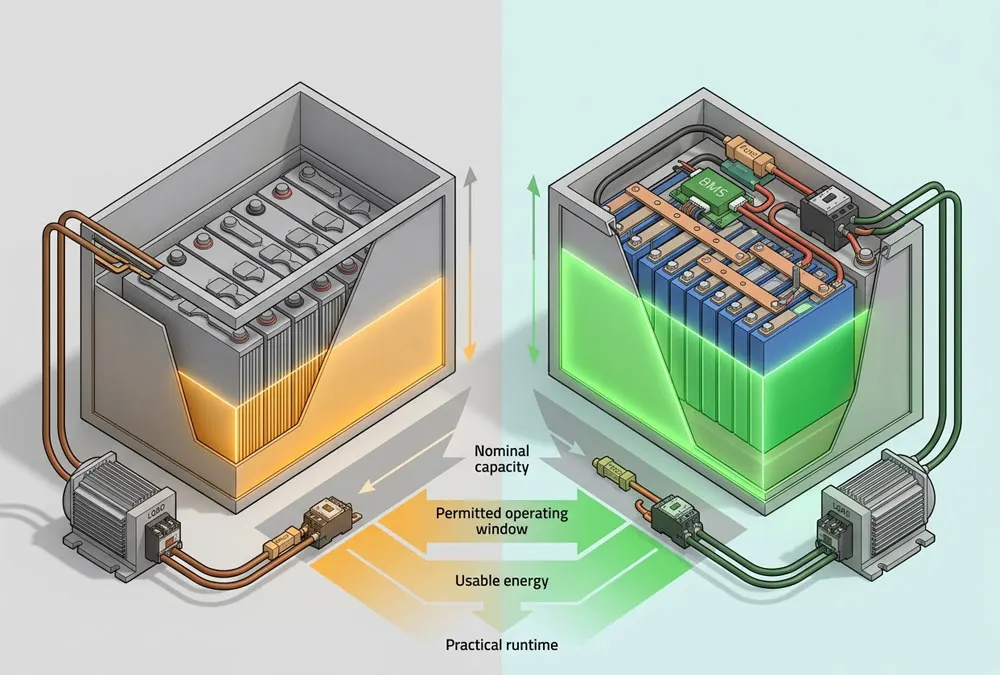
One of the most frustrating outcomes is buying a battery with the “correct” Ah value and still getting the wrong runtime. Ah measures charge capacity; it does not include voltage or the permitted operating window.
Nominal energy (kWh) = voltage × Ah ÷ 1,000
Planning usable energy = nominal energy × approved operating window × condition/rate/temperature factor
| Illustrative battery | Nominal calculation | Assumed planning window | Illustrative usable energy |
|---|---|---|---|
| 48V 200Ah lead-acid | 48 × 200 = 9.6kWh | 50% assumption | 4.8kWh |
| 51.2V 200Ah LFP | 51.2 × 200 = 10.24kWh | 80% assumption | 8.19kWh |
The visible difference: under these assumptions, the LFP example provides about 71% more planning usable energy even though both batteries say 200Ah. This does not mean every LFP battery delivers 71% more runtime. Replace the 50% and 80% assumptions with the exact manufacturer’s warranted window, then account for load, temperature, ageing and system losses.
If the equipment still stops early, do not automatically order more Ah. Record battery voltage, current, temperature and operating time during the event. The problem may be inadequate peak current, an early controller cutoff, cold derating, an inaccurate gauge or a BMS protection event.
What Charging Difference Will You Actually Notice?
The user notices charging in three ways: how long the equipment is unavailable, whether charging fits between shifts, and whether the existing charger must be replaced.
Simple planning example
If 8kWh must be restored and the charger can continuously deliver 4kW, the ideal time is 8 ÷ 4 = 2 hours. Actual charging takes longer when power tapers, the pack is cold, balancing is active or losses are included.
Lithium-ion usually has a practical advantage when short opportunity-charging periods can replace battery swaps or long charging queues. But the advantage disappears if the building cannot supply the charger, the pack restricts charge current, or cold protection blocks charging during the available window.
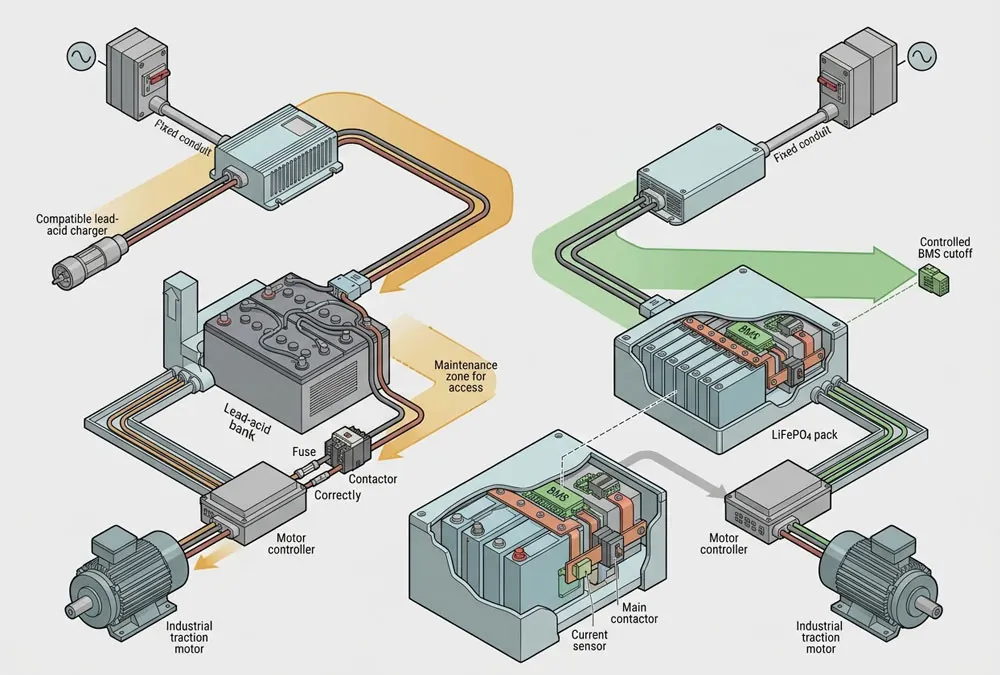
Keeping the old charger may look like an easy saving. It can become the first hidden cost. A lead-acid charger may use equalization, finish, float or temperature compensation that is not approved for the lithium pack. A BMS can disconnect the battery; it cannot correct an unsuitable charging profile.
Before accepting a quote, collect: charger model, maximum output voltage/current, charging phases, temperature inputs, connector, communication, available AC power and the real time available between operations. If the supplier cannot confirm the exact charger-and-pack combination in writing, include a new charger in the project cost.
How Each Battery’s Safety Advantage Looks in Real Use
Safety is not a category where one chemistry receives a simple green tick.
Lead-acid’s operational burden: in its electric-forklift guidance, the U.S. Occupational Safety and Health Administration identifies very heavy batteries, corrosive sulfuric acid, electrical short circuits and hydrogen produced during charging. OSHA’s example charging area includes ventilation and an eyewash capable of a 15-minute flow. For the user, this can mean controlled charging space, PPE, lifting equipment and trained handling. Review OSHA’s forklift charging guidance.
Lithium-ion’s operational burden: the pack needs coordinated cell selection, BMS limits, fuses, contactors, charger control, thermal design, enclosure protection and installation. The U.S. Department of Energy notes that LFP generally offers improved thermal stability compared with some lithium-ion cathodes, but it is not a “silver bullet.” For the user, fewer electrolyte-maintenance tasks do not eliminate inspection, alarms, damage control or emergency planning. See the DOE Energy Storage Safety Strategic Plan.
And no, conventional lithium-ion batteries do not use sulfuric acid. Argonne National Laboratory explains that typical lithium-ion electrolyte uses lithium salt in organic solvents. That answers “do lithium batteries have acid?” without pretending the electrolyte is harmless. See Argonne’s electrolyte explanation.
The Failure Users Remember: It Works Until the Heavy Job Starts
A replacement battery may power on, move the vehicle and appear successful during delivery inspection. Then the operator lifts a heavy pallet while travelling, climbs a ramp or works near low SOC. The truck stops even though the dashboard still shows charge.
The direct cost is a stopped task and uncertain equipment. The important evidence is not another Ah figure: record current, peak duration, voltage, temperature, SOC display and the BMS/controller fault log during the event. Hydraulic dead-heading or simultaneous travel and lift can create a short current demand that exceeds the BMS, contactor, fuse, connector or cable limit.
The solution is to test the current path under the real duty: maximum permitted load, ramp work, simultaneous functions, regenerative current where applicable, low SOC and recharge. A larger-capacity pack is useful only if it also supports the required power path. The full vehicle method is covered in the guide to validating a lead-acid-to-lithium forklift conversion.
The gauge can create a second surprise. Lead-acid voltage usually declines more visibly, while an LFP pack has a flatter discharge curve. A lead-acid-style battery indicator may appear normal before the lithium BMS reaches a protection threshold. Commission the SOC signal, low-energy alarm and controlled shutdown together; do not assume the old display understands the new chemistry.
Which Battery Costs Less for Your Operation?
If the battery runs one lightly used machine, lead-acid’s lower purchase price may be difficult for lithium to recover. If the battery supports two shifts and causes charging queues, swaps or maintenance, the battery-only price hides the largest costs.
Lifecycle cost = battery + charger/electrical work + ventilation or heating/cooling + energy losses + maintenance + replacements + downtime/handling + end-of-life − residual credits
Compare lifecycle cost per usable kWh delivered or productive operating hour—not per rated Ah.
Use your own annual cycles, labour time, electricity price, replacement access and downtime value. The DOE/PNNL assessment similarly treats charging, replacement and decommissioning as parts of storage economics. It does not provide your payback period; it supports using a complete cost boundary.
A practical rejection rule: do not accept a “lithium saves 50%” claim unless the supplier shows the assumed cycles, energy price, maintenance, charger/infrastructure cost, replacement interval and downtime. Do not accept “lead-acid is cheaper” when the quote excludes spare batteries, handling and charging-space costs.
Three Buyers, Three Different Answers
A two-shift warehouse with charging congestion
Likely choice: lithium-ion. The buyer can use opportunity charging and may reduce swaps and routine flooded-battery work. Before ordering, measure daily kWh, peak current, available break time and building power. The battery advantage is valuable only when the charger and truck can use it.
A standby system that rarely discharges
Lead-acid may remain the better buy. Thousands of potential cycles have limited value when the bank spends most of its life waiting. Compare inspection, replacement access, floor loading, monitoring and required autonomy instead of assuming the newer chemistry must win.
An older forklift that needs one replacement battery
Pause before converting. If the truck has limited remaining life, buying a charger, communications interface and engineered ballast can erase lithium’s operating advantage. Compare a correct lead-acid replacement, a validated lithium conversion and vehicle replacement over the same remaining asset horizon.
Where AnengJi’s Lithium Options Fit—and Where They Do Not
When daily cycling, charging windows or maintenance make lithium the stronger direction, AnengJi’s LiFePO4 battery range lists 12V, 24V, 36V, 48V, 60V, 64V and 72V platforms. Its enquiry page also lists configurable BMS protocols, casing and wiring for custom projects. Material-handling buyers can review the available forklift lithium battery options.
Those capabilities narrow the search; they do not prove fit. A standard-format pack is still only a candidate until its voltage window, maximum charge voltage, continuous and peak current, charger, dimensions, mass, restraint, connector, communications and destination documents match the application. A purpose-built enclosure or ballast arrangement solves a specific integration need, not every vehicle in the same voltage class.
Turn your operating problem into a comparison
Provide the application, existing battery, daily operating hours, load/peak current, charging windows, charger model, compartment, permitted mass, temperature and destination. The resulting checklist can show which inputs support lithium, which support lead-acid and what remains unknown.
What Changes Between Europe, the United States and Other Markets?
Europe first: Regulation (EU) 2023/1542 distinguishes battery categories and introduces performance, durability, technical-information and lifecycle obligations according to category and date. A European buyer should request model-level documentation, identify the responsible economic operator and confirm the end-of-life route—not ask whether lithium or lead-acid is generally “EU compliant.” Read the current EUR-Lex text.
United States: workplace charging, product/system requirements, transport and waste are separate questions. The U.S. Environmental Protection Agency states that most discarded lithium batteries in current use are likely hazardous waste because of ignitability and reactivity, while chemistry and design affect the exact determination and state rules may be stricter. See the EPA lithium-ion recycling FAQ.
Central Asia, Africa and other markets: local technician access, spare parts, diagnostic tools, climate, grid quality and real recycling routes can decide the outcome. A lithium system with no qualified local support may create longer downtime than a less energy-dense battery that can be serviced immediately. Validate the specific country instead of treating each region as one regulatory market.
Use This Final Buying Checklist
- Measure the work: daily kWh, continuous current, peak current/duration and required autonomy.
- Map charging: available windows, AC supply, charger voltage/current/profile, connector and communication.
- Record the environment: lowest charging temperature, highest ambient temperature, ventilation, dust, water and vibration.
- Confirm physical fit: dimensions, mass, restraint, lifting, floor/tray loading and counterweight requirements.
- Build the real cost: battery, charger, installation, maintenance, energy, downtime, replacements, service and end-of-life.
- Demand model-level evidence: operating window, test conditions, BMS limits, documentation, warranty conditions and local support route.
If a supplier cannot answer continuous and peak current, approved charger, charge temperature and physical integration questions, the quote is not yet comparable—regardless of chemistry.
Final Verdict
If both batteries were introduced today, lithium-ion would likely win most high-use, space-constrained and maintenance-sensitive projects. Lead-acid would still win some low-cycle, low-CAPEX, cold, high-surge or support-constrained applications.
The best choice is the battery that creates the most usable work at an acceptable installed cost and risk—not the one with the newest chemistry, the largest Ah label or the cheapest quotation.
Frequently Asked Questions
Which lasts longer, lead-acid or lithium-ion?
Lithium-ion, especially LFP, often provides more cycles in frequent-cycling service. Compare the stated depth of discharge, temperature, charge/discharge rate, charge protocol and end-of-life threshold. A cycle number without test conditions is not a service-life promise.
Can lithium directly replace lead-acid?
Sometimes, but nominal voltage and Ah are not enough. Charger, operating-voltage window, current, controller/inverter, connector, communications, dimensions, mass, mounting, temperature and approval must match.
Can I keep the same charger?
Only when the exact charger profile is approved for the exact lithium pack. Equalization, float behaviour, temperature compensation or maximum voltage can make an existing charger unsuitable.
Which battery is safer?
The hazards are different. Lead-acid can involve sulfuric acid, hydrogen and heavy handling. Lithium-ion needs coordinated cell, BMS, electrical, thermal, enclosure and charger protection. Evaluate the complete system and installation.
Which is cheaper over its lifetime?
Lithium often performs better economically in high-cycle operations where downtime and maintenance are costly. Lead-acid may remain cheaper for lightly used or short-horizon assets. Calculate with your own duty cycle and installed costs.
Do lithium batteries contain acid?
They do not use sulfuric acid like lead-acid batteries. Typical lithium-ion batteries use lithium salt in an organic-solvent electrolyte, which still needs controlled handling and recycling.
Get a Comparison Based on Your Actual Duty Cycle
Share the battery platform, daily operating hours, load and peak current, charging windows, charger, space, mass, temperature and market. The review can return a practical chemistry direction, compatibility gaps and the documents still required before quotation.
Related Articles

[post_navigation]
Related Posts
 https://anengjibattery.com/wp-content/uploads/2026/11/AnengjiBattery-Comparing-Battery-Performance-in-the-Test-Lab.webp
675
1000
Battery Expert Team
https://anengjibattery.com/wp-content/uploads/2025/06/logo2-300x138.png
Battery Expert Team2026-11-13 07:37:312026-11-13 07:37:53Lead Acid Battery vs Lithium Ion Battery: Which Would You Choose Today?
 https://anengjibattery.com/wp-content/uploads/2026/11/AnengjiBattery-Documented-Forklift-Battery-Recycling-Pickup.webp
675
1000
Battery Expert Team
https://anengjibattery.com/wp-content/uploads/2025/06/logo2-300x138.png
Battery Expert Team2026-11-11 06:57:582026-11-11 06:58:43Forklift Battery Recycling: A Practical Disposal Guide
 https://anengjibattery.com/wp-content/uploads/2026/11/AnengJIBattery-Battery-Swap-Bottleneck-at-Shift-Change.webp
675
1000
Battery Expert Team
https://anengjibattery.com/wp-content/uploads/2025/06/logo2-300x138.png
Battery Expert Team2026-11-06 07:07:072026-11-06 07:07:2810 Signs Your Forklift Fleet Is Ready for a Lithium Battery Upgrade
 https://anengjibattery.com/wp-content/uploads/2026/11/AnengJIBattery-Forklift-Battery-Purchase-Passport.webp
675
1000
Battery Expert Team
https://anengjibattery.com/wp-content/uploads/2025/06/logo2-300x138.png
Battery Expert Team2026-11-05 06:35:192026-11-05 06:35:53How Do Lithium-Ion Batteries Improve Warehouse Safety?



Leave a Reply
Want to join the discussion?Feel free to contribute!