
How Does Lithium-Ion vs Lead-Acid Battery Safety Compare?
November 18, 2026 / Battery Expert Team / Battery Basics
Introduction
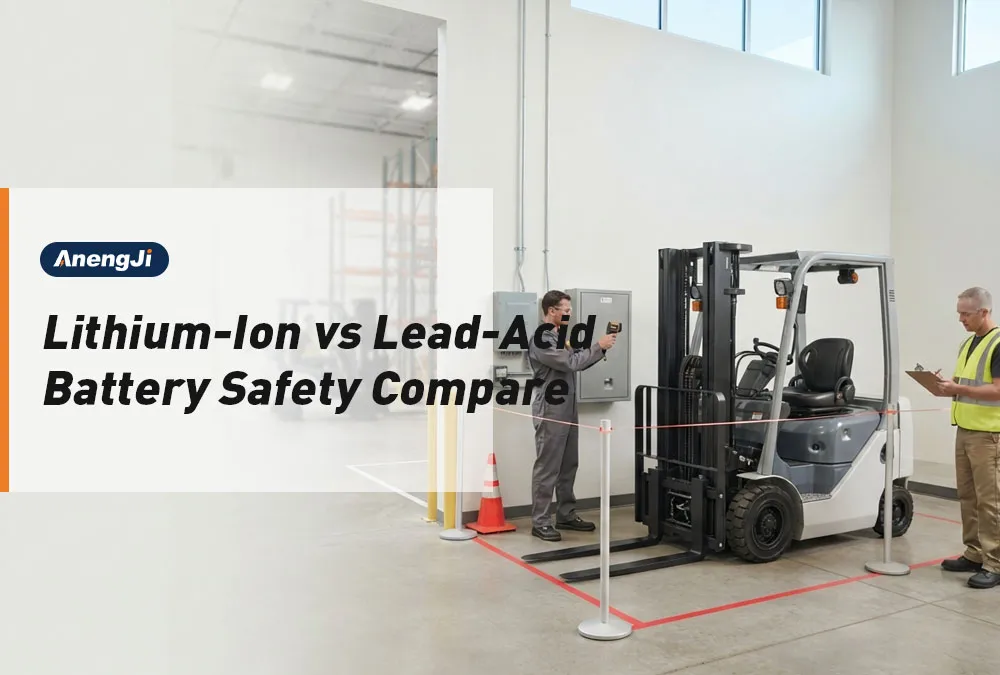
Most battery incidents do not begin with a chemistry debate. They begin with an ordinary decision: an operator resets a fault, a charger is reused because the plug fits, a damaged case is returned to service, or a charging room is assumed to be “ventilated enough.” That is why a useful comparison of lithium ion battery vs lead acid battery safety must show what people actually have to control.
The short answer: neither chemistry is universally safer. Flooded lead-acid creates frequent, visible exposure to sulfuric acid, hydrogen, watering and heavy handling. Lithium-ion can remove much of that routine work, but a damaged, defective or incorrectly charged pack can develop a less frequent but harder-to-manage thermal event. The safer choice is the complete battery–charger–equipment–site system whose hazards your team can control every day—not just on installation day.
The 60-second decision:
when acid handling, watering and battery changes are the recurring exposure—and the charger, BMS, pack and response plan can be validated together.
when duty is modest, existing controls are consistently maintained, required equipment mass matters and competent local service is already established.
when charger compatibility, mechanical fit, fault response, temperature limits or model-specific test scope cannot be documented.
“Sealed,” “maintenance-free,” “smart BMS” and “same voltage” are not safety evidence by themselves.
If you also need a wider comparison of performance, charging, lifecycle cost and weight, see our lead-acid and lithium-ion decision guide. This article stays focused on safety.
Lithium-Ion Battery vs Lead-Acid Battery Safety in Three Numbers
These figures make the risks tangible, but their boundaries matter. They come from different countries and industries, so they should not be combined into a global accident rate or copied into a local compliance plan.
serious injuries per year
UK HSE workplace guidance says at least 25 people are seriously injured each year while using batteries at work. This is UK workplace context, not a worldwide incidence rate.
lead-acid explosions reported
A Queensland mining safety bulletin recorded 37 incidents over 11 years in mines and quarries—3.4 per year in that specific reporting population.
hydrogen in air
CCOHS identifies this approximate explosive range for hydrogen during lead-acid charging. Ventilation therefore has to be engineered for the charging load, not judged by smell alone.
The first figure comes from the UK Health and Safety Executive’s Using Electric Storage Batteries Safely. The incident series comes from the Queensland government bulletin Exploding Lead Acid Batteries. The hydrogen range is stated in current CCOHS forklift battery guidance. Together, they show why both routine controls and severe-event planning matter.
Why “Which Battery Is Safer?” Is the Wrong First Question
A safety decision should compare three things: the probability of an initiating event, the consequences if it develops, and whether the site can maintain the required controls. One technology may reduce daily exposure while creating a different emergency-response problem.
For example, a warehouse may eliminate weekly watering and frequent battery swaps by moving from flooded lead-acid to lithium-ion. That removes recurring contact with electrolyte and heavy battery-handling work. However, the same warehouse must now own the BMS fault process, inspect the enclosure after an impact, protect charging cables from traffic and define when a damaged pack can return to service. The chemistry changed; the need for a safety-management system did not.
The comparison also changes within each family:
- Flooded lead-acid allows gas to vent and requires electrolyte-level maintenance.
- VRLA, AGM and gel lead-acid reduce routine electrolyte access and normally recombine much of the gas, but excessive charging can still build pressure and open relief valves.
- Lithium-ion describes a family of chemistries, not one safety behaviour.
- Lithium iron phosphate (LiFePO4 or LFP) generally offers greater thermal stability than higher-energy NMC or NCA chemistries, but the pack still contains stored energy and typically a combustible electrolyte.
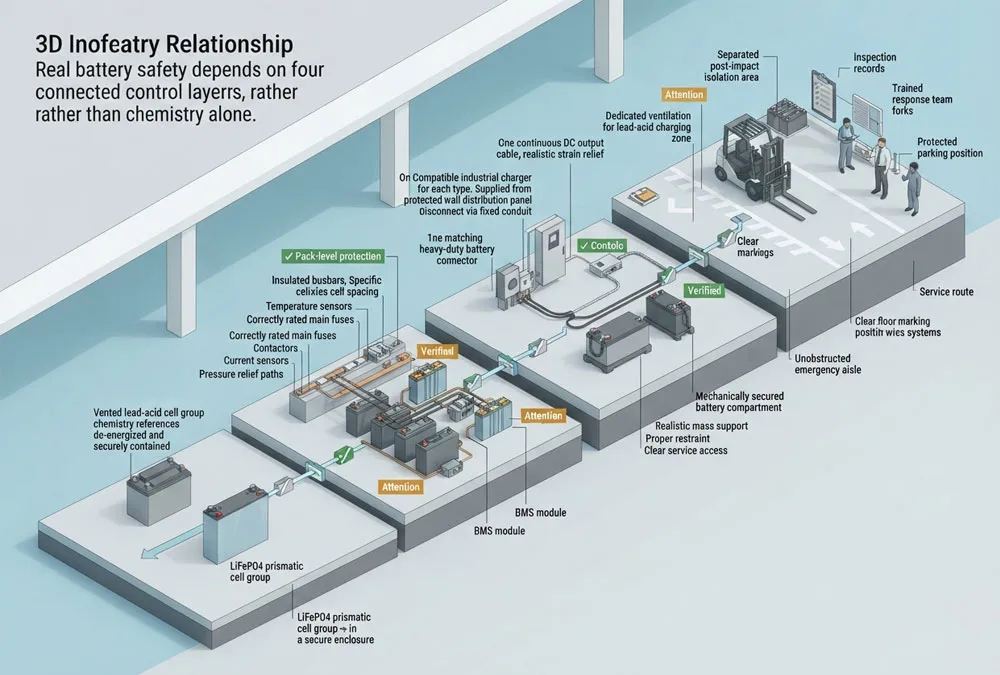
This is why “lead acid batteries vs lithium ion” should be a system comparison: cell chemistry, cell quality, electrical protection, enclosure, thermal paths, charger, equipment interface, operating environment, service process and emergency plan all affect the result.
What a Bad Battery Day Actually Looks Like
The difference becomes clearer when the comparison starts with the problem an operator sees—not a laboratory label.
Lead-acid: the charger trips again
The battery is bubbling more than usual, the odour is stronger and the charger reports high temperature. Production wants another reset because the next shift is waiting.
The real risk: abnormal charging, low electrolyte, blocked ventilation or a damaged cell may be producing heat and gas. Record the battery and charger data, isolate under the site procedure and arrange trained inspection. Smell cannot confirm a safe hydrogen concentration.
Lithium-ion: the truck still drives after an impact
A forklift clips a rack. The battery enclosure has a new dent, but the display looks normal and the truck can still move. The temptation is to finish the shift.
The real risk: internal damage may not be visible or immediately detected by the BMS. Follow the manufacturer’s impact-isolation and inspection process before charging or returning the pack to service. “No fault code” is not the same as “no damage.”
What the examples reveal: lead-acid usually demands disciplined control of frequent maintenance and charging-room hazards. Lithium-ion usually shifts more of the burden toward integration, monitoring, damage assessment and escalation. A buyer should choose the control system the organisation can sustain on a busy shift, not the chemistry with the cleaner brochure.
Lead-Acid Battery Safety: The Risks Buyers Meet in Daily Operation
Hydrogen makes charging-area design a safety control
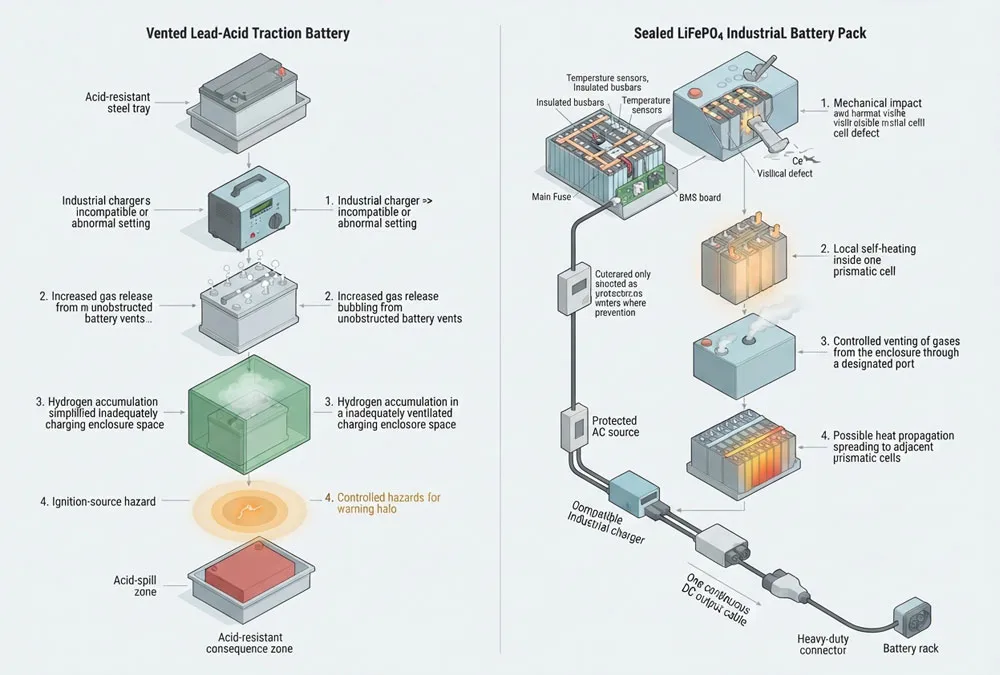
Lead-acid charging can produce hydrogen and oxygen. Gas production increases as a battery approaches full charge and can rise further during overcharging or charging faults. If hydrogen accumulates and meets an ignition source—an electrical arc, a hot surface, smoking or a spark—the battery case may rupture and project plastic fragments and corrosive electrolyte.
The US Occupational Safety and Health Administration identifies highly corrosive sulfuric acid, explosive hydrogen fumes, short-circuit burns and the batteries’ high mass as lead-acid forklift hazards. Its electric-forklift guidance describes a properly equipped charging area with ventilation, ignition control, fire protection, spill-neutralisation provisions and an eyewash capable of a 15-minute flow. These are US workplace examples; the exact legal design for another country must follow its own rules and risk assessment.
When bubbling or odour becomes an operating problem
A facility receives conflicting explanations: one person says bubbling is expected near the end of charge, while an operator reports that the odour is stronger and the charger repeatedly stops on temperature. Continuing production without evidence turns uncertainty into exposure.
Do not diagnose the condition from sound or smell alone. Record the battery ID, charger ID, charge stage, voltage, current, battery temperature, electrolyte condition, water history, ventilation status and every charger fault. Then follow the manufacturer and site stop-use procedure. Abnormal heat, discharged electrolyte, a cracked or distorted case, blocked vents, repeated protective trips or a rapidly worsening condition requires trained inspection—not another reset.
This is the complete pain-to-solution chain: the symptom is familiar, but the consequence may be an unsafe charging bay and interrupted work; the evidence separates normal gassing from overcharge, low electrolyte, a damaged cell or a charger fault; the correct action is controlled isolation and diagnosis rather than guessing.
Sulfuric acid changes maintenance and emergency planning
Flooded lead-acid systems create repeat tasks around watering, inspection, cleaning and spill response. Adding water at the wrong time can contribute to electrolyte overflow. CCOHS advises that flooded forklift batteries are generally watered after charging and cooling, according to the manufacturer, rather than before or during charge. Personnel handling the batteries also need the applicable eye, face, hand and body protection, emergency flushing provisions and spill procedures.
VRLA or AGM batteries reduce routine watering, but “sealed” should not be interpreted as incapable of venting. HSE explains that pressure-relief valves can open when a valve-regulated battery is charged too quickly or for too long. The correct charger remains a safety component.
Electrical and handling hazards remain even without a fire
A spanner, jewellery or damaged cable can bridge terminals and release enough current to create an arc, molten metal and severe burns. Large traction batteries also introduce lifting, crush and change-out hazards. These are not small secondary issues: a chemistry can have a predictable fire profile and still expose workers through poor handling, damaged connectors or uncontrolled maintenance.
Lead-acid control question: Can the facility reliably maintain ventilation, charger settings, electrolyte procedures, ignition control, PPE, spill response, lifting equipment and inspections throughout the battery’s life? If not, the low purchase price does not describe the complete safety burden.
Lithium-Ion Battery Safety: Lower Routine Maintenance Does Not Mean Zero Risk
What starts thermal runaway?
Thermal runaway is a self-heating chain reaction that can begin when heat generation exceeds the cell’s ability to dissipate it. According to OSHA’s lithium-ion battery hazard guidance, initiating conditions include an internal short caused by a manufacturing defect, mechanical damage, exposure to excessive heat or cold, and improper charging.
Defect / impact / temperature / improper charge → internal heating → venting or thermal runaway → possible cell-to-cell propagation and hazardous gases
Warning indicators can include an unusual temperature rise, swelling or enclosure deformation, venting, vapour, smoke, fire, abnormal odour or repeated BMS/charger faults. A damaged pack can look normal externally while an internal defect remains. After a significant impact, water exposure, enclosure breach or serious electrical event, follow the manufacturer’s isolation and trained-inspection process before charging or returning the battery to service.
OSHA also notes that a thermal-runaway fire can produce hazardous substances including hydrogen fluoride, hydrogen chloride, hydrogen cyanide and carbon monoxide. That does not mean every failed battery releases the same mixture or concentration. It means the emergency plan cannot treat smoke as harmless merely because no sulfuric acid is present.
Does LiFePO4 solve the fire problem?
LiFePO4 generally offers a more thermally stable cathode than NMC or NCA, which is one reason it is frequently selected for industrial vehicles and stationary applications. A 2025 Fire and Rescue NSW literature review summarises cell-level studies in which NMC thermal-runaway temperatures ranged from 555–1,066°C versus 357–525°C for LFP. It also reports one 2024 study that found the thermal-runaway reaction speed relative to cell energy was nine times faster for NMC than LFP.
Read the number correctly: this supports a chemistry-level thermal-stability advantage for LFP under the cited test conditions. It is not a nine-times-safer claim for every forklift or storage battery. The same review explains that cell capacity, state of charge, form factor, pack construction and vented-gas composition affect the event—and LFP thermal runaway can still produce hazardous, flammable gases.
Chemistry is therefore only the first layer. Poor cells, an internal defect, inadequate spacing, weak busbar protection, insufficient thermal paths, an unsuitable enclosure or a mismatched charger can still create a dangerous system.
A purchasing specification should therefore say more than “LFP battery.” It should identify the exact pack configuration, cell and pack limits, continuous and peak current, charge limits, sensing, fuse and contactor arrangement, thermal management, enclosure, applicable test evidence, installation instructions and fault response.
What the BMS can—and cannot—protect
A battery management system monitors selected measurements such as cell voltage, pack current and temperature. It can command a contactor or electronic switch to stop charge or discharge when a programmed threshold is crossed. This is valuable protection, but it is not a force field around the cells.
The industry detail buyers should know:
A BMS can disconnect current when it detects a monitored abnormal condition. It cannot make an incompatible charger profile correct, repair an internal cell defect, guarantee that heat will not propagate after a severe internal failure, compensate for an incorrectly rated fuse or contactor, or make an unsafe installation compliant.
If a supplier promises “full BMS protection,” ask for the model-specific thresholds, sensor locations, current and temperature limits, contactor/fuse coordination, fault codes, data access and reset rules. A feature list without limits and test coverage is not enough to evaluate risk.
When Should a Battery Be Taken Out of Service?
Operators do not need to diagnose the battery chemistry. They need clear stop-use triggers and an escalation route. The following signs justify isolation and trained assessment under the manufacturer’s and site’s procedures; they are not a substitute for the product manual.
Lead-acid stop-use signals
- Cracked, distorted or leaking case
- Unusual heat, violent gassing or worsening odour
- Repeated charger temperature or voltage trips
- Damaged connectors, exposed conductors or melted terminals
- Blocked vents, contaminated electrolyte or unexplained overflow
Lithium-ion stop-use signals
- Swelling, deformation, enclosure breach or significant impact
- Unexpected temperature rise, venting, vapour, smoke or unusual odour
- Water ingress or evidence that seals and cable glands are damaged
- Repeated BMS, isolation, temperature or charger faults
- Unapproved charger, modified wiring or bypassed protection
Do not repeatedly clear a protective trip to keep production moving. Preserve the fault record, identify the battery and charger, control access to the area and use the documented emergency or service route. If there is active heating, venting, smoke or fire, follow the site emergency plan and contact emergency responders; do not improvise a repair or firefighting method from a general web article.
Lead-Acid vs Lithium-Ion Safety: A Buyer-Focused Comparison
This table compares the risk profile a buyer must manage. It is not a product guarantee, and it does not replace the instructions or risk assessment for a specific battery and site.
| Safety dimension | Flooded lead-acid | VRLA / AGM lead-acid | Engineered lithium-ion / LFP system | Buyer evidence |
|---|---|---|---|---|
| Routine chemical exposure | Watering and electrolyte contact can be part of normal maintenance | No routine watering, but a damaged case or opened relief valve still matters | No lead-acid watering; damaged cells can release hazardous electrolyte or decomposition products | SDS/hazard information, inspection and damaged-unit procedure |
| Charging gas | Hydrogen and oxygen generation makes ventilation and ignition control central | Gas is largely recombined in normal operation, but overcharge can cause venting | No lead-acid gassing mechanism; an abnormal failure can vent flammable or toxic gases | Approved charger, ventilation/fire assessment and operating instructions |
| Severe thermal event | Less prone to lithium-style self-sustaining propagation; charging and short-circuit events still cause fire or explosion | Similar chemistry with different enclosure and vent behaviour | Thermal runaway is possible; chemistry, cell quality and propagation control matter | Cell chemistry, pack tests, thermal design, enclosure and emergency plan |
| Short circuit and arc | High fault current can heat tools, melt metal and ignite gas | Same stored-energy principle | High fault current requires coordinated cell, busbar, fuse, contactor and BMS protection | Fault-current path, isolation method and component ratings |
| Handling and equipment fit | High mass increases lifting, change-out and crush exposure | High mass remains relevant | Lower mass can reduce handling but may create a counterweight or restraint issue in vehicles | Installed mass, centre of gravity, lifting points, mounting and approval |
| Charger mismatch | Wrong profile or rate can increase gas, heat and damage | Wrong profile can raise pressure or shorten life | Wrong limits or algorithm can cause BMS cut-off, imbalance, overheating or cell damage | Exact battery–charger approval, profile, current, termination and communication |
| Fault visibility | Water level, corrosion, leakage, heat and charger behaviour can reveal problems | Some internal conditions are less visible | BMS data can reveal monitored faults, but hidden internal damage can remain | Inspection, diagnostic access, fault ownership and return-to-service criteria |
Buyer implication: lithium-ion often reduces routine maintenance exposure, while lead-acid—especially VRLA—can offer well-understood behaviour and established service routes. The correct choice depends on whether the site can control the specific hazards, not on which column contains more advantages.
Can You Safely Replace a Lead-Acid Battery With Lithium-Ion?
Sometimes—but “same voltage, similar Ah and the plug fits” is not a safety approval.
Imagine an older forklift whose lead-acid battery no longer finishes a shift. A lightweight lithium pack moves the truck during a workshop test, and the existing charger appears to start. The failure arrives under a loaded lift, ramp travel or low state of charge: current exceeds a BMS or contactor limit, the battery disconnects, and the truck stops while the dashboard still shows energy.
The consequence is not merely inconvenient downtime. An uncontrolled stop, an unapproved vehicle mass or a mismatched charging system can create equipment and personnel risk. Collect the truck plate, original battery plate, approved battery-mass range, controller limits, peak and regenerative current, compartment dimensions, mounting, connector, cable direction, communication, charger model and real duty-cycle evidence. Then obtain written engineering approval for the complete combination.
Only people who work with traction systems regularly tend to catch this early: the old lead-acid battery may be part of a counterbalanced forklift’s approved stability configuration. A lighter lithium pack does not automatically increase payload. It can be electrically functional and still be mechanically unacceptable unless mass, location, enclosure strength, restraint and documentation are engineered correctly.
Our detailed lead-acid-to-lithium forklift conversion assessment covers the vehicle-specific checks. The same principle applies outside forklifts: a replacement must match the load, charger, protection, mechanical environment and responsible approval process.
Unsure whether an existing charger and battery can be used together? Send both model labels, charge limits and the application duty. The review should identify missing compatibility evidence before a purchase decision.
Which Battery Is Safer in Different Applications?
Warehouse and material-handling fleets
Lithium-ion can remove watering, routine acid handling and frequent battery swapping. That is a meaningful safety improvement when the facility replaces those tasks with protected charging points, pre-use inspection, post-impact isolation, BMS event review and a documented return-to-service process. A cable across a traffic lane or a repeatedly reset fault remains unsafe regardless of chemistry.
For a complete operating view, read how warehouse battery safety changes after a lithium conversion.
Stationary backup and energy storage
Lead-acid may remain attractive where discharge is rare, service practices are established and the installation can provide the required ventilation, inspection and floor-loading provisions. Lithium-ion can reduce space and maintenance burdens, but proximity to occupied areas, detection, separation, ventilation, fire strategy, insurer conditions and local authority requirements become part of the project. Do not transfer a forklift charging-room rule directly to a stationary installation.
Mobile, vibration-prone and outdoor equipment
Both chemistries need correct restraint and protection from impact, moisture, dust, cable movement and vibration. A sealed case is not immune to damage. The buying decision should include enclosure construction, ingress protection where applicable, mounting, cable strain relief, thermal path and the inspection process after a collision or tip-over.
Central Asia, Africa and remote-service markets
These regions are not one compliance market. Confirm the destination country, operating and charging temperatures, dust and moisture, local AC supply, fire and workplace requirements, transport route, technician skill, diagnostic access, spare parts and damaged-battery recovery. A system that is safer on paper but cannot be diagnosed, isolated or supported locally can create long downtime and improvised repairs.
Five Battery Safety Claims That Deserve a Second Question
Some sales statements sound reassuring because they contain a true fragment. The missing detail is usually where the purchasing risk sits.
- “LiFePO4 cannot catch fire.” LFP is generally more thermally stable than common nickel-rich lithium-ion chemistries, but a damaged or abused pack still contains stored energy and hazardous materials. Ask for pack-level protection, abuse-test scope and the damaged-battery procedure.
- “The BMS prevents every unsafe condition.” A BMS acts only on the conditions it measures and the limits it is programmed to enforce. Ask for thresholds, sensor locations, disconnect devices, fault logs and the response to a failed sensor or welded contactor.
- “It is a drop-in replacement because the voltage matches.” Nominal voltage does not confirm current capability, regenerative-current acceptance, charger profile, communication, mass, centre of gravity or compartment restraint. Ask for written compatibility with the exact equipment and charger.
- “UN 38.3 means the battery is certified safe for the application.” UN 38.3 addresses transport testing. Ask which industrial or application-specific tests apply and whether the documents cover the offered model, configuration and revision.
- “Maintenance-free means inspection-free.” Eliminating watering does not eliminate checks for damage, cable wear, contamination, temperature, fault history, mounting or charger condition. Ask for the actual inspection schedule and stop-use criteria.
A practical purchasing rule: every safety adjective should lead to a document. “Safer chemistry” should lead to the stated cell chemistry and relevant test evidence; “smart protection” to BMS limits and fault behaviour; “compatible” to a model-level integration record; and “maintenance-free” to a defined inspection plan.
What Safety Evidence Should You Request Before Ordering?
A supplier should be able to identify the exact product—not only the chemistry—and explain how it fits the application. Request the following evidence before the quotation becomes an approved order:
- Battery identity: exact model, configuration, chemistry, nominal and operating-voltage window, energy, continuous current, peak current and peak duration.
- Charging compatibility: approved charger model or limits, maximum charge voltage/current, algorithm, termination, temperature behaviour, connector and communication.
- Protection architecture: BMS functions and thresholds, sensing, fuse, contactor, manual isolation and fault response.
- Mechanical design: dimensions, complete installed mass, centre-of-gravity implications, mounting, restraint, lifting points, cable exit and enclosure details.
- Environmental limits: operating, charging and storage temperature; ingress, vibration or impact evidence when relevant.
- Test and compliance scope: document number, issuing body or laboratory, edition, date and the exact models/configurations covered.
- Operating documents: installation, use, maintenance, fault, storage, emergency and end-of-life instructions.
- Lifecycle support: diagnostic access, change control, spare parts, warranty boundaries and the party responsible for return-to-service decisions.
IEC 62619:2022 specifies safety requirements and tests for secondary lithium cells and batteries used in industrial applications; its scope examples include forklift trucks, golf carts and AGVs. That makes it relevant evidence for many industrial projects, but naming the standard does not prove that the battery offered to you is covered by a valid report.
Likewise, subsection 38.3 of the UN Manual of Tests and Criteria addresses lithium-battery transport testing. It does not by itself prove safe integration into a forklift, ESS or other machine. In Europe, Regulation (EU) 2023/1542 adds battery-market requirements, but product classification, economic-operator duties and transition dates need qualified review for the exact project. In the United States, workplace, electrical, fire, transport and equipment rules can all affect the solution. Treat compliance as destination-, product- and application-specific.
Where AnengJi Battery Options Fit Into the Decision
AnengJi supplies lithium and lead-acid replacement options for applications that include energy storage and industrial vehicles. Buyers can review the available lithium battery platforms, including application-oriented and configurable solutions, after the safety requirements are defined.
For example, a warehouse considering LFP to remove watering and battery-change work should not begin with a product code. It should begin with truck model, duty cycle, original battery mass, compartment drawing, current peaks, regenerative braking, charger arrangement, connector and operating temperature. AnengJi can then assess whether an existing platform is a realistic candidate or whether enclosure, interface or capacity changes require a custom engineering discussion. This makes the product recommendation part of the operating scenario rather than an isolated sales insert.
A product category is a starting point, not proof of fit. A standard-format battery remains only a candidate until voltage window, charge limits, current, temperature, dimensions, mass, mounting, connector, BMS/charger interface and destination evidence are confirmed. A custom case, cable direction or BMS interface can solve a specific integration problem, but customization does not remove the need for testing and approval.
For a useful proposal, provide the application, existing battery and charger labels, required voltage and usable energy, continuous and peak load, dimensions, mass constraints, mounting, connector, communication, operating temperatures, charging windows, destination and evidence requirements. This allows the discussion to move from “Which chemistry is safer?” to “Which documented system controls the hazards in this application?”
Request a Battery Safety and Fit Review
Send the application, battery, charger and installation data. The review should identify compatibility gaps, evidence requirements and the inputs still needed for a model-level proposal.
Frequently Asked Questions
Which is safer, lithium-ion or lead-acid?
Neither chemistry is universally safer. Flooded lead-acid adds routine acid, hydrogen, ventilation, maintenance and heavy-handling risks. Lithium-ion reduces much of that routine exposure but requires control of charging, internal faults, mechanical damage and thermal runaway. Compare the exact product and site controls.
Can a lead-acid battery explode while charging?
Yes. Hydrogen and oxygen can be generated during charging, especially near full charge or under overcharge. If gas accumulates and meets a spark or other ignition source, an explosion can rupture the case and release fragments and electrolyte. Correct charging, ventilation and ignition control are essential.
Do lithium batteries have acid?
Conventional lithium-ion batteries do not use the sulfuric acid electrolyte found in lead-acid batteries. They normally use a lithium salt in organic solvents. That electrolyte and the products produced during a severe failure can still be flammable, reactive or hazardous, so “no sulfuric acid” does not mean “no chemical risk.”
Is LiFePO4 safer than other lithium-ion chemistries?
LFP generally has greater thermal stability than higher-energy NMC or NCA chemistries. It is still not risk-free. Cell quality, pack architecture, electrical protection, thermal design, enclosure, charger compatibility, installation and operating limits determine the safety of the complete system.
Can I use a lead-acid charger on a lithium battery?
Only when the exact charger and battery combination is documented as compatible. Nominal voltage and connector fit are insufficient. Confirm the output-voltage range, current, charging stages, equalisation or float behaviour, temperature logic, termination, communication and protective interlocks.
Does a BMS prevent a lithium battery fire?
A BMS can reduce risk by monitoring selected conditions and disconnecting charge or load when thresholds are exceeded. It cannot detect every internal defect, correct poor mechanical or thermal design, or guarantee that a severely damaged cell will not enter thermal runaway. It must work with cells, fuses, contactors, charger, enclosure and operating procedures.
What should I request from a battery supplier?
Request the exact model specification, chemistry, voltage and current limits, approved charger information, BMS/protection details, dimensions and mass, installation instructions, applicable test reports and transport documents, warranty conditions, fault procedures, diagnostic access and local service route. Verify that every document covers the offered model and configuration.
Final Verdict: Choose the Risk Profile Your Operation Can Control
The strongest lead-acid advantage is not that it is harmless; it is that its failure modes and service practices are mature and familiar in many industries. Its weakness is the recurring burden of acid, gas, ventilation, watering, corrosion and heavy handling—particularly for flooded traction batteries.
The strongest lithium-ion advantage is not that it cannot fail; it is that a properly engineered system can eliminate several routine exposure and maintenance tasks while providing electronic monitoring. Its weakness is that internal faults, mechanical damage or unsuitable charging can create a thermal event whose consequences require a planned system response.
The safest purchase is therefore not the newest chemistry or the longest feature list. It is the battery–charger–equipment–site combination that has defined limits, model-specific evidence, trained users, maintained controls and a realistic service and emergency route.
Related Articles

[post_navigation]
Related Posts
 https://anengjibattery.com/wp-content/uploads/2026/11/AnengJIBattery-Post-Impact-Battery-Safety-Isolation.webp
675
1000
Battery Expert Team
https://anengjibattery.com/wp-content/uploads/2025/06/logo2-300x138.png
Battery Expert Team2026-11-18 02:40:582026-11-18 02:41:12How Does Lithium-Ion vs Lead-Acid Battery Safety Compare?
 https://anengjibattery.com/wp-content/uploads/2026/11/AnengjiBattery-Reviewing-Two-Battery-Quotations.webp
675
1000
Battery Expert Team
https://anengjibattery.com/wp-content/uploads/2025/06/logo2-300x138.png
Battery Expert Team2026-11-17 09:26:542026-11-17 09:27:09Lithium-Ion vs Lead-Acid Battery Price: Which Costs Less?
 https://anengjibattery.com/wp-content/uploads/2026/11/AnengjiBattery-Comparing-Battery-Performance-in-the-Test-Lab.webp
675
1000
Battery Expert Team
https://anengjibattery.com/wp-content/uploads/2025/06/logo2-300x138.png
Battery Expert Team2026-11-13 07:37:312026-11-13 07:37:53Lead Acid Battery vs Lithium Ion Battery: Which Would You Choose Today?
 https://anengjibattery.com/wp-content/uploads/2026/11/AnengjiBattery-Documented-Forklift-Battery-Recycling-Pickup.webp
675
1000
Battery Expert Team
https://anengjibattery.com/wp-content/uploads/2025/06/logo2-300x138.png
Battery Expert Team2026-11-11 06:57:582026-11-11 06:58:43Forklift Battery Recycling: A Practical Disposal Guide



Leave a Reply
Want to join the discussion?Feel free to contribute!