
NiCad vs Lithium Ion Batteries: Which Is Better for Industrial Use?
July 22, 2026 / Battery Expert Team / Battery Basics
Introduction
Choosing between NiCad vs Lithium Ion Batteries often boils down to a clear trade-off between legacy ruggedness and modern efficiency. Nickel cadmium (NiCad) batteries served heavy industries reliably for over a century. However, as operational demands shift toward longer equipment runtimes and lighter power packs, lithium ion battery technology is rapidly taking over. In high-frequency commercial applications—such as golf carts, automated guided vehicles (AGVs), floor cleaning scrubbers, and electric utility trikes—switching away from legacy nickel chemistry is no longer just a trend. It has become a key operational decision. In this guide, we break down the fundamental differences between these two battery chemistries, evaluate real-world operating costs, and explain how upgrading to custom lithium power can eliminate unnecessary equipment downtime.
Understanding NiCad and Lithium Ion Batteries | Battery Chemistry Basics
Before pulling old batteries out of your fleet, you need to understand what is happening inside the cell casing. Both technologies store chemical energy and release it as electricity, but their internal materials react in completely different ways.
What Is a Nickel Cadmium (NiCad) Battery?
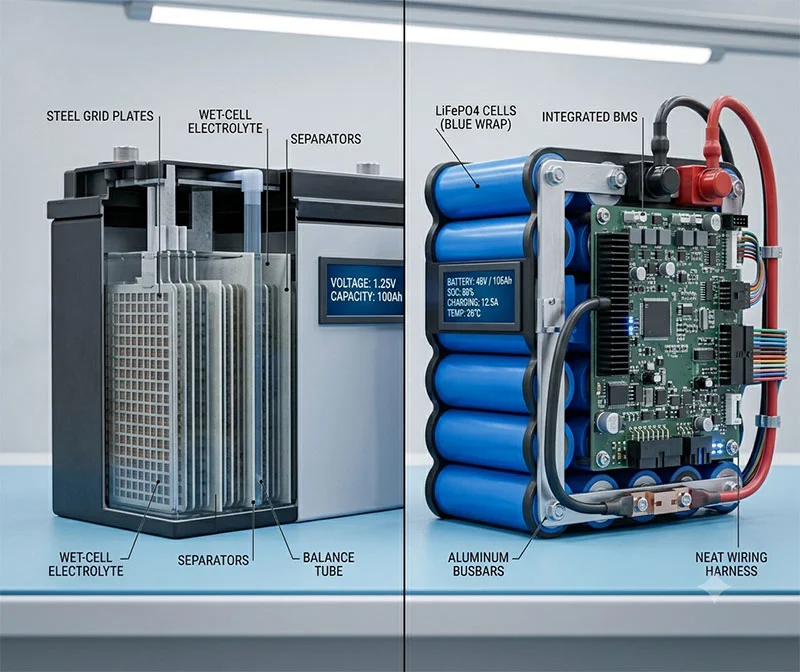
A nickel cadmium battery is a traditional rechargeable battery system built with a nickel oxide hydroxide positive electrode, a cadmium negative electrode, and an alkaline potassium hydroxide electrolyte. First developed back in 1899, this robust chemistry delivered reliable current under brutal mechanical stress. For decades, fleet mechanics relied on NiCad packs to start aircraft, run emergency backup systems, drive power tools, and power early industrial utility haulers.
How Does a NiCad Battery Work?
During discharge, the cadmium anode oxidizes while the nickel cathode undergoes reduction. When you attach a charger, this electrochemical reaction reverses. Because the water inside the liquid electrolyte is not consumed during normal cycling, NiCad cells tolerate deep mechanical shocks and heavy vibration remarkably well. However, handling hazardous cadmium requires strict environmental controls during manufacturing and disposal.
What Is a Lithium Ion Battery?
A lithium ion battery relies on the movement of lithium ions back and forth between the positive cathode and negative graphite anode. Rather than relying on heavy toxic metals, modern commercial packs use advanced cell chemistries like Lithium Iron Phosphate ($LiFePO_4$ or LFP) and Nickel Manganese Cobalt ($LiNiMnCoO_2$ or NMC). LFP chemistry has become the gold standard for heavy commercial equipment due to its exceptional thermal stability and long operational life.
How Does Lithium Ion Battery Technology Work?
When discharging, lithium ions leave the anode, travel through an organic liquid or solid electrolyte, and insert themselves into the cathode matrix. Charging forces those ions back into the anode. What really makes modern lithium technology work seamlessly in commercial environments is the integrated Battery Management System (BMS). The BMS acts as an internal computer, constantly monitoring individual cell voltages, controlling operating temperatures, and protecting the pack against over-current hazards.
NiCad Battery Advantages and Disadvantages | Performance Characteristics of Nickel Cadmium Batteries
NiCad packs dominated heavy industry for decades for good reasons, but their chemical limitations are hard to ignore in fast-paced modern operations.
Advantages of NiCad Batteries
- Proven Historical Reliability: Decades of field testing mean these legacy cells are well understood by maintenance crews.
- High Discharge Capability: NiCad cells deliver rapid bursts of current without suffering immediate internal structural damage.
- Wide Temperature Tolerance: They remain functional in deep cold down to -20°C, making them useful in unheated outdoor environments.
- Rugged Mechanical Design: The thick steel casing tolerates severe vibrations, impacts, and rough handling on construction sites.
Disadvantages of NiCad Batteries
Despite their ruggedness, NiCad packs suffer from severe operational drawbacks. The most frustrating issue is the “memory effect.” If a operator repeatedly recharges a NiCad battery before it is completely empty, the cells “remember” that shortened cycle, permanently losing usable capacity. On top of that, cadmium is a toxic heavy metal restricted under international environmental rules like RoHS. NiCad batteries also lose up to 20% of their charge per month just sitting on a shelf, requiring frequent maintenance cycles to prevent total capacity loss.
Lithium Ion Battery Advantages and Disadvantages | Modern Lithium Battery Technology
Upgrading to modern lithium chemistry eliminates almost all the daily operational friction caused by legacy nickel batteries.
Advantages of Lithium Ion Batteries
When you replace nicad batteries with lithium ion batteries, your equipment immediately runs longer, hits higher top speeds, and stays in service without frequent maintenance breaks. Key benefits include:
- Dramatically Higher Energy Density: Stores up to three times more energy in a casing of the same size.
- Zero Memory Effect: Operators can top off the battery during lunch breaks without reducing overall cell capacity.
- Lightweight Design: Cuts total battery weight by 60% to 70%, reducing wear on vehicle drive motors and braking systems.
- Rapid Charging Speed: Accepts high charging currents, bringing a fully depleted pack back to 100% in under two hours.
- Zero Daily Maintenance: Requires no water topping, equalization charges, or tedious capacity restoration routines.
Disadvantages of Lithium Ion Batteries
The main drawback of lithium power is a higher initial purchase price. Lithium cells also require an integrated BMS circuit board to keep voltages balanced and prevent thermal runaway under heavy load. However, for commercial operations, the initial price difference is quickly recovered through lower energy bills and reduced labor costs.
NiCad vs Lithium Ion Batteries Comparison | Energy Density, Lifespan, Cost and Safety
To see how these chemistries stack up head-to-head in commercial service, let’s compare their core performance metrics side by side.
Energy Density Comparison Between NiCad and Lithium Ion Batteries
According to the Global Industrial Battery Market Report 2025 published by Advanced Energy Analytics, industrial lithium iron phosphate (LiFePO4) packs average an energy density of 140–180 Wh/kg. In comparison, standard NiCad industrial packs deliver just 45–60 Wh/kg. That massive difference means a lithium pack delivers three times the operational runtime while weighing a fraction of a nickel assembly.
| Performance Parameter | NiCad Battery | LiFePO4 Lithium Battery | Operational Benefit for Commercial Buyers |
|---|---|---|---|
| Gravimetric Energy Density | 45 – 60 Wh/kg | 140 – 180 Wh/kg | Higher Payload Capacity: Lighter battery weight increases vehicle acceleration and extends haul capacity on light utility trucks. |
| Typical Cycle Lifespan | 500 – 1,000 Cycles | 3,500 – 7,000 Cycles | Longer Service Life: A single lithium pack lasts 7+ years in multi-shift service, avoiding repeated replacement downtime. |
| Self-Discharge Rate | 15% – 20% per Month | < 2% per Month | Instant Fleet Readiness: Equipment parked over long holidays starts up instantly without needing overnight pre-charging. |
| Round-Trip Efficiency | 70% – 75% | 95% – 98% | Lower Utility Bills: Wastes significantly less electricity during charging, cutting facility power costs year-round. |
Operational Takeaway: Switching your fleet to lithium eliminates daily maintenance routines and delivers nearly 100% electrical efficiency, turning wasted charging energy into pure working runtime.
Battery Lifespan and Cycle Life Comparison
A standard NiCad pack typically delivers around 800 charge cycles before its internal capacity drops below 80%. A quality LiFePO4 commercial pack easily handles 3,500 to over 6,000 deep discharge cycles. In a busy warehouse running 24/7 AGV fleets, a NiCad pack needs replacement every 18 to 24 months. A LiFePO4 pack installed in that same AGV runs reliably for over eight years without opening the chassis.
Charging Efficiency and Charging Speed Comparison
NiCad batteries convert only about 70% of the grid energy supplied into usable stored power, wasting the remaining 30% as excess internal heat. Lithium packs achieve a round-trip efficiency of 95% or higher. Furthermore, while a NiCad pack requires 6 to 8 hours for a slow charge to prevent thermal damage, a commercial lithium battery pack accepts fast charging during 15-minute shift breaks without shortening cell life.
Environmental Impact Comparison
Cadmium is a highly toxic element that poses severe environmental risks if improperly dumped in landfills under guidelines by the United States Environmental Protection Agency (EPA). Many international markets are phasing out NiCad through strict environmental mandates. In contrast, lithium iron phosphate contains no toxic cadmium or lead, making it significantly easier to recycle safely through standard industrial programs.
Safety Comparison Between NiCad and Lithium Ion Batteries
NiCad cells are chemically forgiving and resist catastrophic failure under severe overcharge conditions. However, modern commercial LiFePO4 lithium packs match or exceed this safety level by combining an inherently stable crystal structure with smart BMS protection. The BMS continuously monitors individual cell conditions, instantly disconnecting power if it detects short circuits, voltage spikes, or temperature anomalies.
NiCad vs Lithium Ion Battery Cost Comparison | Initial Price vs Total Ownership Cost
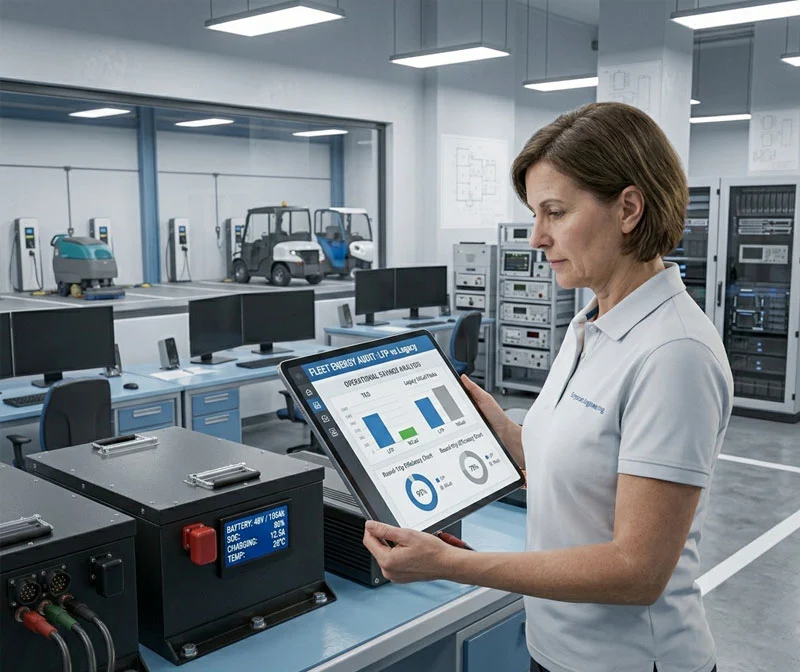
Looking only at the initial purchase price on a quote leads to poor purchasing decisions. You need to calculate the Total Cost of Ownership (TCO) across the entire lifespan of the equipment.
Initial Purchase Cost Comparison
There is no hiding it: a commercial lithium battery pack costs roughly 40% to 60% more upfront than a legacy NiCad pack of equivalent voltage. The advanced cell materials and onboard BMS electronics naturally drive up the initial manufacturing cost.
Long-Term Operating Cost Comparison
Focusing strictly on sticker price ignores the hidden ongoing expenses of legacy tech. Over a five-year period, a NiCad setup demands continuous maintenance labor, frequent capacity restoration routines, high electricity consumption due to charging inefficiency, and at least two complete battery replacements. When you factor in those ongoing expenses, the total operating cost of NiCad climbs rapidly.
Total Cost of Ownership (TCO) = Initial Purchase Price + Maintenance Labor + (Wasted Charging Energy) + (Replacement Packs × Downtime Costs)
Why Lithium Batteries Can Reduce Total Cost Over Time
As battery technology expert Dr. Roderick Myers noted during the 2025 International E-Mobility Symposium: “Commercial operators who look beyond initial cell cost quickly realize that lithium’s zero-maintenance design and high round-trip efficiency lower total fleet operating costs by over 35% within the first three years.” By eliminating watering routines, reducing charging bills, and lasting three to five times longer, a commercial lithium upgrade pays for itself quickly.
NiCad vs Lithium Ion Batteries Applications | Which Battery Is Better for Different Industries?
While legacy nickel batteries still serve a few niche legacy applications, modern commercial equipment runs far better on lithium power.
NiCad Battery Applications
NiCad remains in limited use for legacy commercial aircraft backup systems, fixed emergency station power, and extreme-cold stationary gear where ancient equipment setups have not yet been upgraded to support smart digital communication protocols.
Lithium Ion Battery Applications
Modern high-demand electric equipment runs almost exclusively on advanced lithium power banks:
| Application Sector | Typical Equipment | Recommended Lithium Solution | Why This Choice Benefits the Buyer |
|---|---|---|---|
| Commercial Mobility | Golf Carts, Sightseeing Buses, Resort Shuttles | 48V / 72V Custom LiFePO4 Pack | Conquers Steep Inclines: Maintains steady voltage under load, allowing carts to climb steep hills without losing speed. |
| Material Handling | AGVs, AMRs, Warehouse Tow Tugs | 24V / 48V High-Rate Fast-Charge Pack | Continuous 24/7 Operation: Supports rapid opportunity charging during shift breaks, eliminating spare battery swaps. |
| Industrial Sanitation | Floor Scrubbers, Commercial Sweepers | 24V / 36V Deep-Cycle LFP Pack | Eliminates Acid Corrosion: Sealed maintenance-free design prevents toxic chemical spills on polished commercial floors. |
| Specialty Transport | Electric Tuk-Tuks, Delivery Trikes | 48V / 60V Lightweight LFP Modules | Extends Daily Delivery Range: Shaves off up to 100 kg of dead weight, allowing driver fleets to cover longer daily routes. |
Operational Takeaway: Matching your equipment with a purpose-built lithium battery pack boosts operational productivity while reducing long-term maintenance costs.
Why More Industries Are Switching from NiCad to Lithium Ion
Facility directors are tired of dealing with battery maintenance schedules, shortened runtimes, and unexpected mid-shift fleet breakdowns. Upgrading to an industrial lithium battery pack gives operators consistent power delivery, clear digital battery status tracking, and completely maintenance-free operation.
Can You Replace NiCad Batteries with Lithium Ion Batteries?
Yes, you can directly execute a nicad battery replacement with lifepo4 battery pack setups on most commercial equipment, but you need to pay attention to a few critical integration details.
Key Factors Before Replacing NiCad with Lithium Battery
Executing a successful lithium ion battery upgrade from nicad battery setups requires checking four main specifications:
- Voltage Matching: Ensure the nominal voltage of the new lithium pack matches your original drive motor system (e.g., 24V, 36V, or 48V).
- Charger Compatibility: You must replace old NiCad chargers with a dedicated lithium charger that follows a proper Constant Current/Constant Voltage (CC/CV) algorithm.
- Physical Tray Dimensions: Because lithium packs are much smaller, you may need custom mounting brackets or spacers to secure the new pack inside the existing tray.
- BMS and Controller Communication: Confirm that your vehicle’s motor controller interfaces properly with the new pack’s BMS signal lines (such as CANbus or RS485).
Lithium Battery Retrofit Solutions for Industrial Equipment
Professional battery manufacturers offer drop-in retrofit kits designed to fit directly into standard commercial battery compartments. These turnkey solutions include a custom-shaped steel enclosure, integrated smart BMS, custom wiring harness, and a matching smart charger, making the upgrade fast and straightforward for your mechanics.
Why LiFePO4 Battery Is a Popular NiCad Replacement Choice
When evaluating nicad vs lithium ion batteries for industrial applications, LiFePO4 is the clear winner for retrofits. Its nominal cell voltage (3.2V) makes building standard system voltages simple, while its exceptional thermal stability completely eliminates the thermal runaway risks associated with older cobalt-based chemistries.
How to Choose Between NiCad and Lithium Ion Batteries?
If you are still weighing your options, ask yourself these three simple operational questions to choose the right battery path for your business.
Choose NiCad Battery If You Need:
- A simple replacement for an ancient stationary backup generator where charging infrastructure cannot be upgraded.
- Equipment operating in unheated sub-zero freezing environments without access to insulated battery blankets.
- Initial equipment cost as the only buying metric, regardless of long-term labor and electricity costs.
Choose Lithium Ion Battery If You Need:
- Maximum daily operating range and lightweight vehicle design.
- Zero daily watering, equalizing, or maintenance routines for your staff.
- Fast charging during short shift breaks to support 24/7 multi-shift operations.
- The lowest total cost of ownership across a 5- to 10-year service life.
Consider Your Application Requirements Before Choosing
Take a close look at your operational priorities. If your machinery operates daily in high-demand environments, the productivity gains and labor savings of a modern lithium battery pack will far outweigh the initial purchase price within the first year of operation.
Frequently Asked Questions About NiCad vs Lithium Ion Batteries
Are lithium batteries better than NiCad batteries?
Yes, for almost all modern commercial and industrial uses. Lithium batteries offer up to three times higher energy density, last four to five times longer, charge much faster, and require zero daily maintenance compared to legacy NiCad packs.
Can lithium batteries replace NiCad batteries?
Yes, you can replace old NiCad batteries with a custom LiFePO4 pack. You simply need to match the voltage, fit the physical battery tray, and use a lithium-compatible charger paired with an integrated BMS.
Which battery lasts longer, NiCad or lithium ion?
Lithium ion batteries last significantly longer. A quality LiFePO4 pack delivers 3,500 to 6,000+ deep cycles, whereas a standard industrial NiCad battery typically degrades after 500 to 1,000 cycles.
Are lithium batteries safer than NiCad batteries?
Modern LiFePO4 lithium batteries are extremely safe. Their non-combustible crystal structure, combined with integrated smart BMS over-voltage and thermal protection, makes them just as safe as NiCad while avoiding toxic cadmium exposure.
Why are industries replacing NiCad batteries?
Industries are switching to lower overall operating costs, eliminate toxic cadmium disposal liabilities, remove the performance drops caused by memory effect, and run equipment continuously through fast opportunity charging.
Upgrade from NiCad to Lithium Battery Solutions
Tired of dealing with dead batteries, slow charging times, and high maintenance costs? Our engineering team builds high-performance custom LiFePO4 battery packs designed specifically for golf carts, AGVs, floor scrubbers, and industrial fleets. Whether you need an OEM battery design for new machinery or a plug-and-play retrofit kit to replace aging NiCad packs, we deliver built-to-order power solutions that maximize equipment uptime. Contact our technical team today to request a custom quote, review technical drawings, or discuss your fleet upgrade project with an experienced battery engineer.
Related Article
- Lithium Iron Phosphate Batteries: Advantages and Disadvantages
- Top 10 LiFePO4 Battery Manufacturers in China (2026 Guide) Buyer’s Guide
- How to Choose an LFP Battery Manufacturer: The Complete Qualification Guide
- What Is the LiFePO4 Battery Price? Complete Cost Guide
- LiFePO4 Battery Charger Voltage Chart | Full Charging Guide
- How to Choose Wholesale LiFePO4 Batteries Suppliers?
Related Posts
 https://anengjibattery.com/wp-content/uploads/2026/09/AnengJIBattery-Best-LiFePO4-Battery-How-to-Choose-the-Right-One.webp
675
1000
Battery Expert Team
https://anengjibattery.com/wp-content/uploads/2025/06/logo2-300x138.png
Battery Expert Team2026-09-17 08:52:142026-09-17 08:52:31How to Choose the Best LiFePO4 Battery
https://anengjibattery.com/wp-content/uploads/2026/09/AnengJIBattery-Best-LiFePO4-Battery-How-to-Choose-the-Right-One.webp
675
1000
Battery Expert Team
https://anengjibattery.com/wp-content/uploads/2025/06/logo2-300x138.png
Battery Expert Team2026-09-17 08:52:142026-09-17 08:52:31How to Choose the Best LiFePO4 Battery https://anengjibattery.com/wp-content/uploads/2026/09/anengjiBattery-lifepo4-battery-cell-packaging-wholesale.webp
675
1000
Battery Expert Team
https://anengjibattery.com/wp-content/uploads/2025/06/logo2-300x138.png
Battery Expert Team2026-09-16 09:52:342026-09-16 09:52:57LiFePO4 Battery Wholesale Guide: Best Suppliers in Spain
https://anengjibattery.com/wp-content/uploads/2026/09/anengjiBattery-lifepo4-battery-cell-packaging-wholesale.webp
675
1000
Battery Expert Team
https://anengjibattery.com/wp-content/uploads/2025/06/logo2-300x138.png
Battery Expert Team2026-09-16 09:52:342026-09-16 09:52:57LiFePO4 Battery Wholesale Guide: Best Suppliers in Spain https://anengjibattery.com/wp-content/uploads/2026/09/anengjibattery-Top-Lithium-Ion-Battery-Producers-for-Spain-Market-Growth.webp
675
1000
Battery Expert Team
https://anengjibattery.com/wp-content/uploads/2025/06/logo2-300x138.png
Battery Expert Team2026-09-16 01:13:392026-09-16 01:14:05Top Lithium Ion Battery Producers for Spain’s Market Growth
https://anengjibattery.com/wp-content/uploads/2026/09/anengjibattery-Top-Lithium-Ion-Battery-Producers-for-Spain-Market-Growth.webp
675
1000
Battery Expert Team
https://anengjibattery.com/wp-content/uploads/2025/06/logo2-300x138.png
Battery Expert Team2026-09-16 01:13:392026-09-16 01:14:05Top Lithium Ion Battery Producers for Spain’s Market Growth https://anengjibattery.com/wp-content/uploads/2026/09/Bulk-Lithium-Ion-Battery-Cells-Procurement-Guide-B2B-Sourcing.webp
675
1000
Battery Expert Team
https://anengjibattery.com/wp-content/uploads/2025/06/logo2-300x138.png
Battery Expert Team2026-09-14 09:47:322026-09-14 09:47:48Bulk Lithium-Ion Battery Cells Procurement Guide | B2B Sourcing
https://anengjibattery.com/wp-content/uploads/2026/09/Bulk-Lithium-Ion-Battery-Cells-Procurement-Guide-B2B-Sourcing.webp
675
1000
Battery Expert Team
https://anengjibattery.com/wp-content/uploads/2025/06/logo2-300x138.png
Battery Expert Team2026-09-14 09:47:322026-09-14 09:47:48Bulk Lithium-Ion Battery Cells Procurement Guide | B2B Sourcing


Leave a Reply
Want to join the discussion?Feel free to contribute!