
LiFePO4 Battery Charger Guide: How to Choose the Right Lithium Charger
July 29, 2026 / Battery Expert Team / Battery Basics
Introduction
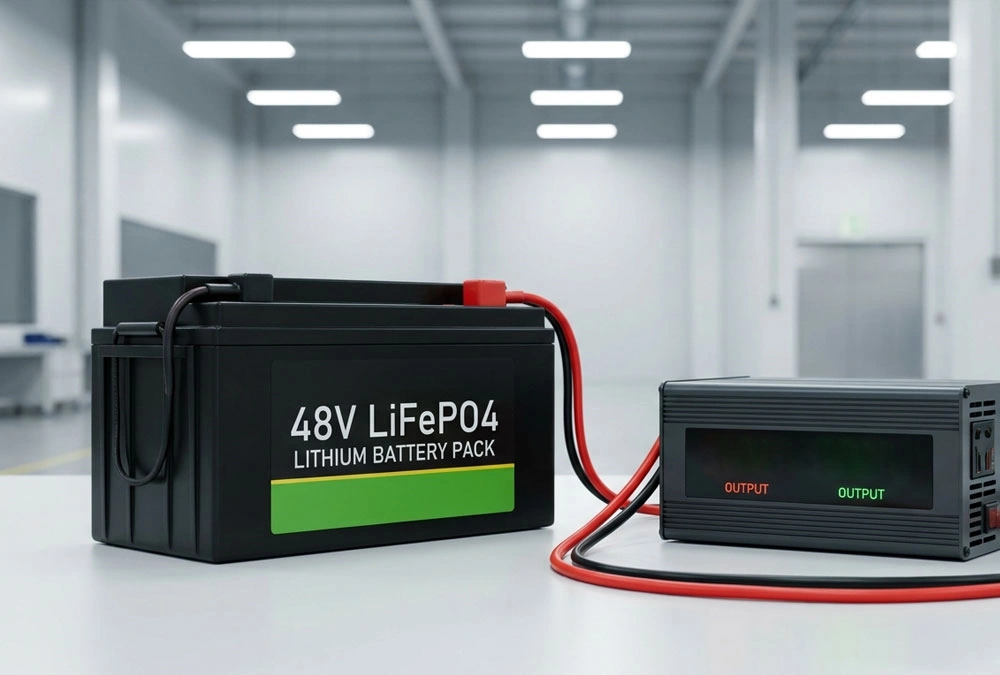
Every week on factory floors and fleet yards, engineers run into the same maddening issue: a brand-new 48V battery pack shuts down halfway through a shift, or a high-capacity AGV sits stranded because its charger flagged a false “full charge” error. The culprit is almost never a dead cell; it is an uncalibrated lifepo4 battery charger voltage chart configuration that ignores real-world electrochemical impedance. Matching terminal output to exact cell count guarantees stable daily operation, unlocks maximum energy density, and protects your investment over 3,000+ deep cycles. If you manage electric golf carts, industrial forklifts, automated sweepers, or stationary solar banks, getting your charging parameters locked down is non-negotiable.
A common procurement error is purchasing a “48V charger” for a “48V lithium pack.” It sounds straightforward, but this mismatch ruins battery efficiency. A nominal 48V system built with 16 cells in series (16S) actually requires a constant 58.4V output to complete its chemical transition. Connecting a standard 48V power supply leaves cells sitting at less than 40% capacity, causing severe speed degradation under heavy payload. Quick Solution: Always calculate your charger specification based on series cell count multiplied by 3.65V, rather than nominal system labels, and ensure your charger maintains a strict voltage tolerance within ±0.05V to prevent early cutoffs.
LiFePO4 Battery Charger Voltage Chart: Understanding Charging Voltage Requirements
Lithium iron phosphate chemistry behaves very differently from legacy lead-acid systems under electrical load. To optimize charging setups, engineers must look beyond high-level marketing numbers and examine cell-level voltage limits.
Why LiFePO4 Battery Voltage Is Different From Charger Voltage
Field technicians frequently ask why a nominal 12.8V battery requires a 14.6V charger output. This difference comes down to internal cell resistance (IR) and polarization voltage during current injection. A single LiFePO4 cell operates at 3.2V nominal. However, forcing lithium ions out of the Olivine crystal cathode and into the graphite anode requires pushing terminal voltage up to 3.65V per cell.
Four primary voltage terms dictate every pack specification:
- Nominal Voltage: The flat working baseline voltage during standard discharge (typically 3.2V per cell).
- Charging Voltage: The regulated DC voltage required to overcome internal cell impedance during charging.
- Maximum Protection Voltage: The absolute upper safety threshold where the BMS trips to prevent cell damage.
- Discharge Cut-off Voltage: The lower threshold (typically 2.5V per cell) where power delivery must stop.
Buyer Pain Point & Immediate Solution: A major frustration for fleet operators is buying third-party chargers that drift in voltage over time, causing the BMS to trigger over-voltage protection (OVP) during hot summer shifts. Solution: Specify industrial-grade chargers equipped with temperature-compensated voltage regulation and secondary hardware over-voltage sensing independent of software controls.
LiFePO4 Battery Voltage Terms You Need to Know
Nominal Voltage represents the wide plateau where the cell delivers stable power for most of its discharge cycle. Full Charge Voltage is the upper limit reached during the Constant Voltage phase when current drops near zero. Discharge Cut-off Voltage is the safety floor; letting cell voltage drop below 2.0V causes irreversible copper dissolution, ruining the cell permanently.
LiFePO4 Battery Charger Voltage Chart (12V to 72V)
Use this technical table to match battery architecture with accurate power conversion parameters:
| LiFePO4 Battery System | Cell Configuration | Nominal Voltage | Full Charge Voltage | Recommended Charger | Operational & Business Advantage |
|---|---|---|---|---|---|
| 12V LiFePO4 | 4S (4 Cells) | 12.8V | 14.6V | 14.6V Charger | Replaces 12V lead-acid directly while eliminating voltage sag under load. |
| 24V LiFePO4 | 8S (8 Cells) | 25.6V | 29.2V | 29.2V Charger | Powers industrial floor scrubbers through full 8-hour working shifts. |
| 36V LiFePO4 | 12S (12 Cells) | 38.4V | 43.8V | 43.8V Charger | Maintains consistent motor torque for commercial utility carts. |
| 48V LiFePO4 | 16S (16 Cells) | 51.2V | 58.4V | 58.4V Charger | Delivers maximum efficiency for heavy AGVs and material handling fleets. |
| 72V LiFePO4 | 24S (24 Cells) | 76.8V | 87.6V | 87.6V Charger | Provides high acceleration and steep hill-climbing power for electric shuttles. |
Buyer Advantage: Matching exact charging voltages eliminates annoying BMS trips, maximizes usable capacity, and prevents fleet downtime.
How Does LiFePO4 Battery Charging Voltage Work?
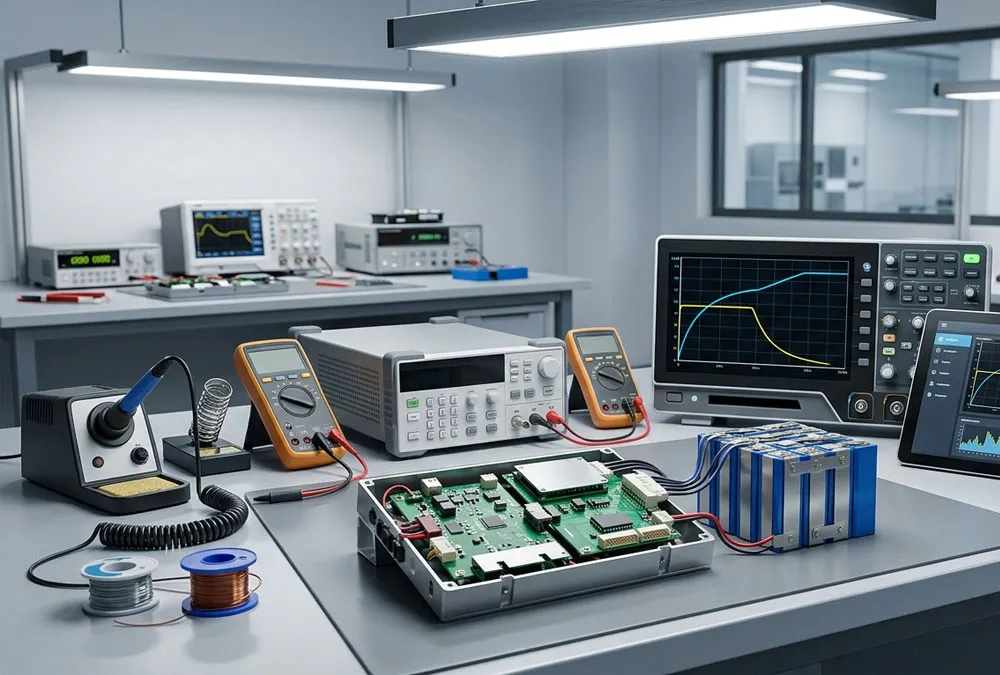
Lithium iron phosphate cells rely on a structured Constant Current / Constant Voltage (CC/CV) charging profile. This process manages thermal buildup while ensuring every cell in the series achieves full saturation.
Constant Current (CC) Charging Stage
During the CC phase, the charger acts as a regulated current source. It pushes a steady amperage into the battery pack while terminal voltage rises steadily. This stage restores roughly 80% to 85% of total capacity rapidly. It is ideal for opportunity charging during scheduled shift breaks in industrial environments.
Constant Voltage (CV) Charging Stage
When terminal voltage reaches its target threshold (such as 58.4V on a 48V pack), the charger switches smoothly to CV mode. The voltage remains locked at 58.4V while charging current tapers down toward zero. This saturation phase fills the remaining 15% of capacity without placing unnecessary thermal stress on the cathode structure.
Buyer Pain Point & Immediate Solution: In many factory setups, chargers switch to CV mode too early because of high cable resistance, doubling total charge times. Solution: Use heavy-gauge copper cabling with low resistance, and select chargers equipped with remote voltage sense leads that measure true voltage at the battery terminals rather than inside the charger housing.
Charge Termination and BMS Protection
Unlike lead-acid chargers that supply continuous float voltage, a dedicated lithium charger cuts power once current drops below a preset threshold (typically 0.02C to 0.05C). Simultaneously, the internal BMS balances cell voltages and provides critical protection layers:
- Over Voltage Protection: Cuts power instantly if charger voltage exceeds safe limits.
- Over Current Protection: Prevents excessive current from overheating internal busbars.
- Temperature Protection: Stops charging below 0°C or above 55°C to prevent lithium plating.
- Cell Balancing: Bleeds off small excess charges from high-voltage cells so all series pairs match.
LiFePO4 Battery Voltage Chart Compared With Lead Acid Battery Charging Voltage
Using a legacy lead-acid charger on a modern lithium pack is a common cause of battery degradation. According to technical findings in the 2025 Fleet Electrification Benchmark Report, over 22% of early lithium field failures stem directly from improper lead-acid charging curves.
Lead Acid Battery Charging Voltage Characteristics
Lead-acid chargers rely on three stages: Bulk, Absorption, and Float. These chargers apply continuous trickle voltage to prevent cell sulfation. However, applying this float charge to lithium cells causes electrolyte breakdown, increases internal gas pressure, and shortens operational lifespan.
LiFePO4 vs Lead Acid Charging Voltage Comparison
| Technical Feature | Lead Acid System | LiFePO4 System | Commercial Buyer Benefit |
|---|---|---|---|
| Nominal Voltage (12V System) | 12.0V | 12.8V | Delivers higher working voltage under heavy load conditions. |
| Charging Algorithm | 3-Stage (Bulk/Abs/Float) | 2-Stage (CC/CV) | Cuts charging time by up to 50% for faster equipment turnaround. |
| Float Charging Required | Yes (Prevents Sulfation) | No (Degrades Cells) | Saves energy costs by eliminating continuous grid draw. |
| Voltage Control Accuracy | Lower (±0.5V Acceptance) | Higher (±0.1V Precision) | Protects delicate electronics from unexpected voltage spikes. |
| BMS Integration Required | No | Yes (Mandatory) | Provides real-time protection against operator and electrical errors. |
Buyer Advantage: Switching to dedicated lithium chargers removes manual acid maintenance, cuts energy loss, and keeps fleets running efficiently.
Why Lead Acid Chargers Are Not Recommended for LiFePO4 Batteries
Lead-acid chargers often feature an automatic equalization mode that spikes output voltage to 15.5V or higher to break up lead sulfate crystals. If applied to a 12V LiFePO4 pack, this voltage spike triggers immediate high-voltage BMS disconnects. Over time, uncalibrated float stages breakdown cell separators and cause permanent capacity loss.
Buyer Pain Point & Immediate Solution: Commercial operators often try reusing lead-acid charging bays to save upfront costs, only to face constant BMS shutoffs. Solution: If retrofitting existing charging bays, install dedicated lithium AC-DC power converters or select multi-profile chargers with physical DIP switches that disable equalization and float modes permanently.
How to Choose the Correct LiFePO4 Battery Charger Voltage
Follow this straightforward selection guide to ensure full compatibility between your battery system and power conversion equipment.
Step 1: Identify Your LiFePO4 Battery Voltage System
Check the technical label on your battery or count the number of cells in series. A standard 12V pack contains 4 series cells (4S), while a standard 48V pack uses 16 series cells (16S). Multiply your series cell count by 3.65V to calculate your exact target charging voltage.
Step 2: Match Charger Voltage With Battery Voltage
Use these exact target parameters when ordering hardware:
| Nominal Pack Setup | Series Configuration | Exact Charger Output Voltage |
|---|---|---|
| 12V LiFePO4 | 4S | 14.6V Output |
| 24V LiFePO4 | 8S | 29.2V Output |
| 48V LiFePO4 | 16S | 58.4V Output |
| 72V LiFePO4 | 24S | 87.6V Output |
Step 3: Select the Correct Charging Current
Amperage selection determines total charging time. Most battery manufacturers recommend an optimal charge rate between 0.2C and 0.5C. For a 100Ah battery, a 20A charger (0.2C) achieves a full charge in roughly 5 hours, while a 40A charger (0.4C) completes the cycle in about 2.5 hours.
Buyer Pain Point & Immediate Solution: Equipment managers often buy ultra-high current chargers to speed up operations, inadvertently overheating packs and causing early capacity loss. Solution: Cap continuous charge rates at 0.5C for daily operations, and use smart chargers with built-in thermal sensors to taper current automatically if cell temperatures exceed 45°C.
LiFePO4 Battery Charger Voltage and Current Chart for Different Applications
Different industries require specific electrical parameters and physical build standards to withstand operating environments.
48V LiFePO4 Battery Charger Voltage Chart for Golf Cart
Commercial golf carts and utility vehicles require high continuous torque on steep inclines. Sizing a 48V LiFePO4 battery charger voltage chart configuration requires targeting a precise 58.4V output. Choose IP67 waterproof, shock-resistant chargers mounted directly on-board for convenient plug-and-play charging anywhere in the facility.
LiFePO4 Charger Voltage Requirements for AGV and Industrial Vehicles
Automated guided vehicles (AGVs), electric forklifts, and industrial sweepers operate in high-demand, multi-shift environments. These systems require high-amperage chargers (50A to 120A+) capable of rapid opportunity charging during break times. Automated charging pads with CANbus integration are standard for these setups.
LiFePO4 Charger Voltage Chart for RV and Marine Battery Systems
Marine vessels and off-grid RVs need quiet, compact power hardware. A standard 12V LiFePO4 battery charger voltage chart calls for a 14.6V target, while larger setups use a 24V LiFePO4 battery charging voltage chart target of 29.2V. Look for fanless, epoxy-potted housings to resist salt air and moisture corrosion.
LiFePO4 Charger Requirements for Solar Energy Storage
Stationary solar power systems use MPPT controllers to convert raw solar input into regulated battery charging profiles. A 48V LiFePO4 battery charger voltage chart target of 58.4V remains the standard for commercial energy storage, ensuring optimal daily solar harvest and long-term battery performance.
LiFePO4 Battery Full Charge Voltage Chart and State of Charge (SOC)
Because lithium batteries feature a flat discharge curve, voltage readings alone can be tricky. Understanding open-circuit resting voltage helps you track remaining capacity accurately.
LiFePO4 Battery Voltage at Different Charge Levels
This reference table shows open-circuit voltages after the battery has rested for at least one hour with no load connected:
| State of Charge (SOC) | 12V Pack (4S) | 24V Pack (8S) | 48V Pack (16S) | User Operational Insight |
|---|---|---|---|---|
| 100% (Full Charge) | 14.6V (Charging) / 13.6V (Resting) | 29.2V (Charging) / 27.2V (Resting) | 58.4V (Charging) / 54.4V (Resting) | Fully charged and ready for maximum operating range. |
| 90% | 13.3V | 26.6V | 53.2V | High capacity reserve; normal operating state. |
| 50% | 13.2V | 26.4V | 52.8V | Flat voltage plateau; steady power delivery under load. |
| 20% | 12.9V | 25.8V | 51.6V | Low capacity threshold; schedule a recharge soon. |
| 0% (Depleted) | 10.0V (Cut-off) | 20.0V (Cut-off) | 40.0V (Cut-off) | BMS disconnects power to prevent permanent cell damage. |
Buyer Advantage: Understanding the gap between active charging voltage and resting voltage prevents false alarms regarding battery health.
Why Voltage Alone Cannot Fully Measure Battery Capacity
Between 30% and 80% state of charge, a lithium cell’s resting voltage varies by only a few tenths of a volt. To track capacity accurately, commercial setups combine voltage readings with coulomb counting built directly into a smart BMS.
Buyer Pain Point & Immediate Solution: Users often complain that their state-of-charge meters drop suddenly from 40% to 0%. Solution: Install a battery monitor with a shunt sensor or choose a BMS that supports CANbus/RS485 communication. This delivers accurate coulomb-counting SOC tracking directly to your vehicle dashboard.
Common Mistakes When Using LiFePO4 Battery Charger Voltage Settings
Avoiding standard setup mistakes keeps operational costs low and extends equipment service life:
Using a Charger With Incorrect Voltage
Connecting a nominal 48V charger to a 48V lithium battery leaves the pack sitting around 30% to 40% capacity. Vehicles will feel underpowered, and available working time will drop significantly.
Using Excessive Charging Voltage
Attempting to speed up charging by setting voltage above 3.65V per cell triggers high-voltage BMS isolation. This stops charging immediately and subjects the cells to unnecessary thermal stress.
Ignoring Temperature Charging Limits
Charging lithium cells below 0°C causes irreversible lithium plating on the graphite anode. This reduces capacity permanently and creates internal short-circuit risks. Always confirm your charger or BMS includes low-temperature charging cutoffs.
How to Extend LiFePO4 Battery Life Through Correct Charging Voltage
With proper care, commercial lithium battery packs routinely last over ten years. Follow these practical operational guidelines:
- Avoid Complete Depletion: Recharge battery packs before they hit the lower 10% BMS cut-off mark.
- Use Precise CC/CV Chargers: Verify your charger maintains tight voltage regulation (±0.1V) during the CV phase.
- Maintain Recommended Temperatures: Charge equipment in well-ventilated bays kept between 10°C and 35°C.
Smart LiFePO4 Battery Charger Features for Modern Battery Systems
Modern fleet operations rely on intelligent power converters to keep equipment running efficiently and minimize maintenance costs.
Intelligent Charging Control
Smart chargers monitor internal parameters continuously. They adjust output current automatically if temperatures rise, protecting sensitive components without requiring manual checks.
BMS Communication Capability
Industrial applications rely on CANbus or RS485 communication. These data lines allow the charger and BMS to share real-time cell information, dynamically adjusting charge profiles for optimal cell balancing.
Protection Functions
High-quality industrial chargers include multiple hardware protections: short-circuit prevention, over-voltage limits, reverse polarity protection, and auto-shutoff safety features.
How to Select a LiFePO4 Battery Charger for OEM Applications
Original equipment manufacturers need reliable suppliers who deliver custom hardware built to exact technical specifications.
Customized Voltage and Current Design
Whether you require a specialized 36V 30A unit or a high-power 72V 60A industrial charger, custom factory output settings ensure seamless operation with your proprietary battery packs.
Charger Integration With Battery Packs
Sourcing fully integrated battery and charger packages simplifies safety certification, streamlines assembly, and reduces warranty issues for equipment manufacturers.
OEM/ODM LiFePO4 Charger Manufacturing Capability
Partner with manufacturers who offer custom cabling, specialized connectors, IP67 waterproof enclosures, and pre-programmed charge curves tailored to your application needs.
Choose AnengJi LiFePO4 Battery Charger Solutions
Pairing commercial equipment with certified, precision-engineered power hardware is vital for long-term operational success. ENERGYSPLENDOR manufactures high-performance lithium chargers designed to meet demanding commercial standards.
Reliable Charging Solutions for Multiple Applications
Our complete range of lithium chargers powers golf carts, automated guided vehicles, utility trucks, marine systems, and solar energy storage installations worldwide.
Complete Battery + Charger System Support
We provide comprehensive engineering support, custom harness manufacturing, and communication protocol integration to ensure seamless system integration.
Frequently Asked Questions
What voltage charger do I need for a 48V LiFePO4 battery?
You need a charger with a regulated DC output voltage of 58.4V. This delivers the necessary 3.65V per cell across a standard 16S battery configuration.
Can I use a 48V charger for a 48V lithium battery?
No, a nominal 48V charger lacks the potential required to fully charge the pack. You must use a charger rated for 58.4V output to achieve a 100% state of charge.
What is the full charge voltage of a 12V LiFePO4 battery?
A 12V LiFePO4 battery (4S) reaches a full charge voltage of 14.6V during charging, settling to a resting voltage of roughly 13.6V once fully charged.
What voltage should a LiFePO4 battery be charged to?
Each cell should be charged to a target maximum of 3.65V. Multiply 3.65V by your total series cell count (4S=14.6V, 8S=29.2V, 16S=58.4V, 24S=87.6V) to calculate your required charging voltage.
How do I calculate LiFePO4 charging time?
Divide battery capacity (Ah) by charger current (A) and multiply by 1.15. For example, a 100Ah battery using a 20A charger takes roughly (100 / 20) × 1.15 = 5.75 hours to fully recharge.
Related Posts
 https://anengjibattery.com/wp-content/uploads/2026/09/AnengJIBattery-Best-LiFePO4-Battery-How-to-Choose-the-Right-One.webp
675
1000
Battery Expert Team
https://anengjibattery.com/wp-content/uploads/2025/06/logo2-300x138.png
Battery Expert Team2026-09-17 08:52:142026-09-17 08:52:31How to Choose the Best LiFePO4 Battery
https://anengjibattery.com/wp-content/uploads/2026/09/AnengJIBattery-Best-LiFePO4-Battery-How-to-Choose-the-Right-One.webp
675
1000
Battery Expert Team
https://anengjibattery.com/wp-content/uploads/2025/06/logo2-300x138.png
Battery Expert Team2026-09-17 08:52:142026-09-17 08:52:31How to Choose the Best LiFePO4 Battery https://anengjibattery.com/wp-content/uploads/2026/09/anengjiBattery-lifepo4-battery-cell-packaging-wholesale.webp
675
1000
Battery Expert Team
https://anengjibattery.com/wp-content/uploads/2025/06/logo2-300x138.png
Battery Expert Team2026-09-16 09:52:342026-09-16 09:52:57LiFePO4 Battery Wholesale Guide: Best Suppliers in Spain
https://anengjibattery.com/wp-content/uploads/2026/09/anengjiBattery-lifepo4-battery-cell-packaging-wholesale.webp
675
1000
Battery Expert Team
https://anengjibattery.com/wp-content/uploads/2025/06/logo2-300x138.png
Battery Expert Team2026-09-16 09:52:342026-09-16 09:52:57LiFePO4 Battery Wholesale Guide: Best Suppliers in Spain https://anengjibattery.com/wp-content/uploads/2026/09/anengjibattery-Top-Lithium-Ion-Battery-Producers-for-Spain-Market-Growth.webp
675
1000
Battery Expert Team
https://anengjibattery.com/wp-content/uploads/2025/06/logo2-300x138.png
Battery Expert Team2026-09-16 01:13:392026-09-16 01:14:05Top Lithium Ion Battery Producers for Spain’s Market Growth
https://anengjibattery.com/wp-content/uploads/2026/09/anengjibattery-Top-Lithium-Ion-Battery-Producers-for-Spain-Market-Growth.webp
675
1000
Battery Expert Team
https://anengjibattery.com/wp-content/uploads/2025/06/logo2-300x138.png
Battery Expert Team2026-09-16 01:13:392026-09-16 01:14:05Top Lithium Ion Battery Producers for Spain’s Market Growth https://anengjibattery.com/wp-content/uploads/2026/09/Bulk-Lithium-Ion-Battery-Cells-Procurement-Guide-B2B-Sourcing.webp
675
1000
Battery Expert Team
https://anengjibattery.com/wp-content/uploads/2025/06/logo2-300x138.png
Battery Expert Team2026-09-14 09:47:322026-09-14 09:47:48Bulk Lithium-Ion Battery Cells Procurement Guide | B2B Sourcing
https://anengjibattery.com/wp-content/uploads/2026/09/Bulk-Lithium-Ion-Battery-Cells-Procurement-Guide-B2B-Sourcing.webp
675
1000
Battery Expert Team
https://anengjibattery.com/wp-content/uploads/2025/06/logo2-300x138.png
Battery Expert Team2026-09-14 09:47:322026-09-14 09:47:48Bulk Lithium-Ion Battery Cells Procurement Guide | B2B Sourcing


Leave a Reply
Want to join the discussion?Feel free to contribute!