
How to Charge a Forklift Battery: Time and Safety Guide
November 2, 2026 / Battery Expert Team / Battery Basics
Introduction
A forklift finishes the late shift, the operator plugs it in, and the charger shows “complete” before morning. Yet the truck loses power during the next loading window. Operations blames the battery, maintenance suspects the charger, and procurement starts asking for a larger pack. This is the real reason learning how to charge a forklift battery correctly requires more than a safe connection sequence: the site must know how much energy was removed, how quickly the approved charger can replace it, and what evidence separates a battery fault from an incomplete charge.
For example, a 51.2V, 412Ah battery contains about 21.09kWh of nominal energy. If 70% has been used, approximately 14.77kWh must be restored. A constant 100A DC charge gives a mathematical baseline of 2.88 hours; 200A gives 1.44 hours. Neither number is a guaranteed completion time because the BMS, charger profile, temperature, cell balancing, cable limits and final current reduction can extend the session.
Practical answer
Identify the battery chemistry and approved charger; calculate the energy to restore from capacity and depth of discharge; confirm that the charger can deliver that energy within the real parking window; then follow the chemistry-specific connection, monitoring and completion procedure. If the calculated time fits but the actual charge does not, collect charger current, returned Ah or kWh, battery temperature and fault data before replacing equipment.
How Long Does It Take to Charge a Forklift Battery?
Charging time starts with the energy that must be returned—not the battery’s full nameplate capacity unless it is actually empty. Depth of discharge (DoD) is the percentage of nominal capacity removed. A battery that starts charging at 50% state of charge has approximately 50% DoD.
Energy method
Nominal energy (kWh) = voltage × capacity (Ah) ÷ 1,000
Energy to restore (kWh) = nominal energy × depth of discharge
Baseline time (hours) = energy to restore ÷ measured average DC charging power
When a charger is discussed in amperes, a useful screening equation is Ah removed ÷ average charge current. This works only as a baseline. It assumes the stated current is actually maintained and does not include ramp-up, taper, balancing, temperature derating, interruptions or a flooded lead-acid finish stage.
Charging-time table for AnengJi reference forklift configurations
The following table converts AnengJi’s current 51.2V and 76.8V reference configurations into energy and constant-current screening times. Each cell shows energy to restore / time at 100A / time at 200A. The published 200A continuous charge value at 25°C is a pack-interface rating, not a recommendation to order or operate a 200A charger. The offered battery, BMS, connector, charger and facility must approve the final current.
| Reference battery | Nominal energy | 20% DoD | 50% DoD | 70% DoD | 80% DoD |
|---|---|---|---|---|---|
| 51.2V 277Ah | 14.18kWh | 2.84kWh 0.55h / 0.28h |
7.09kWh 1.39h / 0.69h |
9.93kWh 1.94h / 0.97h |
11.35kWh 2.22h / 1.11h |
| 51.2V 412Ah | 21.09kWh | 4.22kWh 0.82h / 0.41h |
10.55kWh 2.06h / 1.03h |
14.77kWh 2.88h / 1.44h |
16.88kWh 3.30h / 1.65h |
| 76.8V 280Ah | 21.50kWh | 4.30kWh 0.56h / 0.28h |
10.75kWh 1.40h / 0.70h |
15.05kWh 1.96h / 0.98h |
17.20kWh 2.24h / 1.12h |
| 76.8V 412Ah | 31.64kWh | 6.33kWh 0.82h / 0.41h |
15.82kWh 2.06h / 1.03h |
22.15kWh 2.88h / 1.44h |
25.31kWh 3.30h / 1.65h |
What voltage changes: at the same Ah and charging current, the mathematical time is the same, but the power is not. A 51.2V charger delivering 100A supplies approximately 5.12kW DC; a 76.8V charger at 100A supplies 7.68kW. At 200A those values become 10.24kW and 15.36kW. The higher-voltage system therefore places a larger power demand on the charger and facility even when its Ah-based charging time looks identical.
What can a 30-minute break actually restore?
At a constant 100A, 30 minutes mathematically returns 50Ah. That is about 18.1 percentage points of a 277Ah battery, 17.9 points of a 280Ah battery, or 12.1 points of a 412Ah battery. It represents about 2.56kWh at 51.2V or 3.84kWh at 76.8V.
At 200A the idealised figures double, but a charger label does not prove that the battery will accept full current throughout the break. Connection time, BMS limits, temperature and high-SOC taper reduce the practical recovery. A fleet plan should use charger logs from the busiest shift rather than assuming every break delivers the maximum value.
Lead-acid example: why six calculated hours can still require an eight-hour charge window
Consider an illustrative 36V, 750Ah flooded lead-acid battery connected to a charger whose effective average current is 100A. The current calculation shows the bulk energy requirement, but the battery still needs its approved finish stage and then cooling before returning to heavy service.
| Starting condition | Ah to restore | Nominal energy to restore | 100A baseline | What is still missing |
|---|---|---|---|---|
| 20% DoD | 150Ah | 5.4kWh | 1.5h | Approved finish/maintenance strategy |
| 50% DoD | 375Ah | 13.5kWh | 3.75h | Taper, losses, gassing/finish and cooling |
| 80% DoD | 600Ah | 21.6kWh | 6.0h | Complete approved cycle plus cooling time |
This is why a charger that is restarted every time it reaches its time limit may hide the real problem. The battery could be too deeply discharged for the available window, the charger could be undersized, or a weak cell could be causing an abnormal finish. Record returned Ah or kWh, current over time, ending voltage, temperature and cell condition before deciding that the battery needs replacement.
What published charging-time figures can—and cannot—tell you
| Published source | Published figure | Scope | Correct buyer use |
|---|---|---|---|
| Toyota next-generation power-source paper | Lead-acid: 8h charge plus 8h cooling; lithium: 1–2h continuous session | Manufacturer planning comparison published in 2020 | Use as a broad planning reference, not a promise for an unnamed battery and charger |
| Bobcat forklift battery guidance | 8h use, 8h flooded-battery charging and 8h cooling | Traditional flooded battery operating pattern | Use to test whether a one-shift rotation has enough off-shift time |
| Toyota lithium battery and charger page | 120–540A charger options with BMS-controlled charging for Toyota systems | Named manufacturer system, not a universal charger range | Evidence that charger current and BMS integration must be selected at system level |
A web page that says “fast charging takes two hours” without stating voltage, Ah or kWh, starting SOC, current, temperature and completion definition is not a sizing calculation. Treat it as a topic summary. For a purchase decision, ask for the proposed charger curve or charging test for the exact battery.
Why the Charger Says “Full” but the Forklift Still Stops Early
This symptom is especially frustrating because every team sees different evidence. The charger sees its termination condition; the truck displays an estimated SOC; the operator sees lost runtime. Replacing the battery without reconciling those three views can preserve the real fault.
| What the operator sees | Operational consequence | Evidence that separates the causes | Next decision |
|---|---|---|---|
| Charger completes, runtime remains short | The truck misses the last loading window and the battery is blamed | Returned Ah/kWh, capacity or SOH test, loaded voltage, cell data, workload and temperature | Separate incomplete charging, ageing, imbalance, cold operation and increased duty before adding Ah |
| Charger starts, then reaches maximum time | Repeated restarts delay the shift and hide the original event | Charge-current curve, start/end voltage, cell spread, temperature and charger configuration | Test charger sizing and battery condition instead of resetting until “full” |
| Lithium replacement fits but will not charge | A purchased battery and usable truck remain idle | Voltage window, charge profile, connector pinout, charge-enable signal, CAN messages and contactor events | Resolve the interface; do not bypass the BMS or force the contactor |
| Several chargers trip the facility breaker | The charging queue grows even though each charger works alone | Concurrent input kW/kVA, phase loading, start sequence, breaker data and charger logs | Have a competent electrical designer assess load management and infrastructure |
Check These Seven Interfaces Before You Charge an Electric Forklift
A plug that mates does not prove charger compatibility. Record the following seven interfaces before approving a battery-and-charger combination:
- Battery chemistry and charge profile: flooded lead-acid, TPPL and LiFePO4 systems do not automatically share finish or equalisation behaviour.
- Operating-voltage window: compare maximum charge voltage and minimum operating voltage, not nominal voltage alone.
- Approved charge current: use cell, pack, BMS, connector, cable and thermal limits—not the largest available charger.
- Connector and polarity: verify type, keying, current rating, pinout, cable size and strain relief.
- Communication and interlocks: confirm CAN or other protocol, charge enable, drive-away protection and supported firmware where used.
- Temperature limits: distinguish the permitted charging range from the operating/discharge range and verify any heating or derating logic.
- Facility input: confirm AC voltage, phase, frequency, protective devices, earthing and simultaneous charging demand.
For perspective, six 76.8V chargers delivering 200A simultaneously represent about 92.16kW of nominal DC output; six 51.2V chargers at 200A represent about 61.44kW. Actual AC demand depends on the charger design, power factor, efficiency and output profile, but this calculation explains why a site that tested one charger successfully can still fail at the shift-change peak.
How to Charge a Lead-Acid Forklift Battery Correctly
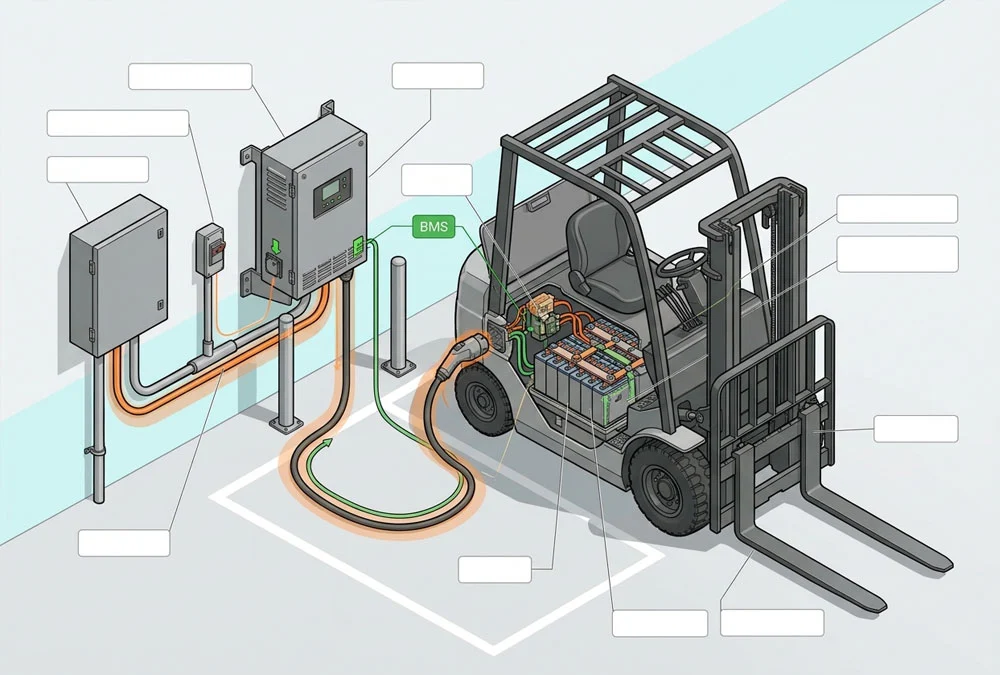
Flooded lead-acid traction batteries contain sulfuric-acid electrolyte and can release hydrogen during charging. The UK Health and Safety Executive’s Rider-operated lift trucks guidance calls for battery care according to the manufacturer, ignition control and suitable charging conditions. It is a UK reference, not an EU-wide installation code.
- Move the truck to the designated bay, lower the forks, neutralise the controls, switch off and apply the parking brake.
- Use the PPE and spill/emergency provisions required by the site assessment. Keep smoking, flames, sparks and metallic objects away.
- Inspect the case, vent caps, top surface, cable and connector. Stop for leakage, damaged insulation, burnt contacts or abnormal heat.
- Confirm electrolyte condition according to the battery manual. Do not routinely fill to the final level before charging.
- Connect the assigned charger in the documented sequence. Some trucks require the battery to be disconnected from the vehicle; onboard and dedicated-port systems may differ.
- Confirm that current is flowing and monitor temperature, gassing, leakage and fault codes.
- Allow the approved conventional, fast or opportunity cycle to complete. Do not disconnect a live DC circuit under load.
- After the full charge and required cooling period, inspect and water to the manufacturer’s final level if required.
The Canadian Centre for Occupational Health and Safety states in its industrial lead-acid forklift guidance that batteries are generally watered after full charging and cooling because filling before or during charge can cause boil-over. If the separator or plates are exposed, stop and use the exact battery manual’s recovery instruction rather than guessing a pre-charge fill level.
How to Charge a Lithium-Ion Forklift Battery Correctly
A lithium forklift battery avoids watering and the conventional lead-acid equalisation routine, but it adds a BMS-controlled electrical interface. The correct workflow is therefore shorter only after the battery, charger and truck have been commissioned as one system.
- Confirm the approved maximum voltage, charge current, profile, connector, BMS protocol and charging-temperature limits.
- Park safely and inspect the pack, charge port, cable and connector. Do not charge a swollen, damaged, leaking or abnormally hot pack.
- Connect in the system’s documented sequence. Do not assume that the main traction connector and a dedicated charge port operate identically.
- Verify an actual charge event using charger current, SOC movement, temperature and event status—not the screen backlight alone.
- Use opportunity charging only when daily charger logs show that the planned breaks restore enough energy for the busiest credible shift.
- Follow the approved completion/disconnection sequence and inspect the connector before returning the truck to service.
AnengJi’s current reference configurations state a 0°C to 55°C charging range, but that is not proof that every offered pack accepts maximum current throughout that range or includes low-temperature heating. Confirm the exact model’s BMS thresholds, sensor locations, charger derating and cold-storage controls.
Buyers can review AnengJi’s lithium battery options for forklifts as a starting point. A standard-format pack or custom enclosure remains a candidate until voltage, current, dimensions, permitted battery mass, restraint, connector, communication and vehicle approval are resolved.
Which Charging Method Fits the Shift?
| Method | Best operational fit | Data needed | Common failure |
|---|---|---|---|
| Conventional | Predictable off-shift window or spare-battery rotation | Energy removed, full cycle and cooling window | The next shift starts before recovery is complete |
| Opportunity | Repeatable breaks with an approved battery/charger strategy | Actual connection minutes and returned kWh per break | The plan assumes breaks that operators miss or chargers that are occupied |
| Fast charging | High utilisation with validated thermal and facility capacity | Current curve, temperature, demand and maintenance requirements | Buying by headline speed creates heat or electrical-demand problems |
Toyota’s current charging-method guidance notes that heavy three-shift demand can exceed what a one-battery-per-truck fast or opportunity strategy can sustain. The practical test is a 24-hour energy balance: energy returned during every reliable charging window must at least match energy used, with an operating reserve and without exceeding battery or facility limits.
Charging-Area Requirements in Europe and the United States
European projects must follow the applicable national occupational-safety, fire, electrical and building rules. The HSE source above is useful UK guidance, not a single European installation code. For the United States, OSHA 29 CFR 1910.178 addresses designated charging areas, truck positioning and braking, ventilation for gassing batteries, apparatus protection and ignition control. OSHA’s charging-only-area directive clarifies the scope of one subsection when no maintenance, battery removal or electrolyte is present.
For Central Asian and African projects, add grid voltage and frequency, phase availability, generator compatibility, surge protection, ambient temperature, dust, local service and spare-module availability to the review. A charger that matches the battery but not the destination supply is still an unusable purchase.
What to Send Before Buying a Forklift Battery or Charger
A request for “a 48V forklift charger” does not contain enough information for a defensible quotation. Send:
- Forklift make, model, serial number, data plate and manual.
- Battery chemistry, operating-voltage window, Ah/kWh, dimensions, mass and label photos.
- Connector part number, pinout, polarity, cable size and port arrangement.
- Existing charger model, DC output, AC input, charge profile, communication and fault history.
- Start/end SOC, energy returned, loads, ramps, temperature, shifts and reliable charging windows.
- Number of chargers that may operate simultaneously and the destination country.
Need the full capacity-sizing method?
Use the duty-cycle method for electric forklift battery Ah to calculate the battery side first, then return here to verify that the charger can recover that energy inside the actual charging window.
How AnengJi Supports a Battery-and-Charger Compatibility Review
AnengJi is a China-based lithium-ion battery manufacturer serving U.S. and international buyers. Its forklift direction includes 51.2V and 76.8V reference configurations, application-specific enclosures and broader LiFePO4 platforms. These examples help create a shortlist, but they are not universal drop-in replacements.
A project review can compare the truck’s voltage and current requirements, permitted battery mass and compartment, duty-cycle energy, charging windows, connector, BMS/charger interface, destination supply and documentation requirements. That is more useful than quoting a battery and discovering after delivery that the charger cannot start, the overnight window is too short or the facility cannot run all chargers together.
Get a charging-time and compatibility review
Send the truck, battery and charger labels, connector photos, start/end SOC, available charging windows, facility input and destination. The review can return a charging-time worksheet and identify missing electrical, mechanical and communication inputs before quotation.
Frequently Asked Questions About Charging Forklift Batteries
How do I calculate forklift battery charging time?
Multiply voltage by Ah and divide by 1,000 to obtain nominal kWh. Multiply by the depth of discharge to find the energy to restore, then divide by measured average DC charging power. Add the time required for taper, balancing, temperature derating, interruptions and any lead-acid finish or cooling stage.
Does a higher-voltage forklift battery charge faster?
Not by voltage alone. At the same Ah and current, the baseline time is similar, while the higher-voltage charger delivers more kW and requires more facility power. Charging time depends on energy removed and approved average charging power.
Can a 200A-rated battery always use a 200A charger?
No. A pack current rating is not a complete charger approval. The cells, BMS settings, connector, cable, communication, temperature, charging curve and facility input must support the proposed charger.
Why does the actual charge take longer than the calculation?
The nameplate charger current may not be the session average. Current can be limited by temperature, BMS settings, cell imbalance, high SOC, cable or input constraints. Lead-acid batteries also require a finish stage and may require cooling before heavy use.
Can a lead-acid charger charge a lithium forklift battery?
Only when the exact battery, charger and truck integration have documented approval for voltage, current, profile, termination, connector and communication. A matching nominal voltage or plug is not enough.
When should water be added to a flooded forklift battery?
Flooded lead-acid batteries are generally brought to the final electrolyte level after full charging and cooling. If plates or separators are exposed before charging, stop and follow the exact product manual’s recovery procedure. Lithium forklift batteries do not require watering.
The Correct Charging Procedure Starts With an Energy Balance
Safe connection steps prevent immediate hazards, but an energy balance prevents the recurring operational failure: a battery that cannot recover before the next shift. Calculate how much energy was used, verify how much the approved charger actually returns, and compare that result with the available parking window.
When those numbers disagree, preserve the charger and BMS evidence. A charger timeout, early “full” signal or weak next shift is a diagnostic starting point—not automatic proof that the battery, charger or operator is at fault.
Related Articles
Related Posts
 https://anengjibattery.com/wp-content/uploads/2026/11/AnengjiBattery-Correct-Forklift-Battery-Charging-in-Practice.webp
675
1000
Battery Expert Team
https://anengjibattery.com/wp-content/uploads/2025/06/logo2-300x138.png
Battery Expert Team2026-11-02 07:02:512026-11-02 07:03:12How to Charge a Forklift Battery: Time and Safety Guide
 https://anengjibattery.com/wp-content/uploads/2026/10/AnengJIBattery-U.S.-Forklift-Battery-Supplier-Evaluation.webp
675
1000
Battery Expert Team
https://anengjibattery.com/wp-content/uploads/2025/06/logo2-300x138.png
Battery Expert Team2026-10-30 03:16:252026-10-30 03:16:42Top 10 Forklift Battery Manufacturers for U.S. Buyers in 2026
 https://anengjibattery.com/wp-content/uploads/2026/10/AnengJIBattery-Lithium-Ion-Power-in-Industrial-Operation.webp
675
1000
Battery Expert Team
https://anengjibattery.com/wp-content/uploads/2025/06/logo2-300x138.png
Battery Expert Team2026-10-29 03:43:242026-10-29 03:46:52How Does a Lithium-Ion Battery Work and Stay Protected?
 https://anengjibattery.com/wp-content/uploads/2026/10/AnengjiBattery-Is-a-Lithium-Ion-Battery-for-3PL-the-Right-Fleet-Choice.webp
675
1000
Battery Expert Team
https://anengjibattery.com/wp-content/uploads/2025/06/logo2-300x138.png
Battery Expert Team2026-10-28 07:16:182026-10-28 07:17:07Is a Lithium-Ion Battery for 3PL the Right Fleet Choice?



Leave a Reply
Want to join the discussion?Feel free to contribute!