
Which Are the Top Forklift Battery Manufacturers in Europe
September 29, 2026 / Battery Expert Team / Battery Basics
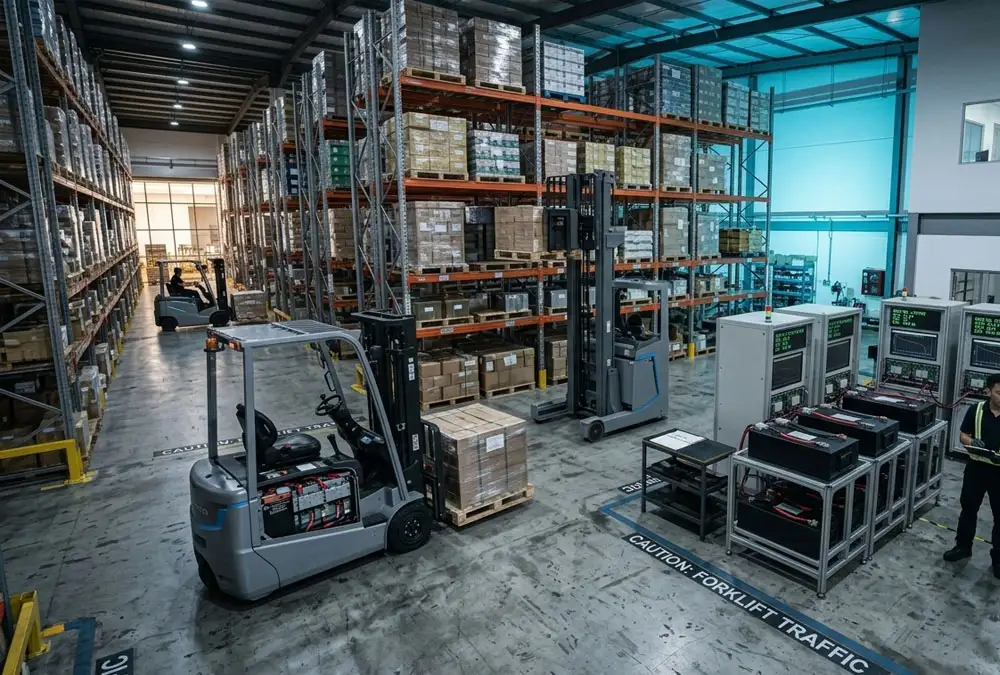
Introduction
The most expensive forklift battery is not necessarily the one with the highest purchase price. It is the battery that arrives late, does not fit the compartment, triggers a BMS shutdown in a freezer, cannot communicate with the truck, or leaves operators waiting beside a charger during the busiest shift of the week.
That is why selecting forklift battery manufacturers is more difficult than comparing voltage, ampere-hours, and price. Procurement teams must determine whether a supplier manufactures cells, assembles battery packs, integrates the BMS and charger, provides local service, and accepts responsibility when the complete system does not perform as expected.
European buyers face an additional challenge: a battery may look competitive on a quotation but become expensive after international shipping, charger replacement, electrical upgrades, compliance documentation, maintenance, and downtime are included. US and global buyers face similar problems, especially when comparing European DIN and British Standard configurations with North American BCI battery dimensions.
If any of these situations sound familiar, the manufacturer—not just the battery—needs to be reconsidered:
- Operators return from breaks and discover the battery did not recover enough energy.
- A “drop-in” lithium replacement requires unexpected ballast, cables, software, or a new charger.
- The battery works well in summer but loses usable runtime or refuses to charge in cold storage.
- A failed battery must be shipped to another country before the warranty can be evaluated.
- Battery, charger, and forklift suppliers blame one another when a communication fault occurs.
This guide compares leading European forklift battery manufacturers, selected international companies, and AnengJi as a flexible global lithium battery option. The companies are not presented as an unverifiable first-to-last market-share ranking. Instead, they are compared by product direction, supported applications, integration capability, market coverage, and the questions buyers should ask before issuing a purchase order.
The 30-Second Shortlist
- Need both lead-acid and lithium options? Start with HOPPECKE, Sunlight Group, MIDAC, or Exide Technologies.
- Need conventional DIN, BS, PzS, or PzV traction batteries? Compare TAB, BAE, HOPPECKE, MIDAC, and Sunlight.
- Operate Linde or STILL trucks and prefer OEM integration? Evaluate KION Battery Systems.
- Need a custom lithium system for an OEM or specialized industrial vehicle? Consider Flash Battery.
- Need a flexible custom LiFePO4 supplier for forklift, AGV, or industrial-vehicle projects? Include AnengJi in the technical qualification process.
What Counts as a Forklift Battery Manufacturer?
Search results often place cell producers, battery assemblers, forklift OEMs, distributors, and repair companies in the same manufacturer list. These businesses can all contribute to a project, but they do not provide the same level of engineering responsibility.
Cell Manufacturer
A cell manufacturer produces the electrochemical cells used inside the battery. It may manufacture flooded lead-acid traction cells, gel cells, lithium iron phosphate cells, or other lithium-ion chemistries. Cell manufacturing capability is important, but it does not automatically prove that the company can supply a complete forklift-ready system.
Battery Pack and System Manufacturer
A system manufacturer integrates the cells into a finished battery. In a lithium forklift battery, this normally includes modules, BMS, contactors, fuses, current sensors, temperature sensors, wiring, communication interfaces, the steel tray, counterweight, display, and charger integration.
This distinction matters when a fault occurs. If the cell, BMS, enclosure, charger, and communication software come from different companies, the buyer needs to know which supplier accepts responsibility for diagnosing the complete system.
Forklift OEM With Integrated Battery Production
An OEM-integrated battery can simplify communication, charging, diagnostics, and warranty responsibility. However, it may be less flexible for mixed-brand fleets or third-party retrofits. Buyers should check whether diagnostic tools, software updates, and replacement components remain available outside the original dealer network.
Distributor or Local Assembler
A distributor may source cells, assemble trays, install connectors, and provide local service. This is not necessarily a weakness. A qualified local provider can sometimes resolve a problem faster than a distant factory. The buyer should nevertheless identify the original manufacturer, the warranty entity, and the organization responsible for engineering approval.
Forklift Battery Manufacturer Comparison
| Manufacturer | Base | Main Product Direction | Supported Applications | Potential Buyer Fit | Official Website |
|---|---|---|---|---|---|
| HOPPECKE | Germany | Lead-acid, lithium-ion, chargers, monitoring, battery-changing systems | Forklifts, warehouse trucks, AGVs, cleaning machines, cold storage, heavy-duty vehicles | Fleets seeking a complete motive-power system | Visit HOPPECKE |
| Sunlight Group / TRIATHLON | Greece / Germany | Lead-acid and lithium industrial mobility batteries, chargers, monitoring | Forklifts, warehouse equipment, AGVs, logistics centers, off-road electric vehicles | Large fleets, OEMs, distributors, and multi-country procurement | Visit Sunlight Group |
| TAB | Slovenia | PzS, PzV, DIN, BS, BCI, and other lead-acid traction products | Forklifts, pallet trucks, cleaning machines, AGVs, industrial electric vehicles | Conventional traction-battery replacement and standardized fleets | Visit TAB |
| MIDAC | Italy | DIN/BS lead-acid traction batteries, fast-charge systems, tailored lithium solutions | Forklifts, pallet trucks, lifting platforms, cleaning equipment, cold-storage applications | Buyers requiring flexible lead-acid or lithium configurations | Visit MIDAC |
| KION Battery Systems | Germany | OEM-integrated lithium-ion battery systems | Counterbalanced forklifts and warehouse trucks within the KION ecosystem | Linde, STILL, and related KION-brand fleets | Visit KION Battery Systems |
| Exide Technologies | European manufacturing and service footprint | Flooded lead-acid, gel, lithium-ion, chargers, fleet energy solutions | Forklifts, pallet trucks, AGVs, retail, warehousing, distribution | Established fleets and staged lead-acid-to-lithium projects | Visit Exide Technologies |
| BAE Batterien | Germany | Industrial lead-acid batteries, including motive-power applications | Forklifts, industrial trucks, rail, stationary and renewable-energy applications | Buyers prioritizing established lead-acid technology | Visit BAE Batterien |
| Flash Battery | Italy | Custom industrial lithium batteries, BMS, remote monitoring | Industrial vehicles, material-handling equipment, construction and specialized machinery | OEMs and engineered custom-electrification projects | Visit Flash Battery |
| AnengJi | China | Custom LiFePO4 and NMC battery packs, smart BMS, industrial lithium systems | Electric forklifts, AGVs, tuggers, industrial vehicles, golf carts, light EVs, energy storage | European and US buyers seeking flexible OEM customization and factory-direct supply | Visit AnengJi Battery |
The table identifies potential product and application fit; it is not a substitute for model-specific validation. Product availability, certifications, warranty coverage, and service arrangements can differ by country and battery model.
Leading Manufacturers in Detail
1. HOPPECKE: Broad Motive-Power Technology Coverage
HOPPECKE offers lead-acid, lithium-ion, charging, battery-changing, monitoring, and energy-management products for industrial vehicles. Its broad portfolio is useful when a buyer wants to evaluate the complete energy system rather than purchase a battery and charger from unrelated suppliers.
- Main products: flooded and sealed lead-acid traction batteries, lithium-ion batteries, chargers, monitoring, and battery-changing equipment.
- Applications: forklifts, warehouse trucks, AGVs, cleaning machines, cold storage, agricultural equipment, and heavy-duty industrial vehicles.
- Potential fit: fleets requiring several battery technologies or multi-site support.
- Buyer concern to address: confirm that projected runtime and charging performance are based on the exact battery, charger, temperature, and duty cycle.
This may appeal to fleet managers who are tired of coordinating several suppliers whenever a charging or performance issue appears. However, even a broad product portfolio does not make every configuration suitable for every shift pattern.
Website:HOPPECKE Motive Power Systems
2. Sunlight Group / TRIATHLON: Large-Scale Industrial Mobility Supply
Sunlight Group manufactures lead-acid and lithium-ion batteries for industrial mobility and operates production, assembly, distribution, and service activities across several markets. The group is relevant to larger fleets, distributors, OEMs, and companies sourcing batteries for operations in more than one country.
- Main products: motive-power lead-acid batteries, lithium-ion industrial batteries, chargers, and battery-monitoring products.
- Applications: forklifts, warehouse equipment, logistics centers, AGVs, and off-road electric vehicles.
- Potential fit: large fleets and buyers requiring European and transatlantic supply capability.
- Buyer concern to address: establish which group company manufactures, supplies, services, and warrants the quoted product.
Buyers should note that Sunlight acquired 100% of Triathlon Holding in 2023. The two names may still appear separately in search results and product discussions, but they should not be counted as two independent corporate groups in a neutral ranking.
Website:Sunlight Industrial Mobility
3. TAB: Conventional Traction Battery Specialist
TAB provides traction batteries in DIN, British Standard, and BCI formats, including flooded tubular-plate and gel products. This makes the company relevant to replacement projects where the buyer must match an existing European or North American battery arrangement.
- Main products: PzS, PzV, PzB, DIN, BS, and BCI traction batteries.
- Applications: forklifts, pallet trucks, AGVs, cleaning machines, and industrial electric vehicles.
- Potential fit: lead-acid fleets using established battery-room and charger infrastructure.
- Buyer concern to address: confirm tray dimensions, minimum battery weight, connector, cable exit, lifting arrangement, and charger profile.
A battery may follow the correct cell standard and still fail to fit the truck as a complete assembly. Buyers who have previously received a battery with the wrong connector position or lifting points should require an approved dimensional drawing before production.
Website:TAB Traction Batteries
4. MIDAC: Flexible Lead-Acid and Lithium Configurations
MIDAC offers motive-power lead-acid products in DIN and British Standard configurations, together with tailored lithium-ion solutions. Its published product information includes applications such as material handling, lifting platforms, cleaning equipment, opportunity charging, and cold-storage operation.
- Main products: lead-acid traction batteries, low-maintenance products, charging systems, and customized lithium batteries.
- Applications: forklifts, pallet trucks, lifting platforms, cleaning machines, and low-temperature environments.
- Potential fit: fleets comparing traditional traction technology with customized lithium conversion.
- Buyer concern to address: request documented temperature limits, heating strategy, usable capacity, and charging conditions for the exact lithium model.
Cold-storage buyers often discover that a battery described as suitable for low temperatures still cannot be charged at the required temperature. The supplier should explain when heating activates, how much energy it consumes, and whether the battery can recover enough energy during available breaks.
Website:MIDAC Batteries
5. KION Battery Systems: OEM-Integrated Lithium Systems
KION Battery Systems is a joint venture between KION Group and BMZ Battery Solutions. It manufactures lithium-ion systems for industrial trucks in Germany, primarily supporting vehicles associated with KION brands.
- Main products: integrated lithium-ion batteries for industrial and warehouse trucks.
- Applications: counterbalanced forklifts, warehouse trucks, and demanding KION-group applications.
- Potential fit: Linde and STILL fleets prioritizing integrated vehicle, battery, charger, and diagnostic support.
- Buyer concern to address: determine whether the system supports mixed-brand trucks and how diagnostic access or firmware updates are handled.
OEM integration can reduce the frustrating situation in which the battery supplier blames the forklift and the forklift dealer blames the charger. For mixed fleets, however, a proprietary ecosystem may make cross-brand standardization more difficult.
Website:KION Battery Systems
6. Exide Technologies: Established European Fleet Support
Exide Technologies supplies established lead-acid motive-power products and newer lithium-ion systems for material-handling applications. This gives fleet operators the option to compare conventional technology with a staged lithium transition.
- Main products: flooded lead-acid, gel, lithium-ion material-handling batteries, chargers, and fleet energy solutions.
- Applications: forklifts, pallet trucks, AGVs, retail facilities, warehouses, and distribution centers.
- Potential fit: existing fleets that want to modernize selected vehicles without immediately replacing every battery and charger.
- Buyer concern to address: confirm which forklift models have been validated and whether the local Exide entity or a distributor performs warranty service.
A staged conversion can reduce disruption, but it also creates a mixed battery fleet. Operators must be clearly trained to avoid connecting a battery to an incompatible charger or applying the wrong maintenance procedure.
Website:Exide Technologies
7. BAE Batterien: German Industrial Lead-Acid Manufacturing
BAE Batterien manufactures industrial lead-acid batteries in Germany and identifies motive-power batteries as part of its wider industrial product activity. It may be relevant to buyers who prefer established lead-acid technology and already operate suitable charging and maintenance infrastructure.
- Main products: industrial lead-acid batteries, including motive-power, stationary, rail, and renewable-energy products.
- Applications: forklifts, industrial trucks, railway systems, backup power, and energy applications.
- Potential fit: operations where predictable single-shift use still supports a lead-acid business case.
- Buyer concern to address: verify the current motive-power model range, local stock, field service, and country-specific warranty route.
Lead-acid should not be rejected simply because lithium is newer. If the fleet works one predictable shift and already has chargers, battery rooms, watering systems, and trained staff, a well-matched lead-acid battery may still offer a commercially sensible result.
Website:BAE Batterien
8. Flash Battery: Custom Lithium Systems for OEM Projects
Flash Battery focuses on customized lithium battery systems for industrial machines and vehicles. Its positioning includes battery-pack engineering, BMS integration, and remote battery monitoring.
- Main products: custom lithium battery packs, integrated BMS, diagnostics, and remote monitoring.
- Applications: industrial vehicles, material-handling equipment, construction machinery, and specialized electric equipment.
- Potential fit: OEMs and projects that cannot use a standard off-the-shelf traction battery.
- Buyer concern to address: define development ownership, validation responsibility, minimum order quantities, firmware support, and long-term module availability.
Custom engineering can solve space, communication, current, and thermal challenges that standard products cannot. The tradeoff is that design approval and future component support become more important. Buyers should establish who owns the final specification before paying for tooling or prototypes.
Website:Flash Battery
9. AnengJi: Flexible Custom Lithium Battery Supply for Global Buyers
AnengJi is a China-based lithium battery manufacturer offering customized LiFePO4 and NMC battery packs for industrial, commercial, mobility, and energy-storage applications. Its product direction includes forklift batteries, industrial lithium packs, smart BMS integration, and OEM battery development.
- Main products: custom LiFePO4 batteries, NMC lithium batteries, smart BMS solutions, lead-acid replacement packs, and industrial battery systems.
- Applications: electric forklifts, AGVs, tuggers, industrial vehicles, golf carts, light electric vehicles, RVs, and energy storage.
- Potential fit: European, American, and global buyers seeking factory-direct supply, flexible voltage and capacity selection, or OEM customization.
- Buyer concern to address: confirm the exact forklift model, dimensions, required counterweight, continuous and peak current, communication protocol, charger, documentation, and local after-sales plan before ordering.
AnengJi may be particularly relevant when a standard catalog battery does not match the vehicle, or when a distributor or OEM requires a customized enclosure, BMS, connector, communication interface, or capacity. This flexibility can help solve fitment problems, but customization should begin with complete vehicle data rather than a simple request for “a 48 V forklift battery.”
For European and US buyers, the commercial comparison should include freight, import responsibilities, spare-parts strategy, remote diagnostics, service response, warranty procedures, and the availability of model-specific compliance and transport documents. A factory-direct price is only attractive if the complete landed and supported cost remains competitive.
Website:AnengJi Battery
A Better Way to Request a Custom Forklift Battery
Do not send only voltage and Ah. Send the forklift brand and model, existing battery nameplate, compartment dimensions, minimum battery weight, connector photographs, cable position, charger model, shift schedule, maximum load, working temperature, and required communication protocol. This information prevents most avoidable quotation and fitment errors.
Which Manufacturer Type Fits Your Daily Problem?
“Our Forklifts Cannot Finish the Final Hours of the Shift”
The cause may be insufficient usable energy, an aging battery, high hydraulic demand, cold temperatures, voltage sag, or a duty cycle that has changed since the original battery was specified. Ask the manufacturer to calculate energy use from real operating data rather than simply supplying a larger Ah rating.
“Operators Spend Too Much Time Changing Batteries”
Multi-shift fleets may benefit from lithium-ion or another opportunity-charging system. However, the manufacturer must verify that break periods and site electrical capacity can return enough energy. Fast charging cannot solve the problem if several chargers exceed the building’s available power.
“Our Battery Performs Poorly in the Freezer”
Ask for permitted charging and discharging temperatures, heater control logic, heating power, insulation, condensation protection, ingress protection, and low-temperature capacity data. The proposal should account for time spent moving between ambient and freezer zones.
“We Want Lithium, but We Cannot Replace the Entire Fleet”
A staged conversion may be more practical. Begin with the trucks that experience the highest maintenance cost, most battery changes, or longest operating hours. Keep chargers and connectors clearly controlled so that operators cannot connect incompatible equipment.
“Every Supplier Gives Us a Different Savings Calculation”
Require all suppliers to use the same comparison period, annual operating hours, electricity rate, maintenance labor rate, charger quantity, replacement assumptions, and downtime cost. Otherwise, the lowest projected TCO may simply be based on the most optimistic assumptions.
Lead-Acid or Lithium-Ion: What Matters Beyond Chemistry?
Lead-acid may remain suitable for predictable single-shift fleets with established charging rooms and maintenance resources. Lithium-ion can reduce routine watering and support opportunity charging, making it attractive for multi-shift operations. Neither technology is automatically the correct answer.
A proper comparison must include:
- Usable energy in kWh—not only nominal Ah.
- Continuous and peak discharge current.
- Charging power and available charging windows.
- Permitted charge and discharge temperatures.
- Battery weight and its role in forklift stability.
- BMS protections and vehicle communication.
- Charger efficiency and compatibility.
- Maintenance, diagnostics, repair, and downtime.
- Cycle-life test conditions and end-of-life definition.
Important: A 48 V lithium battery is not automatically a safe drop-in replacement for a 48 V lead-acid battery. Voltage does not confirm compartment fit, required counterweight, current capability, connector rating, charger compatibility, communication, or truck stability.
Information Manufacturers Need Before Quoting
- Forklift manufacturer, model, serial number, and year.
- Existing battery nameplate and photographs.
- Nominal voltage, rated capacity, and battery technology.
- Battery compartment length, width, and height.
- Minimum and maximum permitted battery weight.
- Connector model, current rating, orientation, and cable position.
- Existing charger model, output voltage, current, and charging profile.
- CAN, RS485, CANopen, J1939, or other communication requirements.
- Operating hours, shifts, breaks, and charging windows.
- Typical load, maximum load, ramps, attachments, and lift height.
- Operating temperature and time spent in freezer or outdoor areas.
- Target country, required documents, annual volume, and delivery schedule.
Stop Comparing Quotes That Were Built on Different Assumptions
Use one technical RFQ for every manufacturer. A consistent specification makes differences in price, performance, warranty, and service much easier to identify.
How to Compare Total Cost of Ownership
TCO = Battery + Charger + Infrastructure + Energy + Maintenance + Downtime − Residual Value
The battery purchase price is only one line in the calculation. Include charger replacement, electrical installation, watering, cleaning, battery-changing labor, spare batteries, charging-room space, repair response, lost truck availability, freight, import costs, and end-of-life handling.
Savings projections must state their assumptions. A cycle-life number is not useful unless the chemistry, temperature, depth of discharge, charge rate, discharge rate, and end-of-life capacity threshold are defined.
European Compliance and Documentation
Ask for model-specific technical data, dimensional drawings, operating instructions, charging requirements, warranty terms, conformity documents, safety information, and appropriate transport documentation.
Regulation (EU) 2023/1542 introduces a battery passport from 18 February 2027 for covered industrial batteries with a capacity greater than 2 kWh. Buyers entering multi-year supply agreements should ask how the manufacturer will provide battery identity, performance, durability, repair, reuse, and recycling information. Review theEuropean Commission battery-passport guidanceand theofficial EU Batteries Regulation.
US operations using conventional lead-acid forklift batteries should also account for charging-area and battery-changing hazards. OSHA guidance discusses ventilation, training, emergency washing facilities, battery handling, corrosive electrolyte, electrical short circuits, and hydrogen generated during charging. See the OSHA powered industrial truck guidance.
Red Flags When Selecting a Manufacturer
- The supplier cannot explain whether it manufactures cells, modules, packs, or only relabels products.
- The proposal is based only on voltage and Ah.
- Cycle-life claims have no test conditions.
- The battery is described as compatible with every forklift.
- No one accepts responsibility for battery, charger, and vehicle integration.
- The warranty requires overseas return but provides no local response procedure.
- The supplier cannot provide model-specific transport or conformity documents.
- A lithium retrofit is proposed without checking battery weight and truck stability.
- The TCO comparison excludes infrastructure, labor, downtime, or import costs.
- The salesperson promises cold-storage operation without documented charging-temperature limits.
Frequently Asked Questions
Who are the leading forklift battery manufacturers in Europe?
Manufacturers worth evaluating include HOPPECKE, Sunlight Group/TRIATHLON, TAB, MIDAC, KION Battery Systems, Exide Technologies, BAE Batterien, and Flash Battery. The correct shortlist depends on battery chemistry, forklift brand, operating country, service expectations, and application.
Why is AnengJi included after the European manufacturers?
AnengJi is not a European-headquartered manufacturer. It is included as a global custom lithium battery option for European and US buyers seeking flexible OEM development, factory-direct supply, and customized LiFePO4 systems for forklifts, AGVs, and industrial vehicles.
Which manufacturers offer both lead-acid and lithium-ion products?
HOPPECKE, Sunlight Group, MIDAC, and Exide Technologies publish industrial portfolios covering both technologies. Availability and service should be confirmed for the exact model and country.
Is a European manufacturer always better than an overseas supplier?
No. A qualified overseas manufacturer may offer stronger customization or pricing. Buyers must compare the complete landed cost, engineering support, documentation, spare parts, warranty process, and local service—not headquarters location alone.
Can any lithium battery replace a lead-acid forklift battery?
No. The system must match voltage range, current demand, dimensions, mounting, connector, charger, communication, temperature, and minimum battery weight. Engineered ballast may be required to maintain the forklift’s approved stability and capacity.
What should be tested before a fleet-wide order?
Test runtime, peak-current behavior, charging during real breaks, temperature performance, communication, operator workflow, fault reporting, charger demand, and service response. Define acceptance criteria before the pilot begins.
Final Recommendation
The best forklift battery manufacturer is not automatically the company with the largest factory, longest history, lowest price, or most impressive cycle-life claim. It is the manufacturer that can demonstrate that its battery, BMS, charger, enclosure, counterweight, communication, documentation, and service structure fit the buyer’s real operation.
European buyers should prioritize compatibility, local support, lifecycle documentation, and preparation for EU battery requirements. US and global buyers should also verify dimensional standards, import responsibilities, regional service, and the practical availability of replacement components.
Start with the forklift and duty cycle—not the battery catalog. Once the truck model, load, shift pattern, charging windows, temperature, compartment, weight, and service locations are known, a long manufacturer list can be reduced to a credible shortlist.
Need a Forklift Battery That Fits the Truck and the Workday?
Send your forklift model, battery nameplate, compartment dimensions, minimum battery weight, charger information, shift schedule, and operating temperature. We can help define the specification and compare suitable battery solutions.
Related Posts
 https://anengjibattery.com/wp-content/uploads/2026/09/anengjiBattery-Lithium-Ion-and-Lead-Acid-Forklift-Battery-Comparison.webp
675
1000
Battery Expert Team
https://anengjibattery.com/wp-content/uploads/2025/06/logo2-300x138.png
Battery Expert Team2026-09-30 07:57:172026-09-30 07:57:31Lithium-Ion vs Lead-Acid Forklift Batteries: Which Is Better?
https://anengjibattery.com/wp-content/uploads/2026/09/anengjiBattery-Lithium-Ion-and-Lead-Acid-Forklift-Battery-Comparison.webp
675
1000
Battery Expert Team
https://anengjibattery.com/wp-content/uploads/2025/06/logo2-300x138.png
Battery Expert Team2026-09-30 07:57:172026-09-30 07:57:31Lithium-Ion vs Lead-Acid Forklift Batteries: Which Is Better? https://anengjibattery.com/wp-content/uploads/2026/09/anengjibattery-Electric-Forklift-Operations-in-a-European-Warehouse.webp
675
1000
Battery Expert Team
https://anengjibattery.com/wp-content/uploads/2025/06/logo2-300x138.png
Battery Expert Team2026-09-29 08:53:352026-09-29 08:53:35Which Are the Top Forklift Battery Manufacturers in Europe
https://anengjibattery.com/wp-content/uploads/2026/09/anengjibattery-Electric-Forklift-Operations-in-a-European-Warehouse.webp
675
1000
Battery Expert Team
https://anengjibattery.com/wp-content/uploads/2025/06/logo2-300x138.png
Battery Expert Team2026-09-29 08:53:352026-09-29 08:53:35Which Are the Top Forklift Battery Manufacturers in Europe https://anengjibattery.com/wp-content/uploads/2026/09/anengjiBattery-Integrated-Freezer-Forklift-Battery-Operation-and-Charging.webp
675
1000
Battery Expert Team
https://anengjibattery.com/wp-content/uploads/2025/06/logo2-300x138.png
Battery Expert Team2026-09-24 08:18:192026-09-24 08:18:38How Does a Lithium Battery for Freezer Forklift Work?
https://anengjibattery.com/wp-content/uploads/2026/09/anengjiBattery-Integrated-Freezer-Forklift-Battery-Operation-and-Charging.webp
675
1000
Battery Expert Team
https://anengjibattery.com/wp-content/uploads/2025/06/logo2-300x138.png
Battery Expert Team2026-09-24 08:18:192026-09-24 08:18:38How Does a Lithium Battery for Freezer Forklift Work? https://anengjibattery.com/wp-content/uploads/2026/09/anengjiBattery-How-to-Choose-the-Right-Forklift-Battery-A-Practical-Selection-Guide.webp
675
1000
Battery Expert Team
https://anengjibattery.com/wp-content/uploads/2025/06/logo2-300x138.png
Battery Expert Team2026-09-20 07:31:262026-09-20 07:31:41How to Choose the Right Forklift Battery: A Practical Selection Guide
https://anengjibattery.com/wp-content/uploads/2026/09/anengjiBattery-How-to-Choose-the-Right-Forklift-Battery-A-Practical-Selection-Guide.webp
675
1000
Battery Expert Team
https://anengjibattery.com/wp-content/uploads/2025/06/logo2-300x138.png
Battery Expert Team2026-09-20 07:31:262026-09-20 07:31:41How to Choose the Right Forklift Battery: A Practical Selection Guide


Leave a Reply
Want to join the discussion?Feel free to contribute!