
Lithium-Ion vs Lead-Acid Forklift Batteries: Which Is Better?
September 30, 2026 / Battery Expert Team / Battery Basics
Introduction
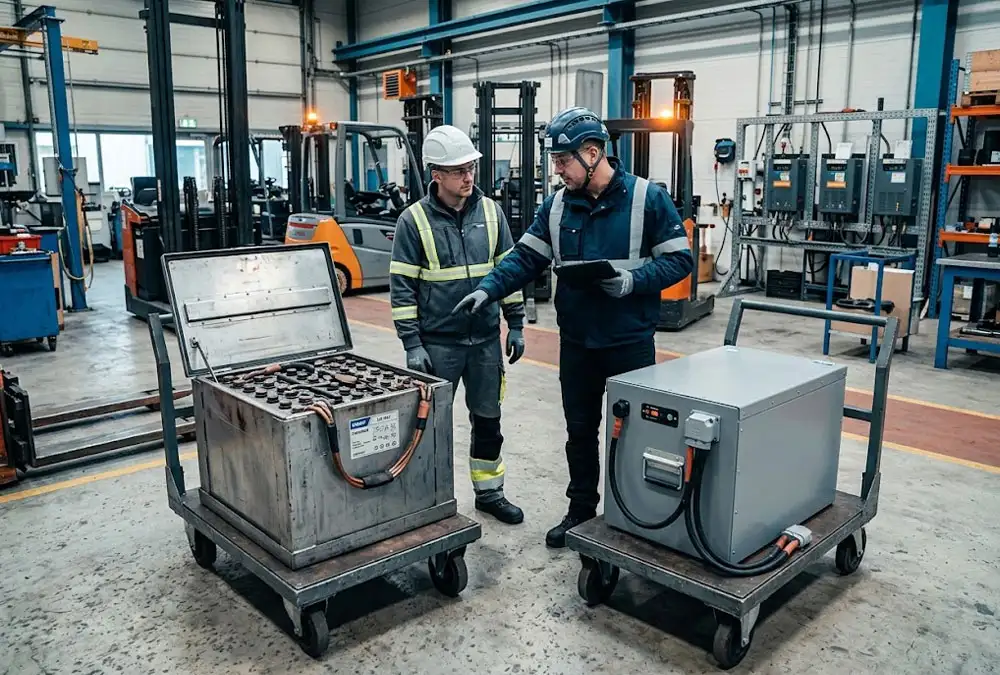
Choosing between Lithium-ion vs Lead-acid Forklift Batteries is not simply a matter of comparing purchase prices, charging times, or cycle-life claims. For a European warehouse, distribution centre, manufacturing plant, or cold-storage operation, the right decision depends on how the forklifts work, when they can charge, what maintenance resources are available, and whether the battery integrates safely with the truck and charging infrastructure.
A lead-acid battery may have the lower initial price, while a lithium-ion battery may reduce routine maintenance and battery-changing downtime. However, either option can become expensive when it is poorly matched to the duty cycle. A low-cost lithium retrofit can require a new charger, electrical upgrades, added ballast, communication integration, or specialised technical support. A low-cost lead-acid purchase can also become expensive when watering, cleaning, battery swaps, charging-room requirements, and lost operating time are ignored.
The most useful question is therefore not, “Which battery chemistry is better?” It is:
Which forklift battery system delivers the required uptime, safety controls, service support, and lowest verifiable total cost for this specific operation?
Lithium-Ion vs Lead-Acid Forklift Batteries: A Quick Decision Guide
There is no universal winner, but several operating patterns can help fleet managers make an initial assessment.
When lead-acid forklift batteries may still make sense
- The forklift operates for one light or moderate shift per day.
- A long overnight charging window is consistently available.
- The facility already has an appropriate charging area and maintenance process.
- Trained employees are available to inspect, water, clean, and service the batteries.
- The business prioritises lower initial capital expenditure over maximum vehicle availability.
- Local lead-acid service, replacement, and recycling support is readily available.
When lithium-ion forklift batteries may offer greater value
- The fleet operates across two or three shifts.
- Battery changing, cooling, or maintenance is causing avoidable downtime.
- Operators can recharge during scheduled breaks or shift changes.
- Battery-room space could be used for more productive activities.
- The company wants to reduce watering, acid cleaning, and battery-handling tasks.
- A qualified local supplier can support the battery, BMS, charger, and vehicle interface.
This is only a preliminary filter. Before making a purchasing decision, the operation must also verify battery weight, usable energy, peak current, charger compatibility, communication, operating temperature, local service capability, and installed cost.
Compare the Forklift Duty Cycle Before Comparing Battery Specifications
Battery brochures usually present voltage, ampere-hours, charging time, and cycle life. These figures are useful, but they cannot describe how the battery will perform in a particular warehouse. A reliable comparison begins with the forklift’s actual duty cycle.
Record at least two to four representative weeks of operating information, including:
- Number of shifts per day and actual operating hours per shift;
- Average and maximum load weight;
- Travel distance, lift height, ramp use, and stop-start frequency;
- Attachment and auxiliary power consumption;
- Scheduled breaks and shift-change charging windows;
- Ambient, freezer, and charging-area temperatures;
- Current battery-changing and maintenance time;
- Unplanned downtime associated with batteries and chargers.
Do not compare forklift batteries by Ah alone
Ampere-hours describe electrical capacity at a stated voltage and under defined test conditions. They do not, by themselves, tell a buyer how much useful energy the forklift will receive. A simplified nominal-energy calculation is:
Nominal energy (kWh) = Nominal voltage (V) × Rated capacity (Ah) ÷ 1,000
Even this calculation is not a runtime guarantee. Actual usable energy is affected by allowable depth of discharge, temperature, current demand, battery age, voltage limits, charger behaviour, motor efficiency, payload, tyre condition, travel speed, and lifting work.
This explains why a lithium-ion battery with a lower Ah rating may sometimes complete the same shift as a larger lead-acid battery—but only when the complete energy balance works. If the smaller battery depends on opportunity charging and operators do not plug it in during breaks, the forklift may stop before the end of the shift.
Lithium-Ion vs Lead-Acid Forklift Battery Comparison
| Decision factor | Lead-acid battery | Lithium-ion battery | Buyer consequence |
|---|---|---|---|
| Routine maintenance | May require watering, cleaning, corrosion control, inspections, and chemistry-specific charging procedures. | No watering, but still requires inspections, connector checks, BMS diagnostics, and thermal-system monitoring. | Lithium reduces physical maintenance but increases dependence on diagnostic and supplier support. |
| Charging strategy | Often suited to a longer continuous charging window; multi-shift use may require spare batteries. | Can support opportunity charging when the battery and charger are designed for it. | Charging windows and site power can matter more than the advertised charge time. |
| Primary hazards | Corrosive electrolyte, hydrogen gas, heavy battery handling, short circuits, and sparks. | High stored energy, short circuits, overtemperature, damaged cells, and possible thermal propagation. | The hazards are different; neither chemistry eliminates the need for engineering controls and training. |
| Battery weight | The heavy battery may form part of the forklift’s required counterweight. | A comparable-energy pack may be lighter and may require engineered ballast. | A physically fitting lithium battery is not automatically a safe retrofit. |
| Initial cost | Normally lower at the battery-purchase stage. | Normally higher and may include charger and integration costs. | Compare installed system cost rather than the battery quotation alone. |
| Service requirements | Mechanical and electrochemical maintenance skills are widely established. | May require proprietary software, BMS access, firmware, and trained technicians. | Local diagnostics and spare-parts availability should be evaluated before purchase. |
Forklift Battery Maintenance: Physical Work vs Digital Diagnostics
The phrase “maintenance-free” can be misleading. Lithium-ion batteries can eliminate several labour-intensive lead-acid tasks, but no industrial traction battery should be installed and then ignored.
Lead-acid forklift battery maintenance
Depending on battery design and manufacturer instructions, lead-acid maintenance can include checking electrolyte levels, adding suitable water, cleaning contamination, monitoring corrosion, inspecting cables and connectors, and performing the specified charging or equalisation procedures.
Charging areas may also require ventilation, ignition-source control, emergency equipment, PPE, and procedures for handling heavy batteries. The UK Health and Safety Executive advises using dedicated, well-ventilated charging areas and checking that charging equipment is suitable for the battery’s voltage and charging rate. See the HSE guidance on using electric storage batteries safely.
Maintenance quality matters as much as the battery specification. Irregular watering, contamination, over-discharge, unsuitable charging, or weak recordkeeping can shorten service life and create safety risks. A low purchase price provides little value if the maintenance programme is not consistently followed.
Lithium-ion forklift battery maintenance
Lithium-ion batteries normally remove watering and acid-cleaning tasks. However, maintenance shifts toward system inspection and diagnostics:
- Inspecting the enclosure, restraint, connectors, and high-current cables;
- Reviewing BMS warnings, temperature events, and state-of-health trends;
- Checking contactors, fuses, interlocks, and emergency disconnects;
- Maintaining heating or cooling components where fitted;
- Confirming charger communication and charge-limit operation;
- Managing firmware, diagnostic access, and fault records;
- Following isolation procedures after impact, water ingress, or abnormal heating.
A fleet can therefore replace frequent routine maintenance with less frequent but more specialised work. Before buying, ask whether local technicians can diagnose the battery, whether modules are replaceable, where spare parts are stored, who controls firmware access, and how quickly the supplier can attend a fault.
Before requesting a price, collect the forklift model, current battery voltage and weight, operating hours, temperature range, and available charging windows. These five inputs can eliminate unsuitable options early.
Forklift Battery Charging and Uptime Considerations
Charging time should never be treated as a universal battery characteristic. It depends on the energy that must be restored, charger output, battery-management limits, charging losses, temperature, balancing, and any current taper near the target state of charge.
Lead-acid charging and battery changing
A light single-shift operation may have enough time to recharge a lead-acid battery overnight. In more intensive applications, a fleet may use spare batteries and changing equipment to keep trucks running. That arrangement adds labour, floor-space, handling equipment, and battery-inventory costs.
For US operations, OSHA’s powered-industrial-truck guidance identifies concerns including corrosive electrolyte, heavy battery handling, hydrogen accumulation, ignition control, flushing facilities, and appropriate ventilation. Buyers serving the US market should review the detailed OSHA electric forklift and charging guidance alongside site-specific requirements.
Lithium-ion opportunity charging
Opportunity charging can allow a forklift to recharge during breaks, meal periods, or shift changes. This can reduce or eliminate battery swaps, but only when four conditions are met:
- The scheduled charging windows are genuinely available.
- Operators connect the truck consistently.
- The charger can restore enough energy within those windows.
- The facility can supply the required power without creating an unacceptable peak demand.
A practical energy check is:
Required shift energy ≤ Starting usable energy + Energy restored during planned breaks
If that inequality is not satisfied with an appropriate operating reserve, the battery may be undersized even when its nominal specification looks acceptable.
Charging infrastructure can change the financial result
A lithium proposal should account for charger input power, simultaneous charger use, distribution-board capacity, cables, protective devices, charger positioning, impact protection, and possible electricity-demand charges. The cost of an electrician, new circuits, or a site-power upgrade belongs in the initial investment—not in a later “unexpected expense” category.
Lithium-Ion vs Lead-Acid Forklift Battery Safety
It is inaccurate to describe one chemistry as dangerous and the other as completely safe. Lead-acid and lithium-ion systems have different hazard profiles, and each requires controls appropriate to its design and application.
Lead-acid forklift battery safety risks
Typical concerns include sulfuric-acid exposure, hydrogen released during charging, electrical short circuits, heavy-battery handling, and sparks near a charging area. Risk controls can include suitable ventilation, trained personnel, appropriate lifting equipment, PPE, ignition-source control, emergency flushing facilities, and documented charging procedures.
Lithium-ion forklift battery safety risks
Lithium-ion systems introduce different concerns: high stored energy, excessive current, internal or external short circuits, overcharge, over-discharge, abnormal temperature, damaged cells, and possible thermal propagation. Many industrial forklift packs use lithium iron phosphate, or LFP, but chemistry alone does not prove that a battery system is safe.
Safety depends on cell quality, pack construction, electrical protection, contactors, fuses, insulation, mechanical restraint, thermal design, battery-management logic, charger integration, production control, validation, and correct installation.
IEC 62619:2022 addresses safety requirements and tests for industrial secondary lithium cells and batteries, including motive applications such as forklift trucks. Its existence does not prove that a particular product complies. Buyers should request the applicable report or certificate, covered model numbers, standard edition, issuing organisation, date, and verification route.
For North American projects, UL explains that UL 2580 evaluates electric-vehicle battery safety requirements involving electrical, mechanical, environmental, and thermal conditions. Again, the relevant question is whether the offered battery model has valid, scope-specific evidence—not whether the supplier mentions a standard on a website.
Forklift counterweight and retrofit safety
Battery weight can be part of the forklift’s counterbalance system. Replacing a heavy lead-acid battery with a lighter lithium pack without engineering review can affect stability and rated performance. Any added ballast must be designed, positioned, and secured for the specific truck; it should not be treated as an informal workshop modification.
A safe retrofit must verify the operating-voltage window, maximum charge voltage, low-voltage limits, continuous and peak current, regenerative current, connector and polarity, compartment dimensions, battery restraint, communication protocol, state-of-charge display, environmental protection, temperature range, charger profile, and required battery mass.
Forklift Battery Cost: Compare Installed TCO, Not Purchase Price
A battery quotation is not a total-cost analysis. Buyers should compare the complete installed and supported systems over a common evaluation period.
Initial forklift battery investment
- Battery purchase price;
- Compatible charger or charging network;
- Electrical installation and distribution upgrades;
- Vehicle interface, communication, and software work;
- Battery restraint, tray modifications, or engineered ballast;
- Commissioning, documentation, and employee training.
Forklift battery operating costs
- Electricity consumption and peak-demand effects;
- Watering, cleaning, inspection, and servicing labour;
- Battery-changing labour and equipment;
- Spare-battery inventory;
- Charging-room floor space;
- Planned and unplanned battery-related downtime.
Lifecycle and supplier-risk costs
- Replacement batteries and modules;
- Transport and specialist repair;
- Firmware, diagnostic, or service fees;
- Warranty exclusions and claim administration;
- Recycling and end-of-life handling;
- Residual value and supplier-support continuity.
A useful calculation is:
TCO = Battery and installation + Infrastructure + Energy + Maintenance + Repairs and replacements + Downtime − Residual value
Do not accept a fixed payback period unless the assumptions are visible. Electricity price, labour rate, annual operating hours, number of shifts, charging behaviour, downtime value, evaluation period, financing cost, and replacement assumptions should all be disclosed. A lithium system may provide an attractive return in a high-utilisation fleet but fail to recover its higher initial cost in a lightly used or seasonal truck.
Cold-Storage Forklift Batteries Need a Separate Comparison
Cold storage changes both battery performance and charging strategy. Buyers should not accept a general statement that one chemistry is “best for freezers” without reviewing the complete system.
Important factors include:
- Minimum discharge and charging temperatures;
- BMS low-temperature charging restrictions;
- Battery-heating method and heater energy consumption;
- Time spent inside and outside the freezer;
- Condensation during repeated temperature transitions;
- Enclosure sealing and environmental protection;
- Location and temperature of the charging area;
- Effect of low temperature on usable energy and power.
A heated lithium battery may work well in a demanding freezer fleet, but the heating strategy must be included in energy sizing. A lead-acid system may also remain viable where shift duration, charging arrangements, and maintenance procedures are suitable. The answer comes from measured duty-cycle data, not chemistry labels alone.
European Forklift Battery Regulations and Procurement Requirements
European buyers should evaluate regulatory information, lifecycle data, service access, and end-of-life responsibility as part of the procurement process.
Article 77 and Annex XIII of the EU Batteries Regulation 2023/1542 establish battery-passport provisions, including an application date of 18 February 2027 for relevant battery categories such as industrial batteries with a capacity greater than 2 kWh. Buyers should verify the final classification and obligations for the specific product placed on the EU market.
For long-term fleet planning, the purchase agreement should define:
- Who supplies the required battery and lifecycle information;
- Who can access state-of-health, event, and operating data;
- Whether the customer retains data access after changing service providers;
- Who is responsible for updates, compliance documents, and record retention;
- How collection, recycling, or end-of-life responsibilities are handled;
- Whether the battery can remain serviceable if the original supplier exits the market.
For the US and other markets, requirements should be assessed separately. An IEC standard, a UL certification, and EU conformity documentation are not interchangeable. Each document has its own scope, model coverage, jurisdiction, and purpose.
When Lead-Acid Forklift Batteries Are the Better Business Choice
Lead-acid should not be dismissed as outdated simply because lithium-ion technology is newer. It may be the more economical choice when:
- Forklifts have low annual operating hours;
- There is enough overnight charging time;
- Existing charging and maintenance facilities are already paid for;
- The business has reliable maintenance discipline;
- The equipment is seasonal or remains idle for long periods;
- Local lead-acid service is stronger than local lithium support;
- A lithium conversion would require major electrical, communication, or counterweight changes.
In these conditions, lithium’s operational savings may not be large enough to justify the additional installed cost. The decision should be based on measured utilisation rather than general industry trends.
When Lithium-Ion Forklift Batteries Are the Better Business Choice
Lithium-ion is more likely to create measurable value when:
- The forklifts operate over multiple shifts;
- Battery changes interrupt productive work;
- Scheduled breaks support opportunity charging;
- Lead-acid maintenance is difficult to perform consistently;
- The facility wants to reduce battery handling and battery-room use;
- The installed charging infrastructure can support the required power;
- The supplier provides qualified local diagnostics, parts, and warranty support;
- The battery, charger, forklift, and operating environment have been validated as one system.
The strongest lithium business cases normally come from higher vehicle utilisation and avoided operational cost—not from cycle-life claims presented without conditions.
Lithium Forklift Battery Retrofit Compatibility Checklist
Before replacing a lead-acid forklift battery with lithium-ion, confirm the following items in writing:
- Nominal and allowable operating-voltage range;
- Required usable energy per shift;
- Continuous, peak, and regenerative current limits;
- Maximum charge voltage and approved charging profile;
- Battery-compartment dimensions and mounting points;
- Minimum battery mass and any engineered ballast requirement;
- Connector type, current rating, and polarity;
- CAN or other vehicle communication requirements;
- State-of-charge display compatibility;
- Operating and charging temperature limits;
- Heating or cooling performance;
- Ingress and environmental protection;
- Battery restraint and emergency isolation;
- Applicable test reports and market documentation;
- Local diagnostics, spare parts, and service response.
If the supplier cannot answer these questions for the specific forklift and battery model, the proposal is not yet ready for approval.
Questions to Ask a Forklift Battery Supplier
- Under what temperature, depth of discharge, charge rate, and end-of-life threshold was the quoted cycle life determined?
- Is the warranty limited by years, cycles, operating hours, or energy throughput?
- What remaining capacity qualifies for a warranty claim?
- Who is responsible for battery, charger, and vehicle communication integration?
- Has the required battery mass or ballast been approved for this forklift model?
- Can the customer access BMS logs and state-of-health data?
- Are replacement modules, contactors, connectors, and chargers stocked in Europe?
- What are the remote-support and on-site response times?
- What happens when the battery is charged below its normal temperature range?
- Which exact battery models are covered by the supplied reports or certificates?
- Who pays for transport, labour, diagnosis, and temporary replacement during a warranty claim?
- Can the system be serviced if the original supplier or software platform becomes unavailable?
How to Choose Between Lithium-Ion and Lead-Acid Forklift Batteries
Step 1: Measure the current forklift fleet
Collect operating hours, loads, routes, charging behaviour, maintenance labour, electricity use, battery changes, faults, and downtime.
Step 2: Remove incompatible battery options
Check voltage, current, usable energy, dimensions, weight, restraint, charger, communication, temperature, and documentation before comparing price.
Step 3: Calculate installed total cost of ownership
Use the same evaluation period, operating assumptions, electricity costs, labour rates, and downtime values for both technologies.
Step 4: Run a controlled forklift battery trial
Test a representative forklift, shift, load profile, temperature, and group of operators. A light demonstration does not prove suitability for a demanding fleet.
Step 5: Review evidence before fleet-wide conversion
Compare energy delivered, opportunity-charging behaviour, operator compliance, fault logs, maintenance time, downtime, and support response. Expand the programme only after the operating data supports the business case.
Lithium-Ion vs Lead-Acid Forklift Battery FAQs
Are lithium-ion forklift batteries always cheaper over their lifetime?
No. They may reduce maintenance, battery-changing, and downtime costs in high-utilisation fleets, but the result depends on operating hours, charging opportunities, electricity prices, infrastructure, service costs, and the installed purchase price.
Can a lead-acid forklift charger charge a lithium-ion battery?
Do not assume that it can. Compatibility depends on voltage limits, charging profile, connector, current, communication, temperature controls, and the battery manufacturer’s approval. An unsuitable charger can reduce performance or create a safety risk.
Are lithium forklift batteries maintenance-free?
They normally eliminate watering and acid cleaning, but they still require inspections, connector and cable checks, BMS monitoring, thermal-system maintenance where applicable, and qualified fault diagnosis.
Which forklift battery is safer?
Neither chemistry is universally safer in every application. Lead-acid and lithium-ion batteries present different risks. Product design, validation, charger compatibility, installation, training, maintenance, and operating controls determine the safety of the complete system.
Which forklift battery is better for cold storage?
The answer depends on the battery’s discharge and charging-temperature limits, heating strategy, usable energy, condensation protection, charger location, and duty cycle. A cold-storage assessment should use actual temperature and shift data.
Can any lead-acid forklift be converted to lithium-ion?
No. The conversion must verify voltage behaviour, energy, continuous and peak current, charger compatibility, battery weight, counterbalance requirements, compartment dimensions, restraints, communication, environmental conditions, and manufacturer restrictions.
Final Verdict: Choose the Forklift Battery System, Not Just the Chemistry
Lead-acid forklift batteries can remain a practical and economical choice for light, predictable operations with adequate charging time and established maintenance resources. Lithium-ion forklift batteries can deliver greater uptime and lower routine labour in intensive multi-shift fleets, provided the charging infrastructure, vehicle integration, safety evidence, and technical support are properly engineered.
The final decision should pass four tests:
- Duty-cycle fit: Can the battery deliver and recover the energy the operation requires?
- Vehicle compatibility: Are voltage, current, weight, dimensions, restraint, communication, and charger requirements verified?
- Safety and site readiness: Are the hazards, procedures, facilities, and documentation appropriate for the selected system?
- Verifiable economics: Does the installed TCO use the fleet’s real operating data rather than generic savings claims?
Evaluate Your Forklift Battery Application
Submit the forklift model, current battery voltage and weight, shift pattern, operating temperature, load profile, and available charging windows for a compatibility and total-cost assessment.
Related Posts
 https://anengjibattery.com/wp-content/uploads/2026/09/anengjiBattery-Lithium-Ion-and-Lead-Acid-Forklift-Battery-Comparison.webp
675
1000
Battery Expert Team
https://anengjibattery.com/wp-content/uploads/2025/06/logo2-300x138.png
Battery Expert Team2026-09-30 07:57:172026-09-30 07:57:31Lithium-Ion vs Lead-Acid Forklift Batteries: Which Is Better?
https://anengjibattery.com/wp-content/uploads/2026/09/anengjiBattery-Lithium-Ion-and-Lead-Acid-Forklift-Battery-Comparison.webp
675
1000
Battery Expert Team
https://anengjibattery.com/wp-content/uploads/2025/06/logo2-300x138.png
Battery Expert Team2026-09-30 07:57:172026-09-30 07:57:31Lithium-Ion vs Lead-Acid Forklift Batteries: Which Is Better? https://anengjibattery.com/wp-content/uploads/2026/09/anengjibattery-Electric-Forklift-Operations-in-a-European-Warehouse.webp
675
1000
Battery Expert Team
https://anengjibattery.com/wp-content/uploads/2025/06/logo2-300x138.png
Battery Expert Team2026-09-29 08:53:352026-09-29 08:53:35Which Are the Top Forklift Battery Manufacturers in Europe
https://anengjibattery.com/wp-content/uploads/2026/09/anengjibattery-Electric-Forklift-Operations-in-a-European-Warehouse.webp
675
1000
Battery Expert Team
https://anengjibattery.com/wp-content/uploads/2025/06/logo2-300x138.png
Battery Expert Team2026-09-29 08:53:352026-09-29 08:53:35Which Are the Top Forklift Battery Manufacturers in Europe https://anengjibattery.com/wp-content/uploads/2026/09/anengjiBattery-Integrated-Freezer-Forklift-Battery-Operation-and-Charging.webp
675
1000
Battery Expert Team
https://anengjibattery.com/wp-content/uploads/2025/06/logo2-300x138.png
Battery Expert Team2026-09-24 08:18:192026-09-24 08:18:38How Does a Lithium Battery for Freezer Forklift Work?
https://anengjibattery.com/wp-content/uploads/2026/09/anengjiBattery-Integrated-Freezer-Forklift-Battery-Operation-and-Charging.webp
675
1000
Battery Expert Team
https://anengjibattery.com/wp-content/uploads/2025/06/logo2-300x138.png
Battery Expert Team2026-09-24 08:18:192026-09-24 08:18:38How Does a Lithium Battery for Freezer Forklift Work? https://anengjibattery.com/wp-content/uploads/2026/09/anengjiBattery-How-to-Choose-the-Right-Forklift-Battery-A-Practical-Selection-Guide.webp
675
1000
Battery Expert Team
https://anengjibattery.com/wp-content/uploads/2025/06/logo2-300x138.png
Battery Expert Team2026-09-20 07:31:262026-09-20 07:31:41How to Choose the Right Forklift Battery: A Practical Selection Guide
https://anengjibattery.com/wp-content/uploads/2026/09/anengjiBattery-How-to-Choose-the-Right-Forklift-Battery-A-Practical-Selection-Guide.webp
675
1000
Battery Expert Team
https://anengjibattery.com/wp-content/uploads/2025/06/logo2-300x138.png
Battery Expert Team2026-09-20 07:31:262026-09-20 07:31:41How to Choose the Right Forklift Battery: A Practical Selection Guide


Leave a Reply
Want to join the discussion?Feel free to contribute!