
How to Choose the Right Forklift Battery: A Practical Selection Guide
September 24, 2026 / Battery Expert Team / Battery Basics
Introduction
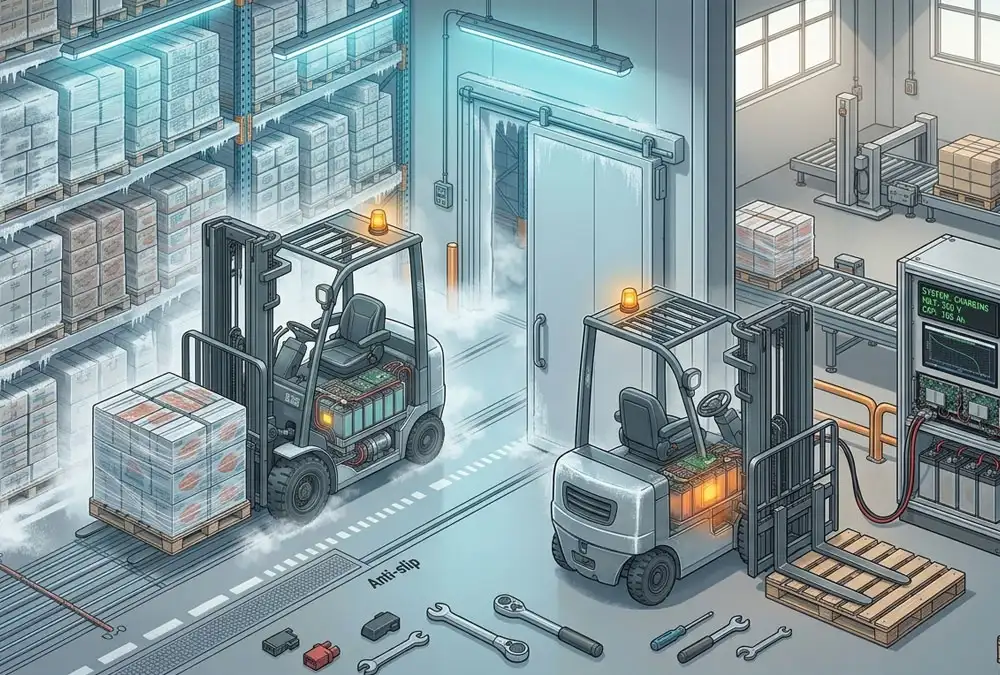
A Lithium Battery for Freezer Forklift applications must do more than store electrical energy. It must deliver enough power for travel and hydraulic lifting at sub-zero temperatures, protect the cells when they are too cold to charge, support the warehouse charging schedule, and withstand repeated movement between freezer rooms and warmer loading areas.
These requirements cannot be met by lithium chemistry alone. A freezer-ready system combines suitable cells, temperature sensors, a battery management system (BMS), contactors, electrical protection, heating elements, insulation, an environmental enclosure, a compatible charger, and correct integration with the forklift.
This article explains how those components work together, what happens during discharge and charging in a freezer, and what European and US buyers should verify before choosing a battery.
The short answer: A freezer forklift lithium battery works by continuously measuring cell conditions, controlling current, warming the cells when necessary, and permitting charging or discharge only within validated operating limits.
What Is a Freezer Forklift Lithium Battery?
A freezer forklift lithium battery is a rechargeable traction-battery system adapted for forklifts, reach trucks, pallet trucks, stackers, and other material-handling equipment used in chilled or frozen environments.
Many industrial systems use lithium iron phosphate, commonly called LiFePO4 or LFP. However, describing a battery as “LiFePO4” does not establish its suitability for a freezer. Cell selection is only one part of the design.
A complete battery pack generally includes:
- Cells: the electrochemical units that store energy;
- Modules or cell groups: cells connected to form the required voltage and capacity;
- BMS: the electronic controller that monitors and protects the battery;
- Contactors: electrically controlled switches that connect or isolate the high-current circuit;
- Fuse and electrical protection: devices that respond to abnormal current or faults;
- Current and temperature sensors: inputs used by the BMS to make control decisions;
- Heating system: elements that raise cell temperature when operation requires it;
- Insulation and enclosure: structures that manage heat loss, impact, moisture, and installation;
- Communication interface: the connection between the battery, charger, display, and sometimes the forklift controller;
- Power connectors and cables: the path through which energy reaches the forklift.
If one of these subsystems is not designed for the actual temperature and duty cycle, the battery may have an adequate voltage and capacity on paper but still produce short runtime, charging delays, protection events, or moisture-related faults in service.
Why Low Temperature Changes Battery Performance
Inside a lithium-ion cell, lithium ions move through an electrolyte between the positive and negative electrodes. Low temperature slows ion transport and electrochemical reaction rates. It also increases resistance and polarization inside the cell.
A 2025 review in Applied Energy identifies slower lithium-ion diffusion, increased internal resistance, reduced capacity and energy, slower reaction kinetics, and lithium plating during cold charging as major low-temperature challenges. See A Review on Challenges in Low Temperature Lithium-Ion Cells and Future Prospects.
Cold affects available power as well as capacity
A forklift battery does not operate under a constant load. Driving across a level warehouse floor may require moderate current, but acceleration, loaded ramp travel, steering, and hydraulic lifting can produce much higher short-duration demand.
When cold increases battery resistance, these current peaks create a larger voltage drop. The BMS or forklift controller may reach a protection threshold even though the battery is not completely discharged. The operator may then experience slow lifting, weak acceleration, an unexpectedly low state-of-charge indication, or a system fault.
The natural solution is not always to choose more amp-hours. Buyers should first verify whether the battery can supply the required continuous current and peak current at the intended cell temperature. A larger battery that cannot support the cold peak load may still interrupt the vehicle during a demanding lift.
Cold charging requires tighter control
During charging, lithium ions must move into and become stored within the negative electrode. If the cells are too cold for the requested charge rate, metallic lithium can deposit on the anode instead of being stored normally. This process is known as lithium plating.
Lithium plating can contribute to irreversible capacity loss and may create safety concerns. The risk depends on cell design, cell temperature, charge rate, state of charge, ageing, and other operating conditions.
A peer-reviewed review in Energies reports that low temperature can sharply reduce available energy and peak power while increasing the risk of lithium plating during charging. It also evaluates internal, external, and hybrid heating methods. See Review of Low-Temperature Performance, Modeling and Heating for Lithium-Ion Batteries, particularly Sections 2 and 4.
This is why a freezer forklift battery may be allowed to discharge at a temperature where normal charging remains blocked. The charge and discharge temperature ranges should always be treated as separate specifications.
Ambient temperature is not cell temperature
A freezer may be operating at −20°C while the cells inside an insulated battery are temporarily warmer. The opposite can also occur: a forklift may enter a warm charging area while the cells remain cold after hours in the freezer.
Battery protection should therefore respond to measured cell or module temperature, not only to the temperature shown on a warehouse wall. For reliable control, the BMS needs appropriately positioned sensors and logic that addresses sensor failure, disagreement between temperature zones, and uneven heating.
Practical solution: Ask where the temperature sensors are located, which reading controls charge permission, and what the BMS does if one sensor is colder than the others or reports an implausible value.
How the Battery Works During Freezer Operation
The battery’s operation can be divided into six connected stages. Understanding these stages helps buyers distinguish a genuine freezer-ready system from a standard battery with a general low-temperature claim.
| Stage | Battery-system response | Operational concern | Engineering response |
|---|---|---|---|
| Entering the freezer | Sensors track cell cooling while insulation slows heat loss | Cell temperature changes more slowly than ambient temperature | Use multiple validated sensing points rather than one ambient reading |
| Travelling and lifting | The battery supplies the traction motor, hydraulic system, and auxiliary loads | High current may cause cold-related voltage sag | Match cold continuous and peak current to the vehicle duty |
| Continuous supervision | The BMS monitors voltage, current, temperature, state, and faults | The pack may reach a validated limit during heavy work | Use controlled warning, current limitation, or isolation logic |
| Connecting the charger | The battery checks cell temperature and charger communication | Cells may be too cold for normal charging | Keep normal charging blocked or limited until conditions are acceptable |
| Preheating and charging | The heating system raises cell temperature before the BMS permits normal charge current | Warm-up can consume part of a short charging window | Model heating time separately from actual energy-restoration time |
| Leaving the freezer | The cold pack enters warmer and potentially humid air | Condensation can affect connectors, electronics, and enclosure interfaces | Combine environmental design with suitable operating procedures |
How the BMS Controls Low-Temperature Operation
The BMS is the control center of the battery, but it does not create energy or physically warm the cells by itself. Its role is to interpret sensor data, make protection decisions, control contactors, coordinate heating and charging, communicate battery status, and record faults where the design supports logging.
During freezer operation, the BMS may monitor:
- Individual cell or parallel-group voltage;
- Total pack voltage;
- Charge and discharge current;
- Temperature at multiple points;
- State of charge and relevant state estimates;
- Contactor state and insulation or interlock status where applicable;
- Heater operation;
- Communication with the charger, display, or forklift controller.
If temperature or voltage reaches a validated limit, the BMS may warn the operator, reduce permitted current, block charging, activate heating, or open a contactor. These actions can prevent battery damage, but frequent protection events also tell the fleet manager that the battery, vehicle demand, or operating plan may not be correctly matched.
For example, if a forklift repeatedly faults only when raising heavy pallets late in the shift, the solution should not be to bypass the current or voltage protection. The correct response is to analyze cell temperature, state of charge, voltage sag, peak current, battery sizing, vehicle demand, and the applicable BMS limits.
How Self-Heating Works Before Charging
A freezer-specific pack may include heating films, plates, or other controlled heating elements positioned around or between cells and modules. Their purpose is to raise cell temperature toward a validated operating window.
A typical controlled sequence is:
- The charger is connected. The battery and charger establish the required electrical or communication state.
- The BMS reads the relevant temperature sensors. It identifies the coldest controlling zone and checks for sensor faults.
- Normal cell charging remains blocked or limited. Charge current is not applied normally while the cells are outside the validated range.
- The BMS activates the heater. Depending on the system, heating energy may come from the charger, the battery, or another validated supply.
- The BMS monitors the warm-up process. It checks heating rate, temperature difference, current, voltage, and fault conditions.
- Normal charging is enabled. The BMS permits charging only after the required temperature and system conditions are satisfied.
This sequence matters to operators because heating takes time and energy. A scheduled 30-minute break does not necessarily provide 30 minutes of battery charging. Travel to the charger, connection, system checks, and preheating may leave a shorter period for restoring energy.
Estimating heating energy
A simplified calculation is:
Heating energy (kWh) = heater power (kW) × heating time (hours)
For illustration, a 0.8 kW heater operating for 45 minutes would use 0.6 kWh. This is only a mathematical example—not a prediction for a production battery.
Actual heating time depends on battery mass, initial cell temperature, target temperature, insulation, airflow, heater position, heat transfer, available power, and control logic. Buyers should therefore request a measured temperature-versus-time curve under stated conditions rather than accepting a heater wattage as proof of performance.
Practical solution: Ask for the heater’s energy source, warm-up curve, temperature uniformity, charge-enable threshold, sensor locations, and response to heater or sensor failure.
How Opportunity Charging Works in a Cold Warehouse
Opportunity charging means adding energy during planned idle periods such as breaks, shift changes, loading delays, or staging time. Lithium batteries can support partial charging when the production battery and charger are designed for it.
However, opportunity charging does not automatically guarantee continuous multi-shift operation. The energy restored during a break depends on:
- Energy consumed since the previous charge;
- Cell temperature on arrival;
- Time required for preheating;
- Charger voltage and available power;
- BMS temperature-dependent current limits;
- Starting state of charge;
- Charging losses, taper behavior, and balancing;
- Actual time connected to the charger.
If the second shift frequently receives a partly charged truck, the cause may be insufficient battery energy, an undersized charger, excessive heating time, missed charging opportunities, poor charger placement, or higher-than-expected vehicle utilization.
The solution is to divide each shift into operating blocks and calculate or measure the energy used and restored in each block. This determines whether opportunity charging can maintain the required reserve or whether the battery, charger, or operating schedule must change.
How the Battery Handles Condensation and Moisture
A forklift that remains continuously in a stable freezer experiences a different moisture cycle from a truck that repeatedly travels between the freezer, chilled staging area, and warm loading dock.
When a cold battery enters warmer, humid air, its surfaces may remain below the air’s dew-point temperature. Water can then condense on the enclosure, connectors, cables, and other cold components.
ASHRAE explains that surface condensation occurs when water vapor contacts a nonporous surface colder than the dew point of the surrounding air. See ASHRAE Handbook—Heat, Air, and Moisture Control in Building Assemblies, Section 6.1.
If the forklift returns to the freezer before the moisture has evaporated, that moisture may freeze. Repeated condensation, freezing, thawing, and washdown exposure can contribute to corrosion, intermittent communication faults, connector problems, and damage to unprotected electronics.
An IP rating is useful, but it does not by itself prove immunity to internal condensation or repeated temperature cycling. A complete moisture-management design may include:
- Temperature-resistant seals and gaskets;
- Appropriate cable glands and sealed mating connectors;
- Pressure-management components where required;
- Corrosion-resistant hardware;
- Protected or coated electronic assemblies;
- Controlled enclosure assembly;
- Thermal-cycle and condensation validation;
- Inspection procedures for unusual moisture, impact, or washdown exposure.
Operating procedures can also reduce risk. Limiting unnecessary temperature-zone transitions and choosing an appropriate charging or parking location may reduce repeated condensation exposure more effectively than relying on enclosure sealing alone.
How to Determine the Required Voltage, Capacity, and Power
Battery selection should begin with the forklift’s electrical architecture, not with the largest available capacity.
Voltage
Nominal voltage is a product class, not a complete compatibility specification. Two batteries described as 48V can use different series-cell arrangements, charge voltages, low-voltage limits, and communication strategies.
The supplier should verify:
- Normal battery operating-voltage window;
- Maximum charging voltage;
- Low-voltage cutoff behavior;
- Forklift-controller voltage limits;
- Charger profile;
- DC/DC converters and auxiliary electrical equipment.
Capacity and energy
Amp-hours measure electric charge. Watt-hours or kilowatt-hours describe nominal energy:
Nominal energy (kWh) = nominal voltage (V) × capacity (Ah) ÷ 1,000
Nominal energy is still not the same as usable cold energy. The usable result depends on load, cell temperature, voltage limits, state-of-charge reserve, BMS restrictions, auxiliary consumption, efficiency, and ageing.
Runtime should therefore be based on the real freezer duty cycle: payload, lift frequency, travel distance, ramps, attachments, floor condition, speed, idle time, auxiliary loads, temperature-zone profile, charging windows, and required reserve.
Continuous and peak current
Continuous current describes the current a battery can support over a stated period and condition. Peak current is a higher short-duration capability. Both values require a duration and temperature condition to be meaningful.
If a battery repeatedly reaches protection limits during lifting, simply increasing Ah may not solve the problem. The pack, BMS, cabling, fuse, contactors, connectors, and cells must all support the required cold peak-current profile.
How to Match the Lithium Battery to the Forklift
A lead-acid-to-lithium conversion should be treated as a vehicle-integration project. Matching voltage and exterior dimensions is not enough.
| Compatibility item | What to confirm | Possible consequence if ignored |
|---|---|---|
| Electrical architecture | Voltage window, current, regeneration, cutoff behavior, and charger profile | Faults, restricted performance, or battery damage |
| Mechanical fit | Compartment dimensions, restraint, mounting, cable routing, and service access | Movement, cable damage, or difficult maintenance |
| Battery mass | Truck-manufacturer minimum and maximum permitted battery weight | Stability, capacity, or axle-loading concerns |
| Power connection | Connector model, polarity, cable size, fuse, and mating-cycle requirements | Heating, arcing, voltage drop, or unreliable connection |
| Communication | CAN, RS485, charger handshake, state-of-charge display, and fault messages | Incorrect display, charge refusal, or unexpected shutdown |
| Cold environment | Cell temperatures, heating, moisture exposure, seals, and materials | Short runtime, charging delays, condensation, or brittle components |
Battery mass is particularly important. In some electric forklifts, the battery contributes to the truck’s required mass or counterbalance. A lighter lithium battery is not automatically an advantage if the forklift requires a minimum battery weight.
For US operations, OSHA 29 CFR 1910.178(a)(4) states that modifications affecting capacity or safe operation require prior written approval from the manufacturer. Section 1910.178(q)(6) also addresses additional counterweighting. See OSHA 29 CFR 1910.178—Powered Industrial Trucks.
Start with the Forklift and Duty Cycle
Record the forklift model, data plate, original battery, approved battery weight range, compartment dimensions, minimum temperature, route, payload, lift pattern, shift schedule, charger, and communication interface before comparing quotations.
Which Technical Evidence Should Buyers Request?
A minimum-temperature statement without test conditions is difficult to evaluate. “Operates at −30°C” could refer to storage, low-current discharge, startup after heating, or a complete operating cycle. It does not automatically mean the battery can accept charge or power a fully loaded forklift at that temperature.
Request evidence showing:
- Battery model and production configuration tested;
- Ambient and measured cell temperatures;
- Cold-soak duration;
- Starting state of charge;
- Continuous and peak load;
- Voltage response and usable energy;
- Charge-lockout behavior;
- Warm-up time and heater energy;
- Charging current after heating;
- Fault response;
- Pass/fail criteria and test-document identification.
IEC 62619
The official scope of IEC 62619:2022 covers safety requirements and tests for secondary lithium cells and batteries used in industrial applications. The IEC identifies motive applications including forklift trucks, golf carts, and automated guided vehicles.
A supplier’s reference to IEC 62619 should be supported by a model-specific certificate or report showing the issuing organization, standard edition, covered products, dates, and verification route.
UN 38.3
Part III, subsection 38.3 of the UN Manual of Tests and Criteria addresses lithium-cell and battery testing for transport classification. UNECE provides the current documents through its Manual of Tests and Criteria Revision 8 and Amendment 1 page.
A UN 38.3 test summary supports applicable transport arrangements. It does not demonstrate freezer runtime, forklift compatibility, low-temperature charging performance, or condensation resistance.
European Union requirements
Regulation (EU) 2023/1542 applies to industrial batteries and establishes phased requirements concerning matters such as sustainability, safety, performance information, labeling, conformity, and end-of-life responsibilities.
Article 1 defines the regulation’s scope, while Article 10 and Annex IV address performance and durability parameters for relevant rechargeable industrial batteries. European buyers should review the consolidated Regulation (EU) 2023/1542 against the battery category, capacity, economic-operator role, and placing-on-the-market date.
US charging and workplace requirements
OSHA 29 CFR 1910.178(g) addresses the changing and charging of powered-industrial-truck batteries, including designated charging areas, truck positioning, charging-equipment protection, and precautions against flames, sparks, or electric arcs.
Several provisions use lead-acid-specific language. A lithium installation should therefore be reviewed for its actual equipment and facility with the forklift and battery manufacturers, qualified electrical and safety personnel, the authority having jurisdiction, and relevant insurance stakeholders.
How to Evaluate a Freezer Forklift Lithium Battery
A reliable evaluation should move from application data to engineering evidence rather than from a catalog model to an assumed application.
- Define the environment. Record minimum and typical temperatures, cold-soak duration, humidity, washdown, and cold-to-warm transitions.
- Define the work. Record travel, payload, lift height, lift cycles, ramps, attachments, utilization, shifts, breaks, and reserve requirements.
- Confirm vehicle compatibility. Verify voltage, current, charger, connector, communication, dimensions, mounting, and battery mass.
- Review thermal control. Confirm sensor placement, temperature limits, heating source, warm-up performance, uniformity, and fault response.
- Audit documents. Match test reports, transport documents, and certificates to the proposed production configuration.
- Run a representative pilot. Test the battery across the expected temperature, route, load, charging schedule, and transition pattern before wider fleet deployment.
A controlled pilot should record energy use, cell temperature where available, peak current, voltage sag, BMS events, warm-up time, actual charging duration, restored energy, operator observations, and moisture-related findings.
Acceptance criteria should be defined before the pilot. For example, the forklift may need to complete a specified operating block with reserve, raise a defined payload without protection events, preheat within the available charging window, and restore sufficient energy for the next block.
Frequently Asked Questions
Can a lithium forklift battery operate at −20°C?
Some systems are designed for sub-zero discharge, but capability depends on the cells, actual cell temperature, load, state of charge, BMS limits, heating, insulation, and validation conditions. Request data for the production model at the intended temperature and load.
Can the battery be charged inside the freezer?
Only if the battery, charger, heating system, electrical installation, and facility procedures are suitable for that location. If cells are outside the validated charging range, the BMS should block or appropriately limit normal charging.
Does every freezer battery require self-heating?
Not necessarily. The answer depends on minimum cell temperature, charging location, insulation, time in the freezer, cell specification, available warm-up time, and operating schedule.
How long does preheating take?
Warm-up time depends on initial temperature, target temperature, pack mass, heater power, heater placement, insulation, heat loss, energy source, and control logic. A supplier should provide a test curve with stated conditions.
Does a higher Ah rating guarantee longer runtime?
No. Runtime also depends on voltage, usable energy, cold performance, load, peak current, BMS limits, auxiliary consumption, charging opportunities, reserve, and ageing.
Does IP67 eliminate condensation risk?
No. An IP rating addresses specified ingress tests. Repeated temperature transitions also involve dew point, pressure changes, connectors, trapped moisture, protected electronics, assembly quality, and operating procedures.
Can any 48V lithium battery replace a 48V lead-acid battery?
No. The complete voltage window, current, charger, connector, communication, compartment, mounting, battery mass, forklift-controller behavior, and truck-manufacturer requirements must be verified.
Conclusion
A lithium battery for a freezer forklift works by coordinating electrochemical energy storage with temperature sensing, BMS protection, high-current power delivery, controlled heating, charger communication, and environmental protection.
During normal operation, the battery supplies energy to the traction and hydraulic systems while the BMS monitors cell voltage, current, and temperature. When charging is requested, the BMS determines whether the cells are within the validated charging range. If they are too cold, the system can keep normal charging blocked, activate the heating system, monitor the warm-up process, and enable charging only when the required conditions are satisfied.
Reliable operation also depends on correct capacity and power sizing, compatible vehicle and charger interfaces, proper battery mass, and protection against condensation during temperature transitions.
The best battery is therefore not automatically the one with the lowest advertised temperature, the highest Ah rating, or the longest claimed cycle life. It is the battery whose production configuration has been matched and validated against the actual forklift, freezer temperature, load profile, charging schedule, moisture exposure, and market requirements.
Request an Application-Specific Battery Review
Provide the forklift model, original battery specification, approved battery weight range, compartment dimensions, minimum freezer temperature, payload, lift pattern, shift schedule, charger information, and available charging windows.
Related Posts
 https://anengjibattery.com/wp-content/uploads/2026/09/anengjiBattery-Integrated-Freezer-Forklift-Battery-Operation-and-Charging.webp
675
1000
Battery Expert Team
https://anengjibattery.com/wp-content/uploads/2025/06/logo2-300x138.png
Battery Expert Team2026-09-24 08:18:192026-09-24 08:18:38How Does a Lithium Battery for Freezer Forklift Work?
https://anengjibattery.com/wp-content/uploads/2026/09/anengjiBattery-Integrated-Freezer-Forklift-Battery-Operation-and-Charging.webp
675
1000
Battery Expert Team
https://anengjibattery.com/wp-content/uploads/2025/06/logo2-300x138.png
Battery Expert Team2026-09-24 08:18:192026-09-24 08:18:38How Does a Lithium Battery for Freezer Forklift Work? https://anengjibattery.com/wp-content/uploads/2026/09/anengjiBattery-How-to-Choose-the-Right-Forklift-Battery-A-Practical-Selection-Guide.webp
675
1000
Battery Expert Team
https://anengjibattery.com/wp-content/uploads/2025/06/logo2-300x138.png
Battery Expert Team2026-09-20 07:31:262026-09-20 07:31:41How to Choose the Right Forklift Battery: A Practical Selection Guide
https://anengjibattery.com/wp-content/uploads/2026/09/anengjiBattery-How-to-Choose-the-Right-Forklift-Battery-A-Practical-Selection-Guide.webp
675
1000
Battery Expert Team
https://anengjibattery.com/wp-content/uploads/2025/06/logo2-300x138.png
Battery Expert Team2026-09-20 07:31:262026-09-20 07:31:41How to Choose the Right Forklift Battery: A Practical Selection Guide https://anengjibattery.com/wp-content/uploads/2026/09/AnengJIBattery-Best-LiFePO4-Battery-How-to-Choose-the-Right-One.webp
675
1000
Battery Expert Team
https://anengjibattery.com/wp-content/uploads/2025/06/logo2-300x138.png
Battery Expert Team2026-09-17 08:52:142026-09-18 09:19:29How to Choose the Best LiFePO4 Battery
https://anengjibattery.com/wp-content/uploads/2026/09/AnengJIBattery-Best-LiFePO4-Battery-How-to-Choose-the-Right-One.webp
675
1000
Battery Expert Team
https://anengjibattery.com/wp-content/uploads/2025/06/logo2-300x138.png
Battery Expert Team2026-09-17 08:52:142026-09-18 09:19:29How to Choose the Best LiFePO4 Battery https://anengjibattery.com/wp-content/uploads/2026/09/anengjiBattery-lifepo4-battery-cell-packaging-wholesale.webp
675
1000
Battery Expert Team
https://anengjibattery.com/wp-content/uploads/2025/06/logo2-300x138.png
Battery Expert Team2026-09-16 09:52:342026-09-18 09:20:12LiFePO4 Battery Wholesale Guide: Best Suppliers in Spain
https://anengjibattery.com/wp-content/uploads/2026/09/anengjiBattery-lifepo4-battery-cell-packaging-wholesale.webp
675
1000
Battery Expert Team
https://anengjibattery.com/wp-content/uploads/2025/06/logo2-300x138.png
Battery Expert Team2026-09-16 09:52:342026-09-18 09:20:12LiFePO4 Battery Wholesale Guide: Best Suppliers in Spain


Leave a Reply
Want to join the discussion?Feel free to contribute!