
How Can 1MW vs 2MW Battery Storage for EV Charging Lower Site Costs?
June 6, 2026 / Battery Expert Team / battery energy storage
Introduction
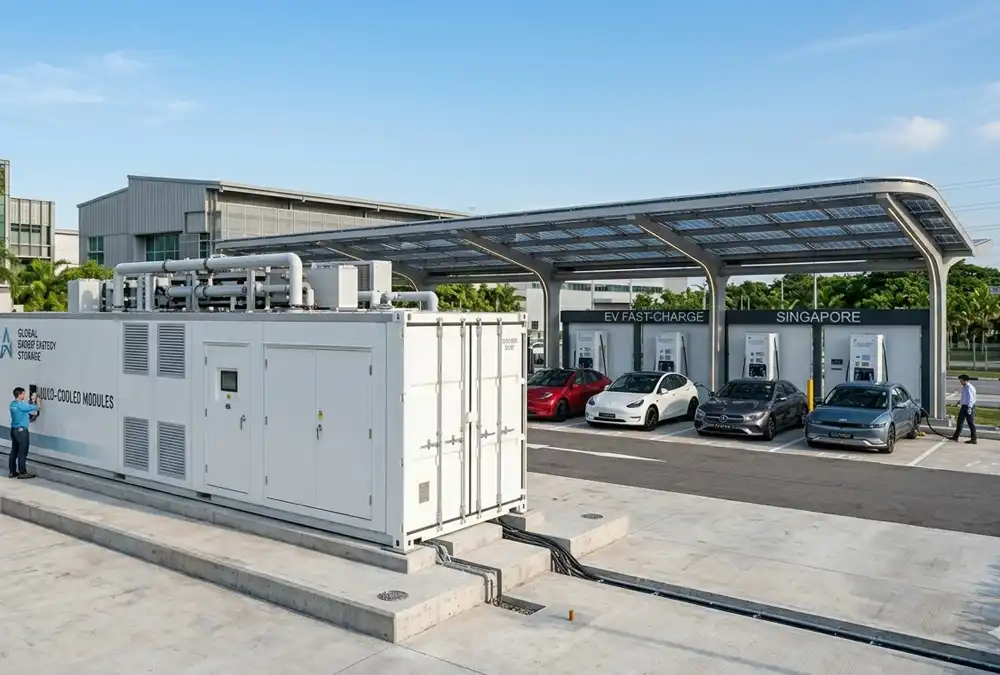
Deploying high-power electrification infrastructure requires navigating a highly complex balance between localized vehicle power demands and macro-level utility grid capacity constraints. For charge point operators (CPOs), fleet directors, and commercial developers, deciding on a 1MW vs 2MW Battery Storage for EV Charging architecture represents one of the most significant engineering and financial decisions in a facility’s development lifecycle. High-output charging dispensers pull severe, instantaneous blocks of current that can strain local transformer substations, trigger massive financial penalties, or delay grid connection permits for up to 24 months. Integrating a localized, containerized battery buffer provides an alternative infrastructure pathway, effectively decoupling a station’s peak charging throughput from real-time utility distribution limits. Deciding between a 1MW and a 2MW system depends on your near-term driver throughput, current switchgear limits, and long-term business scalability goals.
1MW vs 2MW Battery Storage for EV Charging: What Is the Difference?
Featured Snippet Answer: The main difference between 1MW and 2MW battery storage systems for EV charging is power output. A 2MW BESS can support more fast chargers, handle higher peak demand, and provide greater operational flexibility, while a 1MW system offers a lower initial investment and is suitable for small to medium-sized charging stations.
Understanding Power Capacity in Battery Energy Storage Systems
In high-voltage electrical engineering, the power capacity rating of a Battery Energy Storage System (BESS) dictates the maximum instantaneous rate at which the asset can deliver or absorb electricity. Expressed in Megawatts (MW), this value acts as the “width of the pipe” connecting your energy reservoir to your distribution busbar. Sizing this power rate determines how many vehicles can simultaneously fast-charge at peak speed before the facility must throttle charger output or pull high-tariff current from the primary grid feed.
What Does a 1MW Battery Storage System Mean?
A 1MW Battery Storage System delivers a maximum continuous power discharge of 1,000 kilowatts (kW). In field applications, this power rating is commonly paired with a 2-hour storage duration, creating a 1MW/2MWh system configuration. This indicates the unit can sustain a 1,000 kW power output for two consecutive hours before the electrochemical cells reach their minimum safe depth of discharge (DoD).
What Does a 2MW Battery Storage System Mean?
Conversely, a 2MW Battery Storage System doubles that instantaneous capability, providing a maximum continuous power output of 2,000 kW. Typically configured as a 2MW/4MWh block inside a heavy-duty outdoor thermal enclosure, this asset provides the high current required to manage severe, concurrent charging spikes across multi-stall ultra-fast charging hubs.
Why Battery Storage Size Matters for EV Charging Infrastructure
Selecting an inappropriate scale for your battery asset introduces significant long-term operational risks. An undersized system will exhaust its usable capacity during back-to-back charging events, exposing the property to volatile demand charges. Conversely, an oversized asset inflates upfront capital requirements without generating additional yield, lengthening your payback timeline. Sizing should be treated as a strategic decision based on real-world traffic profiles.
Battery Energy Storage System Fundamentals for EV Charging Infrastructure
An industrial-grade EV Charging Station Energy Storage system relies on multiple specialized sub-systems to ensure efficient energy conversion and long-term operating safety:
- Power Conversion System (PCS): The heavy-duty bidirectional inverter subsystem that handles AC-to-DC and DC-to-AC conversions, maintaining low total harmonic distortion (THD) and maximizing round-trip efficiency during high-power fast charging operations.
- Battery Management System (BMS): The core hardware and firmware safety layer that monitors internal cell temperatures, voltages, and structural state-of-health (SoH), balancing cell blocks to prevent thermal runaway risks.
- Energy Management System (EMS): The software control center executing automated load management routines. The EMS processes utility tariff structures in real-time to execute automated peak shaving and grid balancing programs.
Engineering Insight: Chemical Core Options for Station Storage
Lithium Iron Phosphate (LFP): The dominant chemistry for stationary commercial battery storage due to its high thermal stability, lack of cobalt dependency, and long operational life, typically delivering 6,000 to 8,000 full charge-discharge cycles at 80% Depth of Discharge (DoD).
Nickel Manganese Cobalt (NMC): Offers excellent volumetric energy density, enabling compact system configurations. However, NMC chemistry exhibits lower thermal breakdown thresholds and shorter cycle life under intense daily cycling profiles, requiring rigorous liquid cooling systems.
EV Charging Infrastructure Requirements: How Much Battery Storage Do You Need?
Accurately determining your system capacity requires looking beyond average daily vehicle volumes to evaluate real-world peak utilization spikes. For example, if a site deploys four 150kW DC fast charging dispensers, the total connected asset load when all four stalls are occupied is 600kW. If the local utility line capacity restricts the facility’s maximum draw to 200kW, an on-site battery storage asset must be integrated to provide the 400kW power deficit locally.
As consumer and commercial vehicle battery architectures advance, market preference is shifting toward 150kW to 350kW ultra-fast charging sessions. When multiple vehicles connect simultaneously, this high concurrent demand creates intense spikes on your station’s load curve. A proactive battery storage sizing for EV charging infrastructure strategy should account for a 20% to 35% growth in vehicle traffic over the next three to five years to ensure your electrical infrastructure remains resilient as EV adoption accelerates.
1MW Battery Storage for EV Charging Stations
A standard 1MW Battery Storage System configuration (typically built inside a space-efficient 10-foot or 20-foot outdoor modular enclosure) provides a cost-effective solution for site hosts managing moderate utility capacity limits or space constraints.
This power rating is well-suited for supporting up to six 150kW high-speed dispensers or two 350kW ultra-fast charging stalls under typical operational conditions. By injecting up to 1,000 kW of localized power during peak usage windows, it handles simultaneous charging events smoothly without triggering expensive demand charge penalties. The primary advantages of a 1MW platform include a lower initial capital expenditure, a smaller physical footprint, and simplified site integration, making it an excellent fit for urban retail plazas, auto dealerships, and corporate fleet locations. However, its main limitation is long-term scalability—if you plan to significantly expand your dispenser count in the future, a 1MW system may eventually restrict your maximum concurrent throughput.
2MW Battery Storage for EV Charging Stations
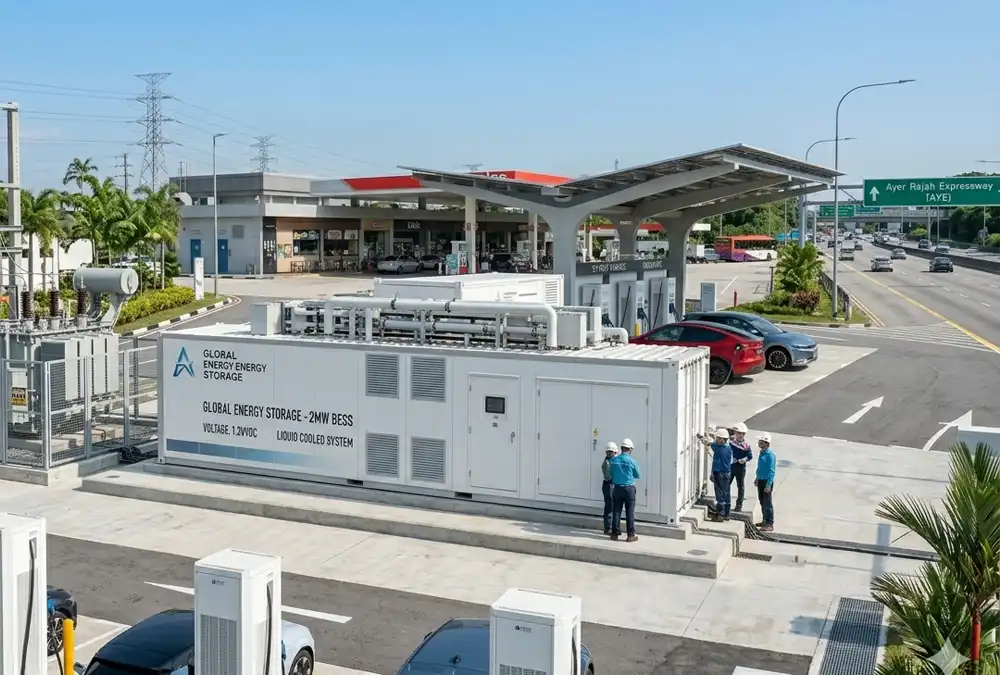
A larger 2MW Battery Storage System (typically housed in a standard 20-foot or 40-foot container with 4MWh of storage capacity) is engineered for heavy-duty industrial or highway electrification hubs.
This high-output system can comfortably support ten to twelve 150kW dispensers or up to four 350kW ultra-fast charging units operating simultaneously. It is an ideal solution for major transit hubs, highway rest areas, and commercial logistics depots where large delivery vans or electric trucks require rapid, back-to-back charging sessions. The core benefit of a 2MW BESS is its high power delivery, which provides excellent operational flexibility and easily manages large grid demand spikes. Additionally, its larger storage capacity allows for more comprehensive energy arbitrage strategies and provides a reliable backup power reserve during extended grid outages. The main considerations for this scale are the higher initial capital investment, larger physical footprint requirements, and the need for more detailed on-site civil and structural preparation.
Battery Storage Sizing Comparison for DC Fast Charging Stations
To help choose the right system for your facility, this table compares how 1MW and 2MW system sizes handle concurrent vehicle loads and support future site expansion:
How Many EV Chargers Can a 1MW or 2MW Battery Storage System Support?
| Operational Parameters | 1MW / 2MWh System Performance | 2MW / 4MWh System Performance |
|---|---|---|
| Peak Continuous Output | 1,000 kW (Instantaneous) | 2,000 kW (Instantaneous) |
| Simultaneous 150kW Chargers | Up to 6 Units (with active load sharing) | Up to 12 Units (Full concurrent load support) |
| Simultaneous 350kW Chargers | Maximum 2 Units | Up to 4-5 Units comfortably |
| Daily Vehicle Support Capacity | 40 – 75 Vehicle sessions / day | 90 – 160+ Vehicle sessions / day |
| Long-Term Scalability Headroom | Moderate (Requires adding parallel systems) | High (Built-in headroom for expansion) |
1MW vs 2MW Battery Storage Cost for EV Charging
Analyzing a 1MW vs 2MW battery storage cost for EV charging project requires evaluating both initial equipment capital expenditures (CAPEX) and long-term site preparation expenses. While doubling system power and capacity increases equipment costs, it does not double total project deployment costs, as elements like trenching, engineering design, and primary permitting remain relatively fixed.
What Is the Cost Difference Between 1MW and 2MW Battery Storage Systems?
| Estimated Cost Component | 1MW / 2MWh Configuration Range | 2MW / 4MWh Configuration Range |
|---|---|---|
| Battery Enclosure (Cells, BMS, Fire Suppression) | $390,000 – $470,000 | $710,000 – $840,000 |
| Bidirectional Power Conversion System (PCS) | $65,000 – $90,000 | $125,000 – $160,000 |
| Civil Works, Interconnection & Foundations | $45,000 – $65,000 | $60,000 – $90,000 |
| Total Turnkey Project Cost | $500,000 – $625,000 | $895,000 – $1,090,000 |
According to comprehensive data from BloombergNEF’s 2025 Energy Storage Cost Survey, large integrated containerized systems benefit from scaling efficiencies, reducing per-kilowatt-hour packaging costs for 4MWh configurations by up to 15% compared to smaller modular setups. This makes a 2MW BESS a cost-effective baseline option for high-volume charging networks looking to future-proof their operations.
Peak Shaving Energy Storage Benefits for EV Charging Stations
To understand the financial viability of on-site battery integration, it is essential to evaluate commercial utility tariff metrics. Utilities apply a significant portion of a property’s monthly bill through commercial demand fees, calculated from the single fifteen-minute window where energy consumption peaks. This penalizes properties that experience rapid, high-power current draws, which are common when multiple electric vehicles plug in simultaneously.
Deploying localized Peak Shaving Energy Storage balances out these usage spikes. By monitoring real-world demand thresholds via an intelligent EMS, the system triggers rapid battery discharge when a high concurrent vehicle load occurs. This local injection supports the connected dispensers, capping the station’s total grid draw and eliminating expensive demand charge penalties.
Demand Charge Reduction and ROI Comparison
The financial returns of an integrated battery asset rely on continuous operational cost optimization. A primary driver of profitability is energy arbitrage—charging the storage system overnight when utility rates are low and discharging into vehicles during peak daytime tariff windows.
A standard 1MW project supporting a mid-sized commercial development can yield between $2,800 and $5,500 in monthly utility bill savings, translating into a projected **payback window of 4.5 to 6 years**. For high-throughput transit hubs or highway applications, a larger 2MW BESS can generate between $7,000 and $13,000 in monthly operational savings by eliminating major load penalties. This higher savings rate, paired with regional carbon credits, optimizes the project’s performance, delivering an accelerated **payback window of 3.8 to 5 years** when backed by solid vehicle utilization rates.
Solar Plus Storage Solutions for EV Charging Stations
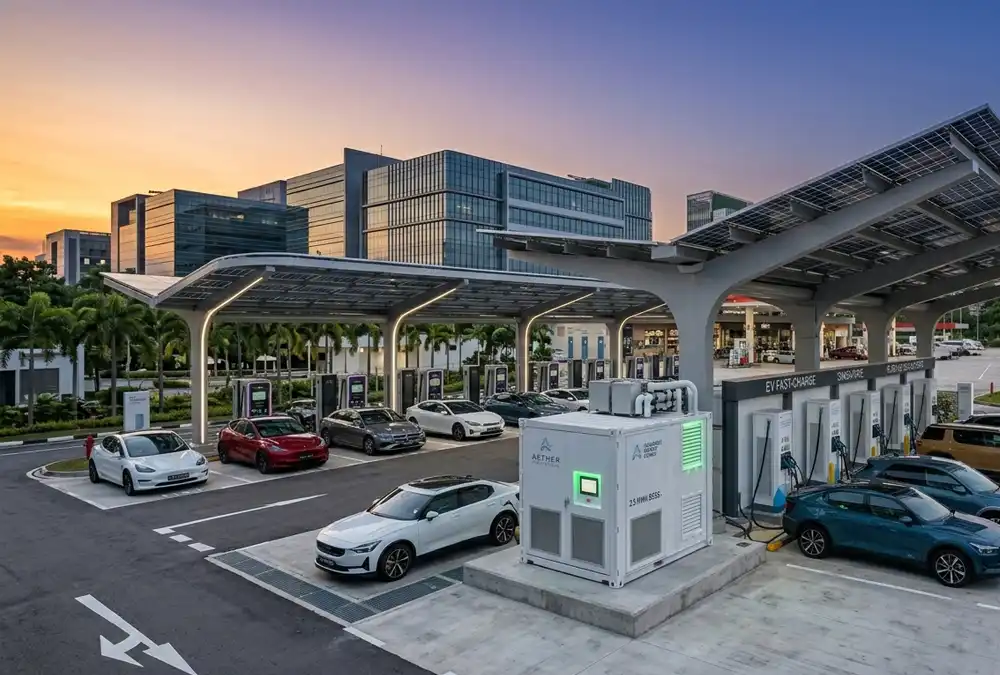
Combining rooftop or canopy solar PV with stationary battery storage helps establish a resilient, self-sustaining local microgrid. While solar arrays provide low-cost energy, their variable output can introduce load challenges when clouds pass over during active vehicle charging sessions.
Implementing an integrated Solar Plus Storage architecture resolves this clean energy volatility. The site EMS automatically routes excess solar generation into your battery cells during peak midday sun hours, creating a low-cost, zero-emission power reserve. This stored clean energy can then be smoothly dispatched into vehicles during evening commutes or morning startup spikes, maximizing renewable self-consumption, lowering grid reliance, and helping your business meet corporate sustainability milestones.
Industrial Product Recommendation: Liquid-Cooled BESS
For high-volume charging networks with frequent back-to-back fast charging cycles, we recommend specifying **All-in-One Outdoor Liquid-Cooled LFP Containers**. Unlike traditional air-cooled setups, advanced liquid cooling loops maintain consistent, stable temperatures across all cell surfaces within a tight ±2.5°C range.
This superior thermal management prevents localized hot spots during high-current discharges, improves round-trip energy efficiency by up to 4%, and protects your battery packs from premature degradation—safeguarding your long-term capital investment.
Commercial Battery Storage Applications for EV Charging
Choosing between a 1MW and 2MW platform requires aligning your system size with your specific property type and vehicle profiles:
- Urban Fast Charging Stations: Retail centers, shopping malls, and public downtown parking structures generally experience moderate vehicle dwell times. A modular 1MW system is often an ideal fit here, providing sufficient peak shaving capacity within a compact physical footprint.
- Highway Service Hubs: Long-distance travel plazas require ultra-fast 250kW to 350kW turn times. A high-output 2MW containerized system is essential for these locations to support multiple dispensers operating simultaneously without performance drops.
- Fleet Charging Depots: Commercial logistics hubs handling electric delivery vans or heavy trucks must manage large, concentrated loads when vehicles return for overnight charging. A 2MW BESS handles these simultaneous plug-in spikes smoothly, keeping fleet charging on schedule.
Containerized BESS Solutions for EV Charging Infrastructure
Modern commercial infrastructure projects have largely converged around pre-engineered Containerized BESS designs over traditional custom indoor battery installations. Housing your entire storage system within a weather-sealed steel ISO enclosure provides significant deployment advantages.
Because these durable enclosures are fully assembled, wired, and tested at the manufacturing facility under strict quality controls, on-site installation risks are practically eliminated. This approach minimizes required site civil works and allows for straightforward placement on a simple outdoor concrete pad next to your main substation. This external placement preserves valuable interior building square footage while providing a modular, scalable architecture that can grow alongside your charging infrastructure needs.
How to Choose Between a 1MW and a 2MW Battery Energy Storage System
To select the right system size for your project, your engineering team should follow this structured framework:
- Analyze Real Load Curves: Gather detailed 15-minute interval power data from your utility to map your site’s true peak energy usage.
- Assess Grid Limits: Work with your utility to identify your current transformer capacity limits and estimate the cost of future grid upgrades.
- Model Traffic Patterns: Calculate your expected daily vehicle throughput, accounting for high-traffic weekend spikes or synchronized fleet arrival windows.
- Plan for Expansion: Review your 3-to-5 year business plan to determine if you will need to add more high-power dispensers over time.
Common Challenges When Deploying Battery Energy Storage for EV Charging
Navigating large-scale energy infrastructure deployments requires careful management of a few key technical areas. System undersizing is a common challenge, where an underconfigured battery can quickly deplete during multi-vehicle rushes, exposing the site to demand charges. Conversely, over-sizing can tie up capital in unutilized capacity, lengthening your project’s payback window.
Ensuring full regulatory compliance is also critical for project success. Storage systems must meet rigorous international safety standards, including **UL 9540** for full system integration safety, **UL 9540A** cell-level fire testing protocols, and **NFPA 855** installation standards. Working with an experienced technical partner helps streamline the permitting process and ensures safe, reliable operation throughout your asset’s lifecycle.
Evaluating Storage Alternatives for Charging Infrastructure
While electrochemical battery storage is the most widely deployed solution for e-mobility infrastructure, it is helpful to understand alternative energy technologies that can support local load management:
- Flywheel Energy Storage: Flywheels store energy mechanically within a high-speed spinning rotor vacuum. They offer exceptional cycle life with minimal degradation and can deliver rapid high-power bursts, making them effective for smoothing brief vehicle plug-in spikes. However, their low energy density makes them less suitable for long-duration peak shaving compared to LFP batteries.
- Hydrogen Fuel Cell Systems: Hydrogen setups generate local power via an electrochemical reaction between hydrogen gas and oxygen. They provide reliable long-term energy backup and can decouple sites from grid capacity entirely. However, high current fuel supply logistics and lower round-trip conversion efficiencies mean they require careful financial modeling.
The Future of Battery Energy Storage Systems (BESS) for EV Charging
As the electrification sector matures, the role of intelligent storage will expand beyond simple local load buffering. Future charging networks will increasingly leverage AI-driven EMS platforms, using predictive machine learning to track regional weather shifts, vehicle queuing times, and real-time utility pricing to optimize battery performance.
Furthermore, the commercialization of Vehicle-to-Grid (V2G) bidirectional charging standards will eventually allow parked EVs to interact dynamically with stationary storage containers. This integration will transform public charging hubs into flexible distributed energy resources (DERs) capable of supporting smart grid stability during regional peak events, opening up new revenue streams for forward-thinking network operators.
Why Is Battery Energy Storage the Future of EV Charging?
Featured Snippet Answer: Battery energy storage is the future of EV charging because it bridges the gap between limited grid capacity and the high-power requirements of ultra-fast chargers. It enables rapid network scaling, lowers operational costs, and supports sustainable infrastructure growth without relying on long utility upgrade timelines.
Frequently Asked Questions About 1MW vs 2MW Battery Storage for EV Charging
Which is better for EV charging, a 1MW or 2MW battery storage system?
It depends on your station’s configuration and traffic. A 1MW system is an efficient, cost-effective choice for mid-sized commercial or retail charging sites, while a 2MW system is recommended for high-volume highway hubs or heavy commercial fleet depots requiring continuous high-power output.
How many fast chargers can a 1MW BESS support?
A 1MW system can comfortably support up to six 150kW fast-charging dispensers or up to two 350kW ultra-fast stalls under typical usage conditions by using smart power-sharing strategies to manage peak loads locally.
How many fast chargers can a 2MW BESS support?
A 2MW system can handle ten to twelve 150kW fast chargers or up to four 350kW ultra-fast charging units operating simultaneously at full continuous load, making it ideal for high-throughput transit locations.
Can a 1MW battery storage system be expanded later?
Yes. Most modern containerized storage solutions utilize a modular architecture, allowing operators to scale up power capacity over time by connecting additional battery containers in parallel as site demand grows.
Is solar integration recommended for EV charging stations?
Yes. Combining solar canopies with local battery storage creates a highly efficient microgrid. This integration allows you to capture low-cost solar energy during the day and save it to power vehicles during peak evening shifts, maximizing clean energy self-consumption.
Conclusion
Deciding between a 1MW and a 2MW system configuration is a key step in building a sustainable, high-performance charging network. By aligning your battery’s power rating with your property’s real-world traffic profiles, you can effectively bypass grid capacity bottlenecks and protect your business from expensive utility demand fees.
While a 1MW platform offers a modular, lower CAPEX entry point for urban retail and destination charging sites, a 2MW containerized system provides the high power delivery and future-proof design required for high-volume highway hubs and heavy commercial logistics. Proper system sizing helps ensure excellent equipment performance, shortens your project’s payback window, and establishes a resilient energy foundation optimized for long-term growth.
Optimize Your EV Charging Station Energy Infrastructure
Avoid project delays from utility grid constraints. Contact our application engineering group today to request a detailed site load profile analysis and receive a tailored equipment proposal optimized for your infrastructure goals.
Related Posts
 https://anengjibattery.com/wp-content/uploads/2026/10/AnengjiBattery-Cell-to-Pack-Energy-Density-Comparison.webp
675
1000
Battery Expert Team
https://anengjibattery.com/wp-content/uploads/2025/06/logo2-300x138.png
Battery Expert Team2026-10-23 06:58:392026-10-23 06:58:41What Does Lithium-Ion Battery Energy Density Really Mean?
https://anengjibattery.com/wp-content/uploads/2026/10/AnengjiBattery-Cell-to-Pack-Energy-Density-Comparison.webp
675
1000
Battery Expert Team
https://anengjibattery.com/wp-content/uploads/2025/06/logo2-300x138.png
Battery Expert Team2026-10-23 06:58:392026-10-23 06:58:41What Does Lithium-Ion Battery Energy Density Really Mean? https://anengjibattery.com/wp-content/uploads/2026/10/AnengjiBattery-Lithium-Battery-Management-in-Daily-Operation.webp
675
1000
Battery Expert Team
https://anengjibattery.com/wp-content/uploads/2025/06/logo2-300x138.png
Battery Expert Team2026-10-22 08:17:332026-10-23 06:58:57How Does a Lithium BMS Improve Battery Longevity?
https://anengjibattery.com/wp-content/uploads/2026/10/AnengjiBattery-Lithium-Battery-Management-in-Daily-Operation.webp
675
1000
Battery Expert Team
https://anengjibattery.com/wp-content/uploads/2025/06/logo2-300x138.png
Battery Expert Team2026-10-22 08:17:332026-10-23 06:58:57How Does a Lithium BMS Improve Battery Longevity? https://anengjibattery.com/wp-content/uploads/2026/10/AnengjiBattery-Industrial-Power-Under-Real-Load.webp
675
1000
Battery Expert Team
https://anengjibattery.com/wp-content/uploads/2025/06/logo2-300x138.png
Battery Expert Team2026-10-22 07:04:542026-10-22 07:05:30How Does a 48V LiFePO4 BMS Protect Industrial Power?
https://anengjibattery.com/wp-content/uploads/2026/10/AnengjiBattery-Industrial-Power-Under-Real-Load.webp
675
1000
Battery Expert Team
https://anengjibattery.com/wp-content/uploads/2025/06/logo2-300x138.png
Battery Expert Team2026-10-22 07:04:542026-10-22 07:05:30How Does a 48V LiFePO4 BMS Protect Industrial Power? https://anengjibattery.com/wp-content/uploads/2026/10/AnengJIBattery-Electric-Forklift-Battery-Buying-Decision.webp
675
1000
Battery Expert Team
https://anengjibattery.com/wp-content/uploads/2025/06/logo2-300x138.png
Battery Expert Team2026-10-21 06:22:222026-10-21 06:22:38Ready to Buy Battery for Electric Forklift? Use This Guide
https://anengjibattery.com/wp-content/uploads/2026/10/AnengJIBattery-Electric-Forklift-Battery-Buying-Decision.webp
675
1000
Battery Expert Team
https://anengjibattery.com/wp-content/uploads/2025/06/logo2-300x138.png
Battery Expert Team2026-10-21 06:22:222026-10-21 06:22:38Ready to Buy Battery for Electric Forklift? Use This Guide


Leave a Reply
Want to join the discussion?Feel free to contribute!