
4 12V Batteries in Series: How to Build a 48V Power System
July 25, 2026 / Battery Expert Team / Battery Basics
Introduction
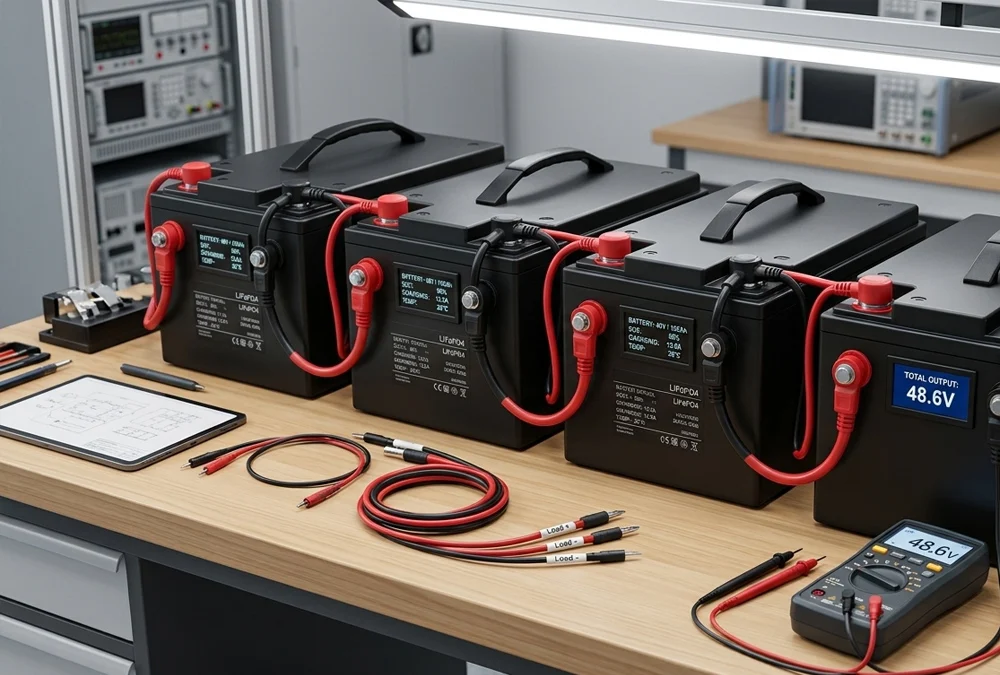
Need to turn several smaller battery blocks into a high-voltage power setup? Wiring 4 12V batteries in series gives you a clean 48V output for heavy-duty gear. Standard battery voltage calculation is dead simple: 12V + 12V + 12V + 12V = 48V. You boost the total electrical pressure while keeping the overall capacity rating in amp-hours (Ah) unchanged. Whether you build an off-grid solar bank or rewire an electric vehicle, getting this series connection of batteries right keeps your equipment running smoothly and safely.
What Does Connecting 4 12V Batteries in Series Mean? | Understanding Battery Series Connection
Connecting batteries in a row changes how electrical charge flows through your system. Let’s look at what happens inside the circuit when you hook up four individual blocks end-to-end.
Basic Concept of Connecting Batteries in Series
In a series string, current flows through each cell one after another. You attach the positive terminal of your first battery directly to the negative terminal of the next block. This daisy-chain configuration forces electron flow through every unit, stacking up their electrical pressure.
Here is the core rule for your setup:
$$\text{Total System Voltage} = \text{Individual Battery Voltage} \times \text{Number of Batteries}$$
The total charge capacity (Ah) stays equal to a single battery. If you connect four 12V 100Ah blocks, you get a 48V 100Ah system, not 400Ah.
Example: 4 × 12V Battery Configuration
Here is how individual voltage steps add up across a four-battery series string:
| Battery Order | Unit Voltage | Cumulative Voltage | Practical Advantage for Buyers |
|---|---|---|---|
| Battery 1 | 12V | 12V | Easy Handling: Light 12V blocks are far easier to carry than one huge 48V metal pack. |
| Battery 2 | 12V | 24V | Modular Upgrades: Standardized 12V components fit tight spaces easily. |
| Battery 3 | 12V | 36V | Wide Compatibility: Works with standard multi-stage chargers during build phases. |
| Battery 4 | 12V | 48V | Full Industrial Output: Delivers true 48V power with lower cable heat losses. |
Operational Advantage: Building a 48V bank from separate 12V units lets you swap out a single worn block if needed, saving you from replacing the whole battery pack at once.
Series Connection vs Parallel Connection
New builders often confuse series and parallel wiring. Parallel wiring joins positive to positive and negative to negative. That keeps voltage constant while stacking amp-hour capacity. Series wiring raises voltage while keeping amp-hours fixed.
| Connection Strategy | System Voltage Impact | Capacity (Ah) Impact | Primary Equipment Use Case |
|---|---|---|---|
| Series Connection | Increases (Sum of all units) | Stays the same | 48V Golf Carts, AGVs, Trolling Motors |
| Parallel Connection | Stays the same | Increases (Sum of all units) | 12V RV house power, low-voltage lighting |
Operational Advantage: Choosing series connections gives you the higher voltage needed for heavy electric drive motors without requiring thicker, expensive copper cabling.
Why Use 4 12V Batteries to Create a 48V Power System?
Stepping up to a 48V power setup solves major efficiency problems for heavy equipment owners. Moving beyond basic 12V or 24V circuits opens up better performance options.
Higher Efficiency for High Power Applications
Electrical power follows a simple relationship:
$$\text{Power (Watts)} = \text{Voltage (Volts)} \times \text{Current (Amps)}$$
If your golf cart motor needs 4800 Watts, running it at 12V pulls a massive 400 Amps! At 48V, that same load drops to just 100 Amps. Lower current draw reduces heat inside your wiring, cuts energy loss, and extends your operating range.
According to the Energy Storage System Cost Survey by BloombergNEF, commercial battery systems are moving toward higher voltages. Doubling circuit voltage cuts current requirements by half, reducing resistive heat losses ($I^2R$) by up to 75%.
Flexible Battery Replacement and Maintenance
Finding a local replacement for a single 12V battery is easy. If one cell inside a custom 48V monoblock fails, sourcing a replacement can take weeks. Standard 12V units keep replacement parts easy to find.
Suitable for 48V Electric Vehicles and Equipment
Higher system voltages deliver stable power to heavy drive motors. That is why 48V systems are the standard choice across many commercial applications:
- Golf Carts: Smooth acceleration and consistent hill-climbing power.
- AGVs & Forklifts: Reliable shift performance in automated warehouses.
- Electric Sightseeing Cars: Dependable power for carrying heavy passenger loads.
- Utility Vehicles & Tuk-Tuks: Strong torque for daily commercial hauling.
Why 48V Systems Are Becoming More Popular
Old 12V configurations struggle under modern heavy loads. Upgrading to a 48V battery system gives you cleaner power delivery and supports high-efficiency off-grid inverters for solar setups.
How Does a Series Battery Circuit Work? | Understanding 48V Battery Wiring Principles
Before grabbing your jumper cables, it helps to understand how current flows through a series battery circuit.
Current Flow in a Series Battery Connection
Electricity leaves the main negative terminal and travels through every internal plate across all four units before exiting the main positive line. Any break or loose lug along that chain stops power flow completely across your entire 48V system.
How Voltage Adds Up in Series Connection
Each 12V battery acts like an electrical booster step. The first block raises potential from 0V to 12V, the second pushes it to 24V, the third to 36V, and the fourth finishes at a full 48V nominal potential.
Important Electrical Rules When Connecting Batteries
Never mix different battery types in a series string! To avoid damaging your pack, make sure your batteries share key specs:
- Same Voltage Rating: Only pair 12V blocks together.
- Same Amp-Hour Capacity: Mixing a 50Ah unit with a 100Ah block causes the smaller battery to over-discharge and fail quickly.
- Same Chemistry: Never combine lead-acid and lithium batteries in the same string.
- Same Age & State of Charge: Always fully charge every battery individually before wiring them together in series.
What Do You Need Before Connecting 4 12V Batteries in Series?
Gather the right gear before starting installation to ensure a smooth, safe setup.
Four Matching 12V Batteries
Verify that all four batteries come from the same manufacturing batch whenever possible. Whether you use sealed lead-acid or a modern LiFePO4 battery pack, matching internal resistance prevents balance issues later.
Battery Cables and Connectors
Undersized interconnecting cables can melt under heavy motor loads! For 48V systems drawing 100A or more, use thick gauge copper wire (such as 2 AWG or 1/0 AWG) with heavy-duty tinned copper lugs.
Fuse, Circuit Breaker and Safety Protection
A short circuit across a 48V bank can create dangerous electrical arcs. Install a high-interrupting-capacity fuse (such as a Class T fuse) or an inline DC circuit breaker on the main positive lead.
Insulated Tools and Safety Equipment
Working around high-voltage DC requires proper safety precautions:
- Insulated Wrenches: Prevents accidental short circuits if a tool drops across terminals.
- Digital Multimeter: Essential for checking individual and total voltage levels.
- Safety Glasses & Gloves: Protects you from electrical sparks.
Step-by-Step Guide: How to Connect 4 12V Batteries in Series for 48V
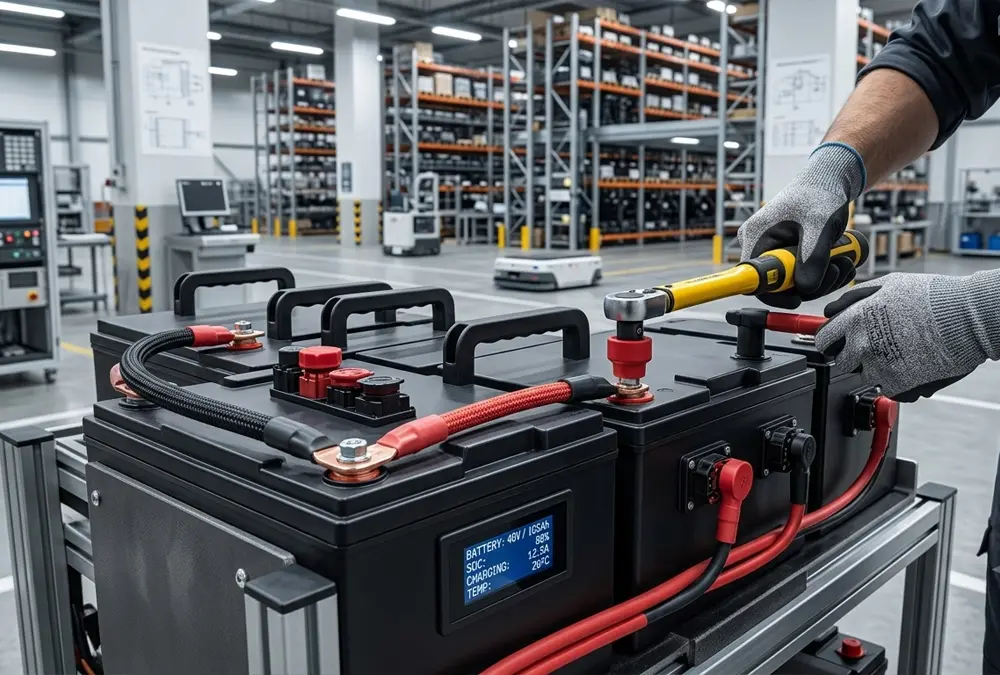
Follow these steps carefully to wire your four 12V batteries into a safe 48V power bank.
Step 1: Place Four Batteries in the Correct Position
Set your four batteries on a level, secure surface close together. Position them so the positive terminal of one unit sits near the negative terminal of the next block. That keeps your interconnecting jumper cables short and neat.
Step 2: Check Each Battery Voltage Before Connection
Take your digital multimeter and measure every unit individually. Every 12V lead-acid battery should read around 12.6V to 12.8V at full charge. A 12V lithium battery usually reads between 13.3V and 13.4V when fully charged. If one block reads lower than the rest, charge it individually before connecting your string.
Step 3: Connect Battery 1 Positive to Battery 2 Negative
Attach your first short jumper cable from the positive terminal (+) of Battery 1 directly to the negative terminal (-) of Battery 2. Tighten the connection securely using an insulated wrench.
Step 4: Connect Battery 2 Positive to Battery 3 Negative
Take your second jumper cable and connect the positive terminal (+) of Battery 2 to the negative terminal (-) of Battery 3.
Step 5: Connect Battery 3 Positive to Battery 4 Negative
Connect your third jumper cable from the positive terminal (+) of Battery 3 to the negative terminal (-) of Battery 4. You now have three jumper cables linking your four blocks together in series.
Step 6: Identify the Main Positive and Negative Output Terminals
You will have two open terminals left over on your string:
- Main System Negative (-): The open negative terminal on Battery 1.
- Main System Positive (+): The open positive terminal on Battery 4.
These two open posts supply your main 48V output to your load or vehicle controller.
Step 7: Measure the Total Voltage Output
Place your multimeter leads on the main positive and negative posts. Your meter should display a steady combined output of approximately 48V to 53.6V, depending on your cell chemistry.
How to Check If 4 12V Batteries Are Connected Correctly?
Checking your work with proper testing steps ensures your system is safe to power up.
Use a Multimeter to Measure Total Voltage
If your total voltage reading equals the sum of all four batteries, your series circuit is complete. If your meter shows 0V, check for a loose cable lug or blown fuse along the string.
Check Individual Battery Voltage Balance
Periodically test each battery while operating under load. If Battery 1 reads 12.1V while Battery 3 drops to 11.2V under load, your string is imbalanced. Imbalance cuts your overall runtime and can shorten the lifespan of your individual batteries.
Common Wiring Mistakes to Avoid
Watch out for these frequent mistakes when building a 48V system:
- Reversing Polarity: Accidentally joining positive to positive creates a short circuit that can spark and ruin terminals.
- Loose Terminal Bolts: Loose bolts raise connection resistance, causing heavy voltage drops and heat buildup under high loads.
- Mixed Wire Gauges: Using thin jumper cables between thick main output leads creates dangerous heat bottlenecks.
4 12V Batteries in Series vs Parallel Connection: Which Is Better?
Deciding between series and parallel setups comes down to your equipment’s operating requirements.
Series Connection for Higher Voltage
Wiring in series is ideal when your motor or inverter needs 48V input. It keeps overall operating current low, reduces wire size needs, and boosts overall running efficiency across heavy machinery.
Parallel Connection for Higher Capacity
Wiring four 12V 100Ah batteries in parallel keeps system voltage at 12V while boosting total capacity to 400Ah. This setup suits low-voltage DC applications that need long runtimes without high motor torque.
Combining Series and Parallel Battery Configurations
Need both high voltage and high capacity? You can combine both wiring strategies into a series-parallel setup. Connecting eight 12V 100Ah batteries in a 4S2P array gives you a 48V 200Ah system, perfect for commercial solar storage bank builds.
When Is a 48V Battery System Better Than 12V or 24V?
Choosing 48V architecture offers clear operational performance benefits over lower-voltage designs.
48V System for Electric Vehicles
A golf cart 48V battery conversion delivers noticeably better acceleration and hill-climbing torque than older 36V setups. Lower operating currents keep motor controllers cooler during heavy daily use.
48V System for Industrial Equipment
Automated Guided Vehicles (AGVs) operating in warehouse hubs rely on 48V systems for stable shift performance. Lower cable heat loss keeps equipment running longer between charges, cutting unexpected downtime.
48V System for Solar Energy Storage
Off-grid solar setups benefit from 48V architecture because modern high-capacity inverters operate most efficiently at this input voltage. Lower amperage lets you run smaller, cost-effective wiring from your solar array.
4 12V Batteries vs One 48V Lithium Battery: Which Solution Is Better?
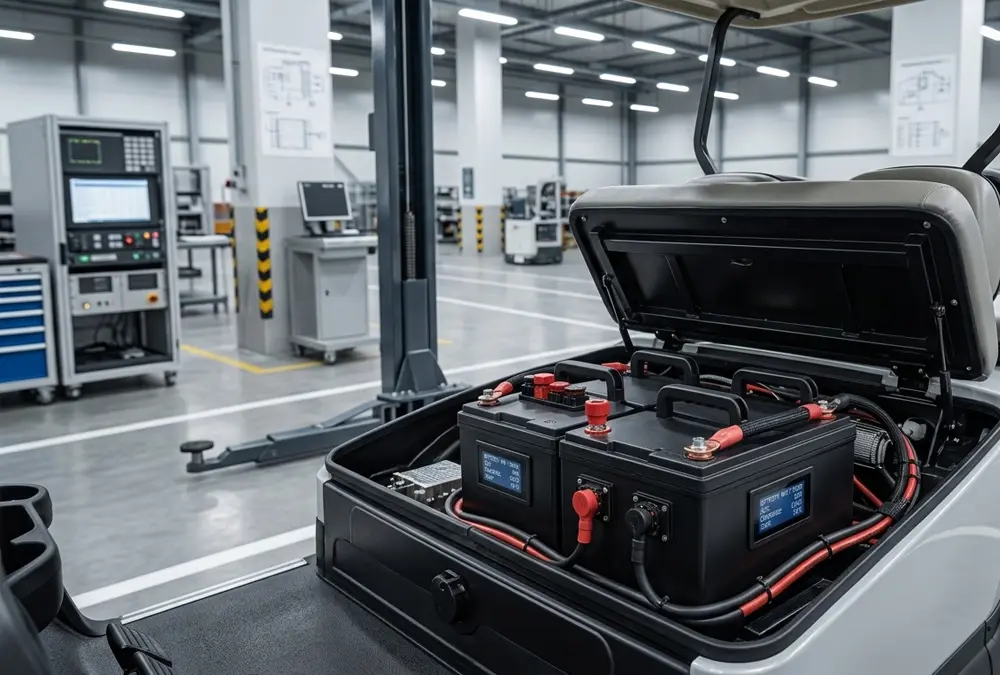
Wiring four separate 12V batteries together works, but modern single-pack 48V lithium solutions offer a cleaner, more efficient alternative.
Traditional 4 × 12V Lead Acid Battery Solution
Using four 12V lead-acid batteries offers a low initial purchase cost, but comes with heavy tradeoffs:
- Heavy Total Weight: Four lead-acid blocks can weigh over 240 lbs, straining vehicle suspensions.
- Short Cycle Life: Typically lasts just 300 to 500 charge cycles before capacity degrades.
- High Maintenance: Flooded models require regular water refills and terminal corrosion cleaning.
48V LiFePO4 Battery Pack Solution
Upgrading to a single 48V lithium battery pack provides substantial performance improvements:
- Long Service Life: Delivers 3,500 to 5,000+ deep discharge cycles.
- Lightweight Design: Weighs up to 70% less than equivalent lead-acid setups.
- Built-in Protection: An integrated battery management system (BMS) automatically guards against over-voltage, cell imbalance, and short circuits.
| Key Performance Metric | 4 × 12V Lead-Acid Array | Single 48V Lithium Pack | Direct Buyer Benefit |
|---|---|---|---|
| Usable Depth of Discharge | 50% Max recommended | 95% – 100% Usable range | Nearly Double Usable Runtime: Get more working energy out of the same rated capacity. |
| Expected Cycle Lifespan | 300 – 500 Cycles | 3,500 – 5,000+ Cycles | Lower Replacement Cost: Lasts up to 10 years without needing frequent replacements. |
| Routine Maintenance | High (Refill water, clean acid rust) | Zero Maintenance | Saved Labor Hours: Cuts weekly maintenance chores for fleet operators. |
Operational Advantage: Upgrading to a single 48V lithium pack eliminates messy inter-battery wiring, reducing potential connection failure points.
Why Many Industries Upgrade to 48V Lithium Batteries
Fleet operators across the golf, material handling, and solar sectors are replacing old multi-battery setups with single 48V lithium units. Eliminating jumper cables cuts resistance losses while reducing weight and maintenance demands.
Frequently Asked Questions About 4 12V Batteries in Series
How many volts do 4 12V batteries make?
Connected in series, four 12V batteries deliver a combined output of 48 Volts nominal.
Can I connect four lithium batteries in series?
Yes, but only if your 12V lithium batteries feature an integrated BMS explicitly rated for series connection up to 48V. Always check your manufacturer’s specs first.
Do 4 batteries in series increase amp hours?
No, series wiring increases total system voltage, but your overall capacity stays equal to a single battery’s amp-hour rating.
Can four 12V batteries replace a 48V battery?
Yes. As long as your four 12V batteries share matching chemistry and capacity ratings, they can replace a single 48V pack in most applications.
Is a 48V lithium battery better than four 12V batteries?
Yes. A single 48V lithium module eliminates extra wiring points, saves physical space, cuts down total weight, and uses a centralized BMS for better safety.
Upgrade Your 48V Battery System with Custom LiFePO4 Solutions
Tired of hassle with complex multi-battery wiring setups? Our engineering team designs custom 48V LiFePO4 battery systems tailored specifically for electric vehicles, AGVs, and industrial storage projects. Each unit features Grade-A cells, smart BMS protection, and long service lifespans to keep your equipment running smoothly. Contact our technical team today to discuss your 48V power requirements or request a custom OEM quote!
Related Posts
 https://anengjibattery.com/wp-content/uploads/2026/09/AnengJIBattery-Best-LiFePO4-Battery-How-to-Choose-the-Right-One.webp
675
1000
Battery Expert Team
https://anengjibattery.com/wp-content/uploads/2025/06/logo2-300x138.png
Battery Expert Team2026-09-17 08:52:142026-09-17 08:52:31How to Choose the Best LiFePO4 Battery
https://anengjibattery.com/wp-content/uploads/2026/09/AnengJIBattery-Best-LiFePO4-Battery-How-to-Choose-the-Right-One.webp
675
1000
Battery Expert Team
https://anengjibattery.com/wp-content/uploads/2025/06/logo2-300x138.png
Battery Expert Team2026-09-17 08:52:142026-09-17 08:52:31How to Choose the Best LiFePO4 Battery https://anengjibattery.com/wp-content/uploads/2026/09/anengjiBattery-lifepo4-battery-cell-packaging-wholesale.webp
675
1000
Battery Expert Team
https://anengjibattery.com/wp-content/uploads/2025/06/logo2-300x138.png
Battery Expert Team2026-09-16 09:52:342026-09-16 09:52:57LiFePO4 Battery Wholesale Guide: Best Suppliers in Spain
https://anengjibattery.com/wp-content/uploads/2026/09/anengjiBattery-lifepo4-battery-cell-packaging-wholesale.webp
675
1000
Battery Expert Team
https://anengjibattery.com/wp-content/uploads/2025/06/logo2-300x138.png
Battery Expert Team2026-09-16 09:52:342026-09-16 09:52:57LiFePO4 Battery Wholesale Guide: Best Suppliers in Spain https://anengjibattery.com/wp-content/uploads/2026/09/anengjibattery-Top-Lithium-Ion-Battery-Producers-for-Spain-Market-Growth.webp
675
1000
Battery Expert Team
https://anengjibattery.com/wp-content/uploads/2025/06/logo2-300x138.png
Battery Expert Team2026-09-16 01:13:392026-09-16 01:14:05Top Lithium Ion Battery Producers for Spain’s Market Growth
https://anengjibattery.com/wp-content/uploads/2026/09/anengjibattery-Top-Lithium-Ion-Battery-Producers-for-Spain-Market-Growth.webp
675
1000
Battery Expert Team
https://anengjibattery.com/wp-content/uploads/2025/06/logo2-300x138.png
Battery Expert Team2026-09-16 01:13:392026-09-16 01:14:05Top Lithium Ion Battery Producers for Spain’s Market Growth https://anengjibattery.com/wp-content/uploads/2026/09/Bulk-Lithium-Ion-Battery-Cells-Procurement-Guide-B2B-Sourcing.webp
675
1000
Battery Expert Team
https://anengjibattery.com/wp-content/uploads/2025/06/logo2-300x138.png
Battery Expert Team2026-09-14 09:47:322026-09-14 09:47:48Bulk Lithium-Ion Battery Cells Procurement Guide | B2B Sourcing
https://anengjibattery.com/wp-content/uploads/2026/09/Bulk-Lithium-Ion-Battery-Cells-Procurement-Guide-B2B-Sourcing.webp
675
1000
Battery Expert Team
https://anengjibattery.com/wp-content/uploads/2025/06/logo2-300x138.png
Battery Expert Team2026-09-14 09:47:322026-09-14 09:47:48Bulk Lithium-Ion Battery Cells Procurement Guide | B2B Sourcing


Leave a Reply
Want to join the discussion?Feel free to contribute!