
How to Choose a Solar EPC Company for Industrial and Utility Projects
June 9, 2026 / Battery Expert Team / battery energy storage
Introduction
Navigating the execution of commercial and utility-scale energy projects demands deep engineering acumen, meticulous regulatory alignment, and rigorous asset integration. For project developers, factory owners, and clean-energy investors, building a highly reliable generation facility requires managing complex hardware logistics and demanding grid interconnection rules. Partnering with a professional, tier-1 Solar EPC Company provides a clear competitive advantage by consolidating all structural phases under a single framework. This integrated contract structure transfers complex execution risks directly away from the project owner, ensuring that massive capital expenditures are successfully converted into highly efficient, high-yielding renewable energy plants that deliver predictable returns over their multi-decade lifecycles.
What Is a Solar EPC Company?
Quick Definition of a Solar EPC Company
A Solar EPC Company is responsible for the engineering, procurement, and construction of solar energy projects. Acting as a single point of responsibility, the EPC contractor manages system design, equipment sourcing, installation, testing, commissioning, and project delivery to ensure performance, quality, and budget compliance.
What Does EPC Stand For?
The abbreviation EPC captures the three fundamental pillars required to take a complex energy concept and transform it into a fully live, synchronized asset:
- Engineering (E): This phase involves advanced physical site layout design, detailed civil works assessments, meticulous electrical string configuration, and complex structural safety calculations.
- Procurement (P): This function covers the strategic sourcing, supply chain logistics, factory quality control, and timely delivery of high-value system hardware.
- Construction (C): This represents the physical field execution, covering everything from civil ground preparation to full mechanical assembly, high-voltage electrical synchronization, and complete system commissioning.
Why Solar EPC Companies Matter in Renewable Energy Projects
Developing utility-scale and industrial clean energy systems involves navigating a highly fragmented, complex web of equipment suppliers, local grid regulators, and field labor groups. By choosing a comprehensive turnkey solar epc company, asset owners significantly reduce project execution complexity. This single-contract model removes the administrative burden of managing disjointed third-party vendors separately. As a result, commercial entities secure reliable cost certainty, minimize expensive schedule friction, and benefit from highly accelerated, standardized asset deployments.
Why Solar EPC Is Critical for Project Success
Ensuring Projects Are Delivered on Time
For commercial building investors and industrial facility managers, project timeline delays directly result in lost energy savings and deferred financial returns. A master solar epc company prevents these bottlenecks by aligning engineering schedules directly with procurement timelines. This allows them to order long-lead electrical items—such as high-voltage transformers and heavy-duty switchgear—well in advance while local site construction permits are still being finalized, keeping the entire project strictly on schedule.
Controlling Project Costs and Budget Risks
Traditional multi-contractor approaches frequently suffer from expensive change orders, as independent construction crews often blame separate design firms for structural layout miscalculations. A unified provider of comprehensive solar installation services eliminates these budget overruns. Because a single firm takes complete contractual ownership of both the initial design blueprints and the final physical installation, they absorb any potential field alignment risks, guaranteeing excellent price predictability throughout the project lifecycle.
Maximizing Long-Term Solar Plant Performance
A solar installation is a long-term capital investment designed to generate reliable power for over 25 years. Ensuring this performance requires precise technical integration between high-efficiency PV arrays, advanced smart inverters, and localized medium-voltage utility connections. Leading firms specializing in end-to-end solar project development design each plant to maximize long-term Performance Ratios (PR) and minimize ongoing system degradation, ensuring the installation consistently achieves its projected financial returns.
Providing a Single Point of Accountability
The biggest operational advantage of utilizing a dedicated Solar EPC Company is the complete consolidation of contract accountability. Having a single point of responsibility eliminates the common finger-pointing and communication delays that occur when coordinating independent design firms and field sub-contractors. If a technical challenge arises during grid synchronization or commissioning, the master EPC firm is legally obligated to resolve it promptly, ensuring a smooth project delivery.
Engineering, Procurement, and Construction: The Three Pillars of Solar EPC
Engineering Design Services
The foundation of long-term asset profitability rests on high-quality solar engineering services. This initial phase involves translating raw land or rooftop measurements into optimized, high-fidelity technical blueprints. Key engineering steps include:
- Conducting detailed drone-based structural and topographical site assessments.
- Performing high-resolution solar irradiance profiling and advanced shading simulations.
- Designing complete electrical single-line diagrams, protective relay coordination networks, and optimized DC/AC wire routing layouts.
- Developing robust wind-load and seismic-resistant structural foundation plans.
Procurement and Equipment Sourcing
Maximizing system reliability requires utilizing high-quality, bankable equipment components sourced through professional solar procurement services. A leading EPC contractor leverages large-scale global purchasing power to procure Tier-1 hardware directly from top-rated manufacturers. The primary hardware categories include high-efficiency N-type bifacial solar modules, advanced smart string or central inverters, durable tracking or fixed racking structures, cloud-based SCADA monitoring platforms, and integrated containerized Battery Energy Storage Systems (BESS).
Construction and Installation
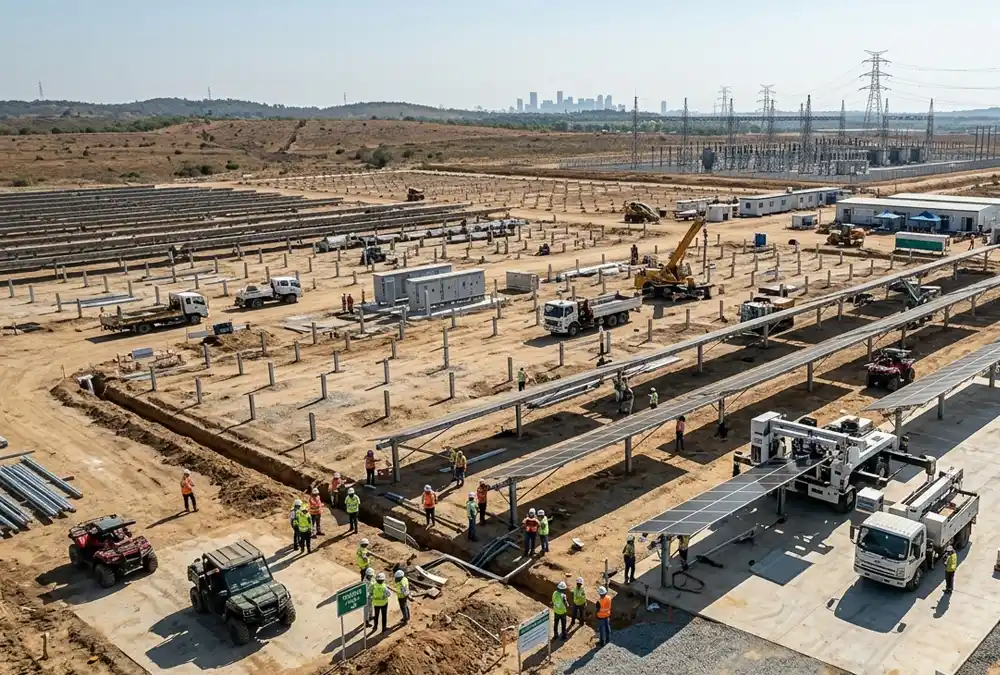
The physical delivery of the generation facility relies on the execution capabilities of a specialized solar construction company. Field teams manage complex civil grading works, drive structural steel piles, assemble massive racking systems, and safely integrate all medium-to-high voltage electrical infrastructure. Throughout this physical assembly phase, senior project managers enforce strict international safety standards, minimizing field liabilities and ensuring the site successfully passes rigorous local utility grid interconnection inspections.
Typical Roles and Responsibilities of a Solar EPC Company
A reliable Solar EPC Company does not just act as a physical builder; they serve as your comprehensive asset manager throughout the entire development lifecycle. Their core contractual responsibilities include:
- Project Feasibility Assessment: Evaluating local utility interconnection capacities, performing soil stability tests, and calculating precise financial model forecasts.
- Engineering & Design Management: Generating certified construction blueprints that strictly comply with local building regulations and regional electrical codes.
- Procurement & Supply Chain Coordination: Managing all international shipping logistics, customs clearances, and factory acceptance testing protocols.
- Construction Supervision: Directing all on-site civil, mechanical, and electrical installation crews under strict quality control guidelines.
- Testing & Commissioning: Performing rigorous insulation resistance, open-circuit voltage, and short-circuit current testing prior to commercial operations.
- Warranty & After-Sales Support: Providing long-term workmanship guarantees and managing component replacement requests with hardware manufacturers.
- Operation & Maintenance Coordination: Transitioning the fully energized plant over to automated monitoring and preventive maintenance schedules.
Solar EPC Process Explained Step by Step
To successfully deliver a large-scale power plant, an experienced solar epc company for industrial projects follows a highly structured, phase-gate execution model. This disciplined sequence ensures that every phase—from initial planning through to asset handover—meets strict technical standards, minimizing risks at every step.
Step 1 – Request for Proposal (RFP) and Initial Consultation
The asset owner releases an RFP outlining their energy goals, current load profiles, and site parameters. The EPC firm reviews this data to propose an optimized technical solution.
Step 2 – Site Survey and Feasibility Study
Engineers deploy on-site to perform geotechnical drilling, structural roof integrity testing, and localized shading evaluations to confirm the project is fully viable.
Step 3 – System Design and Engineering
The engineering team creates highly detailed 3D layouts, complete electrical wiring diagrams, and files for necessary municipal building permits and utility interconnection approvals.
Step 4 – Budgeting and Contract Negotiation
Both parties finalize a transparent, fixed-price EPC contract that includes clear milestones, guaranteed completion dates, and explicit performance ratio metrics.
Step 5 – Procurement and Manufacturing
The procurement team places factory orders for Tier-1 modules, smart inverters, and long-lead transformers, carefully managing logistics to match the on-site construction timeline.
Step 6 – Construction and Installation
Dedicated field crews execute civil grading, build structural racking, mount the PV modules, and install all high-voltage electrical balance of system (BOS) components.
Step 7 – Testing and Commissioning
Commissioning specialists conduct extensive safety testing, verify anti-islanding protections, and secure formal Permission to Operate (PTO) from the utility company.
Step 8 – Project Handover
The contractor delivers comprehensive as-built engineering drawings, factory component manuals, and complete testing certifications directly to the facility owner.
Step 9 – Final Payment and Warranty Activation
Upon verifying initial performance metrics, final milestone payments are completed, and long-term workmanship and power output warranties are formally activated.
What Are the Main Stages of a Solar EPC Project?
- Comprehensive project feasibility assessment
- Detailed structural and electrical engineering design
- Strategic Tier-1 equipment procurement and logistics management
- On-site civil works, mechanical assembly, and electrical construction
- Rigorous system safety testing and performance verification
- Utility grid interconnection and final commissioning
- Formal project asset handover and documentation transfer
- Long-term O&M performance support
EPC vs EPCM and Other Solar Project Contract Models
When planning a large-scale clean energy investment, project developers must choose the right contract delivery model. Understanding the differences between standard Engineering, Procurement, and Construction (EPC) and Engineering, Procurement, and Construction Management (EPCM) is essential for proper risk allocation.
Under a standard EPC contract, the **Solar EPC Company** assumes total commercial and legal liability for the project, delivering a completed asset for a fixed price. In contrast, an EPCM model positions the firm purely as a professional consultant. Under EPCM, the asset owner must sign individual contracts with dozens of separate equipment suppliers and construction crews, bearing all the financial risk of schedule delays or design conflicts. For most commercial entities looking to minimize risk, the turnkey EPC model is the preferred choice.
| Evaluation Factor | Turnkey EPC Contract Model | EPCM Consultant Model |
|---|---|---|
| Contractual Responsibility | Single Point Accountable: The contractor handles all phases and bears full liability. | Multiple Contracts: Owner signs separate agreements with each individual vendor. |
| Cost Certainty & Guarantees | High Certainty: Fixed turnkey pricing protects the owner from unexpected cost overruns. | Variable Costs: Project costs fluctuate based on individual supplier performance. |
| Risk Allocation | Transferred to EPC Firm: Contractor covers costs from delays or engineering errors. | Retained by Owner: Owner bears all financial risks from schedule delays or construction issues. |
| Management Effort Required | Minimal Effort: Owner simply monitors key milestones through one point of contact. | Extremely High Effort: Owner must actively coordinate multiple independent vendors. |
When Should You Choose EPC?
The standard EPC model is the ideal choice for commercial corporations, industrial factory owners, and financial investment groups who want clear cost certainty, fixed delivery timelines, and guaranteed system performance without dedicating extensive internal engineering teams to manage day-to-day field construction.
When Is EPCM More Appropriate?
The EPCM approach is typically reserved for large utilities or experienced international energy developers who maintain large, in-house engineering and procurement divisions. These organizations prefer to maintain direct control over every single vendor contract and are comfortable absorbing field execution risks in exchange for more granular control over specialized project components.
Solar EPC Pricing and Major Cost Drivers
Understanding capital expenditure (CAPEX) allocations is essential for maximizing project returns. A turnkey solar epc company budget breaks down into several distinct cost centers:
- Engineering Costs (5% – 8%): Includes geotechnical drilling, 3D shading simulations, structural wind testing, and utility grid interconnection studies.
- Equipment Procurement Costs (60% – 75%): The largest financial investment, covering high-efficiency PV modules, smart string or central inverters, tracking systems, and balance of system (BOS) materials.
- Construction and Labor Costs (15% – 20%): Covers local site labor, heavy machinery rentals, civil engineering works, and physical electrical integration.
- Grid Connection Costs (5% – 10%): Includes line extensions, protective switchgear, and utility-required transformer upgrades.
- Permitting and Compliance Costs (2% – 4%): Covers municipal building permits, environmental impact clearances, and structural safety certifications.
- Battery Storage Integration Costs: Varies by project scale, covering advanced containerized BESS hardware, dedicated battery management systems (BMS), and bidirectional inverter integrations.
Solar EPC Quality Control, Standards, and Testing Requirements
Ensuring a solar power plant performs reliably over its 25-year operational life requires strict quality control throughout the construction lifecycle. Top tier-1 firms follow rigorous quality assurance programs, sourcing components that hold verified international safety certifications such as IEC standards for PV module durability, UL standards for inverter safety, and ISO certifications for environmental management.
Before any asset goes live, it must pass a strict sequence of field inspections. This begins with Factory Acceptance Testing (FAT) to verify equipment performance before it leaves the manufacturer, followed by Site Acceptance Testing (SAT) once components are installed in the field. Finally, comprehensive Performance Ratio (PR) testing measures the plant’s actual weather-adjusted power output against its engineered design models, proving the system meets its promised performance levels before formal handover.
Key Performance Indicators and Solar EPC Warranties
To protect your capital investment, turnkey contracts include explicit, enforceable financial and performance guarantees:
- Energy Yield Guarantees: A contractual promise specifying the minimum annual kilowatt-hours ($kWh$) of electricity the system will generate under normal weather conditions.
- Performance Ratio (PR): An international metric measuring the overall efficiency of the plant by comparing actual power output against theoretical design capacity, independent of changing weather conditions.
- System Availability: A guarantee that the plant’s critical electrical systems will be operational and ready to generate power a minimum percentage of the time (typically 99% or higher).
- Defect Liability Period (DLP): A dedicated post-handover period (usually 1 to 2 years) during which the EPC firm must repair any structural or installation defects at no cost to the owner.
- Workmanship Warranty: A comprehensive guarantee protecting the asset owner against any installation faults or assembly errors caused by field construction crews.
Common Solar EPC Risks and How Contracts Reduce Them
Large-scale energy projects face a variety of real-world challenges, including unexpected weather delays, supply chain disruptions, and complex grid connection requirements. A professional commercial solar epc company uses robust contract structures to actively mitigate these operational risks:
- Design and Performance Risks: Reduced by including strict, enforceable Performance Ratio guarantees backed by financial penalties if the system underperforms.
- Procurement and Material Delays: Addressed through direct supply contracts with tier-1 manufacturers and maintaining diversified, global supply chains.
- Construction and Cost Overruns: Controlled using fixed-price turnkey contracts that shield the asset owner from unexpected material or labor cost increases.
- Grid Connection Delays: Mitigated by dedicating experienced, in-house regulatory teams to manage utility interconnection applications from day one.
To ensure full accountability, standard contracts incorporate explicit Liquidated Damages (LDs) clauses. If the contractor fails to achieve the agreed commercial operation date or misses guaranteed performance targets, they must provide direct financial compensation to the owner, keeping the investment project secure.
How to Choose the Right Solar EPC Company
Selecting the right partner is the most critical factor in determining your project’s long-term financial success. To assist your team during the evaluation process, use this practical selection checklist:
Practical Solar EPC Company Selection Checklist
- ✅ Proven Project Experience: Does the firm have a strong, verified portfolio of successfully operating commercial and utility-scale installations?
- ✅ Strong Engineering Team: Are all structural, civil, and electrical designs managed by certified, in-house engineering specialists?
- ✅ Bankable Equipment Suppliers: Does the company maintain direct supply relationships with tier-1, Tier-1-rated equipment manufacturers?
- ✅ Transparent Pricing Models: Does the contract offer a clear, fixed-price turnkey structure with no hidden fees or open-ended costs?
- ✅ Performance Guarantees: Are the energy yield and performance ratio metrics backed by clear financial remedies and liquidated damages?
- ✅ Safety Compliance Records: Does the firm maintain a verified, incident-free safety record across past industrial construction sites?
- ✅ Comprehensive O&M Support: Can the provider deliver long-term asset management, cloud-based monitoring, and rapid maintenance support?
- ✅ Financial Stability: Does the contractor possess the strong balance sheet and bonding capacity required to secure large project investments?
Post-Commissioning Handover and Solar O&M Services
Achieving commercial operations is a major milestone, but a successful project handover requires a seamless transition into its long-term operational lifecycle. A reliable utility scale solar epc company provides complete asset documentation, including detailed as-built blueprints, factory warranty sheets, electrical safety reports, and complete system testing records. Concurrently, their engineers conduct comprehensive hands-on training for the owner’s on-site facilities team to ensure safe day-to-day operations.
To safeguard the facility’s financial returns over its 25+ year lifespan, the asset should transition into a structured, proactive Operations & Maintenance (O&M) program. This includes 24/7 remote monitoring via smart SCADA software to instantly flag any string anomalies, scheduled preventive panel cleanings and electrical thermal scans, and fast predictive maintenance to fix minor issues before they cause unexpected system downtime or lost energy revenue.
Technical Spotlight: Industrial Battery Storage Integration & Alternatives
For modern industrial facilities, deploying on-site energy storage is essential for managing peak electrical loads and ensuring power resilience. Selecting the right technology requires a clear understanding of your operational needs:
Battery Technologies Decoded
- Lithium Iron Phosphate (LFP): The dominant industry standard for stationary energy storage. LFP chemistry offers exceptional thermal stability and fire safety, eliminating the risk of thermal runaway. It delivers a long operational life—often exceeding 6,000 to 8,000 full cycles at 80% Depth of Discharge—making it ideal for daily industrial peak-shaving.
- Solid-State Energy Storage: An emerging alternative entering premium industrial projects between 2025 and 2026. By replacing liquid electrolytes with a solid conductive medium, these units provide significantly higher energy density and improved safety profiles, though they carry higher initial manufacturing costs.
Alternative Industrial Storage Technologies
- Vanadium Redox Flow Batteries: A highly scalable alternative optimized for long-duration storage needs (exceeding 8+ hours). Energy is stored in external liquid electrolyte tanks, resulting in zero cell degradation over decades of continuous use, though they require a larger physical installation footprint.
- Green Hydrogen Storage Systems: A cutting-edge long-duration energy solution. Excess daytime solar power runs an electrolyzer to split water into hydrogen gas, which is stored under pressure. This hydrogen can later be converted back into electricity via fuel cells or used directly as clean fuel for industrial manufacturing.
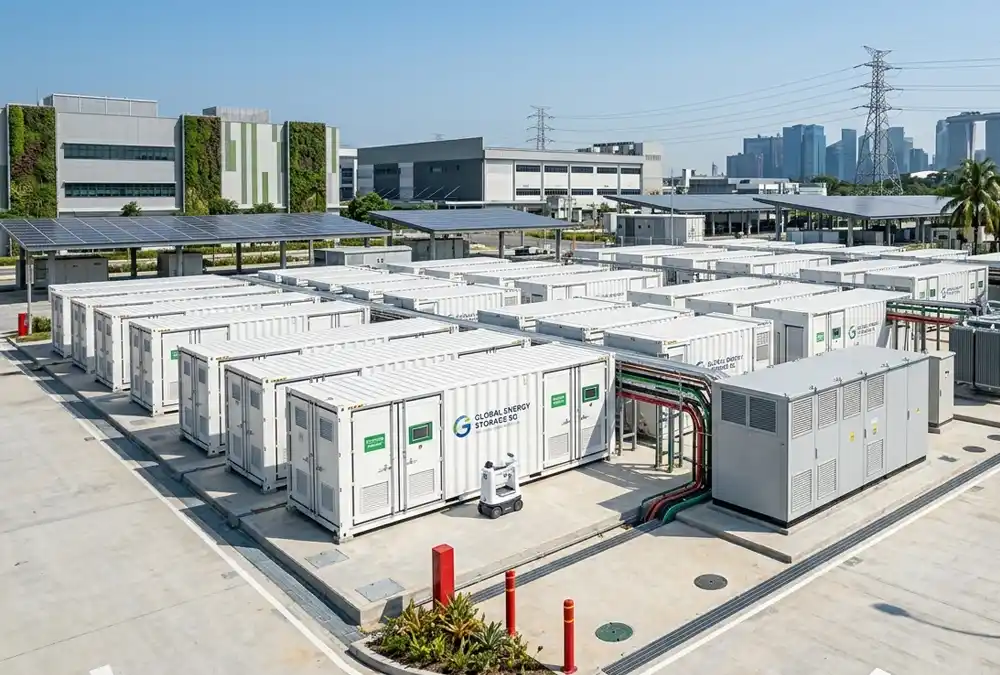
Recommended Industrial Solution: For standard commercial and industrial facilities, we highly recommend deploying pre-engineered, liquid-cooled LFP Containerized BESS Projects (ranging from 2MWh to 5MWh capacities). These systems feature integrated smart battery management systems (BMS) and automated HVAC units, delivering the ideal combination of high round-trip efficiency, proven fire safety, and fast financial payback.
Frequently Asked Questions About Solar EPC Companies
What does a Solar EPC Company do?
A specialized EPC company manages the entire lifecycle of a solar project under a single contract. They handle everything from early engineering design and global equipment procurement to physical construction, grid connection, safety testing, and final handover.
What is included in EPC services?
Turnkey EPC services include site surveys, geotechnical drilling, structural and electrical engineering, component sourcing, logistics management, civil works, physical installation, grid synchronization, utility commissioning, and long-term O&M planning.
How much does a Solar EPC project cost?
Total project costs depend on total capacity, site layout complexities, local grid upgrade requirements, and whether energy storage is included. Commercial and industrial installations benefit from significant economies of scale, making custom engineering reviews necessary to provide a fixed turnkey price.
What is the difference between EPC and EPCM?
Under an EPC contract, the contractor provides a fixed price and assumes all financial and execution risks for delivering a completed plant. In an EPCM model, the firm acts purely as a consultant, leaving the owner to sign separate contracts with multiple vendors and bear all project execution risks.
How long does a Solar EPC project take?
A typical commercial or industrial installation takes between 3 to 6 months from initial design to final grid synchronization. Large utility-scale projects can take from 9 months to over a year, depending on local permitting and utility interconnection timelines.
What warranties should a Solar EPC Company provide?
A reputable contractor provides a comprehensive 1 to 2-year workmanship warranty covering all installation items, along with explicit system availability and weather-adjusted performance ratio guarantees, while also passing along long-term factory warranties from hardware manufacturers.
Can EPC contractors integrate battery energy storage systems?
Yes, absolutely. Leading modern contractors offer specialized solar farm construction and integrated solar-plus-storage solutions, combining PV arrays with containerized battery systems (BESS) to enable advanced peak shaving and independent microgrid operations.
Partner with an Experienced Solar EPC Company for Reliable Project Delivery
Are you looking to optimize your enterprise energy strategy, reduce peak utility demand charges, and invest in high-yield renewable infrastructure?
Our dedicated engineering teams provide world-class, comprehensive turnkey solar solutions tailored for Industrial Solar Solutions, corporate facility footprints, and massive utility scale solar projects worldwide.
End-to-End Solar EPC Services
From initial site feasibility modeling and certified structural engineering to Tier-1 hardware procurement, complete civil construction, and long-term O&M asset management—we manage every phase of your clean energy transition.
Advanced Solar, Battery Storage, and EV Charging Integration
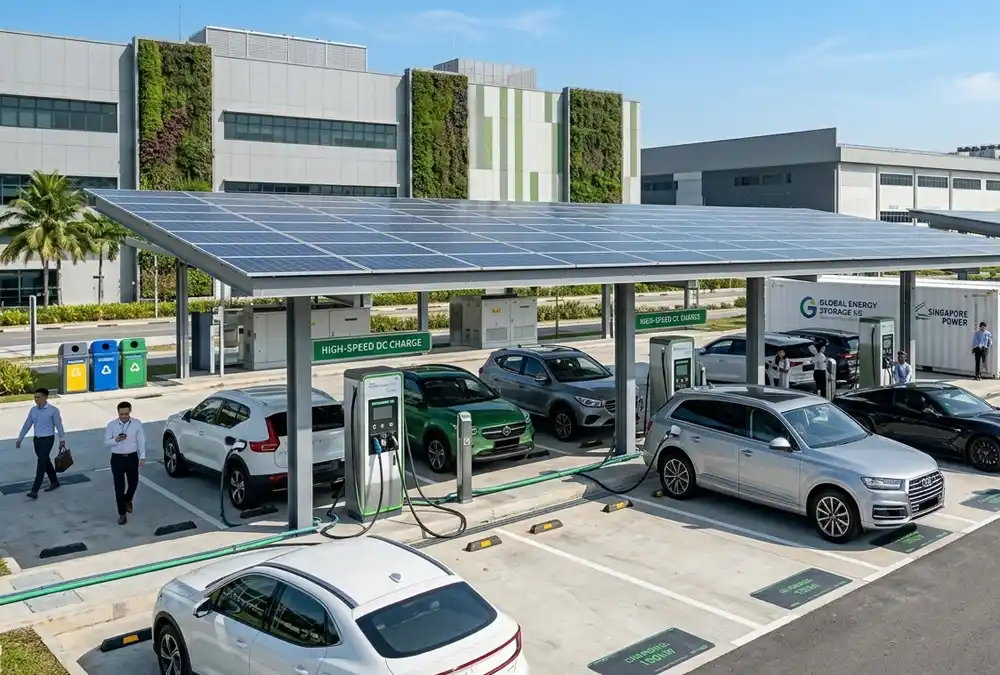
We specialize in delivering integrated clean energy infrastructure, designing and deploying high-capacity Solar + BESS Solutions, containerized commercial energy storage arrays, and high-speed Solar-Powered EV Charging Infrastructure microgrids built to maximize your long-term operational resilience.
Contact Our Engineering Team to Maximize Your Solar Project Performance
Conclusion: Choosing the Right Solar EPC Company Determines Long-Term Project Success
Deploying a commercial or utility-scale clean energy system is a major capital investment that requires deep technical expertise, disciplined project management, and strong supply chain access. A professional Solar EPC Company serves as more than just a standard construction crew; they act as your primary asset partner, managing risks, controlling budgets, and ensuring high quality across the entire development lifecycle.
By selecting an experienced partner with a proven portfolio, solid financial stability, and advanced solar system integration capabilities, businesses can confidently secure high-performing assets. For forward-looking organizations, choosing an EPC contractor with deep expertise across solar PV, smart battery storage (BESS), and EV charging networks is the key to ensuring long-term energy independence and maximizing your investment returns for decades to come.
Related Posts
 https://anengjibattery.com/wp-content/uploads/2026/10/AnengjiBattery-Cell-to-Pack-Energy-Density-Comparison.webp
675
1000
Battery Expert Team
https://anengjibattery.com/wp-content/uploads/2025/06/logo2-300x138.png
Battery Expert Team2026-10-23 06:58:392026-10-23 06:58:41What Does Lithium-Ion Battery Energy Density Really Mean?
https://anengjibattery.com/wp-content/uploads/2026/10/AnengjiBattery-Cell-to-Pack-Energy-Density-Comparison.webp
675
1000
Battery Expert Team
https://anengjibattery.com/wp-content/uploads/2025/06/logo2-300x138.png
Battery Expert Team2026-10-23 06:58:392026-10-23 06:58:41What Does Lithium-Ion Battery Energy Density Really Mean? https://anengjibattery.com/wp-content/uploads/2026/10/AnengjiBattery-Lithium-Battery-Management-in-Daily-Operation.webp
675
1000
Battery Expert Team
https://anengjibattery.com/wp-content/uploads/2025/06/logo2-300x138.png
Battery Expert Team2026-10-22 08:17:332026-10-23 06:58:57How Does a Lithium BMS Improve Battery Longevity?
https://anengjibattery.com/wp-content/uploads/2026/10/AnengjiBattery-Lithium-Battery-Management-in-Daily-Operation.webp
675
1000
Battery Expert Team
https://anengjibattery.com/wp-content/uploads/2025/06/logo2-300x138.png
Battery Expert Team2026-10-22 08:17:332026-10-23 06:58:57How Does a Lithium BMS Improve Battery Longevity? https://anengjibattery.com/wp-content/uploads/2026/10/AnengjiBattery-Industrial-Power-Under-Real-Load.webp
675
1000
Battery Expert Team
https://anengjibattery.com/wp-content/uploads/2025/06/logo2-300x138.png
Battery Expert Team2026-10-22 07:04:542026-10-22 07:05:30How Does a 48V LiFePO4 BMS Protect Industrial Power?
https://anengjibattery.com/wp-content/uploads/2026/10/AnengjiBattery-Industrial-Power-Under-Real-Load.webp
675
1000
Battery Expert Team
https://anengjibattery.com/wp-content/uploads/2025/06/logo2-300x138.png
Battery Expert Team2026-10-22 07:04:542026-10-22 07:05:30How Does a 48V LiFePO4 BMS Protect Industrial Power? https://anengjibattery.com/wp-content/uploads/2026/10/AnengJIBattery-Electric-Forklift-Battery-Buying-Decision.webp
675
1000
Battery Expert Team
https://anengjibattery.com/wp-content/uploads/2025/06/logo2-300x138.png
Battery Expert Team2026-10-21 06:22:222026-10-21 06:22:38Ready to Buy Battery for Electric Forklift? Use This Guide
https://anengjibattery.com/wp-content/uploads/2026/10/AnengJIBattery-Electric-Forklift-Battery-Buying-Decision.webp
675
1000
Battery Expert Team
https://anengjibattery.com/wp-content/uploads/2025/06/logo2-300x138.png
Battery Expert Team2026-10-21 06:22:222026-10-21 06:22:38Ready to Buy Battery for Electric Forklift? Use This Guide


Leave a Reply
Want to join the discussion?Feel free to contribute!