
How Does 1MW Battery Storage for Industrial Manufacturing Reduce Costs?
June 4, 2026 / Battery Expert Team / battery energy storage
Introduction
As heavy industry faces unprecedented energy market volatility and tightening grid constraints, forward-thinking plant operators are overhauling their electrical architectures to shield against soaring peak tariffs. Deploying a tailored 1MW Battery Storage for Industrial Manufacturing facility has transitioned from an experimental sustainability goal to an absolute operational necessity. By acting as a high-capacity localized buffer, these systems protect heavy machinery from crippling voltage sags, capture low-cost off-peak energy, and mitigate the aggressive demand charges imposed by utility providers. For heavy manufacturing sectors trying to balance high production throughput with soaring electrification requirements, an on-site megawatt-scale battery system offers a clear path toward localized energy independence.
What Is a 1MW Battery Storage System for Industrial Manufacturing?
Featured Snippet Answer: A 1MW battery storage for industrial manufacturing is a high-power energy storage solution that delivers up to 1 Megawatt of instantaneous continuous electricity to support factory operations. It serves as an on-site grid balancing asset, enabling plants to eliminate expensive peak demand charges via automated peak shaving, maximize localized solar self-consumption, protect vulnerable processing lines from power quality anomalies, and significantly reduce overall utility expenses.
Definition of a 1MW Battery Energy Storage System (BESS)
A 1MW Battery Energy Storage System (BESS) is a fully integrated industrial-grade electrical asset engineered to absorb, store, and discharge massive blocks of electrical energy on demand. Far beyond a simple collection of battery cells, a comprehensive megawatt-scale installation integrates multi-tiered protection systems, bidirectional high-voltage power electronics, and autonomous software platforms. This allows the factory’s infrastructure to interact dynamically with the utility grid and internal heavy equipment loads simultaneously.
How Industrial Battery Storage Works
The operational cadence of an industrial battery energy storage system 1MW architecture relies on intelligent automated dispatching. During off-peak windows—typically overnight or during midday solar overproduction—the system draws power to recharge its chemical storage reservoir. When plant power monitoring systems detect an intensive load spike, the system switches from charging to discharging mode within milliseconds. By feeding stored direct current (DC) through bidirectional inverters into the factory’s main distribution busbar as alternating current (AC), it effectively caps the total power drawn from the external utility grid.
Understanding MW vs MWh in Manufacturing Applications
In industrial engineering, failing to distinguish between Megawatts (MW) and Megawatt-hours (MWh) can result in costly system sizing errors. **MW** represents the maximum instantaneous power rating of the system—how fast energy can be injected into the plant’s grid. **MWh** represents the total energy capacity—how long the system can sustain a given power output. For instance, a 1MW system rated at 2MWh can discharge its full 1MW capacity for two continuous hours, whereas a 1MW/4MWh system can deliver that same power rate for four hours, providing a deeper reservoir for extended operational support.
Typical 1MW Battery Storage Configurations
Industrial applications generally utilize standardized energy-to-power ratios, resulting in two prominent configurations: 1MW/2MWh (a 2-hour system) and 1MW/4MWh (a 4-hour system). The 2-hour system is highly optimized for targeted peak shaving energy storage and rapid high-power injection to smooth brief machinery start-up spikes. In contrast, the 4-hour architecture is built for comprehensive load shifting, long-duration emergency backup, and storing larger blocks of solar energy for use during extended overnight shifts.
Why Industrial Manufacturing Facilities Need Battery Energy Storage Systems
Operating a modern factory requires navigating a volatile energy landscape. Industrial electricity rates have risen drastically worldwide over the past few years, driven by grid congestion, infrastructure upgrades, and fluctuating fuel markets. For heavy industries like automotive assembly, plastics extrusion, and metal fabrication, energy has become one of the single largest components of ongoing operational overhead.
Compounding these base energy costs are utility demand charges. Utilities must maintain substation capacity to handle a plant’s absolute highest point of consumption, even if that peak lasts for only fifteen minutes when heavy motors or electric arc furnaces start up. This brief consumption peak can account for up to 30% to 50% of a factory’s entire monthly utility bill. At the same time, regional grids face growing stability challenges, leading to frequency variations and brief voltage drops that can disrupt automated PLC systems and CNC machinery, resulting in costly scrap material and unplanned production downtime.
Battery Energy Storage System Components for Industrial Manufacturing
A reliable 1MW BESS for industrial facilities is built upon a highly coordinated multi-tier hardware stack, with each component selected to ensure peak safety and efficiency under heavy cycling:
- Battery Packs and Cell Technologies:
The industry standard for commercial and industrial energy storage has converged around Lithium Iron Phosphate (LFP) chemistry. LFP cells offer a high thermal runaway threshold (exceeding 270°C), produce zero oxygen during failures, and deliver an extended operational lifespan of 6,000 to 8,000 full cycles at 80% Depth of Discharge (DoD), ensuring over 15 years of reliable daily service. - Power Conversion System (PCS):
The PCS serves as the bidirectional power electronics bridge. Utilizing high-frequency insulated-gate bipolar transistors (IGBTs), it translates alternating current (AC) from the factory busbar into direct current (DC) for storage, and vice versa, maintaining precise synchronization with grid voltage and frequency. - Battery Management System (BMS):
A critical multi-tier safety controller that monitors internal cell metrics down to the individual millivolt and milli-degree level. The BMS prevents overcharging, over-discharging, and cell balancing errors, and can isolate specific battery strings if abnormal operating parameters are detected. - Energy Management System (EMS):
The intelligent software brain that orchestrates total system dispatch. By running algorithmic rules for peak shaving, demand tracking, and time-of-use optimization, the EMS integrates directly with factory SCADA setups via Modbus TCP or Profinet protocols. - Thermal and Fire Protection Systems:
To comply with international safety standard NFPA 855, modern layouts utilize active liquid-cooling chillers to maintain internal cell temperature variances within a tight ±3°C range. This is paired with clean-agent fire suppression gas injection, early-stage aerosol detection, and integrated explosion deflagration venting panels.
Industrial Energy Storage Applications in Manufacturing Plants
Deploying a versatile industrial battery storage system unlocks a variety of distinct operational strategies, helping plant managers transform their energy infrastructure into an active financial asset:
- Peak Shaving and Demand Charge Reduction: The most immediate source of cost savings, where the system discharges to flatten the facility’s highest consumption peaks and lower utility fees.
- Load Shifting and Energy Arbitrage: Automatically charging the system when electricity prices are lowest and discharging during expensive peak hours to lower net energy costs.
- Backup Power for Critical Production Lines: Acting as a large-scale, high-speed uninterruptible power supply (UPS) to keep critical tooling and cleanrooms operational during grid outages.
- Renewable Energy Integration: Buffering intermittent generation from large factory solar arrays to maximize on-site self-consumption and prevent underutilized power backfeeding.
- Microgrid Deployment: Combining local generation, energy storage, and industrial loads into an independent network capable of isolating from the main utility grid during extended blackouts.
Peak Shaving Energy Storage Benefits for Manufacturing Facilities
To fully grasp the financial benefits of peak shaving energy storage, it helps to understand how utility billing structures evaluate industrial accounts. Rather than charging a flat rate per kilowatt-hour, utilities apply heavy penalties if a factory draws massive current over short intervals. When large motors, industrial chillers, or heavy welding systems start up simultaneously, they create brief power spikes that establish a high billing benchmark for the entire month.
How Does a 1MW Battery Storage System Reduce Factory Electricity Costs?
Financial Optimization Example: Consider an automotive component factory with a baseline load of 2.5MW. Twice a day, heavy metal stamping presses run, driving total demand up to 3.5MW for 30 minutes. If the regional utility provider charges a high peak demand fee of $20 per kW, that single 1,000kW spike adds an extra $20,000 to the monthly electric bill. By configuring a 1MW battery storage for factory peak shaving, the system discharges 1,000kW directly into the plant busbar during those stamping runs. The grid only sees the steady 2.5MW baseline load, saving the facility $20,000 in monthly demand fees and up to $240,000 annually.
Factory Energy Optimization with Battery Energy Storage Systems
Integrating high-capacity battery storage provides structural benefits that extend beyond monthly utility bills, driving comprehensive **factory energy optimization** across your entire infrastructure. When a megawatt-scale BESS operates alongside your central distribution system, its high-speed power conversion system actively monitors incoming power quality, filtering out harmful harmonic distortions and voltage fluctuations caused by nearby heavy industrial loads.
By stabilizing internal voltage levels, the system reduces thermal stress on large electric motors and variable frequency drives (VFDs), helping lower long-term equipment maintenance costs. This reliable power baseline supports smart manufacturing initiatives and automated production lines, ensuring high-precision robotics and CNC machinery run smoothly without unexpected resets or calibration errors caused by minor grid disturbances.
1MW Battery Storage System Sizing for Industrial Manufacturing
Sizing an **industrial energy storage** asset requires looking past rough facility square-footage estimates to evaluate real historical load data. Plant engineers should gather 12 to 24 months of detailed 15-minute interval power consumption data from the local utility to map out the facility’s unique operational load curve.
Is a 1MW Battery Storage System Large Enough for a Manufacturing Plant?
| Factory Operational Profile | Peak Demand Range | Recommended Storage Configuration | Primary Application Focus |
|---|---|---|---|
| Light Assembly / Electronics Plant | 800 kW – 1.5 MW | 500kW / 1MWh Modular BESS | Full peak shaving & complete facility backup |
| Medium Precision / CNC / Plastics Factory | 2.0 MW – 4.5 MW | 1MW / 2MWh Containerized BESS | Targeted demand charge reduction & voltage sag protection |
| Heavy Automotive / Chemical processing | 5.0 MW – 12.0 MW+ | Multiple 1MW / 4MWh Systems in parallel | Substation capacity relief & long-duration load shifting |
Industrial Battery Storage Cost Analysis
Evaluating a 1MW industrial battery storage cost structure requires looking beyond the base hardware purchase price to examine total installed project capital expenditures (CAPEX). In 2026, standardized production of dense liquid-cooled containers has helped lower global deployment costs, making megawatt-scale infrastructure projects highly accessible for industrial facilities.
A typical turnkey 1MW/2MWh industrial container installation generally ranges from **$450,000 to $620,000**, depending on site-specific civil requirements, regional utility interconnection codes, and local electrical modifications. Base battery modules and mechanical racking account for roughly 55% of total project costs. The bidirectional PCS inverters, multi-level BMS, and smart EMS software make up another 25%, while site preparation, concrete foundation work, utility permitting, and final commission testing represent the remaining 20% of initial expenditures.
Battery Storage ROI for Manufacturing Facilities
Calculating the true **battery storage ROI** for an industrial asset requires a comprehensive financial analysis that factors in both direct utility savings and indirect operational protections. The primary financial returns come from automated demand charge reductions and time-of-use energy arbitrage, where the system shifts energy consumption away from expensive peak utility windows.
However, for high-throughput manufacturing plants, the indirect financial benefits can be even more significant. Preventing a single unexpected power outage or voltage sag on a high-speed production line can save a facility tens of thousands of dollars in ruined raw materials and idle labor costs. When combining these direct utility savings with operational protection benefits, typical payback windows range from **3.8 to 5.5 years**, turning a capital infrastructure project into a highly reliable long-term source of operational efficiency.
Commercial and Industrial Energy Storage Integration with Solar Power
Deploying a standalone rooftop solar array can help factories lower daytime energy bills, but it also introduces challenges due to the natural intermittent nature of renewable energy. Sudden cloud cover can cause sharp drop-offs in solar output, forcing the facility to abruptly draw power from the utility grid and creating unexpected demand peaks.
Pairing your solar array with a **factory energy storage solution** resolves this solar volatility. The system’s EMS automatically absorbs excess solar generation during peak afternoon production windows and smoothly discharges that stored clean energy during high-tariff evening shifts or morning startup periods. This integration helps factories maximize solar self-consumption, lower reliance on the external grid, and establish a highly stable, sustainable energy profile.
Containerized BESS Solutions for Industrial Manufacturing
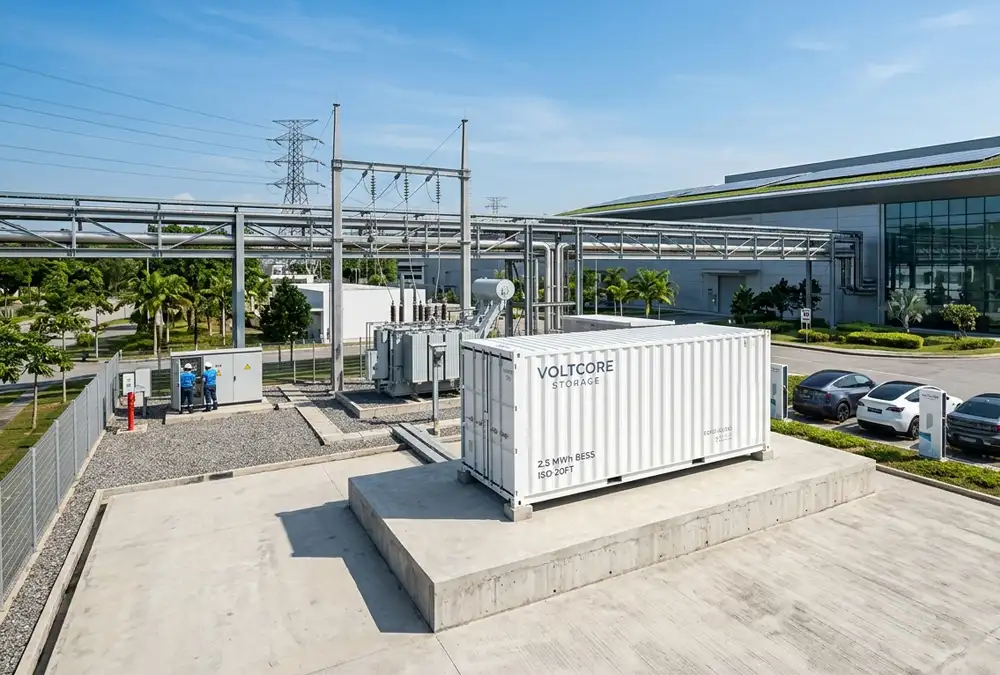
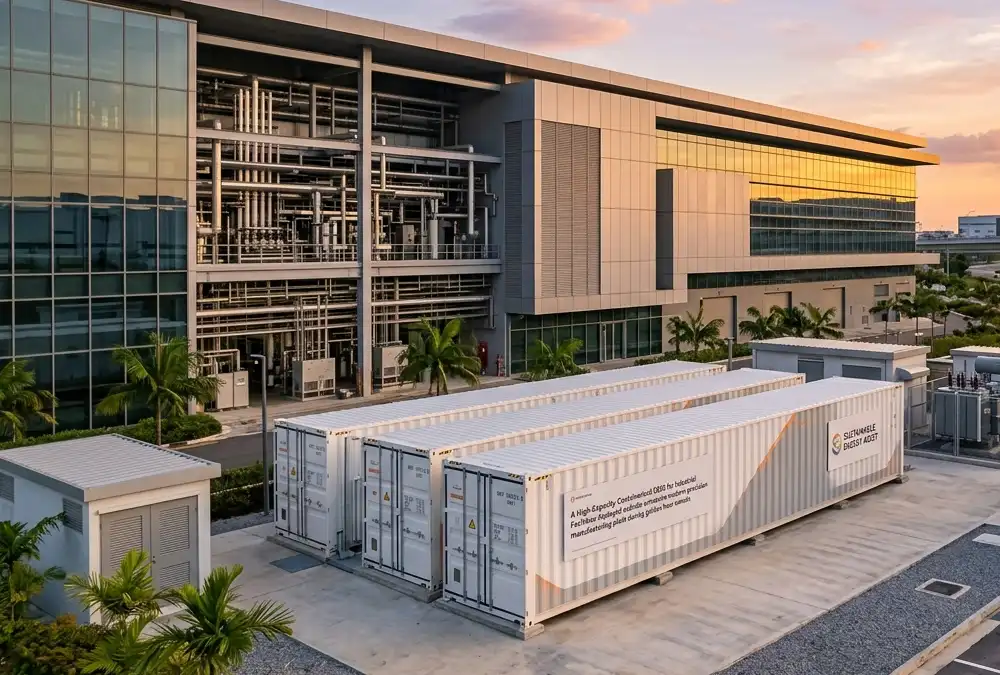
Modern megawatt-scale industrial energy projects have largely shifted toward pre-engineered **containerized BESS** architectures over traditional indoor battery room designs. Housing the entire system within a standard weatherproof ISO enclosure provides significant advantages for space-constrained manufacturing facilities.
Because these durable steel containers are fully assembled, wired, and tested at the manufacturing facility under strict quality controls, on-site installation risks are practically eliminated. This approach minimizes required site civil works and allows for straightforward placement on a simple outdoor concrete pad next to the main electrical substation. This external placement preserves valuable interior factory floor space for core production equipment while providing an easily scalable architecture that can grow alongside your facility’s power demands.
Industrial Technical Specification Recommendation
For demanding manufacturing environments with continuous heavy equipment cycling, plant managers should specify **Liquid-Cooled Lithium Iron Phosphate (LFP) Containerized Systems** over traditional forced-air structures. Liquid-cooled cooling loops maintain consistent, stable temperatures across all internal cell surfaces, completely eliminating localized hot spots during rapid charge and discharge cycles. This superior thermal management improves round-trip energy efficiency and extends the operational life of your battery packs, helping maximize your long-term capital investment.
How to Choose the Right Industrial Battery Storage System
Selecting the optimal equipment layout requires careful technical evaluation of your facility’s real-world energy footprint. Plant managers should avoid relying on generalized industry templates; instead, conduct a thorough audit of your historical load data to identify the exact duration and frequency of your plant’s peak consumption periods.
Next, evaluate the control capabilities of the software you plan to deploy. The integrated EMS must communicate seamlessly with your existing factory automation or building management platforms via open industry standards. Choosing an experienced, vertically integrated supplier with certified components ensures smooth installation, reliable long-term performance, and dedicated technical support throughout the life of the asset.
Common Challenges of Industrial Energy Storage Projects
While the financial benefits of industrial storage projects are clear, implementation requires navigating a few common engineering challenges. The initial capital investment can be a hurdle for some facilities, requiring a thorough, multi-year ROI analysis to secure executive approval. Additionally, inaccurate sizing or poor capacity planning can result in an under-configured system that fails to capture maximum demand charge savings.
Navigating local grid interconnection rules and regional compliance certifications can also introduce unexpected regulatory hurdles. Working with an experienced system integrator who understands local utility requirements helps streamline the permitting process, ensuring your asset is commissioned on schedule and complies with all local safety codes.
Frequently Asked Questions About 1MW Battery Storage for Industrial Manufacturing
What is a 1MW battery storage system used for in manufacturing?
In industrial environments, a 1MW system is primarily used for automated peak shaving to lower utility demand charges, energy arbitrage to shift loads away from high-tariff windows, and providing critical emergency backup power to protect automated production lines from voltage sags and blackouts.
How much does a 1MW industrial battery storage system cost?
The total turnkey installation cost for a standard 1MW/2MWh liquid-cooled LFP container system typically ranges between $450,000 and $620,000. This budgetary estimate includes Tier-1 battery cells, bidirectional PCS inverters, integrated climate controls, fire protection, site civil preparation, and final grid commission testing.
How much electricity can a 1MW BESS supply?
A 1MW system can deliver up to 1 Megawatt of continuous electrical power. The total energy supplied depends on the system’s capacity configuration: a 1MW/2MWh system can deliver 1MW of power for two continuous hours, while a 1MW/4MWh system can sustain that power rate for four hours.
What industries benefit most from battery storage?
Heavy manufacturing sectors with fluctuating load profiles see the highest financial returns. This includes plastics extrusion facilities, automotive component plants, metal fabrication shops, chemical processing facilities, and large automated distribution hubs that utilize heavy machinery or intensive climate control networks.
Can battery storage be integrated with solar power systems?
Yes. Integrating containerized storage with on-site industrial solar arrays allows factories to store excess daytime generation and smoothly dispatch that clean power during expensive peak hours, maximizing renewable utilization and reducing overall reliance on the utility grid.
Conclusion
Key Benefits of 1MW Battery Storage for Manufacturing Facilities
Deploying a dedicated 1MW Battery Storage for Industrial Manufacturing facility helps businesses gain long-term control over volatile electricity overhead. The asset provides a highly responsive power buffer that lowers ongoing operational costs, flattens utility consumption peaks, and helps companies optimize their energy infrastructure.
Why Energy Storage Is Becoming Essential for Industrial Operations
As modern electricity networks face increasing congestion and high peak-use penalties, relying solely on traditional grid infrastructure introduces ongoing operational risks. Standardizing on factory-integrated containerized storage helps industrial facilities build an independent, stable power baseline capable of supporting modern manufacturing requirements.
How to Maximize ROI Through Smart Energy Management
The future of efficient industrial manufacturing relies on smart, data-driven power management. By pairing high-performance liquid-cooled LFP cell technology with intelligent energy management platforms, plant operators can lower ongoing facility expenses and establish a highly resilient infrastructure optimized for long-term growth.
Ready to Optimize Your Industrial Energy Strategy?
Protect your factory from rising demand charges and grid disruptions. Contact our industrial engineering group today to request a comprehensive load profile audit and a tailored equipment proposal optimized for your manufacturing operations.
Related Posts
 https://anengjibattery.com/wp-content/uploads/2026/10/AnengJIBattery-Top-10-Forklift-Battery-Manufacturers-for-Cold-Storage.webp
675
1000
Battery Expert Team
https://anengjibattery.com/wp-content/uploads/2025/06/logo2-300x138.png
Battery Expert Team2026-10-26 09:12:412026-10-26 09:13:00Top 10 Forklift Battery Manufacturers for Cold Storage
https://anengjibattery.com/wp-content/uploads/2026/10/AnengJIBattery-Top-10-Forklift-Battery-Manufacturers-for-Cold-Storage.webp
675
1000
Battery Expert Team
https://anengjibattery.com/wp-content/uploads/2025/06/logo2-300x138.png
Battery Expert Team2026-10-26 09:12:412026-10-26 09:13:00Top 10 Forklift Battery Manufacturers for Cold Storage https://anengjibattery.com/wp-content/uploads/2026/10/AnengjiBattery-Cell-to-Pack-Energy-Density-Comparison.webp
675
1000
Battery Expert Team
https://anengjibattery.com/wp-content/uploads/2025/06/logo2-300x138.png
Battery Expert Team2026-10-23 06:58:392026-10-23 06:58:41What Does Lithium-Ion Battery Energy Density Really Mean?
https://anengjibattery.com/wp-content/uploads/2026/10/AnengjiBattery-Cell-to-Pack-Energy-Density-Comparison.webp
675
1000
Battery Expert Team
https://anengjibattery.com/wp-content/uploads/2025/06/logo2-300x138.png
Battery Expert Team2026-10-23 06:58:392026-10-23 06:58:41What Does Lithium-Ion Battery Energy Density Really Mean? https://anengjibattery.com/wp-content/uploads/2026/10/AnengjiBattery-Lithium-Battery-Management-in-Daily-Operation.webp
675
1000
Battery Expert Team
https://anengjibattery.com/wp-content/uploads/2025/06/logo2-300x138.png
Battery Expert Team2026-10-22 08:17:332026-10-23 06:58:57How Does a Lithium BMS Improve Battery Longevity?
https://anengjibattery.com/wp-content/uploads/2026/10/AnengjiBattery-Lithium-Battery-Management-in-Daily-Operation.webp
675
1000
Battery Expert Team
https://anengjibattery.com/wp-content/uploads/2025/06/logo2-300x138.png
Battery Expert Team2026-10-22 08:17:332026-10-23 06:58:57How Does a Lithium BMS Improve Battery Longevity? https://anengjibattery.com/wp-content/uploads/2026/10/AnengjiBattery-Industrial-Power-Under-Real-Load.webp
675
1000
Battery Expert Team
https://anengjibattery.com/wp-content/uploads/2025/06/logo2-300x138.png
Battery Expert Team2026-10-22 07:04:542026-10-22 07:05:30How Does a 48V LiFePO4 BMS Protect Industrial Power?
https://anengjibattery.com/wp-content/uploads/2026/10/AnengjiBattery-Industrial-Power-Under-Real-Load.webp
675
1000
Battery Expert Team
https://anengjibattery.com/wp-content/uploads/2025/06/logo2-300x138.png
Battery Expert Team2026-10-22 07:04:542026-10-22 07:05:30How Does a 48V LiFePO4 BMS Protect Industrial Power?


Leave a Reply
Want to join the discussion?Feel free to contribute!