
What Are the Benefits of Containerized 1MW Battery Storage Solutions?
June 3, 2026 / Battery Expert Team / battery energy storage
Introduction
As the global energy infrastructure undergoes a massive structural shift toward electrification and decarbonization, industrial facilities, grid operators, and renewable energy developers face unprecedented power stability challenges. Managing peak electrical loads while integrating volatile renewable sources requires assets that are not only highly efficient but also rapidly deployable. Implementing modern Containerized 1MW Battery Storage Solutions has emerged as the global gold standard for scaling power capacity, mitigating costly utility demand charges, and securing localized grid resilience. These modular systems act as a critical macroeconomic bridge, transforming how heavy industries, high-power charging hubs, and localized microgrids manage distribution networks without waiting years for utility substation expansions.
What Are Containerized 1MW Battery Storage Solutions?
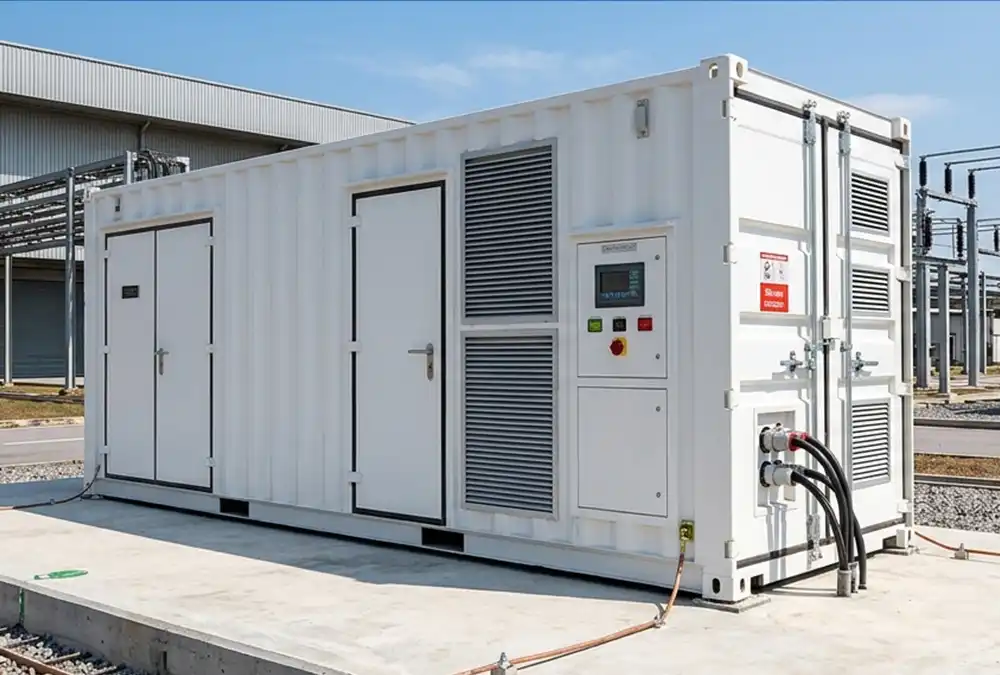
Featured Snippet Answer: A containerized 1MW battery storage solution is a pre-engineered Battery Energy Storage System (BESS) housed in a standard weatherproof ISO enclosure and fully integrated with factory-installed battery modules, a Power Conversion System (PCS), Battery Management System (BMS), Energy Management System (EMS), liquid or forced-air HVAC, and multi-stage fire suppression systems. It enables rapid field deployment, slashes localized site civil works expenses, and delivers highly scalable, high-density energy storage for modern commercial, industrial, EV charging, and utility-scale networks.
Definition of a Containerized Battery Energy Storage System (BESS)
A containerized Battery Energy Storage System (BESS) represents the pinnacle of turnkey electrical engineering. Unlike traditional static indoor battery rooms that require expansive custom building permits, complex on-site wiring, and custom HVAC engineering, a containerized BESS is built entirely inside a structural steel shell. This shipping container framework shields sensitive high-voltage electronics from extreme environmental conditions, ranging from desert heat to sub-zero sub-arctic industrial landscapes, allowing for simple outdoor placement on a standard reinforced concrete foundation pad.
What Does a 1MW Battery Storage System Mean?
In high-power industrial electrical design, “1MW” (one Megawatt, or 1,000 Kilowatts) designates the system’s maximum continuous electrical power output rating. This metric outlines the speed at which the system can deliver current or absorb load from the grid. It is distinct from Megawatt-hours (MWh), which defines the total energy capacity or depth of discharge available over a sustained period. A 1MW asset allows an enterprise to mitigate huge power consumption spikes instantly, acting as a high-speed localized generator that responds within milliseconds to fluctuating network demands.
How Containerized Energy Storage Works
The core operating mechanism of a containerized 1MW battery storage system involves an automated, software-driven charging and discharging matrix. During off-peak windows—when regional utility demand drops and electricity prices fall—the internal control software instructs the system to draw power from the main grid feed or localized solar arrays to replenish its internal cells. When a facility’s power demand surges past pre-set operational limits, or when grid frequency fluctuates dangerously, the system reverses its flow within milliseconds, injecting active current into the facility busbar to smooth the load profile.
Key Advantages of Prefabricated Energy Storage Containers
The clear shift toward container battery storage solutions across global industrial markets stems from a critical engineering advantage: the complete minimization of execution risk. Because the full enclosure is assembled, integrated, and high-voltage tested at a controlled manufacturing plant, the risk of field wiring faults is practically eliminated. Field installation is reduced from months of complex electrical construction to simple mechanical placement, anchoring, and running final AC utility connections, vastly shortening overall project timelines.
Battery Energy Storage System Components in a Containerized 1MW BESS
An industrial-grade 1MW energy storage container is not merely a box of batteries; it is a complex grid of interlinked sub-systems designed to balance safety, longevity, and thermal stability:
- Battery Packs and Lithium Battery Technology:
Modern industrial energy storage system installations have shifted almost entirely toward Lithium Iron Phosphate (LFP) cell chemistry. Compared to older Nickel Manganese Cobalt (NMC) options, LFP technology provides an exceptionally high thermal runaway threshold (around 270°C), zero oxygen release during internal failures, and an extended lifecycle often exceeding 6,000 to 8,000 full cycles at 80% Depth of Discharge (DoD). This ensures over 15 years of reliable daily service. - Power Conversion System (PCS):
The PCS handles high-power bidirectional bi-directional inversion. It utilizes high-efficiency insulated-gate bipolar transistors (IGBTs) or advanced Silicon Carbide (SiC) semiconductors to instantly convert alternating current (AC) from the utility grid into direct current (DC) for battery storage, and vice versa, operating at round-trip efficiencies exceeding 98%. - Battery Management System (BMS):
Operating via a three-tiered architecture (cell, rack, and system level), the BMS continually monitors critical cell parameters including voltage differentials, state of charge (SoC), and surface temperature profiles to optimize cell balancing and protect against over-charging or over-discharging. - Energy Management System (EMS):
The high-level software intelligence that executes advanced algorithms for peak shaving, load forecasting, and demand response tracking, coordinating seamlessly with SCADA and industrial automation networks via Modbus TCP or IEC 61850 protocols. - Fire Protection and HVAC Thermal Management:
To comply with NFPA 855 and UL 9540 regulations, containers incorporate precise liquid-cooling chillers to maintain internal temperatures within an optimal ±3°C variance. This thermal regulation is backed by active multi-stage fire suppression systems utilizing gas sensors, deflagration blowout panels, and clean-agent Novec 1230 gas flooding arrays.
Containerized Energy Storage Architecture and Design
Engineers design a containerized 1MW BESS solution using standard ISO structural footprints. The two most prominent designs across global markets are standard 20-foot and 40-foot shipping containers. Choosing the right physical size depends directly on your system’s required energy capacity and the constraints of your site layout.
A 20-foot shipping container framework is exceptionally dense and typically houses storage layouts up to 2.5MWh, making it highly effective for space-constrained urban projects, commercial office parks, or fast-charging EV corridors. When a project demands longer discharge periods, such as a 4MWh or 5MWh capacity profile, engineers scale up to a 40-foot container. This larger enclosure provides extra internal workspace, simplified access for electrical maintenance, and optimized airflow routing for heavy duty HVAC systems.
This structural approach relies heavily on a flexible modular layout. Internal battery racks are organized into independent electrical strings, allowing operators to easily expand overall system capacity as facility power requirements grow over time. Every internal circuit breaker, auxiliary power transformer, and climate control duct is integrated directly at the manufacturing plant, allowing the asset to pass rigorous high-voltage factory witness testing prior to overseas transit.
1MW Battery Storage System Configurations and Capacity Options
When engineering Containerized 1MW Battery Storage Solutions, matching power delivery to storage duration is vital for maximizing financial returns. The table below outlines how system configurations scale according to operational needs:
| System Configuration | Discharge Duration | Primary Application Scenario | Ideal Target Audience |
|---|---|---|---|
| 1MW / 1MWh System | 1.0 Hour | High-speed frequency regulation & short peak smoothing | Grid Operators & Substation Integrators |
| 1MW / 2MWh System | 2.0 Hours | Commercial demand charge mitigation & EV fast-charging support | C&I Facilities & Charge Point Operators |
| 1MW / 4MWh System | 4.0 Hours | Renewable energy time-shifting & heavy industrial backup | Solar Developers & Large Manufacturing Plants |
Selecting the optimal storage duration depends on your facility’s specific load profile. A facility with brief, intensive power spikes requires a highly responsive 1-hour or 2-hour configuration. Conversely, shifting large blocks of daytime solar power to overnight operational hours requires a deep 4-hour or 5-hour energy reservoir to maximize system effectiveness.
Containerized 1MW Battery Storage Solutions for Commercial Energy Storage
In the commercial sector, the primary economic driver for installing a containerized battery storage system for commercial applications is the reduction of utility demand charges. Modern utility billing structures charge commercial clients based on their highest 15-minute consumption spike during the month. By utilizing automated peak shaving, an integrated storage system can instantly discharge during these demand spikes, keeping your grid profile flat and lowering monthly utility fees.
Beyond demand charge management, an industrial battery array provides critical emergency backup power for sensitive production machinery. For high-precision manufacturing plants, even a brief sub-cycle voltage sag can trip automated assembly lines, causing extensive equipment downtime and product loss. A containerized BESS running in true UPS backup mode provides seamless voltage stabilization, protecting sensitive downstream processes from grid disturbances.
Containerized Battery Storage for EV Charging Infrastructure
The rapid expansion of high-power electric vehicle charging stations poses significant challenges for traditional utility networks. As drivers expect ultra-fast charging options, operators are deploying heavy-duty 150kW and 350kW DC fast chargers. When multiple vehicles initiate charging sessions simultaneously, they generate huge, erratic electrical loads that can easily exceed local grid capacities.
Integrating a 1MW system provides a highly effective power buffer for these high-demand charging hubs. Instead of investing in multi-million dollar substation upgrades and enduring years of utility approval backlogs, station operators can use containerized storage to manage vehicle current draws locally. This approach enables developers to deploy high-speed charging networks in grid-constrained areas, lowering operational overhead while maximizing vehicle turnover rates.
Utility-Scale Energy Storage Applications for Containerized BESS
At the utility level, large-scale storage containers act as modular grid assets that help stabilize modern distribution networks. As traditional fossil-fuel generation is phased out in favor of variable wind and solar energy, balancing grid frequency and maintaining stable voltage levels has become increasingly complex.
Deploying a 1MW container system provides transmission operators with rapid frequency response and spinning reserve capabilities. These systems can inject or absorb power within milliseconds of detecting grid imbalances, helping manage localized congestion and providing a flexible tool to maintain grid reliability across regional transmission lines.
Microgrid Energy Storage Systems and Off-Grid Applications
For remote industrial facilities, mining complexes, and isolated rural electrification projects, relying on a stable central grid connection is often impossible. These operations traditionally depend on expensive diesel generators, leaving them vulnerable to high fuel logistics costs and price volatility.
Integrating a microgrid energy storage system allows remote facilities to pair wind and solar arrays with dependable battery backup, creating a self-sustaining local power network. The system’s central EMS coordinates generation sources in real-time, storing excess renewable power during peak production periods and reducing overall reliance on diesel fuel. This hybrid approach significantly lowers fuel transportation costs and provides a reliable power source for remote industrial environments.
Containerized 1MW Battery Storage Cost Breakdown
According to 2026 industry index data from leading energy research groups, the 1MW battery storage container price has reached an attractive level due to standardized manufacturing processes. However, a proper financial assessment must look past raw hardware purchase prices to evaluate total installed project expenditures (CAPEX) and long-term operational maintenance (OPEX).
| Cost Element Breakdown | Percentage of CAPEX | Budgetary Estimate (1MW/2MWh Liquid LFP) |
|---|---|---|
| Tier-1 LFP Battery Cell Modules & Racks | 55% – 60% | $260,000 – $340,000 |
| PCS Bidirectional Inverters & Switchgear | 12% – 15% | $60,000 – $85,000 |
| Enclosure, Liquid HVAC, Fire Protection, BMS/EMS | 10% – 12% | $50,000 – $70,000 |
| Logistics, Civil Works, Grid Interconnection & Commissioning | 15% – 18% | $75,000 – $105,000 |
| Total Installed Project Cost Range | 100% | $445,000 – $600,000 |
Battery Storage ROI and Financial Benefits
Securing a strong return on investment (ROI) with a 1MW project involves combining multiple distinct revenue and cost-saving streams. The most direct financial benefit is the immediate reduction in monthly demand charges, which protects commercial facilities from high peak-use penalties. Additionally, operators can use automated energy arbitrage strategies—charging the system’s battery packs when regional power prices drop overnight, and discharging that stored energy during expensive daytime peaks to maximize utility savings.
Furthermore, developers can explore secondary revenue streams by participating in localized grid services, such as wholesale demand response programs or regional frequency regulation markets. When these utility incentives are paired with high vehicle or facility throughput, typical payback windows compress to an attractive 4.5 to 6.5 years, transforming a capital infrastructure investment into a reliable long-term profit center.
Why Containerized Battery Storage Is Better Than Traditional Energy Storage Installations
Traditional static energy storage installations often require custom brick-and-mortar structures, multi-layered climate engineering, and complex field integration. This approach exposes developers to construction delays, weather dependencies, and unexpected engineering challenges during on-site assembly.
Transitioning to a factory-integrated containerized solution removes these deployment risks. Because the entire system is built, wired, and tested under strict quality controls before shipping, field installation is simplified to basic foundation placement and running final AC utility connections. This streamlined process reduces site installation risks and shortens overall project timelines, helping operators bring their assets online faster.
Industrial Product Selection Recommendation
For heavy duty commercial and industrial projects, we highly recommend specifying Liquid-Cooled Lithium Iron Phosphate (LFP) Containerized Systems over standard air-cooled alternatives. Liquid-cooling loops deliver precise temperature management across all internal cell surfaces, completely eliminating localized hot spots during heavy discharge cycles. This superior thermal design maximizes round-trip energy efficiency and extends the operational life of your battery packs, helping protect your long-term capital investment.
How to Choose the Right Containerized Battery Energy Storage System
Selecting the optimal equipment layout requires careful technical evaluation of your facility’s historical load profile. Avoid relying on generalized industry templates; instead, collect 12 to 24 months of detailed 15-minute interval energy data from your local utility to identify the exact size and frequency of your historical demand peaks.
Next, evaluate the control capabilities of the software you plan to deploy. The integrated EMS must communicate seamlessly with your existing factory automation or charging management platforms via open standards such as OCPP or Modbus. Choosing an experienced, vertically integrated supplier with certified components ensures smooth installation, reliable long-term performance, and dedicated technical support throughout the life of the asset.
Containerized Battery Storage Supplier Selection Checklist
Before finalizing a contract with a 1000kw energy storage container manufacturer, ensure your engineering team evaluates the following technical criteria:
- Cell Lineage and Sourcing: Confirm the manufacturer utilizes fresh, traceable Tier-1 LFP cells with authenticated serial documentation, avoiding unbranded or secondary-market supply options.
- Global Safety Certifications: Verify full system compliance with critical international safety and grid interconnection codes, including UL 9540, UL 9540A, IEC 62933, and NFPA 855 standards.
- Software Integration and Testing: Ensure the vendor’s EMS features open APIs and supports direct Modbus TCP or IEC 61850 protocols for seamless connection with your facility controls.
- Long-Term Warranty and Support: Confirm the asset includes a comprehensive 10-year performance warranty that covers capacity retention rates and is backed by an authorized technical service network.
Conclusion
Why Containerized BESS Is Becoming the Preferred Energy Storage Solution
Deploying modular containerized storage has shifted from an experimental alternative to a vital structural requirement for modern charging networks and industrial centers. These systems provide a practical, high-power buffer right where it is needed most, protecting operators from grid capacity constraints and unpredictable utility fee models.
Key Benefits of Containerized 1MW Battery Storage Systems
Integrating containerized storage helps businesses lower ongoing operational overhead, bypass lengthy utility connection wait times, and maximize site capabilities. The asset provides a flexible, modular platform that scales seamlessly alongside your facility’s energy requirements.
Selecting the Right Solution for Commercial, Industrial, EV Charging, and Utility Applications
The future of transport electrification and industrial power management relies on smart, localized microgrids. By pairing clean solar canopies with liquid-cooled LFP cell technology and smart energy management platforms, charge point operators can establish highly resilient, highly profitable charging installations built to thrive through 2026 and beyond.
Ready to Secure Your Clean Energy Asset Portfolio?
Avoid project deployment delays and costly monthly peak-use grid fees. Contact our senior technical engineering group today to request a comprehensive load profile audit, tailored equipment sizing metrics, and an accurate budgetary proposal optimized for your business operations.
Related Posts
 https://anengjibattery.com/wp-content/uploads/2026/10/AnengJIBattery-Top-10-Forklift-Battery-Manufacturers-for-Cold-Storage.webp
675
1000
Battery Expert Team
https://anengjibattery.com/wp-content/uploads/2025/06/logo2-300x138.png
Battery Expert Team2026-10-26 09:12:412026-10-26 09:13:00Top 10 Forklift Battery Manufacturers for Cold Storage
https://anengjibattery.com/wp-content/uploads/2026/10/AnengJIBattery-Top-10-Forklift-Battery-Manufacturers-for-Cold-Storage.webp
675
1000
Battery Expert Team
https://anengjibattery.com/wp-content/uploads/2025/06/logo2-300x138.png
Battery Expert Team2026-10-26 09:12:412026-10-26 09:13:00Top 10 Forklift Battery Manufacturers for Cold Storage https://anengjibattery.com/wp-content/uploads/2026/10/AnengjiBattery-Cell-to-Pack-Energy-Density-Comparison.webp
675
1000
Battery Expert Team
https://anengjibattery.com/wp-content/uploads/2025/06/logo2-300x138.png
Battery Expert Team2026-10-23 06:58:392026-10-23 06:58:41What Does Lithium-Ion Battery Energy Density Really Mean?
https://anengjibattery.com/wp-content/uploads/2026/10/AnengjiBattery-Cell-to-Pack-Energy-Density-Comparison.webp
675
1000
Battery Expert Team
https://anengjibattery.com/wp-content/uploads/2025/06/logo2-300x138.png
Battery Expert Team2026-10-23 06:58:392026-10-23 06:58:41What Does Lithium-Ion Battery Energy Density Really Mean? https://anengjibattery.com/wp-content/uploads/2026/10/AnengjiBattery-Lithium-Battery-Management-in-Daily-Operation.webp
675
1000
Battery Expert Team
https://anengjibattery.com/wp-content/uploads/2025/06/logo2-300x138.png
Battery Expert Team2026-10-22 08:17:332026-10-23 06:58:57How Does a Lithium BMS Improve Battery Longevity?
https://anengjibattery.com/wp-content/uploads/2026/10/AnengjiBattery-Lithium-Battery-Management-in-Daily-Operation.webp
675
1000
Battery Expert Team
https://anengjibattery.com/wp-content/uploads/2025/06/logo2-300x138.png
Battery Expert Team2026-10-22 08:17:332026-10-23 06:58:57How Does a Lithium BMS Improve Battery Longevity? https://anengjibattery.com/wp-content/uploads/2026/10/AnengjiBattery-Industrial-Power-Under-Real-Load.webp
675
1000
Battery Expert Team
https://anengjibattery.com/wp-content/uploads/2025/06/logo2-300x138.png
Battery Expert Team2026-10-22 07:04:542026-10-22 07:05:30How Does a 48V LiFePO4 BMS Protect Industrial Power?
https://anengjibattery.com/wp-content/uploads/2026/10/AnengjiBattery-Industrial-Power-Under-Real-Load.webp
675
1000
Battery Expert Team
https://anengjibattery.com/wp-content/uploads/2025/06/logo2-300x138.png
Battery Expert Team2026-10-22 07:04:542026-10-22 07:05:30How Does a 48V LiFePO4 BMS Protect Industrial Power?


Leave a Reply
Want to join the discussion?Feel free to contribute!