
Electric Forklift Battery Life: How Can You Extend It?
October 20, 2026 / Battery Expert Team / Battery Basics
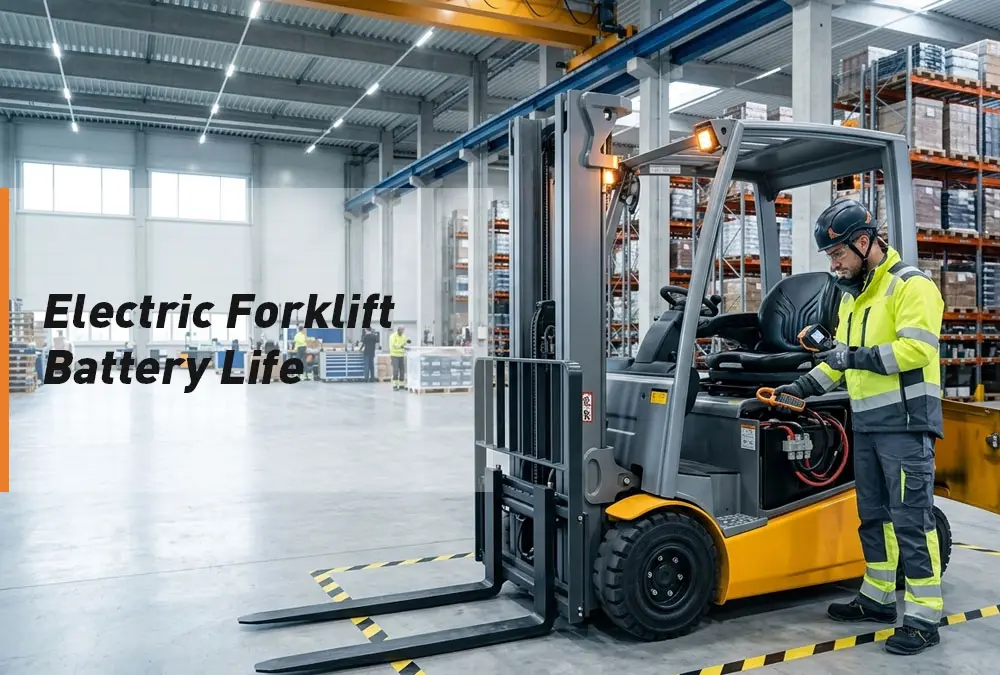
Introduction
The forklift completed the same route last month, but now the battery warning appears before the final loading window. Operations wants a larger battery. Maintenance suspects the charger. Finance questions whether an ageing truck is worth another major investment. This is where a simple question about electric forklift battery life becomes a productivity and purchasing decision.
Replacing the battery immediately may solve the problem—or preserve the wrong diagnosis. Short runtime can result from battery ageing, incomplete charging, a damaged connector, an incorrectly configured battery discharge indicator, low temperature, heavier work or a combination of these factors. The cost-effective response is to identify which part of the truck–battery–charger system has changed before choosing a remedy.
Quick answer: Electric forklift battery life has three meanings: runtime per charge, usable cycle or energy-throughput life, and economic life. None has one universal number. To extend performance and reduce cost, measure the actual duty cycle, confirm that the charger restores the expected energy, investigate abnormal heat or voltage loss, follow chemistry-specific maintenance instructions and compare repair or replacement by cost per productive truck hour.
What Does Electric Forklift Battery Life Actually Mean?
“How long will the battery last?” sounds like one question, but it normally hides three. A useful supplier or fleet review should identify which clock the buyer is trying to improve.
| Battery-Life Clock | The Question It Answers | Evidence to Collect | Common Misreading |
|---|---|---|---|
| Runtime per charge | Will the truck complete the planned work before the next reliable charge? | Start/end SOC, productive hours, energy restored, load, route and temperature | Assuming the Ah label guarantees an eight-hour shift |
| Usable cycle or throughput life | How much repeated service can the battery deliver before reaching its defined end-of-life condition? | Manufacturer test conditions, energy throughput, temperature and maintenance history | Treating every plug-in or every working day as one identical cycle |
| Calendar and economic life | When does keeping the battery cost more than a verified alternative? | Age, storage, capacity tests, repair cost, downtime, truck condition and support | Replacing solely because the battery is old—or keeping it solely because it still moves the truck |
This distinction prevents two expensive mistakes. The first is buying more capacity when the charger is not completing its work. The second is continuing to operate a battery that still produces voltage but no longer meets the required duty cycle reliably. Battery age matters, but measured performance and operating cost make the decision.
What Published Forklift Battery Life Data Can—and Cannot—Tell You
Published figures make lifespan easier to visualise, but only when the source and measurement basis stay attached. The examples below are not interchangeable market averages. One is a general US safety-agency maintenance reference, while the others describe named manufacturers’ batteries, warranties or test definitions.
| Published Source | Published Figure | What the Figure Represents | How a Buyer Should Use It |
|---|---|---|---|
| US OSHA electric-forklift guidance | Approximately 2,000 work shifts or charge/discharge cycles under normal operating conditions | A general maintenance reference in guidance focused mainly on traditional industrial lead-acid batteries | Use as context—not as a warranty or a prediction for every chemistry, charger and duty cycle |
| TCM battery-life article | 1,000–1,500 cycles for properly maintained lead-acid; lithium-ion can often exceed 3,000 cycles, depending on application | A forklift manufacturer’s broad technology benchmark rather than a named-product warranty | Use to frame questions; request the proposed battery’s own data sheet, test conditions and end-of-life threshold |
| Toyota 5/35 lithium-ion range | 5-year / 3,500-cycle warranty | A warranty limit for a specific product family | Compare the actual warranty terms, operating limits and coverage—not just the cycle number |
| Toyota 8/50 lithium-ion range | 8-year / 5,000-cycle warranty; the product sheet separately lists 9,000+ cycle life | Two different product statements: warranty coverage and a cycle-life specification. The sheet defines a cycle as the Ah rating multiplied by 80% | Do not treat rated cycle life and warranted cycles as the same promise; read the footnotes and warranty conditions |
Sources: OSHA electric power-source guidance, TCM’s battery-life overview, Toyota’s lithium-ion product information and Toyota’s 8/50 product sheet.
Worked Example: A 51.2V 412Ah Battery in a Two-Part Warehouse Shift
The following example shows how a fleet manager can turn a real working pattern into runtime and cycle-use estimates. The 51.2 V and 412 Ah values come from a user-supplied reference configuration. The usable-energy percentage, measured average power and charging power below are illustrative planning assumptions, not guaranteed AnengJi product performance.
| Input | Example Value | Evidence Status |
|---|---|---|
| Nominal battery voltage and capacity | 51.2 V, 412 Ah | User-supplied reference configuration |
| Approved usable-energy assumption | 80% of nominal energy | Illustrative; replace with the proposed pack’s validated value |
| Measured average operating power | 2.8 kW during productive work | Illustrative; obtain from a representative power study |
| Working pattern | 4 productive hours, a 45-minute charging window, then 3 productive hours | Illustrative warehouse schedule |
| Net DC energy delivered by the charger | 8 kW for 0.75 hour = 6.0 kWh | Illustrative; verify charger logs, battery acceptance and site power |
Step 1 — Calculate nominal and assumed usable energy.
Nominal energy = 51.2 V × 412 Ah ÷ 1,000 = 21.1 kWh.
Assumed usable energy = 21.1 kWh × 80% = 16.9 kWh.
Step 2 — Calculate consumption before the charging break.
First work period = 2.8 kW × 4 hours = 11.2 kWh.
Energy remaining before the break = 16.9 − 11.2 = 5.7 kWh.
Step 3 — Add only the energy the charging window can realistically restore.
Energy restored = 8 kW × 0.75 hour = 6.0 kWh.
Available energy after the break = 5.7 + 6.0 = 11.7 kWh. This remains below the example’s assumed usable-energy ceiling, so the full 6.0 kWh can be counted in this simplified energy balance.
Step 4 — Check the second work period and end-of-shift reserve.
Second work period = 2.8 kW × 3 hours = 8.4 kWh.
Estimated energy remaining = 11.7 − 8.4 = 3.3 kWh, or about 19.5% of the assumed usable energy.
Step 5 — Convert daily work into equivalent full cycles.
Total energy delivered to work during the day = 11.2 + 8.4 = 19.6 kWh.
Simplified equivalent full cycles per operating day = 19.6 ÷ 21.1 = 0.93 EFC/day.
At 280 operating days per year, annual throughput would be approximately 0.93 × 280 = 260 EFC/year.
What this example proves
Under these assumptions, the battery can mathematically support seven productive hours only because the 45-minute break restores enough energy, and it finishes with a modest calculated reserve. It does not prove real runtime or service years. The next step is to replace every assumed value with measured charger energy, the proposed battery’s approved usable window, actual temperature data and a representative route trial. Annual EFC can then be compared with the manufacturer’s documented cycle-life and warranty conditions.
How Long Should an Electric Forklift Battery Run per Charge?
There is no responsible universal answer such as “one shift” or a fixed number of hours. A forklift lifting heavy loads, climbing ramps or travelling long distances consumes energy differently from the same model performing light, intermittent work. Attachments, hydraulic use, tyre condition, congestion, operator behaviour and temperature can also change demand.
Planning estimate
Estimated runtime = usable battery energy ÷ average operating power
The formula is useful only when the inputs describe the real operation. Nominal voltage multiplied by rated amp-hours gives nominal energy, not guaranteed usable shift energy. The approved operating window, battery condition, peak-current demand, protection limits and environmental conditions still matter.
A better baseline is a representative week of operation. Record the same truck on comparable routes: start and finish state of charge, productive hours, load pattern, high-demand events, temperature, charging interruptions and energy returned by the charger if that data is available. A single unusually easy or difficult shift should not define the purchase.
If the main question is how to convert measured work into capacity, use the detailed method for calculating the required forklift battery Ah. This article focuses on preserving and evaluating life after the duty requirement is understood.
Why Is Your Electric Forklift Battery Losing Runtime?
When a used forklift runs for only a short period, buyers often jump directly to “bad battery.” That may be correct, but the diagnosis should move from the easiest low-cost checks to controlled technical testing. Otherwise, a new pack can be installed behind the same charging, connection or truck-side fault.
1. Confirm That the Workload Is Still Comparable
Ask what changed before asking what failed. Has average pallet weight increased? Is the truck now using a clamp, side-shifter or other attachment? Did the route gain a ramp, longer travel or more congestion? Is the operator lifting higher or spending more time positioning loads? A battery that is healthy for the old job may be undersized for the new energy demand.
Practical response: compare the affected shift with a known-good historical period or another equivalent truck. Use the same payload band, route and temperature. If every truck on the route loses runtime, investigate the operation before condemning one battery.
2. Check Whether the Charger Finished the Job
A truck can begin the day showing “charged” even when the previous session ended early, encountered a fault or used the wrong charging programme. Review the charger status and history where available. Confirm the charger is approved for the exact battery configuration and that site input power remains within its requirements.
Practical response: document start time, end time, interruptions, fault codes and energy delivered. Do not change voltage, current or termination settings merely to make an alarm disappear. Charger configuration should be handled by qualified personnel using the battery and charger manufacturers’ instructions.
3. Inspect Cables, Connectors and Signs of Heat
Loose, worn, contaminated or damaged connections can create resistance, heat and intermittent power loss. The operator may experience weak performance even while the battery indicator appears acceptable. Repeated connector heating is not a problem to work around; it is a reason to stop and investigate under the site’s electrical-safety procedure.
Practical response: isolate the equipment as required, inspect approved connection points and have a qualified technician test suspect components. Record recurring damage so that cable routing, connector selection and operator handling can also be corrected.
4. Verify the BDI or SOC Reading
A battery discharge indicator that is programmed for the wrong voltage behaviour, or a state-of-charge display that has lost reliable communication, can create false confidence. The truck may show remaining charge while voltage collapses under load, or it may restrict operation prematurely even though energy remains.
Practical response: compare the display with charger records, battery or BMS logs and behaviour under a controlled load. Do not use a dashboard percentage as the only basis for a replacement order.
5. Test the Battery According to Its Chemistry
Flooded lead-acid and industrial lithium-ion systems require different diagnostic paths. A lead-acid review may include maintenance history, electrolyte condition, cell readings and a controlled capacity test performed under the correct procedure. A lithium-ion review should examine BMS alarms, cell and temperature trends, contactor events, charge/discharge limits and available service logs. Protection must never be bypassed to force the truck back into service.
Practical response: request the test method, conditions and results in writing. “Battery is weak” is not enough information to compare repair, reconditioning or replacement.
| Observed Symptom | Possible Causes | First Evidence to Check | Escalate When |
|---|---|---|---|
| Runtime declined gradually | Ageing, repeated undercharge, rising workload, temperature or maintenance history | Comparable shift data and charging history | The battery no longer meets the verified duty cycle after correct charging |
| Runtime dropped suddenly | Connection fault, charger failure, cell/module issue, BMS event or new load | Fault logs, connectors, route changes and controlled test | There is abnormal heat, damage, odour, electrolyte leakage or a safety alarm |
| Gauge looks normal but lift is weak | BDI/SOC configuration, voltage sag, high-resistance connection or truck-side fault | Display configuration and performance under controlled load | The truck behaves unpredictably or protection repeatedly activates |
| Battery performs in warmth but not in cold | Reduced available performance, charging limits or an unvalidated cold-store plan | Cell/battery temperature and manufacturer limits | Charging is attempted outside the approved temperature range |
Which Operating Conditions Shorten Forklift Battery Lifespan?
High Energy Demand and Repeated Operation at the Limit
Heavy loads consume more energy, a point also noted in the US Occupational Safety and Health Administration’s guidance for electric powered industrial trucks. The same is true when attachments, long travel, ramps or intensive hydraulics increase demand. Repeatedly reaching a manufacturer’s low-charge or protection boundary can also leave the operation with no reserve for delays or unexpected work.
The solution is not an arbitrary rule such as “always recharge at one percentage.” Define a usable operating window for the exact battery and application, then verify that the selected capacity and charging plan keep the truck inside it during representative work.
Heat, Cold and Temperature Transitions
High temperature can accelerate degradation, while low temperature can temporarily reduce available performance and may restrict charging. The correct boundaries depend on the product design, cell chemistry, BMS logic and charger. A claim that a battery can discharge at a low temperature does not prove that it may also be charged there.
Cold-store planning should identify where charging occurs, the minimum battery temperature at connection, whether a validated heating strategy is present, how condensation is controlled and how long the truck remains outside the cold area. Hot-market planning should include the temperature inside the battery compartment rather than relying only on the day’s ambient forecast.
Long Idle Periods Without a Storage Plan
An occasionally used forklift can still develop battery problems if it is parked without the required state of charge, temperature controls, inspections or maintenance charging. This is a common frustration for small companies: the truck is needed only when deliveries arrive, but the battery is unavailable precisely when work resumes.
Assign ownership of idle equipment. The storage plan should state the approved SOC or charging condition, inspection interval, temperature range, isolation procedure and the person responsible for recording it. Follow the manufacturer’s current instructions for the exact model.
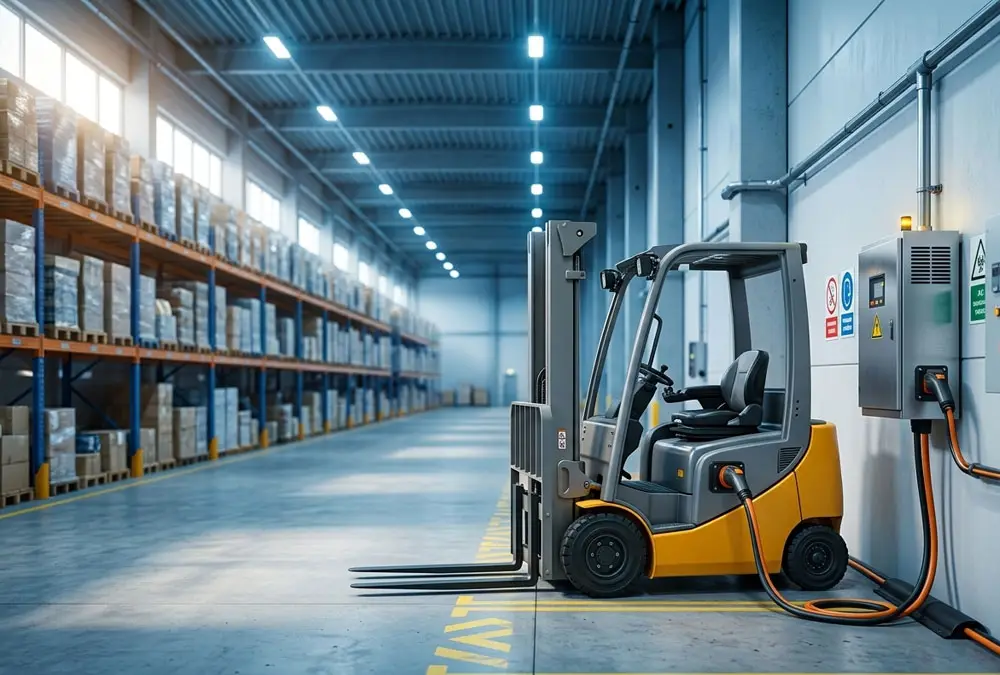
How Should Charging Strategy Protect Electric Forklift Battery Life?
The best strategy is not the one with the most charging opportunities; it is the one that reliably restores the energy the operation consumes while respecting the battery, charger and site limits.
Lead-Acid Charging and Battery-Change Operations
Flooded lead-acid fleets normally require a disciplined cycle of charging, cooling, inspection, watering and any manufacturer-specified equalisation. When spare batteries are changed between shifts, the plan also needs approved handling equipment, trained people and a suitable charging area. Skipping one part of that process can convert a low purchase price into lost life and avoidable downtime.
OSHA’s electric forklift guidance describes designated charging areas, ventilation, electrolyte hazards, battery handling and employee training for relevant US workplaces. It also stresses following the charger manufacturer’s recommendations. These are safety and operating controls, not optional maintenance extras.
Lithium-Ion Opportunity Charging
Opportunity charging can support multi-shift operation when breaks are long enough, chargers restore sufficient energy, site power supports simultaneous demand and the pack is designed for the proposed charging pattern. It can fail operationally even when every component works as designed: the breaks may simply be too short or inconsistent to replace the energy consumed between them.
Shift-energy check
Energy restored during dependable charging windows must cover the energy used between those windows, plus an agreed operational reserve.
Do not plan by the number of times operators connect the charger. Plan by measured energy. Confirm charger output, battery acceptance limits, temperature behaviour, input power and whether communication between the truck, pack and charger is required. For fleets evaluating lithium systems, the site’s forklift battery solution range can provide a starting point, but a product category is not a compatibility approval. The final configuration still has to match the truck, duty cycle, charger and market documentation.
Build a Forklift Battery Maintenance System, Not a Tip List
Many battery-life problems are not caused by a complete lack of knowledge. They occur because responsibility is unclear. One operator assumes maintenance has checked the water; maintenance assumes the night shift recorded the charger fault; purchasing cannot find the last test result. A workable programme assigns each observation to a person and defines when it must be escalated.
| Role | What to Record | What Not to Do | Escalation Trigger |
|---|---|---|---|
| Operator | Start/end SOC or BDI, alarms, interruption, damage, unusual heat or smell | Continue using damaged equipment or bypass protection | Sudden performance change, damage, leakage, heat or warning |
| Maintenance | Charger events, connector condition, chemistry-specific service and test results | Apply one chemistry’s procedure to another or change settings without approval | Repeated alarms, abnormal cell/module trend or failed capacity requirement |
| Fleet manager | Productive hours, charging windows, unplanned downtime and substitute-truck use | Judge performance only by calendar age or dashboard percentage | The system no longer completes the planned duty reliably |
| Procurement | Warranty scope, service response, diagnostics, spares and end-of-life route | Compare battery-only quotes with complete installed systems | Support or downtime cost exceeds the approved threshold |
For lead-acid batteries, water quality, watering timing, cleaning, ventilation and service records must follow the exact product instructions and workplace procedure. For lithium-ion, “maintenance-free” should not be read as “inspection-free” or “management-free.” Connectors, enclosure condition, logs, software access and fault-response arrangements still need ownership.
When Should You Repair, Recondition or Replace a Forklift Battery?
The right decision depends on the fault, verified remaining performance and the truck’s future—not the battery’s age alone.
Repair an Isolated, Serviceable Fault
Repair may be appropriate when a qualified diagnosis identifies a limited fault, replacement parts and procedures are available, the rest of the battery remains in acceptable condition and the repair has a defined test and warranty scope. Ask what will be replaced, how the pack will be validated and which risks remain.
Treat “Reconditioned” as a Scope, Not a Quality Grade
Reconditioning can describe very different work. One offer may include cleaning and limited repair; another may include cell replacement and a documented capacity test. Compare the incoming test, work performed, outgoing test conditions, achieved performance, warranty and expected application. The label alone proves nothing.
Replace When Verified Performance No Longer Meets the Duty Economically
Replacement becomes stronger when controlled testing confirms insufficient usable performance, faults recur, maintenance and downtime are rising, and the truck itself has enough supported service life to justify the investment. The replacement quote must include the compatible charger, integration, permitted battery mass, commissioning, training, documentation and after-sales responsibility.
Retire the Truck When a New Battery Would Preserve a Poor Asset
A small company can face a battery quotation that feels uncomfortably close to the value of its old forklift. Compare the truck’s mechanical condition, availability of parts, safety-related repairs, expected annual hours and the installed cost of the battery system. A technically possible replacement is not automatically an economical investment.
How Do You Calculate Forklift Battery Cost per Productive Hour?
Purchase price is easy to see, but it does not show whether the battery helps the truck work. Use the same assessment period and productive-hour target for every option:
Lifecycle battery cost per productive hour
(battery + charger and infrastructure + installation + energy + maintenance + handling + downtime + replacements − documented residual value) ÷ verified productive operating hours
Use dated quotations, site electricity tariffs, work orders and fleet records. Do not insert an industry-average downtime value when your own missed loading hours can be measured. If a supplier claims lower energy cost or longer service, ask for the exact product, charger, test temperature, operating window and end-of-life criterion behind the comparison.
A purchasing team building a complete budget can use the site’s forklift battery cost framework to separate the battery quote from landed, installed and operating costs.
How Regional Conditions Change Electric Forklift Battery Life Planning
Europe: Documentation and Lifecycle Responsibility
European buyers should treat product and lifecycle documentation as part of the power system, not paperwork to request after shipment. The EU Batteries Regulation establishes requirements affecting batteries and waste batteries, with obligations that depend on battery category, role in the supply chain and application date. Buyers should confirm the applicable documentation, responsible economic operator, information duties and end-of-life arrangements for the specific transaction.
The European Union and the United Kingdom should not be treated as one regulatory jurisdiction. For UK operational safety, the Health and Safety Executive’s storage-battery safety guidance describes hazards associated with charging, handling and maintenance. The final workplace controls must reflect the battery type, installation and current local requirements.
United States: Charging Areas, Handling and Training
US buyers should include charging-area and handling requirements in the operating-cost review. OSHA guidance for electric powered industrial trucks addresses designated lead-acid charging areas, ventilation, electrolyte exposure, heavy-battery handling and trained personnel. These requirements affect facility layout, equipment and labour as well as safety.
A lithium-ion system requires its own site-specific electrical, fire, insurer and authority review; it should not be described as automatically exempt from local controls. Battery, charger and truck approvals must be evaluated as a system.
Central Asia and Africa: Environment, Power and Serviceability
These markets contain very different climates, grids and legal systems, so country-level assumptions are not enough. Record the battery-compartment temperature, dust and water exposure, site input voltage, outage frequency, charger location, internet availability and distance to qualified service.
A theoretically efficient battery can become expensive when a proprietary part takes weeks to arrive or when unstable input power repeatedly interrupts charging. Request a spare-parts plan, remote diagnostic process, time-zone coverage, local service path and clear allocation of warranty freight and labour. In remote operations, serviceability is part of battery life.
What Data Should You Collect Before Requesting a Battery Solution?
A useful review begins with evidence, not a request for “a longer-life battery.” Collect:
- forklift make, model, serial or data plate, approved voltage class and permitted battery mass;
- current battery data plate, installation age and maintenance or BMS history;
- battery compartment dimensions, mounting, cable routing, connector and polarity;
- charger make, model, output, programme, communication and site input power;
- number and length of shifts, productive truck hours and dependable charging windows;
- payload range, lift height, attachments, ramps, route length and congestion;
- ambient and battery-compartment temperature range;
- start/end SOC or BDI, charger faults, BMS alarms and recent runtime trend;
- destination country, required documentation, service response and end-of-life route.
For a 48V-class application, the separate guide on 48V forklift runtime and service life provides a more focused review. If the project is a lead-acid conversion, first check the truck, ballast, charger, communication and acceptance requirements described in the lead-acid-to-lithium conversion assessment.
Frequently Asked Questions About Electric Forklift Battery Life
How long does an electric forklift battery last?
It has no single universal lifespan. As reference points, OSHA discusses approximately 2,000 work shifts or charge/discharge cycles under normal operating conditions in its mainly lead-acid guidance, while current named lithium-ion products publish warranty limits such as 3,500 cycles over five years or 5,000 cycles over eight years. These figures are not direct chemistry-wide comparisons. Runtime per charge depends on usable energy and actual power demand, and service life depends on the product’s cycle definition, test conditions, temperature, charging, storage, maintenance and end-of-life threshold.
How many hours should a forklift battery last per charge?
The battery should cover the verified energy required until the next dependable charging window, with an agreed operational reserve. The number of hours changes with load, route, lift activity, attachments, operator behaviour, temperature and battery condition. Calculate a planning estimate from usable energy and average operating power, then validate it on the actual route.
How do I know if a forklift battery is failing?
Warning signs include a repeatable decline in runtime, abnormal voltage behaviour under load, recurring charger or BMS faults, excessive heat, damaged connections or inability to complete the verified duty after correct charging. These signs do not identify the root cause by themselves. Check the workload, charger, connectors and BDI/SOC system before using a controlled battery test to support the decision.
Does opportunity charging reduce forklift battery life?
It depends on the battery chemistry and design, charger, temperature, charging limits and manufacturer-approved operating strategy. Opportunity charging may support lithium-ion multi-shift operation, but it is not automatically suitable for every pack or charger. Validate the energy balance and operating limits for the exact system.
Does cold weather shorten electric forklift battery life?
Cold conditions can reduce available performance and may limit charging, but temporary low-temperature performance loss is not the same as permanent ageing. The correct response depends on cell temperature, product limits, charging location and any approved heating strategy. Do not charge outside the manufacturer’s permitted conditions.
Should I replace the battery or the whole forklift?
Compare the battery’s controlled test result with the truck’s mechanical condition, remaining supported life, safety-related repairs, annual operating hours and complete installed battery cost. A new battery can be sensible for a sound, supported truck, but it may be poor value when the vehicle itself has major unresolved costs or limited parts support.
Longer Battery Life Starts With Better Evidence
The most effective way to extend electric forklift battery life is not to follow a universal list of charging percentages. It is to manage three clocks: keep enough usable energy for the next reliable charge, operate the battery within its validated limits and replace it only when measured performance and cost justify the decision.
When runtime falls, compare the work first. Then review the charger, connections, SOC indication and chemistry-specific data before ordering a replacement. When evaluating a new system, include the charger, site power, truck integration, environment, service access and market documentation. That process protects uptime and turns battery life into a measurable operating result rather than a sales promise.
Request a battery-life and system-fit review
Send the truck and battery data plates, charger model, shift profile, temperature range and destination market. The review can identify missing compatibility information and prepare a specification-ready request without assuming that higher Ah alone will solve the problem.
Related Articles

Related Posts
 https://anengjibattery.com/wp-content/uploads/2026/10/AnengJIBattery-Diagnosing-Electric-Forklift-Runtime-Loss.webp
675
1000
Battery Expert Team
https://anengjibattery.com/wp-content/uploads/2025/06/logo2-300x138.png
Battery Expert Team2026-10-20 07:16:552026-10-20 09:59:05Electric Forklift Battery Life: How Can You Extend It?
 https://anengjibattery.com/wp-content/uploads/2026/10/AnengJIBattery-Forklift-Battery-Options-in-a-Working-Warehouse.webp
675
1000
Battery Expert Team
https://anengjibattery.com/wp-content/uploads/2025/06/logo2-300x138.png
Battery Expert Team2026-10-19 09:47:272026-10-19 09:53:26Forklift Battery Types: Which One Fits Your Fleet?
 https://anengjibattery.com/wp-content/uploads/2026/10/anengjiBattery-Forklift-Battery-Conversion-Assessment.webp
675
1000
Battery Expert Team
https://anengjibattery.com/wp-content/uploads/2025/06/logo2-300x138.png
Battery Expert Team2026-10-16 09:25:382026-10-16 09:26:06Lithium-Ion Forklift Battery vs Lead-Acid: Can You Convert?
 https://anengjibattery.com/wp-content/uploads/2026/10/AnengjiBattery-Electric-Forklift-Battery-Capacity-Guide.webp
675
1000
Battery Expert Team
https://anengjibattery.com/wp-content/uploads/2025/06/logo2-300x138.png
Battery Expert Team2026-10-16 02:15:092026-10-16 02:15:26How Many Ah Does an Electric Forklift Battery Need? A Duty-Cycle Sizing Guide



Leave a Reply
Want to join the discussion?Feel free to contribute!