
What Is an Industrial BESS? Complete Factory Energy Guide
June 23, 2026 / Battery Expert Team / battery energy storage
Introduction
Spiking peak demand charges can quietly destroy a factory’s monthly operational budget. Deploying a rugged industrial bess framework offers heavy power consumers a reliable way to regain control over volatile utility bills. Relying blindly on the local grid is becoming a dangerous financial gamble for automated production lines. This technical guide breaks down hardware layouts, real financial return metrics, and essential safety engineering protocols. Discover how on-site energy storage can turn your factory from a passive consumer into an active power manager.
Industrial BESS at a Glance (Featured Snippet)
What Is an Industrial Battery Energy Storage System (BESS)?
What Is an Industrial BESS?
An Industrial Battery Energy Storage System (BESS) is a large-scale battery solution designed for factories, industrial facilities, and commercial sites. It stores electricity for later use, helping businesses reduce energy costs, improve power reliability, integrate renewable energy sources, and achieve sustainability goals.
Why Industrial BESS Is Becoming Essential for Modern Industry
Grid infrastructure is aging rapidly while industrial power demands continue to surge. Volatile spot market prices and steep penalties for peak consumption undermine predictable operational planning. On-site infrastructure acts as a vital shock absorber, protecting heavy machinery from sudden grid instability.
Key Benefits of Industrial Battery Energy Storage Systems
- Immediate Cost Mitigation: Drops peak demand spikes instantly via automated dispatch protocols.
- Enhanced Power Resiliency: Provides seamless backup power to safeguard sensitive manufacturing processes.
- Optimized On-Site Renewables: Eliminates clean energy waste by storing midday solar generation for evening production.
What Is an Industrial Battery Energy Storage System (BESS)?
Definition of Industrial BESS
An industrial battery energy storage system integrates heavy-duty batteries with bidirectional power conversion hardware. These systems are specifically engineered to handle the harsh electrical environments found in heavy manufacturing plants. They act as automated, local energy assets that manage complex power demands behind the meter.
How an Industrial BESS Works
The system operates through a continuous cycle of charging and discharging. During low-tariff hours, the system draws power from the grid or on-site solar panels. When factory power demand spikes, an intelligent controller instantly switches the system to discharge mode. This localized injection of electricity keeps facility demand below expensive utility thresholds.
Difference Between Industrial BESS and Residential Energy Storage
Residential systems generally focus on basic backup needs and use simple single-phase configurations under 20 kWh. An industrial bess project routinely handles multi-megawatt capacities and operates at high medium-voltage levels. These industrial installations require sophisticated liquid cooling systems and complex three-phase power controls to manage heavy factory loads.
Industrial BESS vs Commercial Energy Storage Systems
Commercial configurations usually serve retail centers or office buildings with highly predictable lighting and HVAC loads. Industrial energy storage face far tougher challenges, including abrupt inductive load spikes caused by heavy motors and arc furnaces. These industrial systems require heavier components and advanced power electronics to handle high-stress operating conditions.
Key Components of an Industrial Energy Storage System
A reliable battery energy storage system depends on the tight integration of several critical hardware subsystems.
Battery Pack and Cell Technologies
The core of the system relies on high-density electrochemical cells organized into robust, structural modules. Modern industrial systems favor advanced lithium iron phosphate chemistry due to its exceptional thermal stability. These cell groups are monitored by internal sensor arrays that track voltage and temperature variations in real time.
Battery Management System (BMS)
The BMS serves as the primary technical guardian for your energy asset. It monitors performance at the individual cell level, balancing voltages to prevent overcharging or deep discharge damage. If a cell exhibits abnormal thermal behavior, the BMS alerts the main controller to isolate the affected rack immediately.
Power Conversion System (PCS)
The PCS acts as the heavy-duty bidirectional bridge between the battery racks and the factory’s main AC grid. It converts incoming AC grid power to DC for storage, and switches back to AC during discharge cycles. High-performance PCS units use advanced IGBT semiconductors to achieve rapid response times during sudden load changes.
Energy Management System (EMS)
The energy management system operates as the brain of the entire project. It runs smart control algorithms that analyze utility tariffs, weather forecasts, and historical facility load profiles. By calculating optimal charging and discharging schedules, the EMS helps maximize daily operational cost savings.
Fire Suppression System
Industrial installations use multi-layered fire safety systems to ensure safe operation. These systems combine early-stage off-gas detection with specialized chemical suppression agents like Novec 1230 or FM200. Structural thermal barriers isolate individual battery racks, preventing localized failures from spreading throughout the enclosure.
Monitoring and SCADA Platform
The SCADA platform provides facility engineering teams with complete visibility into system performance. It tracks efficiency metrics and provides remote diagnostic tools via secure industrial communication protocols. This real-time data allows engineers to spot potential performance issues before they cause unexpected operational downtime.
Main Industrial BESS Specifications and Performance Metrics
Understanding Energy Capacity (kWh and MWh)
Energy capacity measures the total amount of electricity the system can store and deliver over time. Small industrial operations often start with systems around 215 kWh, while large chemical facilities require multi-megawatt-hour installations. Matching this capacity to your daily consumption patterns is critical for optimizing project returns.
Understanding Power Ratings (kW and MW)
The power rating defines the maximum rate of energy the system can discharge at any given moment. This metric determines how effectively the system can cut sudden peak demand spikes on the factory floor. A higher power rating allows the system to support larger machinery during sudden startup cycles.
What Is C-Rate?
C-Rate measures the speed at which a battery charges or discharges relative to its total capacity. A 1C rate means the system can fully discharge its stored energy in exactly one hour. For standard peak shaving applications, a 0.5C configuration provides an ideal balance of power and long-term cell life.
Round-Trip Efficiency
Round-trip efficiency tracks the percentage of energy recovered during discharge compared to the energy used to charge the cells. High-performance industrial configurations typically achieve efficiencies above 88%, including PCS losses. Minimizing these conversion losses directly lowers your ongoing operational costs.
Cycle Life and Battery Degradation
Cycle life defines the number of charge and discharge cycles a system can perform before its capacity drops to 80% of its original rating. Industrial-grade cells routinely deliver over 6,000 cycles under proper operating conditions. Managing ambient temperatures correctly is essential for preventing premature capacity loss.
Depth of Discharge (DoD)
Depth of Discharge shows the percentage of total battery capacity utilized during a typical cycle. While modern cells can handle 100% discharge, limiting standard operations to 90% DoD extends system lifespan. This conservative approach preserves battery health without sacrificing daily performance.
Why Invest in an Industrial BESS?
Deploying specialized industrial bess solutions provides a powerful tool for optimizing your facility’s long-term energy costs.
Reducing Electricity Costs
The system helps lower utility bills by shifting power consumption away from expensive peak pricing windows. By charging during low-cost periods and discharging during peak times, factories can significantly reduce their energy expenses. This simple strategy delivers predictable savings month after month.
Lowering Demand Charges
Securing a meaningful demand charge reduction remains a primary financial driver for modern manufacturing operations. Utilities levy heavy penalties based on a factory’s highest 15-minute consumption spike each month. Localized battery dispatch caps these sudden spikes, keeping your monthly demand charges low.
Improving Energy Independence
On-site storage insulates your manufacturing business from erratic power market fluctuations and local grid constraints. It gives your team the freedom to manage power allocations based on production schedules rather than utility limitations. This autonomy provides a valuable competitive edge in power-intensive industries.
Enhancing Energy Security
An industrial backup power system protects sensitive production assets from sudden voltage sags and blackouts. If the primary utility grid fails, the system switches to backup mode in milliseconds, keeping critical assembly lines running. This rapid response prevents expensive material waste and machinery damage.
Supporting Decarbonization Goals
Deploying battery infrastructure helps your company meet strict corporate ESG metrics and carbon reduction goals. Storing clean energy ensures your facility runs on zero-carbon power even when local environmental conditions change. This active approach demonstrates a clear commitment to sustainable manufacturing.
Maximizing Renewable Energy Utilization
Integrating an industrial solar battery storage asset prevents clean energy curtailment during periods of low factory activity. Instead of exporting excess solar power to the grid at low rates, you save that clean energy for high-tariff production hours. This internal loop maximizes the value of your solar investment.
Financial Benefits and ROI of Industrial BESS
How Industrial BESS Generates Financial Returns
Financial returns flow through multiple distinct operational mechanisms:
- Peak Shaving: Shaves off costly short-duration demand spikes automatically.
- Load Shifting: Moves bulk energy consumption to low-cost night tariffs.
- Energy Arbitrage: Capitalizes on intraday wholesale market price differences.
- Demand Charge Reduction: Lowers the fixed monthly capacity penalties levied by utilities.
Industrial BESS Revenue Generation Opportunities
Depending on local market rules, factories can participate in lucrative grid flexibility programs. Providing fast frequency response services to the local utility generates steady revenue streams alongside your daily energy savings. This dual-use strategy accelerates project payback timelines.
Typical ROI Ranges for Industrial Projects
According to the BloombergNEF 2025 Energy Storage Market Outlook, industrial projects located in regions with high peak power prices achieve typical payback periods between 4 to 7 years. These strong returns make on-site battery installations a highly viable option for modern energy management.
Factors Affecting Payback Period
Your actual payback period depends heavily on local utility tariff structures and facility load factors. Regions with steep peak demand charges show the fastest returns on investment. Project economics improve further when systems are paired with on-site solar to lower charging costs.
Example Industrial BESS ROI Calculation
| Parameter | Value / Metric |
|---|---|
| System Configuration | 500 kW / 1,000 kWh (1 MWh) |
| Estimated Turnkey Capital Cost | $320,000 |
| Annual Demand Charge Savings | $52,000 |
| Annual Tariff Arbitrage Savings | $18,000 |
| Total Annual Financial Benefit | $70,000 |
| Simple Payback Period | 4.57 Years |
Core Industrial BESS Applications and Behind-the-Meter Services
Deploying commercial and industrial bess infrastructure unlocks several flexible operational options behind the utility meter.
Peak Shaving and Load Shifting
The system actively manages your facility’s load profile to keep power demand smooth and predictable. It dampens sudden power spikes caused by heavy machinery startup cycles, reducing stress on your electrical infrastructure. This consistent load profile helps prevent costly utility penalties.
Emergency Backup Power and Grid Resilience
The system can isolate your facility from the utility grid during sudden blackouts, forming a local microgrid. This ensures continuous power to critical production assets and safety systems. This protection prevents expensive product spoilage and keeps your operations running smoothly.
Renewable Energy Integration
Integrating storage helps smooth out the natural output variations of on-site wind and solar generation. This creates a stable, predictable power source for your manufacturing lines. It ensures clean energy can be used reliably across all production shifts.
Solar Plus Storage Systems
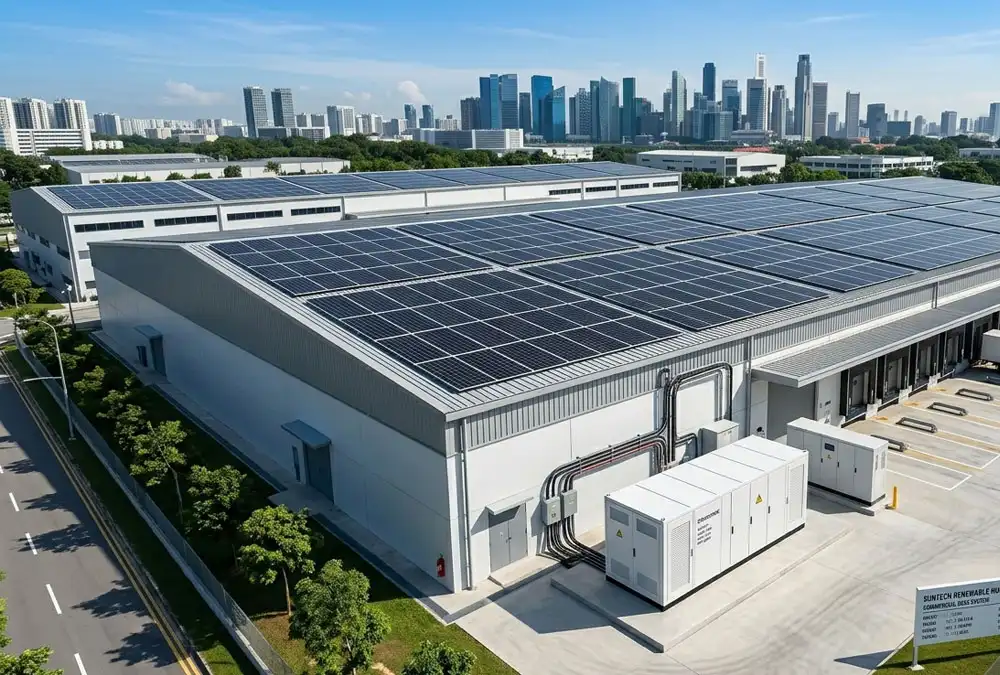
A unified solar plus storage system maximizes the financial return of your clean energy investment. The battery stores excess midday solar generation and deploys it during expensive peak hours. This internal loop keeps your factory insulated from rising grid energy costs.
Wind Energy Storage Applications
Wind generation often peaks at night when factory consumption is lowest. A local BESS captures this clean energy, saving it for heavy daytime production cycles. This capability transforms unpredictable wind output into a reliable asset for your factory floor.
Microgrid Support
For facilities in remote locations, a microgrid energy storage system serves as a central power anchor. It coordinates diverse energy sources like diesel generators, solar arrays, and batteries. This smart management reduces fuel use and ensures a reliable power supply.
EV Charging Infrastructure Support
Adding high-power DC fast chargers for logistics fleets can strain a factory’s electrical system. A dedicated battery storage unit helps manage these charging spikes locally, avoiding expensive grid upgrades. This infrastructure allows you to charge transport fleets without overloading your facility.
Power Quality Improvement
Heavy machinery often introduces harmonic distortions and voltage fluctuations into local electrical circuits. The system’s power electronics actively correct these power quality issues in real time. This clean power protects sensitive automated equipment and extends tool lifespans.
Industrial BESS for Manufacturing Facilities
Tailoring industrial energy storage systems for factories requires adjusting performance parameters to match specific industry workflows.
Automotive Manufacturing
Robotic welding lines cause massive, short-duration power spikes that strain factory electrical systems. High-power battery cabinets absorb these rapid spikes locally, protecting sensitive electronics across the plant. This stabilization prevents automated assembly lines from suffering unexpected resets.
Food Processing Plants
Continuous refrigeration is critical for maintaining strict product safety and quality standards. An on-site battery storage asset provides reliable backup power to eliminate the risk of product spoilage during blackouts. This protection safeguards your inventory and ensures compliance with regulatory standards.
Chemical Factories
Interrupting a chemical process mid-cycle can ruin raw materials and damage expensive production equipment. The system provides seamless backup power to keep critical pumps and mixers running during grid anomalies. This resilience protects your machinery and prevents costly production delays.
Metal and Mining Operations
Heavy crushing equipment and sorting machinery create intense power demands during startup cycles. Localized battery storage helps manage these peak loads, ensuring steady operation without triggering utility demand penalties. This stabilization keeps your heavy machinery running efficiently.
Logistics and Warehousing Facilities
Modern distribution hubs use automated retrieval systems and large electric forklift fleets that require regular charging. A modular battery system helps manage these charging loads smoothly throughout the day. This configuration supports high-volume operations without straining the local utility grid.
Data Centers and Critical Infrastructure
Data centers require absolute power reliability to ensure continuous uptime and prevent data loss. Integrated battery storage works alongside backup generators to provide seamless, uninterruptible power. This multi-layered protection keeps critical IT systems running smoothly through any grid disturbance.
Industrial BESS Product Types and Configurations
Containerized Battery Energy Storage Systems
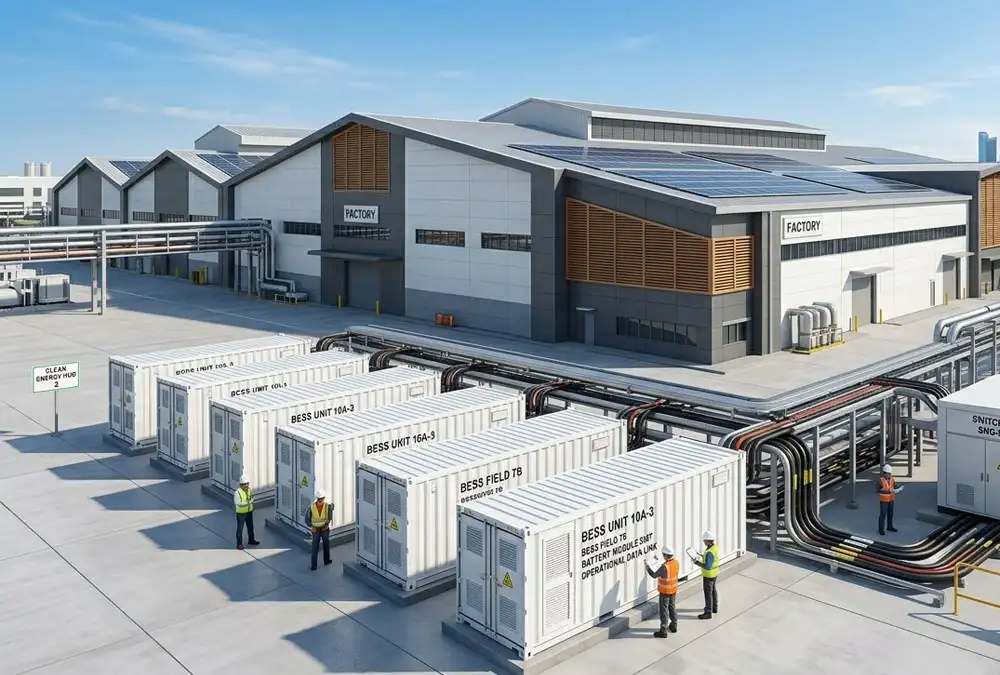
Containerized solutions package all necessary batteries, cooling systems, and safety controls inside a durable, weatherproof enclosure. These rugged systems arrive pre-tested and ready for quick deployment on site. This approach minimizes field installation time and simplifies complex construction workflows.
Recommended Industrial Product Selection: For standard industrial configurations, we highly recommend deploying the AnengJi Energy 215kWh Liquid-Cooled Industrial Outdoor Battery Cabinet or their larger 1MWh–5MWh Containerized BESS Platforms. These heavy-duty industrial systems feature Tier-1 LFP chemistry and integrated liquid thermal management. They are explicitly certified under UL9540 standards to deliver reliable peak shaving performance for factories.
All-in-One Battery Cabinets
All-in-one cabinets combine the battery cells, BMS, and PCS into a compact, space-saving footprint. These integrated units are ideal for smaller factories with limited outdoor space. They provide an efficient solution for managing local power demands without requiring extensive site preparation.
Outdoor Energy Storage Cabinets
Outdoor cabinets feature heavy-duty, weatherproof enclosures designed to withstand harsh environmental conditions. They protect sensitive internal electronics from extreme temperatures, heavy dust, and driving rain. This durability ensures reliable performance when installed adjacent to your main substation.
Modular Industrial BESS Designs
Modular architectures allow your facility to expand its storage capacity as energy demands grow over time. You can scale your system by adding modular battery racks without replacing the existing power conversion hardware. This flexibility protects your initial investment and supports long-term business growth.
Battery Chemistries for Industrial Energy Storage
Lithium-Ion Battery Systems
Lithium-ion chemistries remain the leading standard for modern industrial energy projects due to their high energy density. They provide rapid response times and excellent cycle life, making them ideal for managing short-duration power spikes. These proven systems provide reliable performance across diverse manufacturing applications.
Lithium Iron Phosphate (LiFePO4) Batteries
Lithium Iron Phosphate (LiFePO4) Breakdown: LiFePO4 represents the gold standard for industrial lithium battery storage projects today. This specific chemistry replaces volatile cobalt with stable iron phosphate molecules, eliminating the risk of thermal runaway. They handle high ambient temperatures well and deliver over 6,000 cycles at 90% Depth of Discharge, ensuring a long, safe operational lifespan.
Flow Batteries
Flow Battery Breakdown: Flow systems store energy in external liquid electrolyte tanks rather than packed solid cells. This unique design decouples power output from total energy capacity, allowing you to scale storage duration simply by adding larger liquid tanks. While they suffer from lower round-trip efficiency and require a larger footprint, they experience almost zero degradation over decades of continuous use.
Sodium-Ion Batteries
Sodium-Ion Breakdown: Sodium-ion is an emerging technology that replaces lithium with abundant, low-cost sodium materials. These systems perform exceptionally well in extreme cold and offer excellent safety characteristics at a lower price point. However, their lower energy density means they require a larger physical footprint to deliver the same capacity as standard LFP configurations.
Emerging Battery Technologies
Solid-state batteries and advanced zinc-based systems continue to make progress toward commercial production. These new technologies aim to deliver higher energy densities and improved safety profiles for future industrial installations. Monitoring these developments helps inform your long-term energy strategy.
Which Battery Technology Is Best for Industrial BESS?
Which Battery Technology Is Best?
For 95% of commercial and industrial energy storage applications, Lithium Iron Phosphate (LiFePO4) is the best choice. It offers the optimal balance of high round-trip efficiency, proven safety records, long cycle life, and commercial availability.
Industrial BESS Safety and Cooling Technologies
Why Thermal Management Matters
Industrial battery cells generate significant heat during rapid charge and discharge cycles. Keeping internal temperatures stable is critical for preventing premature capacity loss and avoiding safety hazards. Efficient thermal management ensures your energy asset operates safely and reliably under heavy loads.
Liquid Cooling Systems
Liquid cooling systems pump specialized coolant through integrated plates to manage cell temperatures directly. This method provides precise temperature control across the entire battery rack, reducing variance between cells. This uniform cooling helps extend cell life and improves overall system safety.
Air Cooling Systems
Air cooling uses heavy-duty fans and HVAC units to circulate conditioned air through the battery cabinet. While these systems feature simpler mechanical designs, they can allow temperature variations to develop in large enclosures. This makes air cooling better suited for smaller installations with moderate discharge rates.
Immersion Cooling Technologies
Immersion cooling submerges battery cells directly in a specialized dielectric liquid for maximum thermal management. This direct contact provides exceptional heat transfer and eliminates localized hot spots entirely. While highly effective, it represents a more complex and expensive engineering solution.
Fire Prevention Strategies
Effective fire prevention relies on a multi-layered safety approach that starts at the cell level. Systems feature internal pressure vents, electrical fuses, and smart software boundaries that monitor performance continuously. This layout ensures potential electrical faults are isolated before they cause physical damage.
Gas Detection and Suppression Systems
Enclosures include sensitive off-gas sensors designed to detect trace chemical emissions at the earliest signs of cell stress. If anomalies are found, the system triggers localized chemical suppression agents to protect the rack. This automated response helps ensure your facility remains safe from thermal incidents.
International Safety Certifications
Never purchase a system that lacks verified compliance with international safety standards. Key certifications include:
- UL9540: Validates the safety of the complete, integrated energy storage system.
- UL9540A: Evaluates thermal runaway fire progression through rigorous testing.
- IEC62619: Governs the safety requirements for lithium battery packs in industrial applications.
- CE Certification: Confirms compliance with essential European health, safety, and environmental standards.
How to Size an Industrial BESS Correctly
Properly sizing your system is critical for securing a strong return on investment for your factory battery storage project.
Understanding Factory Load Profiles
Sizing begins with an in-depth analysis of your facility’s historical interval data from utility meters. This data maps your factory’s exact power consumption patterns across different shifts and production cycles. Understanding these variations helps ensure your system is engineered to handle real-world loads.
Peak Demand Analysis
Engineering teams identify the exact timing and magnitude of your largest monthly power spikes. This data determines the minimum power rating required to achieve meaningful demand charge reductions. Accurate analysis ensures your system is powerful enough to handle heavy machinery startup loads.
Energy Consumption Analysis
We analyze your total daily energy use to determine how much electricity needs to be shifted away from peak hours. This calculation helps optimize your battery capacity without over-engineering the installation. Proper scaling ensures you achieve maximum financial value from your system.
Determining Storage Duration
Storage duration defines how many hours the system can sustain its maximum power output. A 2-hour system works well for short peak shaving needs, while a 4-hour configuration is better for extended load shifting. Matching this duration to your tariff structure maximizes monthly savings.
Matching Solar Capacity with Battery Capacity
If you have on-site generation, your storage capacity should scale with your solar array’s typical peak output. This balance ensures your battery can capture all excess midday power without filling up too quickly. Proper coordination prevents clean energy waste and improves project economics.
Common Sizing Examples
| Facility Load Profile | Recommended BESS Configuration |
|---|---|
| 200 kW Average Peak Load | 215 kWh – 430 kWh Storage System |
| 500 kW Average Peak Load | 500 kWh – 1 MWh Storage System |
| 1 MW Heavy Industrial Load | 1 MWh – 2 MWh Storage System |
| 5 MW Large Manufacturing Plant | 5 MWh – 10 MWh Storage System |
Evaluating an Industrial BESS Investment
Estimating Costs
Your total upfront budget must account for both hardware costs and physical site preparation. While battery cell prices continue to decline, engineering and electrical integration remain significant project components. Evaluating these elements early helps prevent unexpected budget overruns during construction.
Space Requirements
Containerized storage systems require solid, level concrete pads with adequate clearance for maintenance access and ventilation. Systems should be located near your facility’s main electrical room to minimize expensive conduit runs. Proper placement lowers installation costs and simplifies ongoing site management.
Installation and EPC Costs
Civil works, structural trenching, and utility interconnection approvals routinely account for roughly 25% of your total project budget. Working with an experienced engineering partner helps keep these execution costs predictable. Efficient project management ensures your system moves smoothly through the commissioning process.
Standard vs Custom Engineering Solutions
Standardized equipment configurations offer lower upfront costs and faster delivery timelines for standard factory applications. However, facilities with unique electrical setups or severe space constraints may require a custom-engineered solution. Balancing these options helps match your specific operational needs.
Financing and Incentive Opportunities
Many regional governments offer tax credits, accelerated depreciation benefits, and clean energy grants to encourage battery storage investments. These financial incentives can offset a significant portion of your upfront project costs. Leveraging these programs helps shorten your payback period and improves overall ROI.
How to Choose the Right Industrial BESS Supplier
Technical Expertise
Your chosen supplier must demonstrate a deep understanding of complex medium-voltage industrial electrical systems. They should possess verified experience managing difficult inductive loads and automated grid integration. This expertise ensures your system operates reliably under real factory conditions.
Manufacturing Capability
Partner with manufacturers that utilize automated production lines and implement strict quality control standards for their cell assembly. Reliable manufacturing consistency ensures stable cell performance and extends your system’s long-term operational life. This quality reduces maintenance issues and protects your investment.
EPC and Turnkey Services
Sourcing an integrated, single-provider turnkey contract simplifies project execution and reduces management friction. A single partner manages the entire project rollout, from early design through final utility commissioning. This approach eliminates coordination disputes between independent contractors.
EMS Integration Capability
Ensure the supplier’s control software integrates smoothly with your factory’s existing energy monitoring and SCADA platforms. Open communication interfaces allow your engineering team to manage system performance efficiently. This connectivity supports smart energy tracking across your entire facility.
Safety Certifications
Verify that all equipment carries authentic, third-party safety certifications from recognized international testing laboratories. Avoid vendors that offer vague assurances instead of official certification documents. Proper safety compliance protects your personnel and your manufacturing infrastructure.
Warranty and After-Sales Support
A comprehensive performance warranty should guarantee cell capacity retention over a 10-year period. Your supplier must maintain local service teams capable of providing rapid on-site technical support when needed. Reliable long-term support is essential for maintaining optimal system performance.
Why Industrial BESS Is Driving the Future of Smart Manufacturing
Energy Digitalization
Modern battery installations convert power consumption from a fixed utility cost into a highly visible, manageable operational asset. Integrated software tracking provides valuable data that helps optimize production schedules across all shifts. This visibility supports smart, data-driven operational decisions.
Carbon Neutrality Goals
Deploying on-site energy storage provides an effective tool for meeting corporate carbon reduction targets. Storing clean energy locally allows your facility to reduce its reliance on fossil-fuel power grids. This active approach helps decouple business growth from your environmental footprint.
Smart Factory Development
Next-generation industrial automation requires exceptionally clean, reliable power to protect sensitive control networks from grid anomalies. Localized storage integrates smoothly with smart factory infrastructure to provide a stable electrical foundation. This protection supports continuous, high-efficiency manufacturing.
Renewable Energy Adoption Trends
As grid regulations evolve, factories must take responsibility for managing their local electrical impacts. On-site battery systems allow companies to expand their solar installations without overloading regional utility lines. This capability supports independent, sustainable corporate energy growth.
Frequently Asked Questions About Industrial BESS
What is the typical lifespan of an industrial battery system?
A high-quality system utilizing premium LiFePO4 cells routinely delivers an operational lifespan of 12 to 15 years. This longevity assumes the system is managed by a high-performance liquid cooling configuration and operates under proper parameters.
How does a BESS integrate with existing factory electrical infrastructure?
The system connects directly to your main switchboard through a dedicated circuit breaker inside the facility’s electrical room. Control signals sync with your existing building management platform to coordinate automated charging and discharging.
What are the differences between Front-of-the-Meter and Behind-the-Meter systems?
Front-of-the-meter installations connect directly to utility distribution lines to support regional grid operations. Behind-the-meter systems sit on the customer’s side of the utility meter to lower local factory bills directly.
How much does an industrial BESS cost?
Turnkey project costs generally range from $300 to $450 per kilowatt-hour of capacity, depending on configuration complexity. This estimate includes the battery packs, power conversion systems, civil engineering works, and final site commissioning.
What size BESS does my factory need?
Your ideal system size depends on your highest monthly peak demand spikes and typical daily energy use. An experienced engineer can analyze your utility data to recommend the optimal capacity for your project.
How long does an industrial BESS take to pay for itself?
Most commercial installations achieve full payback within 4 to 7 years. Timelines can shorten further in regions that offer strong clean energy tax credits or face steep demand charges.
Can industrial BESS work with solar power systems?
Yes. Combining storage with solar creates a highly effective energy solution that allows you to save low-cost daytime generation for expensive peak hours. This integration maximizes the financial value of both assets.
Is liquid cooling better than air cooling?
Liquid cooling is highly recommended for large industrial installations. It provides superior temperature uniformity across all battery racks, which helps maximize cell lifespans and improves overall system safety.
Conclusion: Is an Industrial BESS the Right Investment for Your Facility?
Key Takeaways
- Industrial BESS reduces energy costs and demand charges.
- It improves energy reliability and operational resilience.
- It enables higher renewable energy utilization.
- Modern LiFePO4 battery systems provide long lifespans and excellent ROI.
- Proper sizing, EMS integration, and supplier selection are critical to project success.
Aligning your electrical configuration with smart storage technology is an effective way to lower long-term manufacturing costs. For most power-intensive factories, an integrated energy storage asset provides a reliable path to lower bills and improved grid resilience. To explore how a custom battery installation can optimize your facility’s energy budget, connect with our engineering team today.
Related Posts
 https://anengjibattery.com/wp-content/uploads/2026/10/AnengjiBattery-Cell-to-Pack-Energy-Density-Comparison.webp
675
1000
Battery Expert Team
https://anengjibattery.com/wp-content/uploads/2025/06/logo2-300x138.png
Battery Expert Team2026-10-23 06:58:392026-10-23 06:58:41What Does Lithium-Ion Battery Energy Density Really Mean?
https://anengjibattery.com/wp-content/uploads/2026/10/AnengjiBattery-Cell-to-Pack-Energy-Density-Comparison.webp
675
1000
Battery Expert Team
https://anengjibattery.com/wp-content/uploads/2025/06/logo2-300x138.png
Battery Expert Team2026-10-23 06:58:392026-10-23 06:58:41What Does Lithium-Ion Battery Energy Density Really Mean? https://anengjibattery.com/wp-content/uploads/2026/10/AnengjiBattery-Lithium-Battery-Management-in-Daily-Operation.webp
675
1000
Battery Expert Team
https://anengjibattery.com/wp-content/uploads/2025/06/logo2-300x138.png
Battery Expert Team2026-10-22 08:17:332026-10-23 06:58:57How Does a Lithium BMS Improve Battery Longevity?
https://anengjibattery.com/wp-content/uploads/2026/10/AnengjiBattery-Lithium-Battery-Management-in-Daily-Operation.webp
675
1000
Battery Expert Team
https://anengjibattery.com/wp-content/uploads/2025/06/logo2-300x138.png
Battery Expert Team2026-10-22 08:17:332026-10-23 06:58:57How Does a Lithium BMS Improve Battery Longevity? https://anengjibattery.com/wp-content/uploads/2026/10/AnengjiBattery-Industrial-Power-Under-Real-Load.webp
675
1000
Battery Expert Team
https://anengjibattery.com/wp-content/uploads/2025/06/logo2-300x138.png
Battery Expert Team2026-10-22 07:04:542026-10-22 07:05:30How Does a 48V LiFePO4 BMS Protect Industrial Power?
https://anengjibattery.com/wp-content/uploads/2026/10/AnengjiBattery-Industrial-Power-Under-Real-Load.webp
675
1000
Battery Expert Team
https://anengjibattery.com/wp-content/uploads/2025/06/logo2-300x138.png
Battery Expert Team2026-10-22 07:04:542026-10-22 07:05:30How Does a 48V LiFePO4 BMS Protect Industrial Power? https://anengjibattery.com/wp-content/uploads/2026/10/AnengJIBattery-Electric-Forklift-Battery-Buying-Decision.webp
675
1000
Battery Expert Team
https://anengjibattery.com/wp-content/uploads/2025/06/logo2-300x138.png
Battery Expert Team2026-10-21 06:22:222026-10-21 06:22:38Ready to Buy Battery for Electric Forklift? Use This Guide
https://anengjibattery.com/wp-content/uploads/2026/10/AnengJIBattery-Electric-Forklift-Battery-Buying-Decision.webp
675
1000
Battery Expert Team
https://anengjibattery.com/wp-content/uploads/2025/06/logo2-300x138.png
Battery Expert Team2026-10-21 06:22:222026-10-21 06:22:38Ready to Buy Battery for Electric Forklift? Use This Guide


Leave a Reply
Want to join the discussion?Feel free to contribute!