
How Much to Replace Golf Cart Batteries? 2026 Cost & Guide
August 20, 2026 / Battery Expert Team / Battery Basics
If your golf buggy lags on steep inclines or loses juice halfway through an 18-hole round, it is high time to Replace Golf Cart Batteries before you find yourself stranded on the fairway. According to the energy storage market valuation by Global Market Insights (2026), the global golf cart battery market is expanding rapidly to hit $705.1 million in 2026, propelled by an aggressive 12.8% CAGR shift toward Lithium Iron Phosphate (LiFePO4) chemistry. Upgrading your cart’s power pack involves more than picking the cheapest cell on the shelf. Between high-voltage lithium retrofits and budget lead-acid swaps, this exhaustive 2026 buying guide breaks down real ownership expenses, technical compatibility, continuous discharge metrics, and ROI calculations so you can make an air-tight purchasing decision.
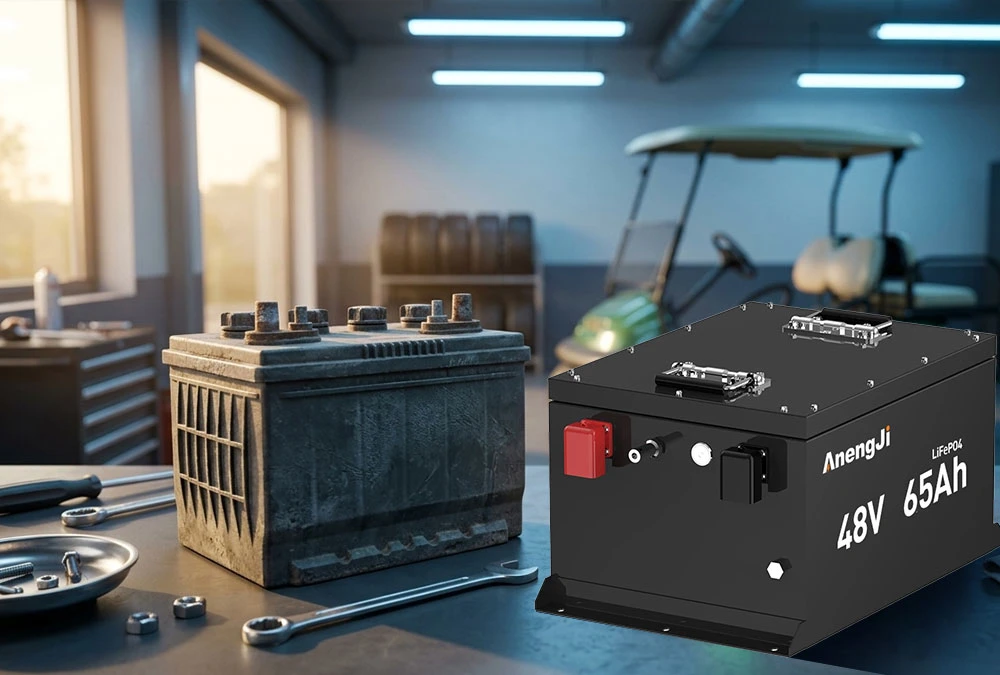
How Much Does It Cost to Replace Golf Cart Batteries in 2026?
Replacing a complete golf cart battery pack in 2026 typically costs anywhere between $800 and $3,800+. This broad price window often confuses cart owners, but the variance boils down directly to four critical core components: cell chemistry, total pack operating voltage (36V vs 48V vs 72V), total usable amp-hour capacity (Ah), and necessary retrofit accessories like chargers or DC-DC converters.
While traditional lead-acid options retain a lower upfront purchase price, rapid advancements in automated lithium manufacturing have narrowed the long-term cost gap dramatically. Understanding these initial price tag nuances helps prevent under-powering your vehicle or overpaying for unnecessary capacity.
Average Golf Cart Battery Replacement Cost by Battery Type
Market analysis from BloombergNEF (2025/2026) demonstrates that cell manufacturing costs for lithium iron phosphate have dropped to historic lows, making lithium retrofits more financially viable than ever. Below is a realistic 2026 breakdown of initial acquisition costs, lifespan expectations, and value retention across all major battery chemistries.
| Battery Type | Typical Voltage | Average Pack Cost | Expected Lifespan | Maintenance Level | Buyer Value Advantage (What You Get) |
|---|---|---|---|---|---|
| Flooded Lead-Acid (FLA) | 6V / 8V / 12V | $800 – $1,500 | 2 – 4 years | High (Watering/Cleaning) | Lowest initial cash outlay; ideal if short-term cash flow is tight or selling cart soon. |
| AGM (Absorbent Glass Mat) | 6V / 8V / 12V | $1,200 – $2,000 | 3 – 5 years | Low (Sealed) | Eliminates water topping maintenance and liquid acid spill risks without custom wiring. |
| Gel Cell | 6V / 8V / 12V | $1,400 – $2,200 | 3 – 5 years | Low (Sealed) | Spill-proof design providing steady deep discharge performance across rough resort terrain. |
| LiFePO4 Lithium | 36V / 48V / 51.2V | $1,500 – $3,800+ | 8 – 12+ years | Zero (BMS Managed) | 70% weight reduction, zero maintenance, 3x faster charging, and lower 10-year total cost. |
36V vs. 48V Golf Cart Battery Replacement Cost
System voltage is the primary hardware driver of total pack expense. A standard 36V golf cart battery replacement utilizing traditional flooded lead-acid usually runs between $900 and $1,300 for a set of six 6V batteries. If you opt for a modern drop-in 36V lithium conversion kit, expect an investment between $1,300 and $2,200 depending on total continuous amp output.
On the other hand, a 48V golf cart battery replacement cost sits noticeably higher due to additional cell requirements. Lead-acid sets (six 8V or four 12V units) range from $1,200 to $1,800, while a high-capacity single-pack 48V golf cart battery replacement using grade-A LiFePO4 chemistry ranges from $1,800 to $3,500+.
Buyer Doubt Check: “Why does 48V cost significantly more upfront than 36V?”
It comes down to raw energy density and electronic limits. Higher voltage systems require more lithium cells or a far heavier Smart BMS to handle current surges. However, 48V systems draw fewer amps to produce the same horsepower, which reduces internal heat build-up and protects your motor controller from burning out over time.
What Actually Determines Golf Cart Battery Replacement Cost?
To make sense of quote variations from local dealers, you need to understand the underlying technical specifications that dictate pricing.
Battery Chemistry and Voltage
Lead-acid batteries use inexpensive lead plates submerged in sulfuric acid solution, which keeps initial production costs low at the expense of energy density and cycle life. In contrast, a high-spec 51.2V lithium replacement incorporates raw lithium iron phosphate, precision copper busbars, integrated thermal sensors, and a sophisticated solid-state BMS, driving higher upfront material costs.
Number of Batteries Required
Legacy setups rely on multiple smaller units chained together in series to match the motor’s operating voltage:
- 36V System: 6 batteries × 6V each
- 48V System (Option A): 6 batteries × 8V each
- 48V System (Option B): 4 batteries × 12V each
- Lithium Single-Pack System: 1 integrated 36V or 48V module
Wiring multiple lead-acid units together increases internal resistance and creates multiple potential failure points across jumper cables. Single-pack lithium modules eliminate external inter-battery cables entirely, delivering cleaner current and simplified installation.
Installation, Charger and Conversion Components
Upgrading your power chemistry often requires supplemental hardware. When budgeting to replace golf cart batteries with lithium, factor in these crucial installation items:
- Dedicated Lithium Charger ($180 – $400): Prevents cell damage caused by improper voltage cut-offs in old lead-acid chargers.
- Upgraded Heavy-Duty Cabling ($50 – $100): Premium 2AWG or 4AWG copper cables to minimize resistance during peak discharge.
- Voltage Reducer / DC-DC Converter ($40 – $90): Steps down 48V main power to 12V for lights, horns, and audio systems, protecting the BMS from current spikes.
- Battery Tray Adapter Brackets ($30 – $80): Fills the excess space left behind when removing heavy, bulky lead-acid batteries.
- Digital State-of-Charge (SoC) Meter ($30 – $75): Accurately tracks remaining capacity via CAN-bus or shunt communication.
Lead-Acid vs. Lithium Golf Cart Battery Replacement: Which Costs Less?
Looking strictly at initial purchase price leads to poor financial decision-making. Evaluating total cost over 5 to 10 years paints a radically different picture.
Upfront Cost vs. Lifetime Cost
We calculate true ownership expenses using the standard Golf Cart Battery Total Cost of Ownership Model:
| Cost Factor | Flooded Lead-Acid | LiFePO4 Lithium | User ROI Advantage |
|---|---|---|---|
| Initial Pack Purchase | Lower ($1,000 – $1,500) | Higher ($1,800 – $3,000) | Lead-acid requires less capital on day one. |
| Maintenance Cost (10 Yrs) | $300 – $500 (Water/Cleaners) | $0 (Fully Sealed) | Saves hundreds in maintenance supplies and hours of messy labor. |
| Charging Efficiency Loss | High (~70-75% efficiency) | Minimal (95%+ efficiency) | Cuts your monthly utility bill per charge significantly over time. |
| Useful Life Cycles | 300 – 500 cycles (2-4 yrs) | 3,500 – 5,000+ cycles (8-12 yrs) | Lithium lasts through 3 to 4 complete lead-acid replacement cycles. |
| 10-Year Total Expenditure | ~$3,600 – $4,500 | ~$2,000 – $2,800 | Lithium saves over $1,200 net cash over a decade of operation. |
When Is a Lithium Upgrade Worth the Higher Upfront Cost?
A lithium golf cart battery upgrade yields rapid ROI if your operating conditions match these scenarios:
- Commercial & Resort Fleets: Eliminates labor costs spent topping off water levels across dozens of carts every month.
- Daily Neighborhood Commuters: Demands fast 2-hour recharge times between trips to school, markets, and golf courses.
- Hilly Terrain Driving: Requires sustained voltage output without the performance drop-off typical of lead-acid units on inclines.
- Performance Enthusiasts: Removing 250+ lbs of battery weight increases acceleration, top speed, and braking responsiveness.
Should You Replace All Golf Cart Batteries at Once?
A frequent dilemma among cart owners on forums like Reddit is whether they can save money by replacing only the single dead battery in their pack.
Why Mixing Old and New Batteries Can Cause Problems
Mixing a single new battery into an aged bank is a recipe for premature system failure. Here is why:
- Internal Resistance Mismatch: Older batteries develop high internal resistance. The charger will struggle to read pack voltage accurately, causing the old batteries to undercharge while constantly overcharging and frying the new unit.
- Capacity Drag: Your cart’s overall discharge range is strictly limited by the weakest battery in the chain. An old cell will drag down the fresh battery’s potential within weeks.
- Accelerated Degradation: You risk destroying a brand-new $180-$250 battery in under six months while failing to resolve your cart’s range issue.
When Can Individual Battery Replacement Make Sense?
Replacing a single battery is advisable only if your entire pack is less than 6 to 12 months old and one specific unit suffered isolated mechanical damage, such as a cracked casing or loose terminal post.
When Should You Replace the Entire Battery Pack?
If your battery pack is older than two years and experiences reduced run-time, always replace the entire set at once.
Replacement Decision Summary:
- Pack under 12 months old + 1 failed battery: Replace individual battery under warranty.
- Pack over 2.5 years old + range dropping: Replace entire lead-acid set simultaneously.
- Tired of maintenance + seeking 8+ year lifespan: Convert entire system to single-pack LiFePO4.
How Do You Know When to Replace Golf Cart Batteries?
Golf Cart Battery Replacement Warning Signs
Batteries rarely die without warning. Keep an eye out for these explicit physical and operational indicators:
- Severe Voltage Sag: The cart stutters or drastically slows down when climbing small hills or accelerating from a full stop.
- Dramatically Reduced Range: A cart that used to handle 36 holes now struggles to complete 9 holes.
- Unusual Charge Times: The charger stays active for 12+ hours without shutting off, or shuts off almost immediately while the pack remains flat.
- Physical Swelling or Deformity: Battery sidewalls bulge outward, indicating severe internal sulfation or grid corrosion.
- Acid Leaks & Terminal Corrosion: Persistent white or greenish powdery build-up around terminals caused by boiling electrolyte gas.
Battery Age vs. Battery Health
Never rely solely on calendar age. A flooded lead-acid pack in a hot climate subjected to deep discharges without regular watering can fail in 18 months, whereas a meticulously maintained pack in mild weather might reach 4 years. Always test specific gravity with a hydrometer or conduct a load test before replacing.
How Much Does It Cost to Upgrade a Golf Cart from Lead-Acid to Lithium?
Lithium Golf Cart Conversion Cost Breakdown
Retrofitting an old lead-acid cart to modern lithium power involves a few key hardware modules. Below is a detailed line-item breakdown of typical conversion expenses:
| Component | Required? | Price Range | What It Does For You |
|---|---|---|---|
| LiFePO4 Lithium Battery Module | Yes | $1,200 – $2,800 | Provides dense, lightweight energy storage with built-in Smart BMS protection. |
| LiFePO4 Compatible Charger | Yes | $180 – $350 | Delivers CC/CV charging curves tailored specifically for lithium cell balancing. |
| Mounting Brackets & Tray Adapters | Recommended | $30 – $80 | Fills empty space in legacy trays, anchoring the lighter lithium battery securely. |
| 48V to 12V DC-DC Voltage Reducer | Recommended | $40 – $90 | Safely powers headlights, turn signals, and audio without tapping individual cells. |
| Professional Installation Labor | Optional | $150 – $350 | Covers professional removal, tray cleaning, wiring, and system safety checks. |
What Makes a Lithium Golf Cart Battery Easy to Install?
Modern drop-in lithium batteries engineered by specialized manufacturers like AnengJi feature standard SAE terminal posts, integrated mounting handles, and factory-configured BMS units. This allows cart owners or technicians to remove old lead-acid blocks and drop in a clean single-pack lithium solution in under two hours using basic hand tools.
How to Choose the Right Replacement Golf Cart Battery
Selecting the correct battery requires systematically verifying four essential electrical and physical dimensions.
Step 1 — Identify Your Golf Cart Voltage
Never guess your voltage. Lift your cart seat and inspect your current set. You can count the water fill holes on a lead-acid battery (each hole equals 2 volts) and multiply by the total number of batteries. Alternatively, inspect the serial tag on your motor or controller. Standard configurations are 36V or 48V.
Step 2 — Check Battery Capacity
Battery capacity is measured in Amp-hours (Ah). To calculate total watt-hour storage capacity, use this standard electrical equation:
For example, a 48V × 105Ah lithium battery equals 5,040Wh (or 5.04kWh) of energy, providing an average driving range of 35 to 45 miles on a single charge.
Step 3 — Check Charger and BMS Compatibility
Ensure the battery’s Battery Management System (BMS) supports your motor controller’s peak current draw. Standard stock carts work fine with a 100A continuous / 200A surge BMS. If you have a lifted cart, upgraded 500A controller, or heavy rear seat, select a lithium pack with a 150A to 200A continuous BMS rating to prevent sudden safety cut-offs during hard acceleration uphill.
Step 4 — Match Battery Size and Installation Space
Measure your battery compartment tray. Lead-acid batteries follow standard GC2 dimensions ($10.3″\text{L} \times 7.1″\text{W} \times 10.8″\text{H}$). Ensure your new lithium pack or lead-acid replacements clear seat undersides and frame crossbars cleanly.
36V vs. 48V Lithium Golf Cart Batteries: Which Replacement Is Better?
36V Lithium Battery Applications
A 36V lithium setup is tailored for older golf cart models (e.g., EZGO TXT prior to 2008 or older Club Car models), light utility carts, and short-distance neighborhood cruising. It provides adequate power without straining vintage motor armatures.
48V Lithium Battery Applications
A 48V lithium setup represents the modern gold standard. It powers contemporary 48V EZGO, Club Car, and Yamaha buggies, street-legal LSVs, lifted 6-passenger vehicles, and commercial fleet haulers requiring maximum torque and hill-climbing endurance.
Can You Upgrade a 36V Golf Cart to 48V?
You cannot simply drop a 48V lithium battery into a 36V cart without changing supporting components. Supplying 48V to a 36V motor controller or solenoid will blow internal capacitors or burn out contact points. Upgrading a 36V cart to 48V requires swapping the motor controller, solenoid, heavy-gauge wiring, and charger alongside the battery pack.
Golf Cart Battery Replacement: Lead-Acid or LiFePO4?
Choose Lead-Acid If…
- Your primary goal is minimizing immediate out-of-pocket replacement expenses.
- You drive the cart less than once or twice a week for short distances.
- You plan to trade in or sell the golf cart within the next 12 to 18 months.
Choose LiFePO4 If…
- You use your cart daily for golfing, commuting, or estate maintenance.
- You want to eliminate battery watering, corrosion cleaning, and garage floor acid stains forever.
- You want long-term reliability backed by an 8 to 10-year service life and lower overall TCO.
The 30-Second Golf Cart Battery Decision Model
Quick Choice Guide:
- Tight Budget + Low Usage: Flooded Lead-Acid ($800–$1,200)
- No Maintenance + Moderate Use: AGM Lead-Acid ($1,200–$1,800)
- Maximum Range + Long Life + Performance: Single-Pack LiFePO4 Lithium ($1,500–$2,800)
How to Replace Golf Cart Batteries Safely
What to Check Before Battery Replacement
Safety is paramount when working with heavy DC voltage banks. Before starting:
- Flipping the cart’s Tow/Run switch under the seat to the TOW position to prevent electrical arcing and controller damage.
- Disconnecting the main negative terminal first, followed by the main positive terminal.
- Wearing protective safety glasses and heavy rubber gloves when handling corroded lead-acid cells.
- Neutralizing acid spills in the battery bay using baking soda and water before dropping in new batteries.
Why Battery Installation Should Follow the Manufacturer’s Specifications
Loose terminal nuts create high resistance, leading to extreme heat melt-downs at connection points. Always use a torque wrench to tighten terminal hardware to manufacturer torque specs (typically 95–105 in-lbs for lead-acid stud terminals).
How Much Can You Save by Choosing the Right Golf Cart Battery?
5-Year Golf Cart Battery Cost Comparison
Over a 5-year operating window, a traditional flooded lead-acid setup typically consumes two full battery sets plus water supplies and terminal sprays, totaling roughly $2,600 to $3,200. Conversely, a quality LiFePO4 lithium conversion requires a single upfront investment of roughly $1,800 to $2,400 with zero ongoing maintenance costs, saving you $800 to $1,000+ over 5 years.
When a More Expensive Battery Becomes the More Economical Choice
Higher initial spend pays back dividends through zero maintenance labor hours, 3x faster charging speeds (saving electricity), extended cart motor controller life, and superior residual resale value for your vehicle.
FAQ About Replacing Golf Cart Batteries
How often should golf cart batteries be replaced?
Flooded lead-acid batteries last 2 to 4 years on average; premium LiFePO4 lithium batteries last 8 to 12+ years depending on usage and charging habits.
Is it better to replace all golf cart batteries at once?
Yes. Replacing only one battery causes severe charge imbalance, dragging down performance and ruining the new battery within months.
Are lithium golf cart batteries worth the extra cost?
Yes. Lithium batteries eliminate watering, cut 250+ lbs off cart weight, charge in 2-3 hours, and deliver a lower total cost over an 8-year lifespan.
How much does it cost to replace a 48V golf cart battery?
A full lead-acid set costs $1,200 to $1,800, while a high-capacity single-pack 48V lithium retrofit costs $1,800 to $3,500.
Can I replace lead-acid golf cart batteries with lithium?
Yes. Drop-in lithium replacement kits are specifically designed to fit into standard GC2 lead-acid tray compartments.
Do I need a new charger when switching to lithium?
Yes. You must use a charger calibrated with a lithium-specific ($\text{LiFePO}_4$) Constant Current / Constant Voltage ($\text{CC/CV}$) charging algorithm.
Get the Right Golf Cart Battery Replacement for Your Application
Need Help Selecting a 36V or 48V Battery?
Share your golf cart make, model, voltage, and daily range requirements with our technical team. We’ll match you with the exact drop-in battery solution.
Looking for Wholesale Golf Cart Lithium Batteries?
We partner directly with golf cart dealers, repair shops, fleet operators, resorts, and commercial managers to supply high-performance LiFePO4 power solutions.
Related Posts
 https://anengjibattery.com/wp-content/uploads/2026/10/AnengjiBattery-Cell-to-Pack-Energy-Density-Comparison.webp
675
1000
Battery Expert Team
https://anengjibattery.com/wp-content/uploads/2025/06/logo2-300x138.png
Battery Expert Team2026-10-23 06:58:392026-10-23 06:58:41What Does Lithium-Ion Battery Energy Density Really Mean?
https://anengjibattery.com/wp-content/uploads/2026/10/AnengjiBattery-Cell-to-Pack-Energy-Density-Comparison.webp
675
1000
Battery Expert Team
https://anengjibattery.com/wp-content/uploads/2025/06/logo2-300x138.png
Battery Expert Team2026-10-23 06:58:392026-10-23 06:58:41What Does Lithium-Ion Battery Energy Density Really Mean? https://anengjibattery.com/wp-content/uploads/2026/10/AnengjiBattery-Lithium-Battery-Management-in-Daily-Operation.webp
675
1000
Battery Expert Team
https://anengjibattery.com/wp-content/uploads/2025/06/logo2-300x138.png
Battery Expert Team2026-10-22 08:17:332026-10-23 06:58:57How Does a Lithium BMS Improve Battery Longevity?
https://anengjibattery.com/wp-content/uploads/2026/10/AnengjiBattery-Lithium-Battery-Management-in-Daily-Operation.webp
675
1000
Battery Expert Team
https://anengjibattery.com/wp-content/uploads/2025/06/logo2-300x138.png
Battery Expert Team2026-10-22 08:17:332026-10-23 06:58:57How Does a Lithium BMS Improve Battery Longevity? https://anengjibattery.com/wp-content/uploads/2026/10/AnengjiBattery-Industrial-Power-Under-Real-Load.webp
675
1000
Battery Expert Team
https://anengjibattery.com/wp-content/uploads/2025/06/logo2-300x138.png
Battery Expert Team2026-10-22 07:04:542026-10-22 07:05:30How Does a 48V LiFePO4 BMS Protect Industrial Power?
https://anengjibattery.com/wp-content/uploads/2026/10/AnengjiBattery-Industrial-Power-Under-Real-Load.webp
675
1000
Battery Expert Team
https://anengjibattery.com/wp-content/uploads/2025/06/logo2-300x138.png
Battery Expert Team2026-10-22 07:04:542026-10-22 07:05:30How Does a 48V LiFePO4 BMS Protect Industrial Power? https://anengjibattery.com/wp-content/uploads/2026/10/AnengJIBattery-Electric-Forklift-Battery-Buying-Decision.webp
675
1000
Battery Expert Team
https://anengjibattery.com/wp-content/uploads/2025/06/logo2-300x138.png
Battery Expert Team2026-10-21 06:22:222026-10-21 06:22:38Ready to Buy Battery for Electric Forklift? Use This Guide
https://anengjibattery.com/wp-content/uploads/2026/10/AnengJIBattery-Electric-Forklift-Battery-Buying-Decision.webp
675
1000
Battery Expert Team
https://anengjibattery.com/wp-content/uploads/2025/06/logo2-300x138.png
Battery Expert Team2026-10-21 06:22:222026-10-21 06:22:38Ready to Buy Battery for Electric Forklift? Use This Guide


Leave a Reply
Want to join the discussion?Feel free to contribute!