
How to Choose a Battery for Electric Cargo Tricycle: Ultimate Guide
August 21, 2026 / Battery Expert Team / Battery Basics
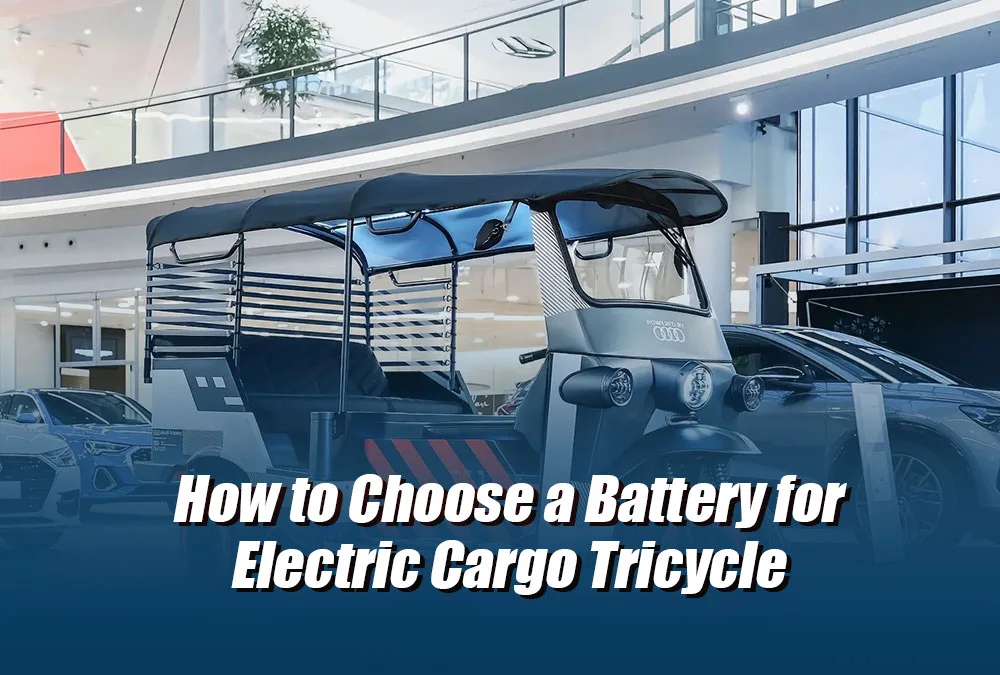
Choosing a cargo tricycle electric battery is not simply about selecting the highest Ah capacity you can find on the market. If you put a huge pack in a light frame, or buy a cheap pack that sags under load, you’ll regret it within a month. The right energy system must match the vehicle’s voltage, motor power, payload, daily mileage, charging requirements, and real-world operating conditions. In commercial logistics and industrial hauling, an improperly specified electric cargo vehicle battery or a poorly built cargo tricycle lithium battery leads to premature cell degradation, unexpected thermal shutdowns, and costly operational downtime that eats into your delivery margins.
Need Help Choosing the Right Battery?
Send us your vehicle voltage, motor power, payload, and required daily range for a precise, application-engineered recommendation.
Why Choosing the Right Cargo Tricycle Electric Battery Matters
We often see fleet operators treat heavy-duty tricycles like basic two-wheel commuters. That is a massive operational mistake. A heavy cargo trike carries three to five times the mass of a passenger bike, demanding a power system designed for high continuous torque, extreme thermal dissipation, and deep cycling without rapid voltage drop.
Cargo Tricycles Have Higher Battery Demands Than Standard Electric Tricycles
Standard passenger tricycles carry a light payload—usually one or two people over smooth urban roads. Cargo tricycles operate in a completely different stress environment. According to the Global Commercial Electric Vehicle Logistics Market Report 2025, heavy-duty last-mile delivery trikes experience up to 40% higher peak current demands during stop-and-go acceleration cycles compared to light commuter trikes. The primary factors driving these high demands include:
- Higher Payload: Hauling 300kg to over 1000kg places continuous strain on motor windings and battery cells.
- Frequent Acceleration: Urban delivery fleets stop every few hundred meters, requiring massive burst currents to get moving again.
- Stop-and-Go Operation: Constant current spikes generate internal heat, accelerating electrolyte breakdown in sub-par packs.
- Longer Working Hours: Commercial tricycles run 8 to 12 hours a day, often demanding double-shifting or rapid opportunity charging.
- Hills and Uneven Roads: Climbing steep ramps or driving over rough terrain forces the motor to draw peak discharge currents for extended periods.
What Happens When the Battery Is Undersized?
When you install an undersized or low-discharge electric tricycle battery, the electrical system breaks down under load. Many operators complain on Reddit forums like r/ebikes about sudden cutoff issues. What they are actually experiencing is severe voltage sag. When a fully loaded trike hits a hill, an under-rated BMS trips its low-voltage protection threshold to save the cells, leaving the driver stranded in middle of traffic.
Undersizing causes a cascade of failure points:
- Insufficient Range: High internal resistance wastes energy as heat rather than pushing wheels forward.
- Severe Voltage Sag: Lowers vehicle speed dramatically under heavy load, making climbing almost impossible.
- Poor Acceleration: Slow response times at intersections endanger drivers in busy urban traffic.
- Overheating: Excess thermal buildup shortens the cycle life of internal lithium cells or boils lead-acid electrolyte.
- Reduced Battery Life: Forcing a small pack to discharge at 2C to 3C continuous current reduces standard lifespan by up to 60%.
- Unexpected Downtime: Vehicle cutoffs ruin delivery schedules and increase warranty and service expenses.
The Battery Should Be Matched to the Vehicle, Not Chosen by Ah Alone
Many buyers wrongly assume that buying a 100Ah battery automatically guarantees long range and great performance. Ah (Ampere-hours) only measures electrical charge capacity—it tells you nothing about power delivery or structural durability. To pick the right pack, you must evaluate the complete engineering equation:
Voltage + Energy + Power + Payload + Operating Conditions
The Cargo Tricycle Battery Selection Model
To streamline engineering decisions for fleet buyers and OEM designers, we utilize the proprietary Cargo Battery Fit Model™. This systematic framework prevents costly specification errors by establishing a clear evaluation order before purchasing any battery hardware.
Vehicle → Load → Energy → Power → Chemistry → BMS
Vehicle — What Is the Tricycle’s Electrical System?
Start with the mechanical and electrical baseline of your vehicle frame. You need to record the system operational voltage, the nominal and peak wattage ratings of the drivetrain motor, controller current cutoff limits, and physical dimensions of the battery compartment.
Load — How Much Cargo Will the Vehicle Carry?
Document the unladen curb weight of the vehicle alongside its maximum rated payload capacity. A heavy duty cargo tricycle battery operating under a 800kg load consumes vastly more Watt-hours per kilometer than a light delivery trike running empty. You must also account for local route topography, such as maximum incline angles.
Energy — How Much Battery Capacity Is Required?
Determine total energy consumption per shift. By multiplying total operational voltage by capacity, you calculate usable Watt-hours (Wh):
Power — Can the Battery Handle the Motor’s Demand?
Energy is about endurance; power is about strength. The pack must supply required continuous discharge currents for long flat runs and peak surge currents during hill climbs and heavy startups without tripping protection circuits or over-heating.
Battery — Which Chemistry and Configuration Fit the Application?
Compare energy density, cycle life, weight constraints, and upfront budget between traditional flooded/AGM lead-acid units and modern tricycle lithium battery solutions, primarily Lithium Iron Phosphate (LiFePO4).
BMS — What Protection and Monitoring Are Required?
Select an integrated Battery Management System tailored to commercial environments. Key considerations include continuous current handling, cell balancing logic, thermal monitoring sensors, and optional CANbus or RS485 communication protocols for fleet tracking.
What Battery Voltage Does an Electric Cargo Tricycle Need?
System voltage dictates the efficiency and power transfer capabilities of your electric drivetrain. Matching your motor system with the correct tricycle battery voltage step is critical for avoiding thermal stress in motor windings and motor controllers.
48V Cargo Tricycle Battery
A 48V cargo tricycle battery platform is standard for light-duty urban transport, small cargo boxes, and short-distance postal distribution. It typically pairs with motors rated between 800W and 1500W. While affordable and widely available, 48V systems pull higher current (Amps) to match power outputs of higher voltage setups, causing increased heat generation under heavy loads.
60V Cargo Tricycle Battery
A 60V electric tricycle battery system offers an excellent balance between cost, safety, and torque performance. Widely deployed in medium-duty commercial express delivery and agricultural transport, this voltage tier comfortably handles 1500W to 3000W motors. It provides higher hill-climbing torque and efficiency than 48V systems without stepping into high-voltage safety regulations.
72V Cargo Tricycle Battery
For heavy commercial operations, a 72V electric tricycle battery is the industry standard. High voltage lowers current draw for the exact same power output, reducing thermal buildup across cables, controllers, and motor windings. A 72V configuration easily powers 3000W to 5000W motors driving heavy industrial loads over 800kg up steep inclines.
How to Confirm Your Tricycle’s Battery Voltage
Never select system voltage based solely on your target driving speed or performance desires. You must confirm complete hardware compatibility across four key drivetrain components:
| Component | What to Check | User Benefit of Correct Verification |
|---|---|---|
| Drive Motor | Nominal voltage label rating (e.g., 60V DC) | Prevents motor overheating, insulation failure, and loss of efficiency. |
| Motor Controller | Operating voltage range and Over/Under-voltage cutoff points | Protects expensive control electronics from burning out or unexpected shutoffs. |
| Battery Charger | Max output charge voltage matching chemistry profile | Ensures 100% full charge cycles without overcharging or fire hazards. |
| Original Pack | Series cell count (e.g., 16S vs 20S LiFePO4) | Guarantees direct plug-and-play drop-in physical installation. |
How Much Battery Capacity Does an Electric Cargo Tricycle Need?
Determining exact tricycle battery capacity demands moving beyond generic estimates and calculating actual electrical energy requirements based on vehicle usage patterns.
What Does Battery Capacity in Ah Mean?
Ampere-hours (Ah) measure the electrical charge volume a pack can deliver over a specific time frame. For instance, a 50Ah pack theoretically outputs 50 Amps for 1 hour, or 5 Amps for 10 hours. However, comparing Ah across different voltage platforms leads to errors, because voltage directly impacts total available energy work.
Calculate Battery Energy Using Voltage × Ah
To accurately analyze different battery configurations, always convert Ah into Watt-hours (Wh) or kilowatt-hours (kWh):
Example Calculation: A 60V electric tricycle battery rated at 100Ah yields:
60V × 100Ah = 6,000 Wh = 6.0 kWh total energy
How Daily Mileage and Energy Consumption Affect Battery Capacity
Empirical data from the 2026 EPAC Commercial Fleet Study reveals that average medium-duty cargo tricycles consume between 35 Wh and 60 Wh per kilometer under normal load conditions. To determine required battery size:
- Determine daily required route mileage (e.g., 80 km).
- Multiply by average consumption rate under load (e.g., 50 Wh/km) = 4,000 Wh (4.0 kWh).
- Apply safety margins to prevent deep discharge degradation.
Why Usable Capacity Matters
Total nominal capacity is not the same as usable capacity. Lead-acid batteries should never be discharged past 50% Depth of Discharge (DoD) without causing permanent plate sulfation. Conversely, a cargo tricycle LiFePO4 battery safely provides 80% to 90% usable DoD. Therefore, a 100Ah LiFePO4 pack yields significantly more practical driving distance than a 100Ah lead-acid pack on a single charge.
How Payload Changes Battery Capacity Requirements
Carrying extra weight increases rolling resistance and mechanical drag on drivetrain motors. Field tests show that doubling cargo payload from 200kg to 400kg increases electrical consumption per kilometer by roughly 30% to 45%. You must scale total battery Watt-hours up proportionally to preserve operational range on fully loaded legs.
How Far Can an Electric Cargo Tricycle Go on One Charge?
Calculating achievable driving distance prevents unexpected vehicle stranding and helps managers design reliable daily route schedules.
How to Estimate Cargo Tricycle Battery Range
Use this baseline range estimation formula for planning commercial routes:
Why 60V 100Ah Does Not Mean a Fixed Driving Range
A common mistake among buyers is assuming a 60V 100Ah pack delivers a fixed 100km range on every vehicle. In reality, actual range varies dramatically based on operational conditions:
| Operational Scenario | Average Speed | Avg Consumption | Est. Range (6kWh Pack) | Operational Takeaway for Buyers |
|---|---|---|---|---|
| Light Cargo (100kg), Flat Roads | 20 km/h | 35 Wh/km | ~135 km | Ideal for light urban courier mail routes. |
| Heavy Cargo (500kg), City Traffic | 25 km/h | 65 Wh/km | ~73 km | Standard performance expectation for cargo logistics. |
| Max Cargo (800kg), Hilly Routes | 18 km/h | 100 Wh/km | ~48 km | Requires higher capacity or mid-day charging top-ups. |
The Main Factors Affecting Real-World Range
- Payload Weight: Gross weight directly correlates to energy consumed per mile.
- Operating Speed: Aerodynamic drag and motor heat losses rise exponentially above 30 km/h.
- Topography: Repeated climbing draws continuous peak currents, depleting capacity rapidly.
- Ambient Temperature: Cold conditions under 0°C temporarily lower lithium ion mobility, reducing usable range by 15% to 25%.
- Tire Inflation: Under-inflated tires double rolling resistance, silently wasting battery energy.
How to Match Battery Power With the Cargo Tricycle Motor
A common point of confusion is mixing up battery energy (Wh) with battery discharge power (Watts/Amps). Your battery must be capable of delivering the peak current drawn by the motor controller without triggering BMS over-current cutoffs or causing extreme voltage drops.
Battery Capacity vs Motor Power
Think of battery capacity (Ah) as the size of a fuel tank, while motor power rating (Watts) is how fast the engine drinks fuel. A massive fuel tank is useless if the fuel lines are too narrow to supply maximum throttle acceleration.
Why Heavy Loads Require Higher Discharge Capability
Starting a fully loaded 1-ton trike from a complete stop demands up to three times the current of steady cruising speeds. A low-grade cargo trike battery built with cheap cells will experience internal voltage drop under these conditions, causing motor hesitation, slow response, and excess internal heat buildup.
Continuous vs Peak Discharge Current
When analyzing battery spec sheets for a heavy duty electric tricycle battery, carefully check these two critical current ratings:
- Continuous Discharge Current (Amps): The maximum current output the battery can sustain indefinitely without exceeding thermal safety limits. This rating must match or exceed your motor’s maximum rated continuous current.
- Peak Discharge Current (Amps): The burst current the pack can supply for short periods (typically 5 to 30 seconds) during heavy starting acceleration or steep incline climbs.
LiFePO4 vs Lead-Acid Battery for Electric Cargo Tricycles
Selecting the right chemical foundation directly impacts upfront purchasing costs, long-term fleet operational expenses, and day-to-day vehicle payload efficiency.
Why Lead-Acid Batteries Are Still Used in Cargo Tricycles
Lead-acid batteries (including flooded and sealed AGM/Gel variants) remain common in low-cost markets. Their main advantage is low upfront procurement cost. Replacement batteries are available globally, and simple charging requirements allow basic operation without complex electronics. However, their excessive weight, short cycle life, and low energy density create significant operational drawbacks for modern commercial fleets.
Why LiFePO4 Is Attractive for Cargo Tricycle Applications
Lithium Iron Phosphate (LiFePO4) has emerged as the premier technology for commercial electric transport. A high-quality cargo tricycle LiFePO4 battery delivers clear operational advantages over legacy lead-acid units:
- 70% Mass Reduction: LiFePO4 weighs roughly one-third of an equivalent lead-acid pack, converting dead battery mass directly into extra cargo payload capacity.
- Superior Service Lifespan: Provides 3,000 to 5,000 deep charge cycles compared to just 300 to 500 cycles for lead-acid.
- Flat Discharge Voltage Curve: Maintains stable voltage delivery and constant vehicle speed even down to 10% remaining capacity.
- Zero Routine Maintenance: Sealed solid-state construction requires no acid top-offs, equalizing charges, or corrosion cleaning.
- Fast Charging Capability: Supports 0.5C to 1C rapid charging, allowing full recharges in 1.5 to 2 hours during shift breaks.
Lead-Acid vs LiFePO4 Total Cost of Ownership
Evaluating pure initial purchase price creates a false sense of economy. Fleet managers should evaluate ROI using our Cargo Battery TCO Model™ across a standard 3-year commercial vehicle lifespan:
| Cost Metric | Lead-Acid (60V 100Ah) | LiFePO4 (60V 100Ah) | Fleet Value / ROI Advantage |
|---|---|---|---|
| Initial Purchase Cost | ~$450 | ~$1,100 | Lead-acid has lower initial purchase cost. |
| Expected Lifespan | 1 Years (approx. 400 cycles) | 5+ Years (approx. 3,500 cycles) | LiFePO4 lasts over 5x longer in service. |
| Replacements over 3 Years | 2 Replacements ($900 additional) | 0 Replacements ($0 additional) | Eliminates battery replacement labor costs. |
| Total Weight | ~150 kg | ~42 kg | Saves 108 kg, increasing payload and efficiency. |
| Total 3-Year Battery Hardware Cost | $1,350 | $1,100 | LiFePO4 lowers total operational expenses over time. |
When Is a LiFePO4 Upgrade Worth Considering?
Upgrading to LiFePO4 is clearly worth the investment if your tricycle operates more than 4 hours daily, carries payloads exceeding 250kg, encounters frequent routes with hills, or if reducing vehicle weight is critical for operational efficiency.
What BMS Features Should a Cargo Tricycle Battery Have?
The Battery Management System (BMS) acts as the electronic brain of a lithium battery pack. In heavy-duty commercial applications, a robust BMS is essential for preventing premature cell failure and ensuring safe daily operation.
Overcharge and Over-Discharge Protection
Prevents chargers from driving individual cells past safe voltage limits (typically 3.65V for LiFePO4) and disconnects output before cells drop below critical minimum thresholds (2.5V), which permanently damages internal cell chemistry.
Overcurrent and Short-Circuit Protection
Monitors continuous discharge levels and immediately cuts power in milliseconds during massive current surges or short-circuit events, protecting wiring harnesses and motor controllers from catching fire.
Temperature Monitoring and Protection
Commercial cargo trikes frequently experience thermal stress during summer operations. Integrated temperature sensors actively block charging below 0°C (preventing lithium plating) and cut power if internal temperatures exceed 65°C during high-torque climbs.
Cell Balancing
Ensures all individual cells connected in series maintain identical state-of-charge levels. Active or passive balancing prevents weak cells from limiting total pack performance and extends battery operational life.
SOC Monitoring and Battery Status
Accurate State of Charge (SOC) tracking using coulomb-counting algorithms provides drivers with precise fuel-gauge readings on dashboard displays, eliminating unexpected low-voltage shutdowns.
Optional CAN, RS485 or Bluetooth Communication
Advanced commercial fleets use CANbus or RS485 protocols to integrate battery data into vehicle dashboards or GPS telematics platforms. Note that industrial communication features depend on overall vehicle, controller, and fleet tracking requirements, and are not strictly mandatory for standard standalone applications.
How to Replace a Lead-Acid Battery With LiFePO4
Executing an electric cargo tricycle battery replacement requires systematic compatibility checks to ensure seamless integration and avoid damage to electronic components.
Check the Original Battery Voltage
Verify total system voltage by calculating series lead-acid block connections (e.g., four 12V blocks connected in series equal a 48V system; five equal 60V). Match this voltage directly with a corresponding LiFePO4 configuration (15S for 48V nominal, or 19S/20S for 60V nominal).
Check the Required Battery Capacity
Because LiFePO4 provides deeper usable DoD (80–90% vs 50% for lead-acid), a 60Ah LiFePO4 battery often delivers equivalent usable daily driving range to an old 80Ah lead-acid pack, while saving substantial physical space and weight.
Check Motor and Controller Compatibility
Confirm your controller’s peak current limit does not exceed the new lithium BMS peak discharge rating. If the controller draws 100A peak current, your new BMS must be rated for at least 100A continuous or burst output to prevent protection tripping.
Check Battery Dimensions and Mounting
Lithium packs are much more compact than lead-acid options. Measure the vehicle battery compartment carefully and add protective rubber padding or custom mounting brackets to prevent the pack from shifting or taking impacts during transit.
Match the Charger With the New Battery
NEVER use a lead-acid battery charger on a lithium pack. Lead-acid chargers use de-sulfation pulse stages and elevated voltages that can damage lithium BMS boards. Always purchase a dedicated CC/CV (Constant Current / Constant Voltage) LiFePO4 smart charger matched to your exact battery voltage profile.
Confirm Connectors and BMS Communication
Inspect power output connections (Anderson plugs, M8 screw terminals, or copper busbars). Ensure wiring gauges handle peak current flow without resistance heating.
Upgrading your vehicle fleet from Lead-Acid to Lithium?
Download our step-by-step engineering checklist to ensure complete electrical compatibility.
Cargo Tricycle Battery Size and Specification Checklist
When preparing to send RFQs to commercial suppliers, review this technical checklist to ensure you receive accurate pricing and engineered battery designs.
Electrical Specifications
- Nominal Voltage (V) and Operating Voltage Window
- Rated Capacity (Ah) and Total Energy (Wh)
- Maximum Continuous Discharge Current (Amps)
- Peak Discharge Current (Amps) and Duration Seconds
Mechanical Specifications
- Maximum Dimensions: Length × Width × Height (mm)
- Total Enclosure Weight Restrictions (kg)
- Casing Construction: Stainless Steel, Powder-coated Iron, or ABS Enclosure
- Power Terminals and Plug Models (e.g., REMA, Anderson, Chogori)
Charging and Communication
- Maximum Charge Current (Amps)
- Charger Input Connection Type
- Telematics Interface Protocols (Standalone, CANbus 2.0B, RS485)
Environmental and Safety Requirements
- IP Environmental Ingress Rating (IP65, IP67 recommended for open trikes)
- Operating Temperature Ranges (Charging: 0 to 45°C; Discharging: -20 to 60°C)
- Transport Certifications (UN38.3, MSDS, CE, IEC 62619)
How to Choose a Cargo Tricycle Battery Manufacturer or Supplier
Partnering with a reliable cargo tricycle battery manufacturer ensures consistent product quality, stable safety standards, and reliable long-term warranty support. Avoid white-label assemblers who cut costs by using second-life or unbranded battery cells.
Battery Cell Quality
Verify that your manufacturer uses brand-new Grade-A prismatic cells sourced from top manufacturers like CATL, EVE, or REPT. Demand factory batch traceability documents and capacity testing reports for every production lot.
BMS and Battery Protection
Ensure the manufacturer uses industrial-grade BMS hardware built with auto-grade MOSFETs or contactors, moisture-proof conformal coatings, and independent hardware safety backups.
Certifications and Testing
A trustworthy cargo tricycle lithium battery supplier provides valid international test certifications, including UN38.3 (transportation safety), CE, UL1973, and IEC 62619 compliance for industrial vehicles.
OEM and ODM Capability
Experienced manufacturers offer full engineering support for custom voltage configurations, custom metal enclosures, flexible BMS programming, and custom wiring connectors tailored to specific vehicle frames.
Warranty and Technical Support
Look for commercial battery suppliers offering clear, written 3 to 5-year replacement warranties backed by local technical support, accessible spare parts, and dedicated field failure analysis.
Cargo Tricycle Battery Selection Examples
The following real-world scenarios demonstrate how to apply our engineering selection models to different operational applications.
Example 1 — Urban Express Delivery Cargo Tricycle
Application Profile: Last-mile urban package delivery with frequent stop-and-go driving.
- Vehicle Frame: Standard commercial e-trike frame (Curb Weight: 180 kg)
- Max Payload: 250 kg | Targeted Daily Range: 80 km
- Motor Rating: 60V 1500W Brushless DC Motor
Recommended Specification Solution:
Deploy a 60V 80Ah LiFePO4 battery (4.8 kWh total energy) paired with a 60A continuous BMS. Provides reliable ~90 km usable driving range per charge with comfortable reserve capacity, while saving 70 kg over lead-acid alternatives.
Example 2 — Heavy-Load Agricultural & Industrial Tricycle
Application Profile: Factory material hauling across unpaved roads and steep ramps.
- Vehicle Frame: Reinforced heavy cargo trike (Curb Weight: 350 kg)
- Max Payload: 800 kg | Targeted Daily Range: 60 km
- Motor Rating: 72V 4000W High-Torque Motor
Recommended Specification Solution:
Deploy a high-discharge 72V 120Ah LiFePO4 battery (8.64 kWh energy) with a 150A continuous / 300A peak BMS housed in a heavy-duty IP67 steel enclosure. Delivers high climbing torque without voltage sag or overheating.
Example 3 — Fleet Upgrade: Lead-Acid to LiFePO4 Conversion
Application Profile: Retrofitting existing postal delivery fleet vehicles equipped with lead-acid batteries.
- Original System: 48V 120Ah SLA Lead-Acid Battery Array (Weight: ~160 kg)
- Issues: Severe voltage sag under load, batteries failing after 10 months of use
Recommended Specification Solution:
Drop-in replacement using a single 48V 100Ah LiFePO4 pack (4.8 kWh energy) with an integrated smart BMS and dedicated 54.75V 20A LiFePO4 charger. Weight drops by 115 kg, climbing speed doubles, and operational service life increases from 10 months to over 5 years.
Cargo Tricycle Battery Buying Checklist
Use this reference table when requesting quotes from sales engineers to confirm all technical parameters before issuing a purchase order:
| Key Parameters | Target Specs to Confirm | Buyer Benefit / Value Confirmation |
|---|---|---|
| Nominal Voltage | 48V / 60V / 72V | Matches motor system to prevent electrical burnout. |
| Rated Capacity | Ah / Total Wh (Energy) | Guarantees full daily delivery shift range without mid-day charging. |
| Discharge Amperage | Continuous Amps / Peak Amps | Prevents vehicle cutoffs under heavy loads or steep climbs. |
| Physical Dimensions | L × W × H (mm) | Ensures a direct fit inside vehicle battery compartments. |
| Max Weight Limit | Total Weight in kg | Maximizes usable payload capacity for cargo goods. |
| Charger Pairing | Matching CC/CV Smart Charger | Protects cell life and prevents dangerous overcharging. |
| BMS Protections | Temp, Overcurrent, Short-circuit | Protects equipment investments from electrical damage. |
| Safety Certifications | UN38.3, CE, IEC 62619 | Ensures legal transport compliance and safety standards. |
| Warranty Coverage | 3 to 5-year commercial warranty | Secures long-term ROI and provides local service support. |
Cargo Tricycle Electric Battery FAQ
What battery is best for an electric cargo tricycle?
Lithium Iron Phosphate (LiFePO4) is the best choice for commercial cargo tricycles. It delivers 3,000 to 5,000 operational cycles, excellent thermal stability, stable voltage under heavy loads, zero maintenance, and weighs 70% less than standard lead-acid packs.
What voltage battery does a cargo tricycle use?
Most commercial cargo tricycles use 48V, 60V, or 72V platforms. Light delivery vehicles typically use 48V systems, while heavy-duty commercial trikes with motors over 2000W rely on 60V or 72V systems to maximize output efficiency and reduce thermal current draw.
How many Ah does a cargo tricycle battery need?
Required Ah capacity depends on your target daily range and motor power. Most commercial fleet operations require between 60Ah and 120Ah to ensure a full 8-hour working shift without mid-day recharges.
How far can an electric cargo tricycle travel on one charge?
Range varies significantly based on total payload weight, travel speed, route terrain, and ambient temperature. On average, a 60V 100Ah LiFePO4 battery (6.0 kWh) provides roughly 60 to 90 km of usable range under typical urban commercial loading conditions.
Is LiFePO4 better than lead-acid for cargo tricycles?
Yes. Although LiFePO4 carries a higher initial purchase price, it lasts over 5 times longer than lead-acid, charges faster, saves over 100 kg in vehicle weight, and maintains full power delivery without severe voltage sag under heavy load.
Can I replace a lead-acid battery with LiFePO4?
Yes, you can easily replace lead-acid with LiFePO4. You must confirm that system voltages match, ensure the new BMS handles the controller’s peak current, secure the pack inside the battery tray, and replace the old lead-acid charger with a dedicated LiFePO4 lithium smart charger.
How long does a cargo tricycle lithium battery last?
A quality Grade-A LiFePO4 cargo battery typically lasts 5 to 8 years under commercial daily cycling conditions, retaining over 80% of original rated capacity after 3,000 full discharge cycles.
Can a cargo tricycle battery be customized?
Yes. Professional manufacturers offer full OEM/ODM customization services for pack dimensions, mounting enclosures, discharge connectors, BMS continuous current limits, and CANbus telematics integration.
Get a Battery Recommendation for Your Electric Cargo Tricycle
Avoid costly trial-and-error purchases. Let our engineering team design or select the perfect high-reliability battery pack for your commercial vehicle fleet.
Please provide these details for an instant quote:
- System Voltage (48V / 60V / 72V)
- Motor Power Rating (Watts)
- Maximum Operational Payload (kg)
- Required Daily Driving Range (km)
- Battery Compartment Dimensions (L × W × H mm)
- Estimated Order Quantity
Related Posts
 https://anengjibattery.com/wp-content/uploads/2026/10/AnengjiBattery-Cell-to-Pack-Energy-Density-Comparison.webp
675
1000
Battery Expert Team
https://anengjibattery.com/wp-content/uploads/2025/06/logo2-300x138.png
Battery Expert Team2026-10-23 06:58:392026-10-23 06:58:41What Does Lithium-Ion Battery Energy Density Really Mean?
https://anengjibattery.com/wp-content/uploads/2026/10/AnengjiBattery-Cell-to-Pack-Energy-Density-Comparison.webp
675
1000
Battery Expert Team
https://anengjibattery.com/wp-content/uploads/2025/06/logo2-300x138.png
Battery Expert Team2026-10-23 06:58:392026-10-23 06:58:41What Does Lithium-Ion Battery Energy Density Really Mean? https://anengjibattery.com/wp-content/uploads/2026/10/AnengjiBattery-Lithium-Battery-Management-in-Daily-Operation.webp
675
1000
Battery Expert Team
https://anengjibattery.com/wp-content/uploads/2025/06/logo2-300x138.png
Battery Expert Team2026-10-22 08:17:332026-10-23 06:58:57How Does a Lithium BMS Improve Battery Longevity?
https://anengjibattery.com/wp-content/uploads/2026/10/AnengjiBattery-Lithium-Battery-Management-in-Daily-Operation.webp
675
1000
Battery Expert Team
https://anengjibattery.com/wp-content/uploads/2025/06/logo2-300x138.png
Battery Expert Team2026-10-22 08:17:332026-10-23 06:58:57How Does a Lithium BMS Improve Battery Longevity? https://anengjibattery.com/wp-content/uploads/2026/10/AnengjiBattery-Industrial-Power-Under-Real-Load.webp
675
1000
Battery Expert Team
https://anengjibattery.com/wp-content/uploads/2025/06/logo2-300x138.png
Battery Expert Team2026-10-22 07:04:542026-10-22 07:05:30How Does a 48V LiFePO4 BMS Protect Industrial Power?
https://anengjibattery.com/wp-content/uploads/2026/10/AnengjiBattery-Industrial-Power-Under-Real-Load.webp
675
1000
Battery Expert Team
https://anengjibattery.com/wp-content/uploads/2025/06/logo2-300x138.png
Battery Expert Team2026-10-22 07:04:542026-10-22 07:05:30How Does a 48V LiFePO4 BMS Protect Industrial Power? https://anengjibattery.com/wp-content/uploads/2026/10/AnengJIBattery-Electric-Forklift-Battery-Buying-Decision.webp
675
1000
Battery Expert Team
https://anengjibattery.com/wp-content/uploads/2025/06/logo2-300x138.png
Battery Expert Team2026-10-21 06:22:222026-10-21 06:22:38Ready to Buy Battery for Electric Forklift? Use This Guide
https://anengjibattery.com/wp-content/uploads/2026/10/AnengJIBattery-Electric-Forklift-Battery-Buying-Decision.webp
675
1000
Battery Expert Team
https://anengjibattery.com/wp-content/uploads/2025/06/logo2-300x138.png
Battery Expert Team2026-10-21 06:22:222026-10-21 06:22:38Ready to Buy Battery for Electric Forklift? Use This Guide


Leave a Reply
Want to join the discussion?Feel free to contribute!