
How Does Forklift Battery Weight Affect Stability and Fit?
October 27, 2026 / Battery Expert Team / Battery Basics
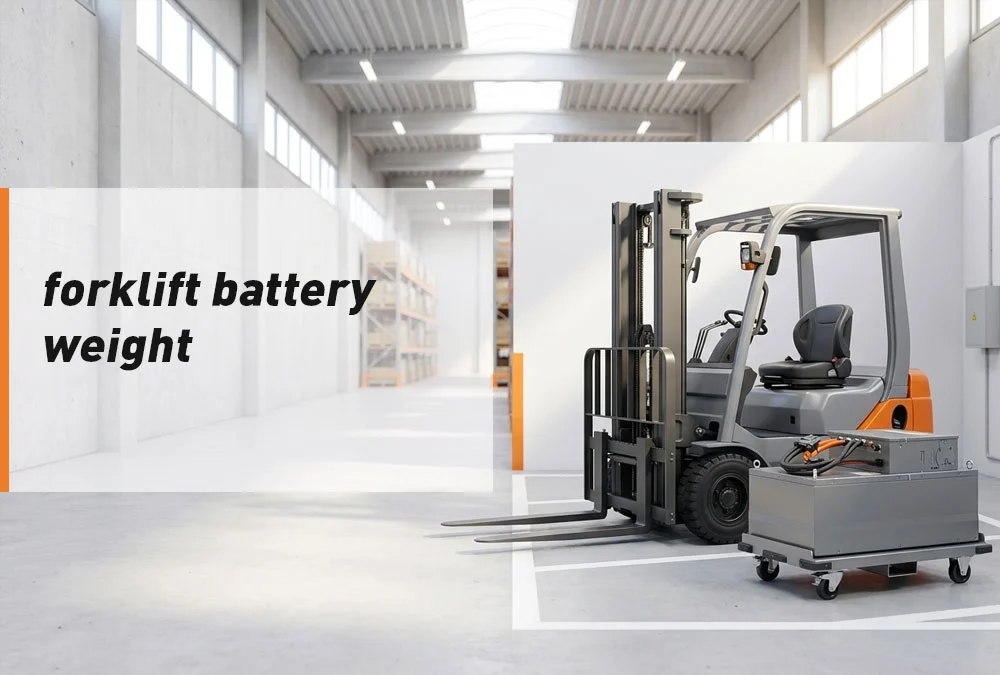
Introduction
A buyer searching for forklift battery weight usually needs more than a number. The battery may have to pass through a narrow access route, sit on an existing change-out stand, remain within the truck’s approved weight range and arrive on a vehicle that can actually unload it. A quotation based only on “48V” can therefore look complete while leaving the most important compatibility question unanswered.
Forklift batteries range from relatively small units for pallet trucks to packs weighing well over a tonne in larger industrial equipment. However, an internet average cannot approve a replacement. The controlling figures are the minimum and maximum battery mass shown on the truck data plate or in manufacturer documentation, followed by the complete installed mass, dimensions, restraint and centre of gravity of the proposed battery.
Quick answer: There is no single standard forklift battery weight. Public product and procurement examples run from a few hundred pounds to several thousand pounds. To obtain the correct number for your truck, read the truck data plate first, confirm the battery’s complete service mass—not merely cell or shipping net weight—and then verify fit, restraint, ballast position and handling equipment.
Forklift Battery Weight Examples: Why One Average Is Misleading
Published numbers are useful for setting expectations, but only when their scope is clear. A current US flooded lead-acid catalogue, for example, lists a 24V 150Ah unit at 333lb (151kg), a 48V 510Ah unit at 1,950lb (885kg), and a 48V 1,250Ah unit at 3,869lb (1,755kg). These are supplier-specific products, not universal weights for those voltages. The same catalogue contains two 48V 510Ah cases weighing 1,950lb and 1,990lb, demonstrating that even matching voltage and Ah do not guarantee matching construction or mass.
A US federal forklift-battery specification requires a 36V 18-85-21 industrial battery, complete with its case and hinged lid, to weigh between 2,420 and 2,680lb (approximately 1,098–1,216kg). The same specification also defines dimensions, connector, cable exit and crane-lifting brackets. This is how an authoritative procurement requirement differs from a generic voltage table: it treats weight as one part of a complete installed configuration.
| Published example | Configuration | Published weight | What the buyer should learn |
|---|---|---|---|
| US supplier catalogue | 24V, 150Ah flooded lead-acid | 333lb / 151kg | Small industrial batteries can still require planned mechanical handling. |
| US supplier catalogue | 48V, 510Ah flooded lead-acid | 1,950lb / 885kg | Voltage and Ah identify electrical class, not complete compatibility. |
| Federal procurement specification | 36V, 18-85-21 battery with case and lid | 2,420–2,680lb / 1,098–1,216kg | A valid specification defines an allowable interval and the included hardware. |
| AnengJi forklift battery configuration | 51.2V, 277Ah or 412Ah, counterbalanced E20 configuration | 210kg / 463lb | The truck’s permitted battery mass still has to be checked. |
| AnengJi forklift battery configuration | 51.2V, 277Ah or 412Ah, reach-truck configuration | 1,200kg / 2,646lb | The same voltage and capacity choices can lead to radically different mass targets. |
These AnengJi product specifications are model-specific values rather than universal recommendations. Their value here is the contrast: the two 51.2V configurations offer the same 277Ah or 412Ah capacity choices, yet one is listed at 210kg and the other at 1,200kg. Application, enclosure and ballast requirements—not voltage alone—explain why our engineering team asks for the exact truck before recommending a battery.
Where to Find the Correct Forklift Battery Weight
Start with the truck data plate
The truck data plate—also called a capacity plate or nameplate—is the first control point. Toyota Forklifts Canada explains that electric-truck plates can include battery voltage, compartment size, maximum Ah, minimum and maximum battery weight, and truck weight with or without the battery. The displayed fields vary by truck type, so copy the labels exactly instead of assuming that one weight represents another.
A common buying problem begins with an unreadable old battery label. Operations needs the truck back quickly, and purchasing sends suppliers only a photograph and “probably 48V.” That shortcut can produce a battery that powers the controller but falls outside the approved mass range or cannot be removed through the intended side-access route. Record the truck make, model and serial number; obtain a clear data-plate image; then ask the OEM or authorised dealer for the applicable manual or replacement specification if the plate is damaged or missing.
Check the battery label and model-specific drawing
The battery label should identify the offered model and actual mass. For traditional traction batteries, designations such as 18-85-17 can help identify the number of cells and plate family, but the code does not replace a drawing. Two batteries can share an electrical designation and still differ in case orientation, cable exit, connector, lid, dimensions or total weight.
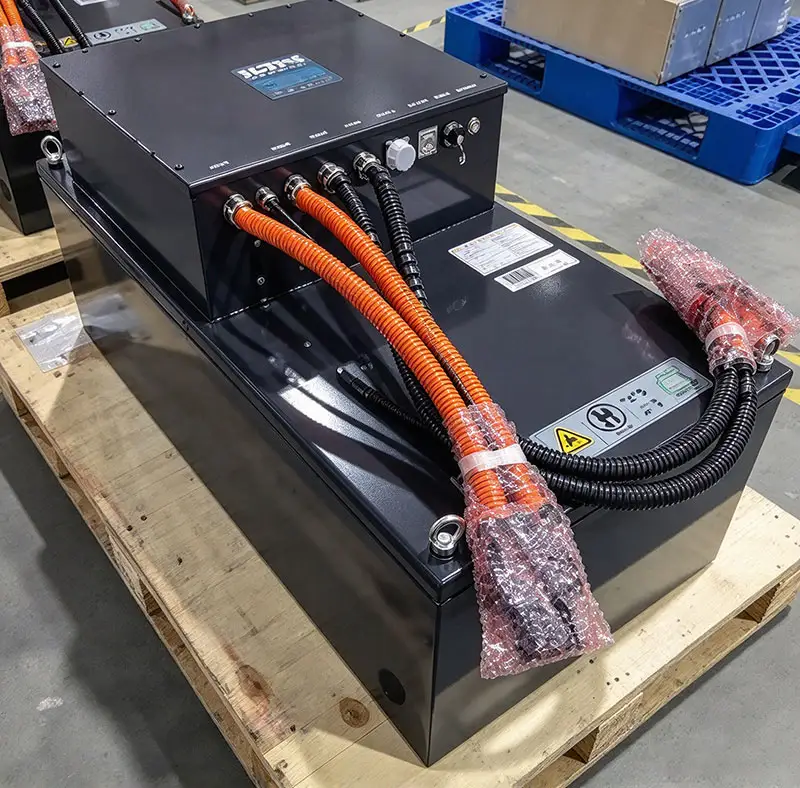
Ask the supplier whether the declared mass includes the tray, lid, electrolyte at service level, integrated ballast, BMS, contactors, cables and connector. For a lithium system, “cell weight” or “module weight” is not the number that belongs in the truck-integration review. The relevant value is the mass of the complete assembly as installed.
Do not confuse installed mass with shipping weight
- Battery service or installed mass: the complete battery configuration placed in the truck.
- Truck weight without battery: the vehicle mass before the traction battery is installed.
- Truck operating mass: the configured truck, often dependent on the defined battery and attachments.
- Gross shipping weight: the battery plus pallet, crate, protective material and other shipping hardware.
This distinction becomes expensive when the carrier arrives with a liftgate or warehouse truck that is rated for the battery’s net weight but not the packaged load. Request gross weight, outer dimensions, centre-of-gravity or lifting information, fork-pocket arrangement and unloading requirements before dispatch—not after the crate reaches the destination.
What Determines Forklift Battery Weight?
Battery chemistry and energy are only the beginning
A flooded lead-acid traction battery contains lead plates, electrolyte, separators and a steel tray. A lithium system replaces that electrochemical structure with cells and adds a battery management system, contactors, current sensing, fusing, busbars, wiring and an engineered enclosure. Heating, cooling, displays and communication hardware may add further mass.
The equation voltage × amp-hours ÷ 1,000 calculates nominal kilowatt-hours; it does not calculate battery weight. Energy density can help explain why one chemistry may store the required energy in a lighter cell assembly, but the finished forklift battery can deliberately include a reinforced steel enclosure and fixed ballast. For capacity selection, use the separate method for sizing battery Ah from the actual duty cycle rather than treating weight as a proxy for runtime.
Truck type and battery geometry change the target
A walkie pallet truck, order picker, reach truck and sit-down counterbalanced forklift do not use the same compartment geometry or battery-changing method. Some trucks pull the battery through the side; others lift it vertically or use a dedicated roller stand. The tray must fit the intended route, clear the lid and cab, retain service access and place cables where they cannot be pinched.
This is why “How much does a 48V forklift battery weigh?” has no safe one-line answer. The voltage must match, but the truck can still reject the candidate because of Ah limits, dimensions, mass, restraint, connector, polarity, cable exit, peak current, communication or charger requirements.
Why Forklift Battery Weight Affects Stability
In many electric forklifts, battery mass is part of the configuration used to establish stability. The OSHA stability appendix explains that counterweight offsets the load and increases resistance to tipping, while centre of gravity and load moment influence stability. The exact role of the battery depends on truck design; the data plate and manufacturer documentation remain controlling.
A lighter battery does not create extra lifting capacity by “freeing” the difference for cargo. Removing mass from the wrong location can reduce the stabilising moment. Nor does a heavier battery automatically make the truck safer: excess mass may fall outside the approved range and affect tyres, axles, braking, handling equipment or floor loading.
The detail buyers often miss: Equal total weight does not guarantee equal stability. Ballast fixed low in an engineered tray can create a different centre of gravity from the same mass placed higher or farther forward. Loose steel plates can also move, interfere with restraint or overload parts of the enclosure. Matching the number on a scale is necessary, but it is not the complete approval.
In the United States, OSHA 29 CFR 1910.178 states that modifications and additions affecting capacity or safe operation require the manufacturer’s prior written approval and corresponding updates to plates, tags or decals. Other markets have their own machinery and workplace rules, but the practical procurement lesson is consistent: do not leave ballast design and vehicle approval until installation day.
Lithium vs Lead-Acid Forklift Battery Weight
Lithium cells can provide higher energy density than traditional flooded lead-acid construction, so an unballasted lithium assembly may be materially lighter at a comparable energy target. That can simplify some applications, but it can create a compatibility gap in a truck whose approved configuration expects a heavier battery.
Use the truck’s permitted range as a rejection gate. Consider an illustrative data plate allowing 1,130–1,360kg and a proposed complete lithium assembly weighing 1,020kg:
Minimum mass shortfall = 1,130kg − 1,020kg = 110kg
The calculation proves that the proposal is below the stated minimum by 110kg. It does not approve the addition of 110kg of steel. The solution must still address ballast material and location, mechanical fixation, enclosure loading, battery restraint, centre of gravity, lifting points, truck approval and the final documented mass. The electrical conversion must also cover voltage window, peak and regenerative current, charger, connector, BMS communication and state-of-charge indication. The broader lead-acid-to-lithium assessment explains those additional gates.
Have a truck plate but no reliable battery specification?
Send the truck model, serial number, data-plate photo, existing battery label and compartment dimensions. The review should identify missing fit-and-mass data before a quotation is treated as compatible.
What Happens If a Forklift Battery Is Too Light or Too Heavy?
| Observed problem | Buyer consequence | Evidence to collect | Decision |
|---|---|---|---|
| Below minimum mass | The approved stability or rated configuration may no longer apply. | Truck plate, OEM manual, complete candidate mass and ballast drawing. | Reject until an approved engineered configuration closes the gap. |
| Above maximum mass | Truck components, tyres, handling equipment or floors may be outside design assumptions. | Maximum battery mass, axle/tyre requirements, change-out and floor ratings. | Do not assume heavier is safer; obtain OEM review. |
| Correct mass, wrong centre of gravity | The number matches while the mass distribution and handling behaviour do not. | Tray/ballast drawing, centre-of-gravity information, restraint and lifting plan. | Require engineering validation, not a scale ticket alone. |
| Correct mass, wrong fit | The battery cannot be secured, serviced, connected or removed safely. | Compartment drawing, clearances, cable exit, connector, restraint and removal route. | Revise enclosure or select a compatible model. |
Handling, Changing and Shipping a Heavy Forklift Battery
Battery changing turns a specification problem into a daily workplace task. The UK Health and Safety Executive’s L117 lift-truck guidance says that battery changing should have a safe system of work and be performed by people with suitable training and instruction. In the US, OSHA requires a conveyor, overhead hoist or equivalent material-handling equipment for battery handling and requires reinstalled batteries to be properly positioned and secured.
The rated capacity of a crane or hoist is only the first check. The lifting beam, sling angle, designated lifting holes, battery centre of gravity, overhead clearance and travel route all matter. Using only two of four specified lifting points can twist a heavy enclosure even when the hoist has ample capacity. Pulling on cables or connectors is never a substitute for an approved lifting feature.
For cross-border deliveries, provide the logistics company with gross packaged weight and dimensions, not just installed battery mass. Confirm whether the destination has a suitable loading dock, crane or forklift; whether the handling truck can reach the centre of the pallet; and whether dangerous-goods documentation and damaged-battery procedures are required. These details are especially important for remote destinations in Central Asia and Africa, where an incorrect unloading assumption can delay commissioning and expose the pack to avoidable handling damage.
Forklift Battery Specs to Send Before Requesting a Quote
A supplier cannot issue a defensible compatibility recommendation from voltage alone. Send the following as one specification package:
- Forklift make, model, serial number and a readable truck data-plate photo.
- Permitted minimum and maximum battery mass.
- Existing battery model, chemistry, service mass and label photos.
- Battery-compartment length, width and height, plus the removal direction.
- Restraint, lid clearance, service access, lifting points and change-out equipment.
- Connector model, polarity, cable length and cable exit.
- Required voltage, measured energy use, Ah target, continuous/peak current and charging windows.
- Charger model, output, charge profile, connector and communication method.
- Loads, attachments, ramps, shift pattern and operating-temperature range.
- Destination country, required documentation, installation scope, training and local service expectations.
AnengJi Forklift Battery Options: Purpose-Built and Standard-Format
Our forklift battery offering is not limited to one enclosure style. AnengJi’s purpose-built configurations include 51.2V packs at 277Ah or 412Ah and 76.8V packs at 280Ah or 412Ah, with different cases and mass targets for counterbalanced trucks, reach trucks and fuel-to-electric conversion projects. The listed configurations show 200A continuous charge and discharge at 25°C. That rating is one engineering input, not a complete truck approval: peak hydraulic demand, regenerative current, temperature, charger, connector, communication and permitted vehicle mass still require model-specific review.
Alongside these application-specific enclosures, AnengJi publishes a broader range of standard-format LiFePO4 batteries across common voltage classes. These general platforms can provide a starting point for pallet trucks, stackers, lifting equipment, AGVs and other material-handling applications when the dimensions and power requirements align. They should not be treated as universal drop-in forklift batteries: the truck’s voltage window, continuous and peak current, battery mass, compartment, restraint, connector, BMS/charger interface and approval route must still be matched.
For buyers comparing options, the practical product conversation should therefore be: “Can you configure and document a complete pack for this truck and duty?”—not simply “Do you sell a 48V battery?” The wider forklift battery selection process can help organise the electrical and operational inputs after the fit-and-mass gate is understood.
Regional Considerations: Europe, the United States and Export Markets
Europe
European projects should begin with the forklift manufacturer’s instructions and the applicable machinery and workplace requirements in the destination country. ISO 3691-1 covers safety requirements and verification for several types of self-propelled industrial trucks, including battery-powered equipment. Citing the standard does not prove that a particular battery conversion or truck configuration complies.
The consolidated EU Machinery Regulation 2023/1230 is scheduled to apply from 20 January 2027 and addresses substantial modifications that create or increase safety risks. At the time of writing, buyers should document the applicable current framework and transition plan with the truck manufacturer or a qualified conformity professional rather than assuming a battery supplier’s declaration covers the modified vehicle.
United States
US projects should document manufacturer approval where a modification affects capacity or safe operation, keep plates and markings legible, and design battery-changing facilities around OSHA requirements. Model-specific listing, insurer and authority-having-jurisdiction expectations may also apply. A certificate mentioned on a supplier website is not enough; request the document or listing, exact covered model, edition, date and verification route.
Central Asia, Africa and other export markets
These regions are not one regulatory market. Confirm the destination country’s import, transport, installation, workplace and recycling rules. Commercially, add grid voltage and frequency, generator use, dust, temperature, network coverage, language, spare-parts distance, warranty labour, customs responsibility and inland unloading to the RFQ. A solution supported from a nearby European service centre may require a different spares and diagnostic plan at a remote mine, port or factory.
Frequently Asked Questions About Forklift Battery Weight
How much does a forklift battery weigh?
Depending on the truck and battery, published examples range from a few hundred pounds to several thousand pounds. That range is useful for planning only. The exact replacement must meet the truck’s permitted battery mass, dimensions, restraint and configuration requirements.
How much does a 48V forklift battery weigh?
There is no standard 48V weight. Public 48V flooded lead-acid catalogue examples alone range from about 1,180lb to 3,869lb, and lithium configurations can be constructed to different energy and ballast targets. Use the truck data plate and exact battery drawing.
Are lithium forklift batteries lighter than lead-acid batteries?
The cell and module assembly can be lighter for a comparable energy requirement, but a finished forklift pack may include structural steel and engineered ballast. Compare complete installed configurations rather than generic chemistry percentages.
Does a heavier battery increase forklift lifting capacity?
No such increase should be assumed. Rated capacity depends on the manufacturer-approved configuration, truck geometry, load centre, mast, attachments, tyres and stability—not a simple subtraction between battery and payload.
Can steel plates be added when converting a forklift to lithium?
Only as part of a properly engineered and approved solution. The final design must address mass, location, fixation, enclosure strength, centre of gravity, battery restraint, handling and documentation. Loose steel is not an acceptable substitute for engineered ballast.
What weight should be given to the freight company?
Provide the gross packaged shipping weight, outer dimensions, handling points and unloading requirements. Also retain the separate complete service mass used for truck compatibility; the two figures answer different questions.
Treat Battery Weight as a Vehicle Specification, Not a Guess
The right answer to “How much does a forklift battery weigh?” begins with a range, but it ends with a model-specific approval. Read the truck plate, identify the permitted battery mass, obtain the candidate’s complete installed weight, and then validate dimensions, restraint, centre of gravity, lifting method, electrical integration and documentation.
This process prevents two expensive failures: receiving a battery that cannot be safely installed and discovering after conversion that a lighter pack no longer matches the truck’s approved configuration. It also gives suppliers the information needed to quote one complete solution—battery, enclosure, ballast, interface and delivery scope—instead of issuing a low-detail price that grows during commissioning.
Request a model-specific battery specification review
Provide the forklift data plate, current battery label, compartment dimensions and duty information. The review can identify the required mass window, missing compatibility data and the inputs needed for a custom battery quotation.
Related Articles

Related Posts
 https://anengjibattery.com/wp-content/uploads/2026/10/AnengjiBattery-Forklift-Battery-Weight-in-a-Working-Warehouse.webp
675
1000
Battery Expert Team
https://anengjibattery.com/wp-content/uploads/2025/06/logo2-300x138.png
Battery Expert Team2026-10-27 02:59:132026-10-27 02:59:15How Does Forklift Battery Weight Affect Stability and Fit?
 https://anengjibattery.com/wp-content/uploads/2026/10/AnengJIBattery-Top-10-Forklift-Battery-Manufacturers-for-Cold-Storage.webp
675
1000
Battery Expert Team
https://anengjibattery.com/wp-content/uploads/2025/06/logo2-300x138.png
Battery Expert Team2026-10-26 09:12:412026-10-27 02:59:38Top 10 Forklift Battery Manufacturers for Cold Storage
 https://anengjibattery.com/wp-content/uploads/2026/10/AnengjiBattery-Cell-to-Pack-Energy-Density-Comparison.webp
675
1000
Battery Expert Team
https://anengjibattery.com/wp-content/uploads/2025/06/logo2-300x138.png
Battery Expert Team2026-10-23 06:58:392026-10-23 06:58:41What Does Lithium-Ion Battery Energy Density Really Mean?
 https://anengjibattery.com/wp-content/uploads/2026/10/AnengjiBattery-Lithium-Battery-Management-in-Daily-Operation.webp
675
1000
Battery Expert Team
https://anengjibattery.com/wp-content/uploads/2025/06/logo2-300x138.png
Battery Expert Team2026-10-22 08:17:332026-10-23 06:58:57How Does a Lithium BMS Improve Battery Longevity?



Leave a Reply
Want to join the discussion?Feel free to contribute!