
How to Calculate Electric Tricycle Battery Capacity
September 3, 2026 / Battery Expert Team / Battery Basics
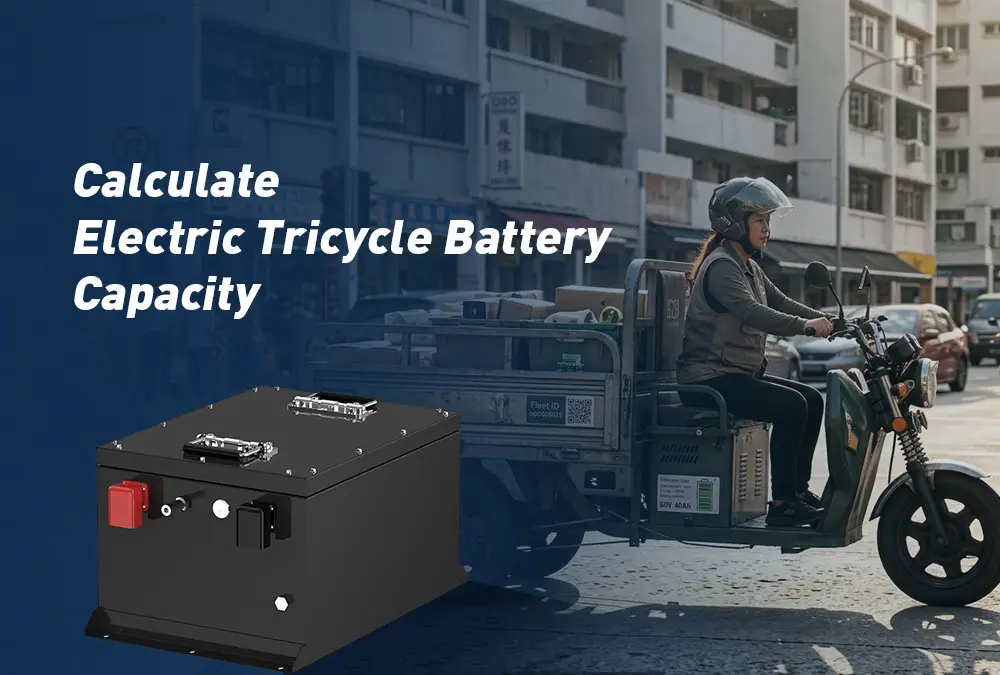
Introduction
Choosing the right Electric Tricycle Battery Capacity is not simply a matter of asking whether 20Ah, 40Ah or 60Ah is enough. An electric tricycle used for passenger transport may have very different energy requirements from a cargo model running all day with frequent stops. Battery voltage, daily distance, energy consumption, payload, usable battery capacity and discharge current all affect the result. The market is also moving quickly: the IEA reports that global electric three-wheeler sales exceeded 1.2 million in 2025, with electric models representing more than 25% of total three-wheeler sales.
That growth matters because battery sizing is becoming less of a simple replacement question and more of a vehicle-engineering question. In this guide, we will calculate battery capacity from actual operating requirements, explain the difference between Ah and Wh, compare 48V, 60V and 72V systems, connect battery capacity with motor and controller current, estimate electric tricycle range, and show how to check a replacement or custom battery before ordering.
Quick Answer: How Much Battery Capacity Does an Electric Tricycle Need?
The fastest way to estimate the required battery is to calculate daily energy consumption first. Once the required watt-hours are known, convert that energy into amp-hours according to the battery voltage.
The Basic Electric Tricycle Battery Capacity Formula
Required Battery Energy (Wh) = Daily Distance (km) × Energy Consumption (Wh/km)
Then account for the portion of the battery that you actually intend to use:
Recommended Battery Energy (Wh) = Required Energy (Wh) ÷ Usable Capacity Ratio
Finally:
Battery Capacity (Ah) = Recommended Battery Energy (Wh) ÷ Battery Voltage (V)
For example, assume a tricycle operates at 60V, travels 40 km per day, and consumes approximately 50 Wh/km.
40 km × 50 Wh/km = 2,000 Wh
If 80% of the nominal battery energy is treated as usable for the sizing calculation:
2,000 Wh ÷ 0.80 = 2,500 Wh
Then:
2,500 Wh ÷ 60V = 41.7Ah
So, a 60V 40–45Ah battery would be a reasonable engineering starting point for this example.
This is an example, not a universal specification. Actual battery sizing should be checked against the vehicle, controller, motor, payload, road conditions, charging pattern and battery operating limits.
The Five Inputs You Need to Calculate Battery Capacity
| Input | Why It Matters |
|---|---|
| Battery voltage | Converts Wh into Ah and must match the electrical system. |
| Daily distance | Determines how much energy is required each day. |
| Energy consumption | Shows how many Wh are consumed per kilometer. |
| Usable capacity | Prevents the calculation from assuming that every rated Wh is always available. |
| Reserve | Reduces the risk of undersizing the battery. |
Send us your vehicle voltage, motor power and typical daily mileage for a preliminary battery sizing recommendation.
The Electric Tricycle Battery Capacity Calculation Model
A useful way to think about battery sizing is the 5-Step Battery Sizing Model:
Distance → Consumption → Energy → Capacity → Current
This sequence is deliberately simple. It avoids a common mistake: starting with a popular battery size and trying to make the vehicle fit the battery.
Step 1 — Determine Daily Driving Distance
Start with the actual operating distance. Do not automatically use the manufacturer’s advertised maximum range.
Record:
- One-way distance
- Round-trip distance
- Total km/day
- Operating hours/day
- Number of trips
- Expected route variation
A delivery tricycle running 10 km per trip for four trips has a very different daily energy requirement from a passenger tricycle making one 15 km journey.
Step 2 — Determine Energy Consumption in Wh/km
This is often the most uncertain number in an electric tricycle battery capacity calculation.
If reliable vehicle data exists, use it. Otherwise, energy consumption can be estimated from an existing battery and actual operating distance.
Actual Wh/km = Energy Used (Wh) ÷ Distance Traveled (km)
For a battery with known nominal energy:
Battery Energy (Wh) = Battery Voltage (V) × Battery Capacity (Ah)
Suppose an existing 60V 50Ah battery provides 3,000Wh of nominal energy. If the vehicle consumes a measured 2,100Wh over 42 km, the observed consumption is:
2,100Wh ÷ 42km = 50Wh/km
That measured figure is much more useful than copying a generic number from another tricycle.
Energy consumption changes with speed, payload, road slope, acceleration, tire pressure, wind, temperature and stop-and-go operation. A delivery vehicle can therefore show a very different Wh/km figure from a lightly loaded vehicle on a flat road.
Step 3 — Calculate Required Battery Energy in Wh
The basic calculation is:
Required Wh = Daily Distance × Wh/km
If daily distance is 60 km and measured consumption is 55 Wh/km:
60 × 55 = 3,300Wh
The vehicle therefore needs approximately 3.3kWh of energy for that operating condition before applying the chosen reserve or usable-capacity assumption.
Step 4 — Convert Wh Into Ah
Once the energy requirement is known:
Ah = Wh ÷ Battery Voltage
This is why comparing batteries only by amp hours can become misleading.
Step 5 — Add Reserve and Usable Capacity
Rated capacity and usable energy are not necessarily identical.
The difference can come from battery management limits, operating temperature, discharge rate, aging, cell characteristics, voltage cut-off settings and system losses.
For planning purposes, the important question is not simply “How many Ah does the label show?” It is “How much energy can this battery reliably deliver under my actual operating conditions?”
Ah vs Wh: What Really Determines Electric Tricycle Battery Capacity?
What Does Ah Mean?
Amp-hours, written as Ah, describe electrical charge capacity. A 40Ah battery can theoretically deliver 40 amps for one hour under a simplified constant-current interpretation.
Real battery operation is more complicated. Discharge rate, temperature, voltage range and battery condition influence how much energy can actually be obtained.
What Does Wh Mean?
Watt-hours describe energy.
Wh = Voltage × Ah
For battery selection, Wh is often the more useful comparison because it combines voltage and amp-hour capacity into one energy figure.
Why Wh Is Better for Comparing Different Voltages
| Battery | Nominal Energy | What It Means |
|---|---|---|
| 48V 20Ah | 960Wh | Lower energy reserve |
| 48V 40Ah | 1,920Wh | Twice the nominal energy of 48V 20Ah |
| 60V 40Ah | 2,400Wh | More energy than 48V 40Ah |
| 60V 60Ah | 3,600Wh | Large energy reserve for longer operation |
| 72V 40Ah | 2,880Wh | Higher energy at the same Ah |
| 72V 60Ah | 4,320Wh | Substantially larger energy reserve |
| 72V 100Ah | 7,200Wh | Very large pack for demanding applications |
User benefit: Looking at Wh helps a buyer compare different voltage systems without being distracted by a larger Ah number. A 72V 40Ah battery has more nominal energy than a 48V 40Ah battery, even though both are rated at 40Ah.
Wh remains an energy calculation rather than a guarantee of real-world range. Usable energy can be lower because of battery chemistry, BMS limits, temperature, aging and electrical losses.
Same Ah Does Not Mean Same Battery Energy
Consider 48V 40Ah and 72V 40Ah.
48V × 40Ah = 1,920Wh
72V × 40Ah = 2,880Wh
The Ah number is identical. The stored nominal energy is not.
How Battery Voltage Affects Electric Tricycle Battery Capacity
48V, 60V and 72V Battery Systems
48V systems are common in lighter electric vehicles. 60V systems can provide a useful middle ground for vehicles requiring more power or energy. 72V systems are often considered where higher power and lower operating current are useful.
But voltage selection must begin with the vehicle electrical architecture.
Why Higher Voltage Can Reduce Required Current
Electrical power can be approximated as:
Power (W) ≈ Voltage (V) × Current (A)
For a 5,000W electrical load:
5,000W ÷ 48V ≈ 104A
At 72V:
5,000W ÷ 72V ≈ 69A
At the same electrical power, a higher-voltage system generally requires less current, assuming similar system efficiency.
Lower current can help reduce conductor losses and make high-power electrical design more manageable. It does not automatically make the vehicle more efficient in every real-world condition.
Does Higher Voltage Mean Longer Range?
No.
Higher voltage does not automatically mean longer range.
For example:
48V × 40Ah = 1.92kWh
96V × 20Ah = 1.92kWh
The nominal energy is the same.
Range depends much more directly on usable energy and vehicle energy consumption.
Voltage Must Match the Motor and Controller
A higher-voltage battery should never be treated as a simple performance upgrade.
The motor, controller, charger, display, DC-DC converter, lighting system, wiring and connectors may all have voltage limits.
UN Regulation No. 100 treats the battery as part of the vehicle’s electrical propulsion system and defines the traction battery and associated electrical components within the vehicle safety framework.
How Motor Power and Controller Current Affect Battery Sizing
Motor Power Is Not the Same as Battery Capacity
A 5kW motor rating does not mean that the vehicle needs a 5kWh battery.
Motor power describes the rate at which mechanical or electrical power can be delivered. Battery capacity describes how much energy is stored.
A high-power motor may require a battery with strong discharge capability even when the desired range is relatively short.
Battery Continuous Discharge Current
The battery must be able to support the controller’s expected continuous current under normal operation.
This is particularly important for cargo tricycles climbing slopes or operating with heavy payloads.
Battery Peak Discharge Current
Acceleration and hill climbing can create short periods of high current demand.
Therefore, a battery specification should distinguish between continuous discharge current and peak discharge current.
Match Battery Current With the Controller
Imagine a controller configured for 100A peak current. A battery rated for only a much lower discharge current may trigger BMS protection or experience excessive voltage sag.
This is one reason a buyer should not compare battery quotations using voltage and Ah alone.
IEC 62619:2022 specifies safety requirements and tests for secondary lithium cells and batteries used in industrial applications. Its listed motive applications include forklifts, golf carts and automated guided vehicles.
For road-vehicle lithium-ion cells, IEC 62660-3:2022 addresses safety performance and emphasizes operation within the voltage, current and temperature limits specified by the cell manufacturer.
Buyer question: “If I increase Ah, do I automatically get more power?”
Not necessarily. Higher Ah mainly increases energy capacity. Discharge current capability is a separate specification. A 60Ah pack with an undersized BMS can be a poor choice for a high-current vehicle.
How to Calculate Electric Tricycle Range From Battery Capacity
Electric Tricycle Range Formula
The reverse calculation is straightforward:
Estimated Range = Usable Battery Energy ÷ Energy Consumption per km
Suppose a 60V 40Ah battery is used.
60V × 40Ah = 2,400Wh
If 80% is used for the planning calculation:
2,400Wh × 0.80 = 1,920Wh
At 50Wh/km:
1,920Wh ÷ 50Wh/km = 38.4km
So the theoretical planning estimate is approximately 38 km under the assumed conditions.
Why Real-World Range Is Different
Actual electric tricycle range can move considerably away from a simple calculation.
- Payload
- Vehicle weight
- Average speed
- Terrain
- Wind
- Temperature
- Stop-and-go operation
- Tire pressure
- Motor and controller efficiency
- Battery age
This is not merely theoretical. In online EV community discussions, users regularly report unexpectedly short range after changing operating conditions or battery packs. One 2026 Reddit discussion, for example, described a heavy electric trike with a 48V 20Ah battery and much lower real-world range than the owner expected. The discussion also raised battery condition, vehicle weight and compatibility as possible factors. This is useful as a user-experience signal, but it should not be treated as controlled engineering test data.
Why a Bigger Battery Is Not Always the Best Solution
A larger battery increases energy storage, but it also normally adds weight, volume and cost.
For a passenger tricycle used for short urban trips, a very large pack may provide little practical benefit if the vehicle is charged every night.
For a delivery fleet running multiple shifts, the calculation changes. Higher capacity may reduce charging interruptions and improve daily operating flexibility.
Electric Tricycle Battery Capacity Calculator
A useful electric tricycle battery capacity calculator should do more than convert voltage and Ah.
Required Inputs
- Battery voltage
- Daily distance
- Energy consumption in Wh/km
- Usable capacity ratio or reserve
Optional Inputs
- Motor power
- Controller current
- Payload
- Average speed
- Terrain
- Charging time available
Calculator Results
A practical calculator can return:
- Required Wh
- Recommended Ah
- Estimated range
- Required continuous discharge current
- Estimated charging time
What If You Don’t Know Your Energy Consumption?
There are three practical approaches.
Method 1: Manufacturer data. Use verified vehicle test data if the test conditions are known.
Method 2: Existing battery calculation. Estimate the energy used by the current battery and compare it with actual kilometers traveled.
Method 3: Real-world test. Measure battery energy consumption over a known route under representative payload and speed conditions.
The third method is usually the most useful when the vehicle is already operating in the field.
Send us your existing battery voltage, Ah, motor power and typical daily distance. We can use those inputs for a preliminary battery sizing calculation.
How Many Ah Does an Electric Tricycle Need?
This is where many online battery guides become too simplistic.
Is 20Ah Enough for an Electric Tricycle?
It can be enough for a light vehicle with short daily mileage and modest energy consumption.
But 20Ah means very different things at different voltages.
48V 20Ah = 960Wh.
60V 20Ah = 1,200Wh.
72V 20Ah = 1,440Wh.
The vehicle’s energy demand must therefore be known before judging whether 20Ah is enough.
Is 40Ah Enough for an Electric Tricycle?
40Ah can be a useful capacity for many medium-duty configurations, but it is still not a universal recommendation.
A 60V 40Ah battery stores 2.4kWh nominally. Whether that provides 30km, 40km or substantially more depends on the vehicle’s Wh/km.
When Do You Need 60Ah or More?
Higher capacity becomes more attractive when the vehicle has high daily mileage, heavy payload, frequent stop-and-start operation or limited charging opportunities.
Fleet operators may also prioritize larger capacity because reducing charging interruptions can be more valuable than minimizing the initial battery price.
Why There Is No Universal Ah Recommendation
The correct relationship is:
Voltage + Wh/km + Distance + Load + Reserve = Battery Sizing
Electric Tricycle Battery Sizing by Application
| Application | Main Sizing Factors | Buyer Benefit |
|---|---|---|
| Passenger tricycle | Vehicle weight, passenger load, daily distance | Avoids carrying unnecessary battery weight |
| Light cargo | Payload and daily mileage | Balances range and useful cargo capacity |
| Urban delivery | Distance, stop/start frequency | Reduces charging interruptions |
| Heavy cargo | Payload, terrain, motor power, current | Prevents both capacity and discharge-current undersizing |
| Fleet operation | Daily utilization, cycle frequency, charging schedule | Supports predictable vehicle availability |
Important: Application type alone cannot determine battery capacity. Two delivery tricycles may have completely different battery requirements if one carries 100kg on flat roads and the other carries 300kg through hilly terrain.
Electric Tricycle Battery Capacity Examples
Example 1 — 48V Light-Duty Electric Tricycle
Assume:
- 48V battery system
- 20 km/day
- 40Wh/km
- 80% usable-energy planning factor
20 × 40 = 800Wh
800Wh ÷ 0.80 = 1,000Wh
1,000Wh ÷ 48V = 20.8Ah
A battery around 48V 20–25Ah would therefore be a reasonable starting point for this specific example.
Example 2 — 60V Urban Cargo Tricycle
Assume:
- 60V system
- 40km/day
- 50Wh/km
- 80% usable-energy planning factor
40 × 50 = 2,000Wh
2,000Wh ÷ 0.80 = 2,500Wh
2,500Wh ÷ 60V = 41.7Ah
This produces the practical starting point of approximately 60V 40–45Ah.
Example 3 — 72V Long-Range Delivery Tricycle
Suppose a 72V system needs 3,600Wh of usable energy planning capacity.
3,600Wh ÷ 72V = 50Ah
The result is approximately 72V 50Ah.
Notice what happened. The higher voltage did not magically create range. The capacity was calculated from the required energy first.
Example 4 — Heavy-Load Commercial Tricycle
For a heavy-load vehicle, the calculation should include more than distance and Wh/km.
Check:
- Maximum payload
- Motor rated power
- Controller continuous current
- Controller peak current
- Battery continuous discharge current
- Battery peak discharge current
- Terrain
- Operating temperature
A battery may have enough Ah for the required range and still fail to deliver the required peak current. This is why capacity and power capability must be evaluated separately.
Why Two Electric Tricycle Batteries With the Same Voltage Are Not the Same
Same Voltage, Different Ah
A 60V 30Ah battery and a 60V 60Ah battery have the same nominal voltage but twice the nominal energy.
Same Ah, Different Discharge Current
Two 60V 40Ah batteries may have completely different BMS current ratings.
One may be designed for a low-power vehicle. Another may use cells and a BMS designed for substantially higher current.
Different Cell Chemistry
LiFePO4, or lithium iron phosphate, is a lithium-ion battery chemistry known for its strong thermal stability and long cycle-life potential. Other lithium-ion chemistries can prioritize different combinations of energy density, power capability, cost and packaging.
Lead-acid batteries remain relevant where low initial purchase cost and established vehicle architecture matter. LiFePO4 becomes particularly attractive when weight reduction, frequent cycling and longer service life are important.
Different BMS Capability
The BMS, or Battery Management System, monitors and protects the battery. Depending on the design, it can manage overcharge, over-discharge, overcurrent, temperature, cell balancing and communication.
Modern battery-management research continues to treat state-of-health estimation as an important part of reliable battery operation. A 2026 SAE technical paper describes SOH as important for battery performance, reliability, safety and decisions involving charging, discharging and power delivery.
Different Usable Energy
Two packs with identical nominal Wh values can deliver different practical results because their operating limits, temperature behavior and voltage characteristics differ.
Different Internal Resistance and Thermal Performance
Under high current, internal resistance contributes to voltage drop and heat generation. This becomes especially important for heavy cargo vehicles and frequent acceleration.
Can You Upgrade to a Higher-Capacity Electric Tricycle Battery?
Increasing Ah While Keeping the Same Voltage
This is generally the simpler type of capacity upgrade.
For example, replacing a 60V 40Ah battery with a 60V 60Ah battery can increase nominal energy from:
60 × 40 = 2,400Wh
to:
60 × 60 = 3,600Wh
However, physical and electrical compatibility still needs to be confirmed.
What Must Be Checked Before Increasing Battery Capacity?
- Battery compartment
- Battery weight
- Mounting method
- Connector
- Cable size and length
- Charger
- BMS
- Controller
Does a Higher-Capacity Battery Need a Larger Charger?
Not necessarily.
A larger battery can often be charged with the same compatible charger, but charging time will generally increase.
A simplified estimate is:
Estimated Charging Time ≈ Battery Capacity (Ah) ÷ Charger Current (A)
A 60Ah battery charged at 10A gives a simplified estimate of:
60Ah ÷ 10A = 6 hours
Real charging time can be longer because charging is not a perfectly constant-current process. Constant-current and constant-voltage stages, charging efficiency and battery state of charge all matter.
Can You Add a Second Battery?
Do not simply connect two batteries because their labels look similar.
Voltage, chemistry, state of charge, BMS design, internal resistance, connector arrangement and charging architecture all need to be considered before batteries are connected in parallel or series.
Can You Upgrade an Electric Tricycle to a Higher Battery Voltage?
Can You Change 48V to 60V?
Only after checking the complete electrical system.
Can You Change 48V to 72V?
The same rule applies, with even greater attention to voltage-sensitive components.
What Must Be Checked Before a Voltage Upgrade?
| Component | What to Check | Why It Helps |
|---|---|---|
| Motor | Voltage and operating range | Prevents operation outside the motor design range |
| Controller | Input voltage range | Protects the main power electronics |
| Charger | Charging voltage | Ensures correct charging |
| BMS | Voltage and current limits | Maintains battery protection |
| Display | Voltage compatibility | Avoids incorrect readings or damage |
| DC-DC converter | Input voltage | Protects low-voltage accessories |
| Wiring/connectors | Voltage and current rating | Supports safe power delivery |
Never connect a higher-voltage battery directly to a lower-voltage system unless all voltage-sensitive components have been confirmed compatible.
How Battery Chemistry Affects Electric Tricycle Battery Capacity
LiFePO4 Battery Capacity for Electric Tricycles
LiFePO4 means lithium iron phosphate. It is a lithium-ion chemistry commonly selected where safety characteristics, cycle durability and usable energy are important.
For an electric tricycle used every day, the economic calculation should not stop at purchase price. Battery weight, cycle frequency, maintenance requirements, charging behavior and expected service life can influence total operating cost.
LiFePO4 vs Lead-Acid
| Factor | LiFePO4 | Lead-Acid | Buyer Benefit |
|---|---|---|---|
| Weight | Generally lower for comparable usable energy | Generally heavier | Lower battery weight can preserve payload capacity |
| Cycle use | Well suited to frequent cycling | Can be economical for lower-cost applications | Technology can be selected according to duty cycle |
| BMS | Normally requires dedicated battery management | Different charging/protection architecture | Improves compatibility planning |
| Upfront cost | Usually higher | Often lower | Lets buyers balance initial cost against lifecycle needs |
The correct statement is not “LiFePO4 is always better.” For frequent commercial cycling, weight-sensitive applications and long service-life requirements, LiFePO4 can be attractive. Lead-acid may still make sense when upfront cost is the dominant consideration.
Usable Capacity and Cycle Life
Battery capacity should be evaluated together with the intended depth of discharge and operating conditions.
IEC standards also make an important distinction between different applications. IEC 62619 covers industrial lithium batteries and specifically lists motive applications such as forklifts, golf carts and AGVs.
How to Choose the Right Charger for an Electric Tricycle Battery
Charger Voltage Must Match the Battery
The charger must be designed for the battery chemistry and voltage system.
A nominal “48V” lithium battery, for example, does not mean that every 48V charger is interchangeable. The actual charging voltage profile must match the battery design.
Charging Current and Charging Time
A higher charging current can shorten charging time, but the battery and BMS must support it.
Use:
Estimated Charging Time ≈ Battery Capacity (Ah) ÷ Charger Current (A)
Use this only as a planning estimate. Actual charging time depends on the charging profile, battery SOC, temperature, efficiency and charger behavior.
LiFePO4 vs Lead-Acid Charger Requirements
LiFePO4 and lead-acid batteries use different charging characteristics. A charger designed for one chemistry should not automatically be assumed suitable for another.
Charger and BMS Compatibility
The BMS may limit charging current or disconnect the battery under abnormal conditions. The charger should therefore be selected as part of the complete battery system rather than as an isolated accessory.
Connector Compatibility
The connector should be checked for polarity, current rating, physical fit and cable arrangement. “The plug looks the same” is not enough.
Will the Battery Physically Fit Your Electric Tricycle?
Capacity calculations can produce an electrically correct battery that still cannot be installed.
Battery Dimensions
Measure length, width and height. Allow space for connectors, cables and ventilation or thermal-management requirements where applicable.
Battery Weight
A larger battery may improve range but reduce available payload or change vehicle handling.
Battery Compartment and Mounting
Check mounting points, locking mechanisms, brackets and structural support.
Connector and Terminal Location
Two batteries with identical electrical specifications may require completely different cable layouts.
Enclosure and IP Rating
Commercial tricycles often operate outdoors. Dust, water, vibration and road debris should therefore be considered when specifying the battery enclosure.
This becomes especially important for an electric tricycle battery replacement. The replacement pack should be treated as a complete mechanical and electrical replacement, not merely an Ah upgrade.
What Battery Specifications Should You Confirm Before Ordering?
Electrical Specifications
- Nominal voltage
- Nominal Ah
- Nominal Wh
- Continuous discharge current
- Peak discharge current
- Charging voltage
- Maximum charging current
Mechanical Specifications
- Dimensions
- Weight
- Mounting method
- Connector type
- Cable length
- Terminal location
- Enclosure protection
BMS Specifications
- Overcharge protection
- Over-discharge protection
- Overcurrent protection
- Short-circuit protection
- Temperature protection
- Cell balancing
- SOC information
- CAN, RS485 or Bluetooth communication where required
Charger and Vehicle Compatibility
Before ordering, confirm:
- Charger voltage
- Charging current
- Controller voltage range
- Controller current
- Motor voltage
- DC-DC converter input range
- Display compatibility
How to Validate an Electric Tricycle Battery Before Bulk Ordering
For a B2B buyer, this stage is often more important than comparing the first quotation.
Request a Battery Sample
Before ordering hundreds or thousands of packs, validate a representative sample against the actual vehicle.
Verify Voltage and Capacity
Confirm that the delivered pack matches the agreed specification and test method.
Test Continuous and Peak Current
Run the vehicle under representative acceleration, payload and slope conditions.
Test Charger and Controller Compatibility
Check charging behavior, BMS protection and communication where applicable.
Check Battery Dimensions and Installation
Confirm that the sample fits the production vehicle without cable interference or mounting problems.
Review Test Reports and Certification Documents
For lithium batteries, transport and application requirements should be considered separately. IEC 62281 specifies safety requirements and test methods for lithium cells and batteries during transport, while other standards address battery or vehicle application safety.
For road-vehicle propulsion cells, IEC 62660-3 provides safety-performance testing for lithium-ion cells and cell blocks used in EV propulsion systems.
Confirm Production Consistency Before Mass Production
A successful sample does not automatically guarantee that every production batch will be identical.
For fleet procurement, establish agreed specifications for cells, BMS parameters, enclosure dimensions, connectors, labels, firmware where applicable and end-of-line testing.
Need a Custom Electric Tricycle Battery?
Custom Voltage and Capacity
A custom battery pack can be designed around the vehicle’s actual voltage and energy requirement rather than forcing the vehicle to use an off-the-shelf size.
Custom Battery Dimensions
Battery dimensions can be adapted to the available compartment, mounting structure and vehicle layout.
Custom BMS Parameters
BMS settings can be selected around the vehicle’s charging and discharge requirements.
Custom Connectors and Cables
Connector type, cable length and terminal position can be specified according to the vehicle harness.
CAN / RS485 / Bluetooth Options
For commercial fleets, communication can help integrate battery information into the vehicle or fleet-management system.
OEM and ODM Battery Packs
OEM and ODM development can cover prototype packs, customized enclosures, battery labels, BMS configuration and production requirements.
Prototype and Mass Production
The practical workflow is usually:
Vehicle information → Battery sizing → Sample → Vehicle testing → Specification confirmation → Pilot production → Mass production
Electric Tricycle Battery Capacity FAQ
How many Ah does an electric tricycle need?
There is no universal answer. Calculate the required Wh from daily distance and energy consumption, then divide by battery voltage. Payload, reserve, current demand and vehicle conditions must also be considered.
How do I calculate electric tricycle battery capacity?
Use: Required Wh = Daily Distance × Wh/km. Then divide the required energy by the usable capacity ratio and battery voltage to estimate the required Ah.
How many Wh does an electric tricycle battery need?
Calculate Wh from the vehicle’s daily distance and measured energy consumption. For example, 40km at 50Wh/km requires approximately 2,000Wh before applying a reserve or usable-capacity factor.
Is 40Ah enough for an electric tricycle?
It depends on voltage and energy consumption. A 60V 40Ah battery has 2,400Wh nominal energy, while a 48V 40Ah battery has 1,920Wh.
Does a higher Ah battery give more range?
Usually, a higher Ah battery at the same voltage provides more nominal energy and can increase range. However, actual range also depends on Wh/km, payload, speed, terrain, temperature and battery condition.
Can I replace my existing battery with a higher-capacity battery?
Possibly, if voltage, physical dimensions, BMS current capability, charger, controller, connectors and vehicle architecture are compatible. Increasing Ah is not the same as increasing voltage.
Need Help Choosing the Right Electric Tricycle Battery?
If you already have a vehicle, there is no need to start with a complicated RFQ.
Low-Threshold Option
Send Us Your Existing Battery Label
Please provide:
- Battery voltage
- Battery Ah
- Motor power
- Typical daily mileage
- Vehicle photo
- Battery compartment dimensions, if available
These details are usually enough for a preliminary electric tricycle battery capacity assessment.
Request a Custom Electric Tricycle Battery Quote
For a project quotation, provide the voltage, capacity, motor power, battery dimensions, quantity, application and target market.
Evidence and Technical Reference Notes
Market evidence: The IEA’s Global EV Outlook 2026 reports more than 1.2 million electric three-wheelers sold globally in 2025. Electric three-wheelers represented more than 25% of total three-wheeler sales. India remained the world’s largest electric three-wheeler market, with nearly 800,000 electric 3Ws sold in 2025.
2024 market evidence: The IEA reported that electric three-wheeler sales surpassed 1 million in 2024 and represented almost one-quarter of all three-wheeler sales. India recorded nearly 700,000 electric three-wheeler sales that year.
2026 market evidence: The IEA’s 2026 analysis states that China, India, Türkiye and Viet Nam together accounted for about 95% of global electric two- and three-wheeler sales in 2025. This concentration helps explain why battery requirements for commercial three-wheelers remain particularly important in these markets.
Battery safety evidence: IEC 62619:2022 specifies safety requirements and tests for secondary lithium cells and batteries used in industrial applications. The standard explicitly includes motive applications such as forklifts, golf carts and AGVs.
Road-vehicle battery evidence: IEC 62660-3:2022 covers safety performance testing for secondary lithium-ion cells used for electric-road-vehicle propulsion and states that cells should be operated within manufacturer-specified voltage, current and temperature limits.
Vehicle regulatory evidence: UNECE Regulation No. 100 defines the traction battery as an assembly of battery modules electrically connected to supply energy to the vehicle power circuit and addresses construction and functional safety requirements for relevant battery-electric road vehicles.
Battery-health evidence: A 2026 SAE technical paper discusses state-of-health estimation as important for EV battery performance, reliability, safety and decisions concerning charging, discharging, power delivery and maintenance.
Community evidence: Reddit discussions show that users frequently confuse Ah with range and often ask whether a higher-capacity battery can simply replace an existing pack. These discussions are useful for identifying buyer concerns, but they are anecdotal and should not replace controlled battery or vehicle testing.
Related Posts
 https://anengjibattery.com/wp-content/uploads/2026/10/AnengjiBattery-Cell-to-Pack-Energy-Density-Comparison.webp
675
1000
Battery Expert Team
https://anengjibattery.com/wp-content/uploads/2025/06/logo2-300x138.png
Battery Expert Team2026-10-23 06:58:392026-10-23 06:58:41What Does Lithium-Ion Battery Energy Density Really Mean?
https://anengjibattery.com/wp-content/uploads/2026/10/AnengjiBattery-Cell-to-Pack-Energy-Density-Comparison.webp
675
1000
Battery Expert Team
https://anengjibattery.com/wp-content/uploads/2025/06/logo2-300x138.png
Battery Expert Team2026-10-23 06:58:392026-10-23 06:58:41What Does Lithium-Ion Battery Energy Density Really Mean? https://anengjibattery.com/wp-content/uploads/2026/10/AnengjiBattery-Lithium-Battery-Management-in-Daily-Operation.webp
675
1000
Battery Expert Team
https://anengjibattery.com/wp-content/uploads/2025/06/logo2-300x138.png
Battery Expert Team2026-10-22 08:17:332026-10-23 06:58:57How Does a Lithium BMS Improve Battery Longevity?
https://anengjibattery.com/wp-content/uploads/2026/10/AnengjiBattery-Lithium-Battery-Management-in-Daily-Operation.webp
675
1000
Battery Expert Team
https://anengjibattery.com/wp-content/uploads/2025/06/logo2-300x138.png
Battery Expert Team2026-10-22 08:17:332026-10-23 06:58:57How Does a Lithium BMS Improve Battery Longevity? https://anengjibattery.com/wp-content/uploads/2026/10/AnengjiBattery-Industrial-Power-Under-Real-Load.webp
675
1000
Battery Expert Team
https://anengjibattery.com/wp-content/uploads/2025/06/logo2-300x138.png
Battery Expert Team2026-10-22 07:04:542026-10-22 07:05:30How Does a 48V LiFePO4 BMS Protect Industrial Power?
https://anengjibattery.com/wp-content/uploads/2026/10/AnengjiBattery-Industrial-Power-Under-Real-Load.webp
675
1000
Battery Expert Team
https://anengjibattery.com/wp-content/uploads/2025/06/logo2-300x138.png
Battery Expert Team2026-10-22 07:04:542026-10-22 07:05:30How Does a 48V LiFePO4 BMS Protect Industrial Power? https://anengjibattery.com/wp-content/uploads/2026/10/AnengJIBattery-Electric-Forklift-Battery-Buying-Decision.webp
675
1000
Battery Expert Team
https://anengjibattery.com/wp-content/uploads/2025/06/logo2-300x138.png
Battery Expert Team2026-10-21 06:22:222026-10-21 06:22:38Ready to Buy Battery for Electric Forklift? Use This Guide
https://anengjibattery.com/wp-content/uploads/2026/10/AnengJIBattery-Electric-Forklift-Battery-Buying-Decision.webp
675
1000
Battery Expert Team
https://anengjibattery.com/wp-content/uploads/2025/06/logo2-300x138.png
Battery Expert Team2026-10-21 06:22:222026-10-21 06:22:38Ready to Buy Battery for Electric Forklift? Use This Guide


Leave a Reply
Want to join the discussion?Feel free to contribute!