
How to Test Lithium Ion Battery: Industrial Testing Guide
August 5, 2026 / Battery Expert Team / Battery Basics
Introduction
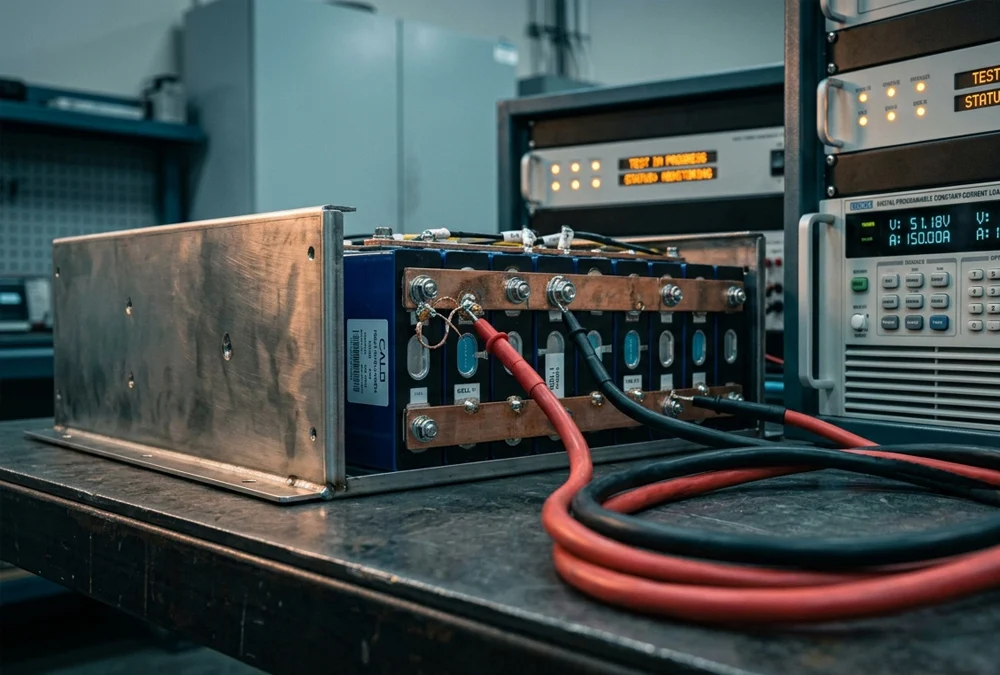
I have designed industrial energy storage systems for over two decades. A reliable lithium ion test requires much more than checking open terminal voltage. You need a rigorous, multi-tiered testing methodology. This means analyzing electrochemistry, measuring capacity under active load, and checking BMS protection logic. If you import, distribute, or service commercial batteries, this guide provides your exact blueprint.
Every industrial battery module looks immaculate when fresh out of its shipping crate. However, clean steel cases often hide serious internal degradation. Manufacturing defects, cell imbalance, and active material loss develop silently. Without a comprehensive lithium ion test program, hidden cell variances will quickly cause severe equipment downtime.
Understanding Lithium Ion Battery Testing: What Are You Actually Measuring?
Testing battery systems goes beyond verifying basic electrical output. You must measure fundamental electrochemical parameters. Tracking these metrics allows you to predict cell degradation and prevent catastrophic field failures.
Why Lithium Ion Battery Testing Is Important
A structured lithium battery health test protects your fleet from operational risk. Technical inspections deliver clear operational benefits:
- Evaluate actual State of Health (SOH) against theoretical manufacturer ratings.
- Detect loss of active lithium ions caused by Solid Electrolyte Interphase (SEI) layer growth.
- Identify micro-shorts and lithium plating before thermal runaway occurs.
- Extend total operational life using targeted module rebalancing.
- Verify supplier specifications before mass integration into industrial equipment.
According to the BNEF Energy Storage Quality Benchmark, up to 14% of unverified commercial shipments exhibit capacity variances exceeding 5%. Unverified capacity leads directly to early field failure and severe warranty disputes. Executing a strict battery performance evaluation eliminates these financial risks entirely.
The Electrochemical Mechanisms Behind Battery Degradation
Understanding degradation physics makes your testing much more effective. Batteries do not fail randomly. They degrade through specific chemical pathways. Over time, graphite anodes suffer structural degradation during fast charging. Simultaneously, cathode materials undergo micro-cracking under heavy thermal stress.
Furthermore, electrolyte oxidation increases internal resistance over continuous operational cycles. These microscopic changes drop usable capacity long before terminal voltage collapses. Performing a structured battery condition check isolates these electrochemical degradation signals early.
The Three Key Parameters of Lithium Battery Health
Accurate battery diagnosis requires analyzing three fundamental electrical parameters together. Evaluating any single metric alone produces misleading diagnostic conclusions.
1. Voltage
Terminal voltage reflects immediate State of Charge (SOC). Open-circuit voltage drops as chemical energy exhausts. However, static surface voltage does not prove true usable energy capacity inside the cells.
2. Capacity (Ah)
Capacity measures absolute energy output over time. It quantifies how long a battery powers equipment before reaching cut-off limits. Calculate delivered capacity using this standard formula:
For example, a 100Ah LiFePO4 module discharged at 20A for 5 hours delivers 100Ah usable capacity. If cut-off triggers after 4.1 hours, actual capacity is only 82Ah. That represents a severe 18% loss in total SOH.
3. Internal Resistance
Internal resistance (IR) quantifies resistance to electron and ion movement. High internal resistance causes steep voltage drop under load, generates extreme heat, and cuts power conversion efficiency.
As batteries age, internal chemical degradation increases resistance. Elevated IR degrades peak acceleration, causes excessive thermal loss, and shortens operational life. Tracking IR during a lithium ion test provides actionable advance warning of failure.
Lithium Ion Battery Voltage Test Using a Multimeter
Checking open-circuit voltage gives a quick initial baseline. A precise lithium battery voltage test helps technicians identify blown fuses, tripped BMS switches, and dead cell groups.
Tools Required for Lithium Battery Voltage Testing
Assemble proper high-precision testing instruments before opening any battery casing:
- True-RMS Digital Multimeter (CAT III 1000V rated, 0.05% DC accuracy).
- Manufacturer technical datasheet detailing exact cell architecture.
- Class 0 high-voltage insulated protective safety gloves.
- VDE-certified insulated hand tools to prevent short circuits.
Step-by-Step Guide to Measure Lithium Battery Voltage
Follow this procedure to measure true battery voltage measurement parameters accurately:
- Set your digital multimeter dial directly to DC Voltage mode. Select the correct measuring scale for your target pack rating.
- Attach test probes firmly to main terminals. Place red on positive (+), black on negative (-).
- Disconnect all charging sources and active loads. Allow the battery pack to rest undisturbed for 30 minutes minimum.
- Record displayed open-circuit voltage. Compare measured values against a verified lithium ion battery voltage test chart.
Lithium Battery Voltage and State of Charge (SOC) Chart
Use this reference table to evaluate measured terminal voltage against remaining charge for LiFePO4 chemistries:
| Nominal Voltage | 100% SOC (Full Charge) | 50% SOC (Nominal) | 0% SOC (Cut-off) | Buyer Benefit & Decision Value |
|---|---|---|---|---|
| 12.8V LiFePO4 | 14.6V | 12.8V | 10.0V | Prevents deep discharge damage in small equipment retrofits. |
| 25.6V LiFePO4 | 29.2V | 25.6V | 20.0V | Ensures stable operating voltage for commercial floor scrubbers. |
| 51.2V LiFePO4 | 58.4V | 51.2V | 40.0V | Protects high-torque golf carts and AGVs from early thermal cut-off. |
| 76.8V LiFePO4 | 87.6V | 76.8V | 60.0V | Maximizes daily operating range for heavy electric utility vehicles. |
Lithium iron phosphate features a flat voltage curve. Voltage remains flat between 20% and 80% SOC. Conversely, NMC chemistries display linear voltage drop. Therefore, checking open-circuit voltage alone on LiFePO4 packs cannot accurately measure precise state of charge.
Lithium Ion Battery Capacity Test: Measuring Real Battery Performance
Open voltage readings cannot verify stored energy reserves. Executing a full lithium battery capacity testing cycle reveals real operational energy output under controlled conditions.
Why Voltage Alone Cannot Determine Battery Capacity
Degraded batteries frequently display a deceptively normal fully charged open voltage. However, that superficial voltage collapses instantly when an industrial load hits the terminals. Engineers call this false surface voltage.
Surface voltage hides active material depletion, high internal resistance, and string imbalance. Without a true discharge test, static voltage tricks maintenance crews. You must run a controlled battery Ah test to measure actual delivered capacity.
Step-by-Step Lithium Battery Capacity Test
Perform this step-by-step capacity verification using a programmable constant-current load bank:
- Charge the battery fully using the recommended profile until current drops below 0.02C cut-off.
- Connect the module securely to an electronic constant-current load bank.
- Set discharge current to 0.5C per datasheet specs. Monitor voltage drop, discharge current, and time.
- Stop discharge the moment any cell reaches minimum low-voltage threshold. Multiply current by total hours.
Battery Capacity (Ah) = Discharge Current (A) × Time to Cut-off (Hours)
Lithium Battery Capacity Test Example
Consider a 51.2V 100Ah LiFePO4 module powering an automated guided vehicle. Its nominal rated energy equals 5,120Wh (51.2V × 100Ah). You apply a constant 50A load (0.5C rate) to verify capacity performance.
If discharge triggers low-voltage cut-off at 1.9 hours, delivered capacity equals 95Ah (50A × 1.9h). Total delivered energy equals 4,864Wh. This proves the pack retains 95% SOH. That result meets strict factory standards for high-demand industrial fleets.
Lithium Ion Battery Load Test: Checking Real Discharge Ability
Full capacity cycles measure overall energy storage density. A high-amperage battery load test measures dynamic power delivery under maximum electrical strain. It evaluates how your pack performs under peak acceleration and heavy hydraulic lift demands.
What Is a Lithium Battery Load Test?
A continuous lithium battery discharge test applies extreme current draw to evaluate voltage stability. This test exposes weak internal busbars, bad spot welds, and failing BMS switches under high load stress.
Heavy load testing is vital across high-torque commercial applications:
- Golf Carts: Verifies uphill acceleration and high-load torque stability.
- AGVs & Forklifts: Validates motor start pulses and high-tonnage hydraulic lifting capacity.
- Electric Utility Trucks: Confirms multi-shift power stability carrying maximum payload weights.
How to Perform a Lithium Battery Load Test
Follow this procedure to run high-current load tests safely:
- Charge the battery fully and verify individual cell balance across all series strings.
- Attach a programmable dynamic load bank sized for maximum pulse current ratings.
- Apply maximum rated current load while monitoring real-time voltage sag, thermal buildup, and amperage.
- Record instantaneous voltage drop. Hold the load for 30 seconds to confirm steady current flow.
How to Interpret Load Test Results
Interpreting load performance requires reading three core electrical behaviors:
Healthy Battery Response: Voltage drops slightly during peak load, then stabilizes quickly. Module temperature increases uniformly without thermal hotspots. The BMS maintains unbroken current flow throughout the burst.
Failing Battery Response: Terminal voltage drops instantly below cut-off limits under load. Cell temperatures spike dangerously, or the BMS trips over-current protection immediately. These signals indicate elevated internal resistance, weak internal welds, or failing power MOSFETs.
Lithium Ion Battery Internal Resistance Test and BMS Diagnosis

Advanced electrical diagnostics isolate subtle cell degradation and BMS logic failures. Conducting a precise battery internal resistance test identifies structural manufacturing defects before total module failure.
Why Internal Resistance Matters
Internal resistance controls how efficiently electrical energy flows inside cells. Increased resistance impacts four primary performance areas directly:
- Power Output: High internal resistance causes severe voltage collapse under heavy acceleration loads.
- Charge Efficiency: Excess resistance transforms charging energy into dangerous waste heat, extending charge times.
- Thermal Safety: High internal resistance causes excessive heat buildup, increasing thermal runaway risks.
- Cycle Life: Severe thermal stress breaks down electrolyte solvent, accelerating capacity loss.
How Battery Manufacturers Test Internal Resistance
Factories use specialized high-frequency testing instruments to measure internal resistance accurately:
- AC Internal Resistance (AC-IR): Applies a 1kHz AC signal to measure electrochemical impedance without discharging cells.
- DC Internal Resistance (DC-IR): Measures voltage drop across brief high-current discharge pulses to calculate real-world operational resistance.
- BMS Telemetry Monitoring: Modern battery management systems track individual cell group resistance trends continuously over time.
Checking Battery Management System (BMS)
A comprehensive lithium battery diagnostic test must evaluate BMS hardware protection logic. The BMS serves as your primary defense against catastrophic pack failure. You should verify four primary safety functions:
| BMS Protection Function | Standard Trigger Level | System Response | Buyer Benefit & Value |
|---|---|---|---|
| Overcharge Protection | 3.65V per cell (LiFePO4) | Cuts charge current instantly | Prevents cell swelling, structural deformation, and electrolyte oxidation. |
| Over-discharge Protection | 2.50V per cell (LiFePO4) | Disconnects output load | Prevents irreversible capacity loss and internal copper dendrite shorting. |
| Thermal Protection | > 55°C Charge / > 65°C Discharge | Shuts down power circuits | Protects pack integrity during extreme duty cycles and high ambient heat. |
| Active Cell Balancing | > 20mV delta between cells | Redistributes excess energy | Maintains usable capacity and prevents premature string cut-off. |
Lithium Ion Battery Self-Discharge Test: Checking Long-Term Storage Performance
Evaluating long-term storage stability requires measuring self-discharge rates. Running a lithium battery self discharge rate assessment isolates micro-short circuits in stored battery packs.
Why Test Lithium Battery Self-Discharge?
Tracking self-discharge rates is critical across three primary commercial operations:
- Warehouse Management: Guarantees modules stored over months do not fall into deep discharge states.
- Standby Power Systems: Confirms backup systems keep maximum runtime capacity during unexpected outages.
- Energy Storage Systems: Prevents silent capacity loss across outdoor multi-megawatt commercial battery banks.
Self-Discharge Testing Method
Follow this procedure to complete a precise long-term battery storage test:
- Charge the battery module to 50% SOC (the optimal level for extended storage).
- Record baseline open-circuit voltage, individual cell balance deltas, and ambient room temperature.
- Store the module undisturbed in a climate-controlled space (20°C to 25°C) for 30 consecutive days.
- Re-measure open voltage after 30 days. Quality LiFePO4 cells lose under 2% to 3% SOC monthly. Higher drops indicate internal micro-shorts or BMS parasitic drain.
Lithium Battery Quality Inspection Checklist for Importers and Distributors
Standardized incoming quality controls protect your business from costly warranty claims and defective inventory shipments.
Incoming Inspection Before Accepting Battery Shipment
Use this technical inspection checklist before accepting incoming battery shipments from manufacturing suppliers:
| Test Parameter | Acceptable Quality Standard | Inspection Purpose | Buyer Benefit & Decision Value |
|---|---|---|---|
| Open Voltage Test | Tight batch tolerance (±0.03V) | Verifies initial charge state | Confirms low self-discharge during long oceanic transport. |
| Capacity Verification | ≥ 100% rated Ah output at 0.5C | Validates nameplate ratings | Eliminates short-range customer warranty complaints. |
| Internal Resistance | Balanced across cells (< 5% delta) | Checks cell matching quality | Ensures extended operational life and balanced pack wear. |
| BMS Diagnostic Check | Protection limits trip precisely | Verifies safety shutoffs | Prevents thermal runaway and expensive field failures. |
| Physical Inspection | Intact housing, clean terminals | Verifies assembly quality | Guarantees IP-rated weather protection in harsh conditions. |
Questions to Ask Lithium Battery Manufacturers
Ask these key technical questions before placing bulk commercial purchase orders:
- Do you build packs using Grade-A fresh cells, or re-sorted secondary stock?
- What is your verified cycle life rating at 80% Depth of Discharge (DOD)?
- Do you perform automated 100% capacity cycle testing on every pack before shipment?
- Does your BMS feature active cell balancing, CANbus communication, and temperature logging?
- Can you provide certified factory test reports for voltage, capacity, and IR by serial number?
Safety Precautions Before Performing Lithium Ion Battery Tests
High-energy commercial battery packs demand strict safety procedures during diagnostic testing routines.
Wear Proper Protection Equipment
Equip all technical personnel with certified safety gear before launching battery diagnostics:
- ANSI-approved high-impact safety glasses equipped with side protection.
- 1000V rated insulated electrical gloves to prevent arc-flash injuries.
- VDE-certified insulated hand tools to prevent accidental terminal short circuits.
- Class D metal fires extinguishers positioned near test benches.
Avoid Common Lithium Battery Testing Mistakes
Prevent severe equipment damage and personal injuries by avoiding these common testing mistakes:
- Never Short-Circuit Terminals: High discharge currents cause instantaneous arc flashes, molten metal, and fire.
- Never Test Swollen Modules: Avoid testing mechanically deformed battery modules. Swollen cases indicate gas accumulation and structural failure.
- Avoid Over-Discharging: Never bypass BMS protection limits during discharge cycles. Discharging below 2.0V per cell destroys cathode materials.
- Use Calibrated Test Equipment: Never run diagnostics with cheap, uncalibrated meters. Inaccurate meters produce misleading capacity and resistance data.
- Respect Active BMS Warnings: Never ignore active BMS diagnostic alarms. Resolve internal electrical faults completely before running further tests.
Professional Lithium Ion Battery Testing for Different Applications
Operating demands differ by application. Adapt your testing routines to match specific equipment duty cycles.
Golf Cart Lithium Battery Testing
Golf cart batteries encounter dynamic current spikes during acceleration and steep hill climbs. Focus testing on these key parameters:
- High peak current capability (testing 3C surge output for 10-second intervals).
- Delivered Ah capacity across continuous stop-and-go driving profiles.
- Terminal voltage stability under heavy acceleration loads.
AGV and Forklift Battery Testing
Warehouse AGVs and electric forklifts operate on continuous multi-shift schedules with frequent fast charging. Prioritize these performance metrics:
- Fast-charge current acceptance without excessive heat generation.
- Extended cycle life retention under partial state-of-charge operating modes.
- Continuous high C-rate output during heavy hydraulic lift cycles.
Solar Energy Storage Battery Testing
Stationary solar batteries demand multi-year reliability and ultra-precise monitoring. Focus testing protocols on these factors:
- Long-term capacity retention across deep daily discharge cycles (80% to 90% DOD).
- SOC telemetry precision within the BMS during low C-rate solar cycles.
- BMS communication stability with off-grid industrial inverters.
Conclusion: How to Accurately Test Lithium Ion Battery Health
Executing a comprehensive lithium ion test requires checking terminal voltage, usable Ah capacity, load dynamic performance, internal resistance, BMS protection logic, and self-discharge rates together. Skipping any single diagnostic metric leaves your equipment vulnerable to unpredicted power failure.
Partnering with a professional manufacturer who enforces automated 100% factory quality testing minimizes supply chain risk. It guarantees your equipment delivers full rated power, maximum thermal safety, and multi-year operational reliability.
Related Posts
 https://anengjibattery.com/wp-content/uploads/2026/09/anengjiBattery-How-to-Choose-the-Right-Forklift-Battery-A-Practical-Selection-Guide.webp
675
1000
Battery Expert Team
https://anengjibattery.com/wp-content/uploads/2025/06/logo2-300x138.png
Battery Expert Team2026-09-20 07:31:262026-09-20 07:31:41How to Choose the Right Forklift Battery: A Practical Selection Guide
https://anengjibattery.com/wp-content/uploads/2026/09/anengjiBattery-How-to-Choose-the-Right-Forklift-Battery-A-Practical-Selection-Guide.webp
675
1000
Battery Expert Team
https://anengjibattery.com/wp-content/uploads/2025/06/logo2-300x138.png
Battery Expert Team2026-09-20 07:31:262026-09-20 07:31:41How to Choose the Right Forklift Battery: A Practical Selection Guide https://anengjibattery.com/wp-content/uploads/2026/09/AnengJIBattery-Best-LiFePO4-Battery-How-to-Choose-the-Right-One.webp
675
1000
Battery Expert Team
https://anengjibattery.com/wp-content/uploads/2025/06/logo2-300x138.png
Battery Expert Team2026-09-17 08:52:142026-09-18 09:19:29How to Choose the Best LiFePO4 Battery
https://anengjibattery.com/wp-content/uploads/2026/09/AnengJIBattery-Best-LiFePO4-Battery-How-to-Choose-the-Right-One.webp
675
1000
Battery Expert Team
https://anengjibattery.com/wp-content/uploads/2025/06/logo2-300x138.png
Battery Expert Team2026-09-17 08:52:142026-09-18 09:19:29How to Choose the Best LiFePO4 Battery https://anengjibattery.com/wp-content/uploads/2026/09/anengjiBattery-lifepo4-battery-cell-packaging-wholesale.webp
675
1000
Battery Expert Team
https://anengjibattery.com/wp-content/uploads/2025/06/logo2-300x138.png
Battery Expert Team2026-09-16 09:52:342026-09-18 09:20:12LiFePO4 Battery Wholesale Guide: Best Suppliers in Spain
https://anengjibattery.com/wp-content/uploads/2026/09/anengjiBattery-lifepo4-battery-cell-packaging-wholesale.webp
675
1000
Battery Expert Team
https://anengjibattery.com/wp-content/uploads/2025/06/logo2-300x138.png
Battery Expert Team2026-09-16 09:52:342026-09-18 09:20:12LiFePO4 Battery Wholesale Guide: Best Suppliers in Spain https://anengjibattery.com/wp-content/uploads/2026/09/anengjibattery-Top-Lithium-Ion-Battery-Producers-for-Spain-Market-Growth.webp
675
1000
Battery Expert Team
https://anengjibattery.com/wp-content/uploads/2025/06/logo2-300x138.png
Battery Expert Team2026-09-16 01:13:392026-09-16 01:14:05Top Lithium Ion Battery Producers for Spain’s Market Growth
https://anengjibattery.com/wp-content/uploads/2026/09/anengjibattery-Top-Lithium-Ion-Battery-Producers-for-Spain-Market-Growth.webp
675
1000
Battery Expert Team
https://anengjibattery.com/wp-content/uploads/2025/06/logo2-300x138.png
Battery Expert Team2026-09-16 01:13:392026-09-16 01:14:05Top Lithium Ion Battery Producers for Spain’s Market Growth


Leave a Reply
Want to join the discussion?Feel free to contribute!