
10 Signs Your Forklift Fleet Is Ready for a Lithium Battery Upgrade
November 6, 2026 / Battery Expert Team / Battery Basics

Introduction
The late shift is finishing its last loading window when one truck slows under lift, another waits for a charged battery, and a third is parked beside a charger that showed “complete” that morning. Operations calls it a battery problem. Maintenance suspects the charger. Procurement sees the price of a lithium battery upgrade and asks whether the fleet will actually recover the investment.
All three reactions are reasonable—and none is enough to approve an upgrade. Short runtime can come from an ageing battery, incomplete charging, hot or damaged connectors, a heavier duty cycle, cold conditions or a truck problem. Lithium-ion can remove battery changes, watering and some charging constraints, but only when the forklift, battery, charger, facility and operating schedule work as one system.
The practical answer
Upgrade now when measurable battery work is constraining an otherwise serviceable fleet, the compatibility gates can be closed and the complete business case meets your threshold. Pilot first when the value looks promising but energy, temperature, charging or communications data are incomplete. Wait when the truck is near the end of its economic life, utilisation is low or a critical approval remains unresolved.
Should You Upgrade Now, Pilot First or Wait?
A useful upgrade conversation begins with a decision, not a catalogue. The same lithium system that can create value in a three-shift distribution centre may add cost without enough benefit on a truck that runs intermittently for a few hours each week.
| Decision | Evidence you can see | What must still be true | Buyer action |
|---|---|---|---|
| Upgrade now | Measured swap, maintenance or charging delays repeatedly affect production; the truck has useful remaining life. | Energy balance, charging capacity, permitted battery mass, fit, current, communication, documentation and support are confirmed. | Approve a model-specific pilot and installed-cost comparison. |
| Pilot first | The operating case is strong, but the hardest shift, cold-room duty, peak current, break-time charging or fault recovery has not been proved. | One representative truck can be instrumented and tested without disrupting the full fleet. | Define acceptance criteria before purchasing the pilot system. |
| Wait and correct the root cause | Utilisation is low, the charger is not completing its cycle, the truck needs major repairs, or the approved battery-weight range cannot be confirmed. | The current system can be made reliable at lower risk or the whole truck should be evaluated for replacement. | Repair, test or replace the correct asset before reopening the upgrade project. |
This boundary is supported by the Battery Council International’s forklift information brief. It notes that lithium-ion has a higher initial investment and is especially relevant where intensive, around-the-clock operation makes faster charging and reduced downtime valuable. It also says a truck used only a few hours a day may not need that higher performance. That is an application boundary, not an argument that one chemistry is always superior.
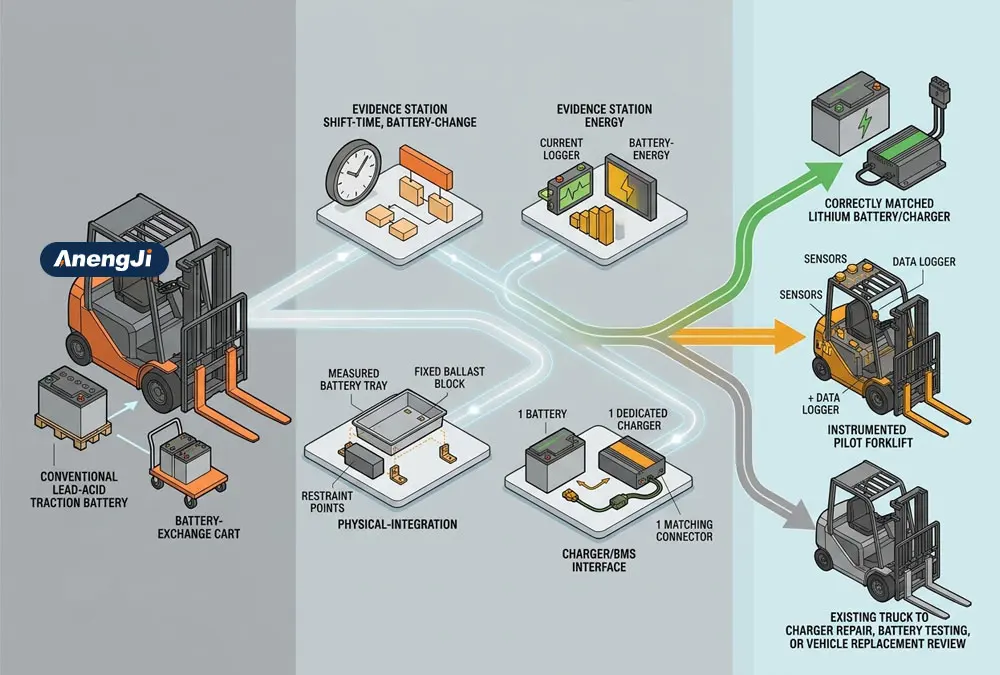
Measure the Problem Before You Call It a Lithium Upgrade
A battery warning near the end of a shift is a symptom. It does not identify the failed component. Replacing the battery without testing the charger, connector and workload can preserve the same problem inside a more expensive system.
Record one representative week before asking suppliers to size the replacement. For each truck and shift, capture:
- starting and ending state of charge—or the existing battery discharge indicator reading;
- productive hours, idle time, payload range, lift height, ramps, attachments and abnormal travel;
- battery-change events, minutes lost and the people or equipment involved;
- actual charger connection minutes, returned Ah or kWh where available, and simultaneous chargers;
- charger faults, hot connectors, damaged insulation, low-voltage events and unusual odour or temperature;
- ambient and battery temperature for cold, hot or outdoor work.
The US Occupational Safety and Health Administration’s Powered Industrial Trucks eTool specifically notes that heavy loads drain forklift batteries more quickly. For a buyer, that means a runtime complaint after a route or payload change should not be treated as proof that the battery chemistry has failed.
Use the separate guides to diagnose declining electric forklift battery life and to calculate the energy a charger can realistically return. This article focuses on the decision signals that remain after the basic diagnosis is complete.
What Are the 10 Signs a Forklift Fleet Is Ready for a Lithium Battery Upgrade?
1. Battery Changes Are Interrupting Production Windows
The sign is not simply that the fleet changes batteries. It is that the change process repeatedly misses a loading, production or picking window. Measure the travel to the battery room, queue time, extraction and installation time, inspection time and the number of people involved. A five-minute mechanical exchange can create a much longer interruption when the operator waits for equipment or a clear route.
A forklift lithium-ion battery can remain in the truck and accept approved opportunity charging during breaks. That may remove swap labour and spare-battery handling. The solution only works when break-time charging returns at least as much energy as the next operating block consumes. If it does not, the warehouse replaces a battery-change queue with a charger queue.
Illustrative labour calculation: 400 recorded battery-change hours per year
For a fleet of eight trucks, one 12-minute battery-change interruption per truck per operating day across 250 days equals 8 × 12 × 250 ÷ 60 = 400 hours. This is a transparent example, not an industry average. Replace every input with site records and add queue, travel or supervision time only when those minutes are actually measured.
2. A Correctly Charged Battery No Longer Completes the Verified Duty
When a battery that previously covered the route now reaches low charge before the final task, the business consequence is immediate: an unfinished pallet movement, an idle operator or a second truck pulled away from another job. But the evidence must separate capacity loss from incomplete charging, connector resistance, cold temperature, heavier loads or added hydraulic work.
First prove that the existing battery received its complete approved charge. Then compare a controlled capacity or energy test with the week-long duty record. If the truck is mechanically sound, the duty is stable and the battery cannot economically supply it, the replacement window is a sensible time to compare a correct lead-acid replacement with a lithium system.
3. Lead-Acid Maintenance Has Become a Persistent Labour and Safety Burden
Flooded lead-acid work can include watering, electrolyte inspection, equalisation, corrosion cleaning, change-out equipment, PPE, ventilation management and spill-response readiness. The real upgrade signal is that these controlled tasks require enough recurring labour, space or supervision to affect the business case—not merely that the tasks exist.
OSHA’s US guidance says a properly equipped lead-acid charging area includes warning signs, fire protection, ventilation, electrolyte-flushing provisions and an eyewash capable of a 15-minute flow. It also requires trained personnel and appropriate procedures for charging and changing batteries. These are US workplace requirements and recommendations, not a global checklist, but they show why a battery quotation should include the operating system around it.
Lithium does not mean zero maintenance. The UK Material Handling Association’s GN69 guidance says lithium traction batteries do not require watering, but the case, cables, connectors and charging equipment still need regular visual inspection. It also recommends specialist inspection and BMS diagnostic review. The task changes from electrolyte care to system inspection and fault evidence.
4. The Available Charging Window No Longer Matches the Shift Pattern
A warehouse may have two hours between shifts on paper but only 75 minutes of actual plug-in time after travel, parking, handover and queuing. A charger nameplate also does not prove that maximum current is maintained through the entire session. Temperature limits, cell imbalance, high state of charge, power sharing and the BMS can reduce average charging power.
UKMHA GN69 states that a lithium traction battery may achieve a full charge in one to two hours, depending on chemistry, capacity, charger characteristics and available power. It also gives a useful infrastructure warning: as a rough guide, one-hour charging requires about eight times the current of charging over eight hours. A fleet that wants faster charging must therefore evaluate simultaneous site demand, not just battery capacity.
Baseline charging time = energy to restore (kWh) ÷ measured average DC charging power (kW)
This is a screening calculation, not a guarantee. Add connection time, taper, balancing, temperature derating and charging losses before promising a completion time.
Application calculation: one 51.2V 412Ah pack represents 21.09kWh of nominal energy; 60% is 12.66kWh, and eight packs require 101.25kWh. Dividing by two or three hours gives the ideal DC averages above. The facility design must still allow for charger efficiency, taper, temperature limits, power sharing, diversity, upstream electrical capacity and other site loads.
5. The Batteries and Chargers Are Reaching a Joint Investment Point
Replacing a worn battery while keeping a marginal charger can be a false saving. Replacing the charger without considering the next battery technology can also lock the fleet into another investment cycle. When both assets require significant work, compare three complete alternatives:
- a correct lead-acid replacement plus charger repair or replacement;
- a lithium battery, compatible charger, integration, commissioning and training;
- replacement of the entire truck where the chassis, mast, hydraulics, controller or parts support is already weak.
The cheapest battery-only quotation is not necessarily the lowest installed or operating cost. Include ballast, cables, connectors, site electrical work, freight, commissioning, diagnostic access, training and local service.
The OSHA Powered Industrial Trucks eTool gives 2,000 work shifts or charge/discharge cycles as a normal-service planning reference for forklift batteries. This is useful for budgeting a lead-acid replacement point, but it is not a universal retirement age, a lithium-life comparison or a substitute for capacity tests and condition records.
6. Battery Rooms, Spare Packs and Handling Routes Restrict the Facility
Measure the floor area occupied by spare batteries, transfer stands, hoists, watering equipment and protected routes. Then ask what the space is worth operationally. A warehouse that can recover a high-value picking or staging area may have a stronger business case than a site where the battery room occupies otherwise unusable space.
Do not assume lithium allows charging anywhere. The 2025 safe-charging guidance from Sweden’s MaskinLeverantörerna calls for the supplier-recommended charger, temperature limits, inspection of batteries and connections, a marked charging point, emergency planning and coordination with insurers and local fire authorities. Distributed charging still needs controlled locations, protected equipment and safe cable routes.
7. Late-Shift Voltage Behaviour Is Reducing Productive Performance
Operators may describe a truck that still drives but lifts more slowly, struggles on a ramp or reaches the low-battery limit during combined travel and lift. That description creates a useful test condition, not an automatic diagnosis.
Record battery voltage and current under the demanding event, the duration of the peak, connector voltage drop, temperature and the existing battery discharge indicator. The lithium candidate must support continuous demand, peak current, peak duration and regenerative current within the exact truck’s operating voltage window. A high Ah figure cannot compensate for an insufficient current path or an incompatible controller interface.
8. Multi-Shift Growth Has Outrun the Original Battery Rotation
A battery system selected for one shift may become a bottleneck after a second shift, peak-season overtime or a longer travel route is added. The warning sign is a widening gap between daily energy used and energy returned during dependable charging windows.
Build a 24-hour energy map: kWh used in every operating block, kWh realistically restored in each break, the minimum reserve before the next charger and the number of trucks charging simultaneously. Lithium opportunity charging is attractive when these numbers close the energy balance without frequent deep discharge or queues. If the balance does not close, increase validated capacity, charging power, charging access or vehicle count rather than relying on a “full-shift” claim.
This is where a product discussion becomes useful. AnengJi’s forklift lithium battery options include 51.2V and 76.8V reference configurations with different Ah and nominal-energy envelopes. A supplier can screen the closest candidate against the measured 24-hour map, but the recommendation must still pass the truck’s voltage window, current demand, permitted mass, compartment, restraint, connector, charger/BMS interface and approval route.
9. Battery-Related Downtime Cannot Be Diagnosed Before It Stops the Truck
A modern BMS may record cell voltage, current, temperature, charge/discharge activity, alarms and shutdown events. That data can distinguish an overloaded duty, thermal limit, low-SOC cutoff or charging problem—but only if the buyer can access and understand it.
Ask what the operator can see, what maintenance can export, which faults require supplier software, how a shutdown is recovered and what service response is available locally. This detail matters in remote markets: a battery that protects itself correctly can still create extended downtime if only an overseas technician can interpret or reset the event. Do not bypass the BMS, contactor, fuse or temperature protection to return equipment to service.
10. The Complete TCO Has Crossed Your Company’s Upgrade Threshold
The final signal is financial, but it should be based on site evidence rather than a universal payback promise. Compare the complete cash flows over the same analysis period and include the residual life of the truck.
- Installed system: compare the lead-acid battery, charger work and handling equipment with the lithium battery, compatible charger, approved case or ballast, interface work and commissioning. A battery-only price is not an installed-system price.
- Routine labour: enter recorded watering, cleaning, equalisation, inspection and change time for lead-acid; enter inspection, charger-point checks, fault review and specialist service for lithium. “Maintenance free” must not turn the lithium column into zero.
- Productive downtime: separate change, queue, maintenance and fault hours from scheduled breaks. For the lithium proposal, include charging queues, protected shutdown recovery and service response.
- Energy: compare metered AC kWh under equivalent routes, loads and temperatures. Nameplate efficiency alone does not establish the site energy cost.
- Replacement and support: include tested remaining life, warranty conditions, end-of-life definition, diagnostic access, freight, local service and recycling. A cycle-life number without conditions is not a budget.
Illustrative TCO difference = complete installed cost + energy + labour + downtime + replacements + service − residual value
Use actual local labour rates, tariffs, asset values and completed-work records. The detailed forklift battery cost method explains why battery price, installed cost, annual operating cost and cost per productive truck hour should be kept separate.
Turn the symptoms into an upgrade-readiness file
Send one truck data plate, the existing battery and charger labels, compartment dimensions and a representative week of operating records. The first review can identify missing inputs, likely no-go conditions and whether the next step should be testing, a pilot or a quotation.
How Much Energy Do AnengJi Forklift Battery Configurations Represent?
Voltage and Ah become more useful when converted into nominal energy. The following AnengJi reference configurations show why a fleet should compare kWh and charging windows instead of assuming that equal Ah means equal energy.
Nominal energy (kWh) = nominal voltage × capacity (Ah) ÷ 1,000
| AnengJi reference configuration | Calculated nominal energy | Ideal energy returned in 30 min at 100A | Ideal share of nominal capacity | Buyer interpretation |
|---|---|---|---|---|
| 51.2V 277Ah | 14.18kWh | 2.56kWh | 18.1% | A short break may replace a larger proportion of this pack than a 412Ah pack, but it also stores less total energy. |
| 51.2V 412Ah | 21.09kWh | 2.56kWh | 12.1% | The same current and time restore the same Ah, but a smaller percentage of the larger battery. |
| 76.8V 280Ah | 21.50kWh | 3.84kWh | 17.9% | At the same 100A, higher voltage means more charging power and higher facility demand. |
| 76.8V 412Ah | 31.64kWh | 3.84kWh | 12.1% | The largest nominal energy does not prove fit, runtime or charger availability for a particular truck. |
Calculation status: The kWh figures are nominal engineering calculations from AnengJi’s current reference voltage and Ah data. The 30-minute column is an idealised example assuming a constant 100A DC current for the full 0.5 hour. It excludes connection delay, losses, temperature limits, BMS derating, current taper and balancing. It is not measured runtime, an approved charger selection or a performance guarantee.
AnengJi’s supplied interface examples list 200A continuous charge and discharge ratings at 25°C. That figure is a pack-interface reference, not proof that a particular truck, connector, charger, cable or facility should operate at 200A. Final current must be approved for the complete system.
How to use these reference configurations in a real enquiry
- 51.2V platform with a smaller measured energy requirement: the 277Ah reference may be a starting candidate, but only after the shift energy, reserve and permitted battery mass are confirmed.
- 51.2V platform with a larger daily energy requirement: the 412Ah reference adds nominal energy, while the same 30-minute current restores a smaller percentage of the pack.
- 76.8V platform: the 280Ah and 412Ah references provide different energy envelopes; neither should be selected until the truck’s actual voltage window and charging infrastructure are verified.
- Non-standard compartment or vehicle interface: AnengJi can evaluate a standard-format candidate or an application-specific enclosure and wiring direction, but drawings, installed mass, restraint, connector, BMS/charger communication and vehicle responsibility must be agreed before manufacture.
Review the available AnengJi forklift battery range as a starting point for a model-specific enquiry, not as a universal fitment chart.
What Must Pass Before a Forklift Lithium Battery Upgrade Is Ordered?
Do not reduce the conversion to “same volts, similar Ah and a tray that fits.” UKMHA GN69 states that lithium-ion batteries are generally not directly interchangeable with lead-acid or other battery designs. Its compatibility list includes voltage, capacity, discharge rate, weight and centre of gravity, electrical connector, mechanical fixing, regenerative braking, safety isolation and charging equipment.
- Truck identity: collect the model, serial number, data plate, manual and an authorised technical response. If the permitted voltage or battery-mass range cannot be confirmed, stop the order until the responsible truck or OEM party resolves it.
- Electrical load: document the operating voltage window, continuous and peak current, peak duration and regenerative current. Nominal voltage and Ah alone are insufficient; measure the demanding duty and define current acceptance tests.
- Fit and restraint: verify compartment dimensions, hood and roller clearance, extraction direction, mounting and cable exit. A case that physically enters the tray still fails if it cannot be restrained, connected or safely removed.
- Mass and stability: confirm the allowed battery mass, complete installed mass, centre of gravity and engineered ballast design. Do not assume a lighter pack increases payload, and never use loose steel as ballast.
- Charging interface: approve the exact charger model, curve, voltage/current limits, BMS communication, connector and facility supply. A matching plug or nominal voltage does not establish compatibility.
- Display and diagnostics: define the SOC source, warning thresholds, fault access, data export, reset process and service route. Validate the truck display against BMS SOC rather than assuming the original lead-acid indicator remains accurate.
The full lead-acid-to-lithium compatibility method explains these integration and commissioning checks in more detail. Keeping that procedure on its own page prevents an upgrade-readiness article from becoming an unsafe installation shortcut.
How Should a 30-Day Lithium Battery Upgrade Pilot Be Run?
Choose a representative difficult truck, not the easiest route in the fleet. If the real risk occurs on a ramp, in a freezer, during simultaneous travel and lift or in the final hour of the second shift, the pilot must reproduce that condition.
- Freeze the baseline. Record the existing truck’s energy, productive time, charging, faults and maintenance under a known route and load.
- Approve the interfaces. Close voltage, current, mass, fit, restraint, connector, charger, communication and documentation gates before installation.
- Define pass/fail values. Specify minimum end-of-shift reserve, required energy returned per break, permitted temperatures, unacceptable faults and recovery time.
- Test abnormal but credible events. Include missed charging, a long weekend idle period, a charger fault, a low-SOC warning and the authorised recovery process.
- Scale by truck family and duty. A pass on one counterbalance truck does not automatically approve a reach truck, cold-store model or different controller.
At the end of 30 days, compare evidence—not impressions: productive hours, energy per shift, actual charging minutes and kWh, minimum SOC, peak events, fault count, recovery time, operator compliance and maintenance hours. A pilot can still fail even when the truck “ran all day” if the charger overloaded the site or fault recovery requires unavailable support.
What Changes Across Europe, the United States, Central Asia and Africa?
Europe
Confirm who is responsible for the modified truck, whether the change affects the original conformity assessment and which documents cover the final battery and vehicle configuration. The official Regulation (EU) 2023/1542 on batteries and waste batteries requires rechargeable industrial batteries above 2kWh to be accompanied by specified performance and durability information from 18 August 2024. It also sets 18 February 2027 for the battery passport requirement for industrial batteries above 2kWh. Buyers should confirm the applicable obligations, economic operator and implementation status for the exact placing-on-the-market date.
United States
OSHA rules and guidance address powered-industrial-truck charging, changing, training and workplace controls. OSHA’s warehousing guidance also says written manufacturer approval should be obtained for modifications or additions that affect capacity and safe operation, with plates and markings updated accordingly. The exact approval and code path must be established for the truck, battery system, facility and jurisdiction; a battery supplier’s compatibility statement alone may not resolve the vehicle responsibility.
Central Asia, Africa and other export markets
Do not treat these regions as one regulatory or operating environment. Confirm destination-country conformity, transport documents, recycling route, mains voltage, phase and frequency, maximum site demand, ambient temperature, dust/moisture exposure, charging location, training language, diagnostic connectivity, spare parts and local service. A technically compatible pack can still be a poor upgrade when the charger cannot be powered or a protected shutdown cannot be serviced promptly.
How AnengJi Supports a Model-Specific Forklift Lithium Battery Upgrade
AnengJi supplies lithium battery options for forklift applications and can evaluate standard-format candidates as well as application-specific enclosures, wiring directions and BMS interfaces. A custom case can solve a packaging problem, but no standard or custom pack should be described as a universal drop-in replacement.
A useful review begins with evidence: truck data plate and model, existing battery and charger labels, permitted battery-mass range, compartment dimensions, connector and cable-exit photographs, current duty cycle, loads, slopes, temperature, charging windows and destination. The output should identify missing inputs, no-go conditions, a proposed configuration range and the tests needed before a fleet-wide order.
Request a Model-Specific Upgrade Assessment
Receive a structured review of truck fit, permitted mass, electrical demand, charging interface, duty-cycle energy, missing documents and pilot inputs before the commercial specification is finalised.
Frequently Asked Questions About a Lithium Battery Upgrade
Can every lead-acid forklift be upgraded to lithium?
No. The exact truck must pass electrical, current, energy, mass/stability, fit, restraint, charging, communications, display and approval checks. If the permitted battery mass or vehicle responsibility cannot be confirmed, do not order the conversion.
Can the existing lead-acid charger be reused?
Only when the exact charger and battery models have documented compatibility for voltage, current, charging curve, termination, connector, communication and protective interlocks. A matching plug or nominal voltage is not enough.
Does lithium need the same Ah rating as the old lead-acid battery?
Not necessarily, and there is no safe universal conversion percentage. Compare measured shift energy, usable operating window, charging opportunities, reserve, peak current, temperature and permitted installed mass. Compare kWh as well as Ah when voltages or usable windows differ.
How do I know whether the upgrade will pay back?
Calculate the complete installed system and compare energy, routine labour, battery changes, downtime, replacement timing, facility space, service and disposal over the same period. Use local records and tariff data; do not apply a generic two- or three-year payback claim to an unmeasured fleet.
Can a lighter lithium battery change forklift stability?
Yes. On some counterbalance trucks the battery is part of the approved mass configuration. Confirm the permitted battery-weight range and centre-of-gravity requirements. Any ballast must be engineered, fixed and approved as part of the complete enclosure—not added as loose weight.
Should we upgrade the battery or replace the whole forklift?
Compare the truck’s remaining mechanical and supported life, safety-related repairs, annual utilisation and complete installed battery cost. A new battery can be sensible for a healthy supported truck; it can be poor value when the chassis, mast, hydraulics, controller or parts support is already approaching an economic limit.
Upgrade When the Evidence Supports the Whole System
The strongest sign that a forklift fleet is ready for a lithium battery upgrade is not an old battery or a persuasive feature list. It is a verified operational constraint that a compatible lithium system can solve at an acceptable complete cost.
Measure the current duty. Separate battery deterioration from charger and truck problems. Quantify swap, maintenance, charging and downtime costs. Confirm mass, fit, current, regeneration, charger and communications. Then prove the solution on the hardest representative truck. This process turns an upgrade from a technology purchase into a controlled fleet decision.
Related Articles

[post_navigation]
Related Posts
 https://anengjibattery.com/wp-content/uploads/2026/11/AnengJIBattery-Battery-Swap-Bottleneck-at-Shift-Change.webp
675
1000
Battery Expert Team
https://anengjibattery.com/wp-content/uploads/2025/06/logo2-300x138.png
Battery Expert Team2026-11-06 07:07:072026-11-06 07:07:2810 Signs Your Forklift Fleet Is Ready for a Lithium Battery Upgrade
 https://anengjibattery.com/wp-content/uploads/2026/11/AnengJIBattery-Forklift-Battery-Purchase-Passport.webp
675
1000
Battery Expert Team
https://anengjibattery.com/wp-content/uploads/2025/06/logo2-300x138.png
Battery Expert Team2026-11-05 06:35:192026-11-05 06:35:53How Do Lithium-Ion Batteries Improve Warehouse Safety?
https://anengjibattery.com/wp-content/uploads/2026/11/AnengJIBattery-Forklift-Battery-Purchase-Passport.webp
675
1000
Battery Expert Team
https://anengjibattery.com/wp-content/uploads/2025/06/logo2-300x138.png
Battery Expert Team2026-11-04 06:47:322026-11-04 06:48:06How Do You Match Electric Fork Truck Batteries Correctly?
 https://anengjibattery.com/wp-content/uploads/2026/11/AnengjiBattery-LiFePO4-Forklift-Charging-During-a-Scheduled-Break.webp
675
1000
Battery Expert Team
https://anengjibattery.com/wp-content/uploads/2025/06/logo2-300x138.png
Battery Expert Team2026-11-03 08:12:112026-11-03 08:12:44When Is a LiFePO4 Forklift Battery the Best Choice for Your Business?



Leave a Reply
Want to join the discussion?Feel free to contribute!