
How Do Lithium-Ion Batteries Improve Warehouse Safety?
November 5, 2026 / Battery Expert Team / Battery Basics
Introduction
A warehouse replaces flooded lead-acid batteries with Lithium-Ion Batteries. Watering and routine acid handling disappear, battery swaps become less frequent, and operators can charge during scheduled breaks. Yet a month later, a charger cable lies across a vehicle route and the same BMS warning has been reset on three shifts because nobody owns the fault. The battery technology changed; the safety-management system did not.
That is the practical answer to this topic. Lithium-ion batteries can remove several labour-intensive and exposure-prone tasks from battery-powered material handling, but they do not make warehouse equipment “maintenance free.” The work shifts toward enclosure and connector inspection, approved charger integration, BMS event review, charging-point protection, post-impact isolation and a documented return-to-service decision.
The management principle
Do not measure the change by tasks eliminated alone. Map every task that disappears, every control that remains and every new responsibility created by the battery–truck–charger system. A safer warehouse has fewer uncontrolled exposures and faster defect escalation—not simply fewer maintenance entries.
How Much of Warehouse Safety Can a Battery Actually Change?
Battery choice matters, but it is only one layer of industrial-truck safety. The Irish Health and Safety Authority’s 2025 Code of Practice: Safe Use of Industrial Trucks reports that, during 2010–2019, 217 of 490 reported work-related deaths in Ireland involved vehicles; forklifts accounted for 13 of those 217 vehicle-related deaths. The same code analysed 11,510 fatal and non-fatal incidents reported between 2013 and 2022 that involved a vehicle, transport or handling equipment and found that 17.64% were associated with mobile handling devices such as handling trucks, barrows and pallet trucks.
490 → 217 → 13
From 2010–2019, HSA recorded 490 work-related deaths in Ireland. Vehicles were involved in 217, and forklifts accounted for 13 of those vehicle-related deaths. The figures reinforce that battery selection cannot replace traffic control, operator training or pedestrian protection.
11,510 incidents; 17.64%
In HSA’s 2013–2022 incident analysis, 17.64% of the 11,510 incidents involving vehicles, transport or handling equipment were associated with mobile handling devices. Battery controls therefore belong inside the complete industrial-truck safety system.
These figures are Ireland-specific and are not battery-incident statistics. Their value is the boundary they establish: a lithium system may reduce acid handling and battery-changing exposure, but it cannot prevent a pedestrian collision, an unstable load or an overturn by itself. Warehouse managers should evaluate the battery improvement without losing sight of the vehicle, route, operator and load.
What Changes When a Warehouse Moves From Lead-Acid to Lithium-Ion?
The clearest way to see the change is to compare tasks rather than slogans. A sealed lithium traction battery does not require routine electrolyte watering or the conventional lead-acid equalisation process. In a duty cycle that supports opportunity charging, it may also reduce spare-battery changes. However, visual checks, charger inspection, fault handling and specialist diagnostics remain.
| Operational area | Lead-acid task or exposure that may reduce | Lithium control that remains or becomes more important | Buyer consequence |
|---|---|---|---|
| Routine battery care | Watering, electrolyte-level checks, acid cleaning and equalisation work | Case, mounting, connector, cable, charge port, cleanliness and fault-display inspection | Labour falls only when the replacement inspection process is short, assigned and completed. |
| Battery handling | Spare-battery lifting and change operations where one lithium pack covers the duty | Energy-balance validation, charger availability and physical protection at more charging points | A pack swap can disappear while charging-cable exposure moves closer to daily traffic. |
| Charging | Flooded-battery hydrogen and acid-related routines | Approved charger profile, BMS communication, temperature limits, connector condition and site power | A plug that fits is not evidence that the battery and charger are compatible. |
| Maintenance records | Watering and equalisation records | BMS/charger events, physical defects, shutdown response, quarantine and return-to-service evidence | Maintenance moves from visible fluid work toward electrical and diagnostic evidence. |
This is why “maintenance free” is an incomplete purchasing phrase. The UK Material Handling Association’s GN69 guidance on lithium-ion traction batteries says watering is not required, but it also calls for regular visual inspection of the battery casing, cables, connectors and charging equipment, with faults or damage referred to appropriately trained personnel.
For a full chemistry and operating-cost comparison, use the separate guide to compare lithium-ion and lead-acid forklift batteries. This article stays focused on the warehouse control system after lithium adoption.
Which Safety Exposures Can Lithium-Ion Batteries Reduce?
Less routine contact with flooded electrolyte
Removing scheduled watering from normal operation reduces the number of times workers open, fill or clean flooded batteries. It can also reduce the chance of an incorrectly filled battery boiling over during charge. The improvement is practical: fewer chemical-handling tasks, fewer maintenance consumables and fewer opportunities for the task to be skipped or done without the right equipment.
That does not mean a damaged lithium pack has no chemical hazard. The OSHA Lithium-ion Battery Safety fact sheet explains that lithium-ion failures can involve stored electrical energy, fire, explosion and hazardous decomposition products. The correct comparison is therefore “fewer routine acid tasks” rather than “no chemical risk.”
Fewer battery-change operations—when the energy plan supports them
Opportunity charging may allow one battery to remain in the truck through multiple operating blocks, reducing lifting, rolling or crane-assisted battery changes. But a warehouse should not assume that every break restores enough energy. If operators connect for ten minutes but the truck consumes more energy between breaks than the charger returns, the site still needs a spare-battery or charging-capacity solution.
Use charger logs or measured returned kWh to prove the plan. The detailed forklift battery charging method explains how voltage, capacity, depth of discharge and real DC charging power affect recovery time.
Earlier visibility into abnormal conditions
A battery management system can monitor conditions such as voltage, current and temperature and can open contactors or reject charge when configured limits are crossed. The operational advantage is not simply that a BMS exists; it is that the warehouse can capture the event before someone resets it.
When an operator sees a repeat warning, the useful evidence is the truck ID, battery ID, charger ID, time, state of charge, battery temperature and displayed code. That record lets maintenance distinguish an under-voltage event, excessive temperature, charger interruption, communication problem or repeated load spike. Without the record, the next shift sees only an apparently recovered truck and the failure pattern continues.
What Does Low Maintenance Mean in Measurable Terms?
The published guidance is more useful when its frequency, owner and scope are visible. The figures below are not a universal service schedule. They show what current official, industry and manufacturer guidance actually says and how a warehouse should apply it.
| Published figure or frequency | Source and scope | What the warehouse should do | Important boundary |
|---|---|---|---|
| Before the beginning of each shift | Ireland HSA 2025 industrial-truck code | Record a pre-use truck and attachment check; report defects and withdraw safety-critical equipment until corrected. | Official Irish guidance; battery-specific items still come from the exact manuals. |
| Annual specialist inspection recommended | UKMHA GN69 traction-battery guidance | Consider BMS-log interrogation, protection testing, cell-resistance and balancing review within the specialist scope. | Industry recommendation, not a universal legal interval; follow manufacturer and site requirements. |
| At least every 3 months during extended idle storage | UKMHA GN69 storage guidance | Inspect stored traction batteries and prevent deep discharge. | Applies to storage/extended idle periods, not normal daily operation. |
| >50% state of charge; 0–40°C; maximum 85% humidity | UKMHA GN69 general storage guidance | Use these as a screening reference for stored traction batteries before checking the exact product manual. | Not a universal operating or charging range; manufacturer limits take precedence. |
| Daily battery-system verification | Yale 2026 employer guide, OEM example | Check display faults, SOC, visible physical damage, charge ports, cleanliness, dryness and condition. | A manufacturer example, not a universal legal checklist. |
A practical site schedule should therefore have four layers: a short operator check at each shift, a defined supervisor or maintenance audit, the manufacturer’s preventive-maintenance interval and an event-triggered specialist inspection. Dirty, cold, wet, high-utilisation or high-impact work may justify shorter intervals than a clean, low-use warehouse.
Review the battery system—not just the chemistry
AnengJi’s forklift battery range can be a starting point for comparing voltage, capacity and enclosure directions. Final suitability still depends on the truck, approved mass, current demand, charger, communication, operating environment and destination-market documents.
How Much Energy Is the Warehouse Actually Managing?
Battery labels become more meaningful when Ah is converted to kWh. The following AnengJi reference configurations come from our forklift-battery specification records. They illustrate how much nominal electrical energy can be present in one pack; they do not prove usable energy, runtime, charger compatibility or fit in a different truck.
Nominal energy (kWh) = nominal voltage (V) × capacity (Ah) ÷ 1,000
| AnengJi reference configuration | Nominal energy | Energy represented by a 60% SOC change | Why it matters to safety and maintenance |
|---|---|---|---|
| 51.2V 277Ah | 14.18kWh | 8.51kWh | Even a smaller reference pack is an industrial energy system; connector heat, impact and abnormal charging need a controlled response. |
| 51.2V 412Ah | 21.09kWh | 12.66kWh | A larger Ah option changes the energy that the charger and site must restore inside the real break window. |
| 76.8V 280Ah | 21.50kWh | 12.90kWh | Similar kWh does not mean compatibility: voltage window, truck controller and charger still differ from a 51.2V system. |
| 76.8V 412Ah | 31.64kWh | 18.98kWh | Higher nominal energy raises the importance of charger sizing, simultaneous demand and a documented fault/escalation process. |
The 60% column is a transparent calculation, not a recommended SOC window. It simply shows the energy associated with moving from, for example, 20% to 80% SOC. The approved operating window, maximum charge current and temperature behaviour must come from the exact battery and charger documentation.
Why simultaneous charging becomes a site-safety issue
Suppose ten 51.2V 412Ah trucks each need to restore the calculated 12.66kWh during a shift-change window. Ignoring losses and taper:
| Illustrative window | Fleet energy to restore | Ideal average DC output required | Decision consequence |
|---|---|---|---|
| 1.5 hours | 10 × 12.66kWh = 126.6kWh | 84.4kW DC | The electrical design, charger locations and peak simultaneous demand need formal review. |
| 3 hours | 126.6kWh | 42.2kW DC | A longer window halves the ideal average DC output, but may not match the operation. |
This example is not a facility-load design. Actual AC demand is higher or different because charger efficiency, power factor, output profile, temperature limits, BMS control and high-SOC taper matter. Its purpose is to make one operational problem visible: a site that tested one charger successfully can still fail when ten chargers start together.
UKMHA GN69 states that a full charge may be achievable in one to two hours for suitable lithium systems and gives a rough guide that charging in one hour can require approximately eight times the current of charging over eight hours. Those are industry-planning references—not universal promises. The exact battery, charger and supply decide the result.
Why Opportunity Charging Can Move Risk Across the Warehouse
A lead-acid fleet may return to a central battery room. A lithium fleet may charge beside loading lanes, packing areas or break locations. That can reduce battery travel and swapping, but it also creates more places where a truck can strike a charger, a flexible cable can cross a route or stock can be placed too close to charging equipment.
For every charging point, record:
- the assigned truck/battery/charger combination and connector;
- the charger’s fixed power source and protective devices;
- physical protection against vehicle impact;
- one continuous, protected cable path from charger to vehicle;
- clearance from stock and other combustible exposure according to the site assessment;
- housekeeping, escape routes and emergency responder access;
- who inspects the point and who closes a reported defect; and
- how simultaneous charging demand is limited or managed.
Do not copy a universal room, ventilation or separation rule from a vendor article. Lithium charging-area design depends on the product instructions, site fire-risk assessment, insurer, local authority and actual layout. In the United States, OSHA’s Lithium-ion Battery Safety standards page expressly states that there is no single OSHA standard specifically for lithium-ion batteries; multiple general-industry standards and the General Duty Clause may apply.
How Should BMS Data Support Maintenance?
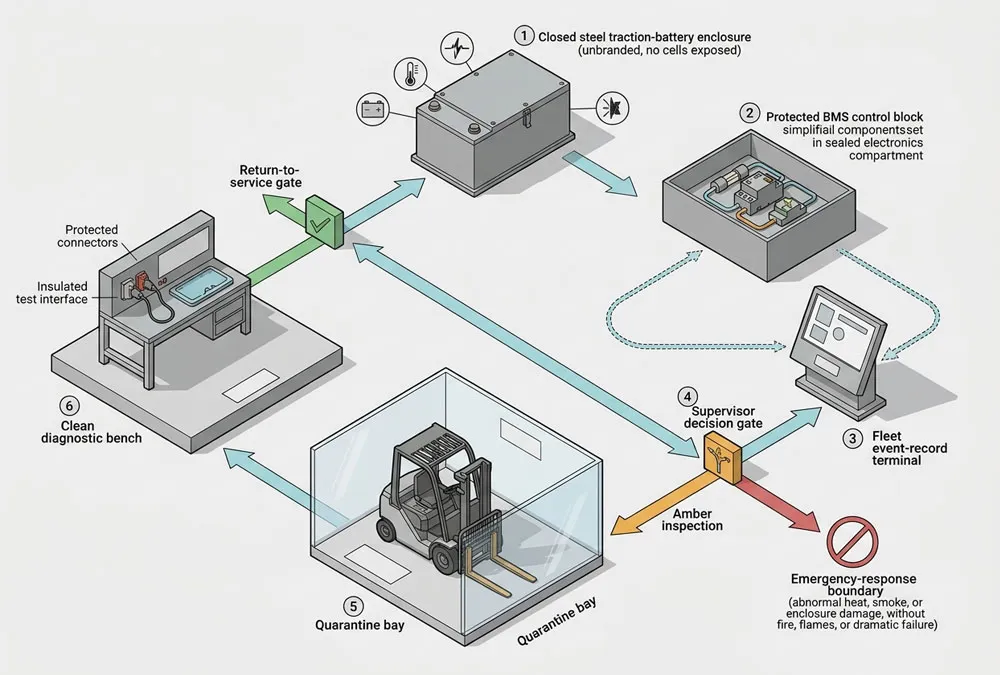
A BMS can stop charging or discharging when a monitored limit is crossed, but it cannot assign responsibility inside the warehouse. If the operator repeatedly resets a fault to recover production, the original evidence may be lost and the battery may remain in an unresolved condition.
Six-step fault-evidence chain
- Stop the normal task and park the truck safely.
- Record the truck, battery and charger IDs.
- Capture the time, SOC, temperature, displayed code and recent operating event.
- Apply the site’s stop-use or isolation rule; do not bypass the BMS or interlock.
- Have authorised maintenance or the supplier review the relevant logs and physical condition.
- Record the corrective action and the evidence used to return the truck to service.
UKMHA guidance notes that BMS logs may contain charge/discharge cycles, temperatures, cell resistance, errors, faults and alarms. It also warns that prompt specialist response can matter after a shutdown because continued charge decay may make recovery more difficult. That does not mean an operator should repair or reset the pack; it means the escalation path should be fast enough to preserve both the battery and the evidence.
What Should Happen After Impact, Tip-Over, Water Exposure or Abnormal Heat?
A battery mounted low in a truck can experience a dock-leveler strike, a pallet or fork impact, water exposure, a tip-over or an off-dock incident. The enclosure may look normal after the event, but external appearance alone is not a return-to-service test.
As a current OEM example, the Yale 2026 Employer’s Operation Guide says a lithium-ion battery exposed to water, fire or physical damage—including potential damage from impact, tip-over or an off-dock incident—should be inspected by an appropriately trained and certified service technician before return to service. This is manufacturer guidance, not a universal legal rule, but it demonstrates the event-triggered inspection logic that a warehouse procedure should resolve.
- After a significant impact, tip-over or off-dock event:
park safely, isolate the truck and report the event. Preserve photographs, truck and battery IDs, the fault display and the operating state. Do not keep working merely because the enclosure looks intact; use the exact manufacturer inspection and diagnostic procedure as the return-to-service gate. - After water or fire exposure:
follow the site emergency plan and do not energise or charge the equipment. Record the exposure source, duration if known, visible condition and system status. A specialist or manufacturer decision is required before reuse. - When heat, venting, hissing, vapour or smoke is increasing:
stop use, warn others and activate the lithium-battery emergency procedure. Personnel should not approach an escalating event merely to collect readings; the emergency plan and competent responders control the next action. - After repeated BMS or charger shutdowns:
end reset-and-retry behaviour. Preserve the code, SOC, temperature, charger event, recent load and environmental condition. Return the system only after the cause and corrective action have been recorded and a controlled check has succeeded.
OSHA identifies rising temperature, venting gas or vapour, smoke and fire as thermal-runaway indicators. It also connects thermal runaway with internal short circuits, manufacturing defects, mechanical damage, temperature extremes and improper charging. The site emergency plan must use the exact product instructions and local responder guidance; a generic blog should not prescribe one universal method for moving or extinguishing a damaged industrial battery.
What Should Buyers Request Before Deploying Warehouse Lithium Equipment?
The maintenance system begins at procurement. If the supplier hands over only voltage, Ah and a charger plug, the warehouse does not have enough information to manage faults or approve the installation.
Before approving a project, ask the supplier to close six evidence gaps:
- Truck–battery integration: voltage window, continuous and peak current, dimensions, installed mass, restraint, connector, cable route, communication and regenerative behaviour. This determines whether the proposed pack is a system candidate rather than a drop-in guess.
- Charger approval: exact battery and charger models, voltage, current, charge profile, connector, BMS interface, AC input and commissioning evidence. This shows whether the pack can recover safely inside the real charging window.
- Operating limits: separate charge, discharge and storage temperatures, environmental rating and any condensation or cold-store controls. These define when the BMS may limit operation and where charging is allowed.
- Safety and maintenance: operator checks, fault-code information, shutdown response, emergency instructions, repair boundaries and the damaged-pack route. This prevents an abnormal event from becoming an unowned problem.
- Model-level compliance evidence: document number, covered model, edition/date, issuing body or laboratory and verification route. A company logo or certificate title is not proof that the quoted configuration is covered.
- Lifecycle support: diagnostic access, firmware/change control, spares, service route, warranty exclusions and end-of-life handling. These factors decide whether a small fault becomes a short service event or a long truck outage.
Standard-format batteries can simplify common applications, while a custom enclosure, cable exit, ballast arrangement or communication interface may be required for a specific truck. Neither option is automatically compatible. A lead-acid replacement should be treated as an engineering integration project; the detailed lead-acid-to-lithium conversion assessment covers the additional gates.
What Changes Across Europe, the United States and Export Markets?
Europe first
Europe is not one workplace-safety rulebook. The Irish HSA code used above is an official Irish source. UKMHA material is UK industry guidance, and the UK is not an EU member state. For a European deployment, use the destination country’s workplace, electrical and fire requirements together with the truck, battery and charger manuals, the site fire-risk assessment and insurer conditions.
The HSA code gives a strong operating model: trained operators should complete and record pre-use checks at the beginning of each shift; safety-critical defects should be corrected before use; preventive maintenance should follow at least the manufacturer’s instructions; and written records should be maintained. Those principles translate well to a battery programme even where the legal details differ.
United States
OSHA does not publish one lithium-ion-battery-specific standard. Its current standards page points instead to potentially applicable areas such as emergency planning, fire protection, electrical safety, lockout/tagout, PPE, Hazard Communication and powered industrial trucks. OSHA’s fact sheet also recommends that workplace emergency action plans include lithium-related incident response based on manufacturer instructions and appropriate fire-safety guidance, with workers trained on the procedure.
Central Asia, Africa and other destinations
Do not treat these regions as one compliance market. Ask for the destination country, site AC supply, phase/frequency, ambient temperature, dust and moisture conditions, charging location, local fire/insurer requirements, training language, spare-parts route and recovery plan. In remote markets, diagnostic access and the ability to resolve a fault without returning a complete battery can be as important as the headline specification.
How Can a Warehouse Measure Whether Safety and Maintenance Improved?
Do not claim success because the watering log disappeared. Establish a pre-change baseline and compare the new task categories using the same fleet, time period and operating conditions where possible.
| Measure | Lead-acid baseline | Lithium measurement | What improvement looks like |
|---|---|---|---|
| Routine battery-care hours | Watering, cleaning, equalisation and change-out time | Pre-shift battery checks, charger-point inspections and specialist diagnostics | Lower total hours without falling inspection completion |
| Defect response | Open battery/charger defects and closure time | Fault-code capture, isolation and root-cause closure time | Fewer repeat faults and faster evidence-based closure |
| Charging-point condition | Central battery-room defects | Cable, connector, impact-protection and housekeeping defects by location | Lower defect rate as charging points scale |
| Unplanned downtime | Battery, charger, truck and swap-equipment hours | Battery, BMS, charger, communication and truck hours | Lower productive hours lost, with root causes preserved |
| Inspection completion | Percentage of required tasks completed | Percentage of shift checks and periodic actions completed | Maintenance hours fall without creating an inspection gap |
A simple labour worksheet keeps the comparison honest:
Annual task hours = measured minutes per task × actual annual frequency × number of batteries or charge points ÷ 60
Run this formula separately for watering, cleaning, change-outs, shift checks, charging-point inspections, fault reviews and specialist service. Use observed minutes and completed-work records. A supplier’s generic labour-saving percentage cannot replace a site baseline.
A 30-Day Warehouse Lithium Safety and Maintenance Plan
- Days 1–7 — Map the system. Inventory trucks, batteries, chargers and every charging location. Separate traction batteries from loose, returned or damaged battery inventory. The output is an asset and charging-point map with unique IDs and named owners.
- Days 8–14 — Assign responsibility. Define what the operator, supervisor, maintenance team, EHS team and supplier must do. Set clear stop-use events. The output is a signed fault, isolation and escalation workflow.
- Days 15–21 — Train and test. Train each shift on inspections, charger connection, fault capture and emergency communication. Run one tabletop impact or abnormal-heat scenario. Record both attendance and the gaps exposed by the exercise.
- Days 22–30 — Audit before scaling. Review charger protection, cable routing, open faults, product documents and simultaneous demand. Close critical gaps and record the boundary that must be met before the fleet expands.
How AnengJi Supports Warehouse Battery Projects
AnengJi develops lithium battery options for forklift and other industrial applications, including standard-format candidates and application-specific configurations. A custom case, cable arrangement, BMS interface or wiring direction can address a particular truck, but customization is not proof of compatibility by itself.
For a useful project review, send the truck data plate, existing battery label, charger label, compartment dimensions, permitted battery-mass range, connector photographs, loads, shift pattern, charging windows, environment and destination. The review can then identify missing mechanical, electrical, charger, documentation and site-power inputs before a quotation is treated as final.
Request a Warehouse Battery Safety and Fit Review
Receive a structured list of the truck, battery, charger, charging-site and destination evidence still needed for a model-level decision.
Frequently Asked Questions About Lithium-Ion Batteries in Warehouses
Are lithium-ion batteries safer than lead-acid batteries in warehouses?
They can reduce routine electrolyte watering, acid handling and battery-change exposure. They also introduce system-specific electrical, mechanical-damage, charging and thermal-event controls. The defensible conclusion is that the risk profile changes; actual safety depends on product design, truck/charger integration, operator behaviour and the warehouse management system.
Do lithium forklift batteries require maintenance?
They do not require routine watering or the conventional lead-acid equalisation process, but they still require pre-use condition checks, connector and charging-equipment inspection, fault review and manufacturer-defined specialist service. Cooling fans or other auxiliary equipment may also need cleaning or service.
Do lithium forklift batteries need a dedicated charging room?
There is no universal yes/no answer. The battery and charger instructions, site fire-risk assessment, traffic and stock layout, insurer, local authority and destination-country requirements determine whether charging occurs in a room, a protected area or controlled distributed points. Do not copy a lead-acid room design or a vendor’s “no room required” claim without a site assessment.
What should operators inspect before each shift?
At minimum, use the exact manuals to check SOC and display warnings, visible battery/enclosure condition, mounting or restraint, charge port, cables and connectors, and whether components are clean and dry. The truck itself still needs its full pre-use safety check; a battery checklist does not replace it.
What should happen after a battery is hit or exposed to water?
Remove the equipment from normal use, preserve the event and fault evidence, and follow the manufacturer’s isolation and trained-inspection process. Do not return it to service because the case looks normal, and do not charge or energise it until the applicable procedure permits that action.
Can a lead-acid charger be reused with a lithium forklift battery?
Only when the exact battery, charger and truck combination has documented approval for voltage, current, profile, termination, connector, communication and interlocks. A matching nominal voltage or plug is insufficient.
Lithium Improves Safety When the Operating System Changes With It
The most valuable benefit of lithium-ion batteries is not a single maintenance claim. It is the opportunity to remove repeat acid-handling and battery-change work while making abnormal conditions more visible. That opportunity becomes a real safety improvement only when the warehouse assigns the new tasks: inspecting the system, protecting charging points, preserving fault data, isolating damaged equipment and documenting the decision to return it to service.
Use numbers to manage the change. Track energy and simultaneous charging demand. Measure task hours before and after conversion. Record inspection completion, defects and closure time. Most importantly, keep every published figure inside its scope: official national guidance, industry recommendation, OEM example, AnengJi reference specification or transparent calculation.
Related Articles

Related Posts
 https://anengjibattery.com/wp-content/uploads/2026/11/AnengJIBattery-Forklift-Battery-Purchase-Passport.webp
675
1000
Battery Expert Team
https://anengjibattery.com/wp-content/uploads/2025/06/logo2-300x138.png
Battery Expert Team2026-11-05 06:35:192026-11-05 06:35:53How Do Lithium-Ion Batteries Improve Warehouse Safety?
https://anengjibattery.com/wp-content/uploads/2026/11/AnengJIBattery-Forklift-Battery-Purchase-Passport.webp
675
1000
Battery Expert Team
https://anengjibattery.com/wp-content/uploads/2025/06/logo2-300x138.png
Battery Expert Team2026-11-04 06:47:322026-11-04 06:48:06How Do You Match Electric Fork Truck Batteries Correctly?
 https://anengjibattery.com/wp-content/uploads/2026/11/AnengjiBattery-LiFePO4-Forklift-Charging-During-a-Scheduled-Break.webp
675
1000
Battery Expert Team
https://anengjibattery.com/wp-content/uploads/2025/06/logo2-300x138.png
Battery Expert Team2026-11-03 08:12:112026-11-03 08:12:44When Is a LiFePO4 Forklift Battery the Best Choice for Your Business?
 https://anengjibattery.com/wp-content/uploads/2026/11/AnengjiBattery-Correct-Forklift-Battery-Charging-in-Practice.webp
675
1000
Battery Expert Team
https://anengjibattery.com/wp-content/uploads/2025/06/logo2-300x138.png
Battery Expert Team2026-11-02 07:02:512026-11-02 07:03:12How to Charge a Forklift Battery: Time and Safety Guide



Leave a Reply
Want to join the discussion?Feel free to contribute!