
When Is a LiFePO4 Forklift Battery the Best Choice for Your Business?
November 3, 2026 / Battery Expert Team / Battery Basics

Introduction
It is 3:40 p.m., the outbound dock is filling up, and one forklift has just slowed during a loaded lift. The operator has already used two breaks to charge it. The dashboard still shows usable energy, but no one knows whether the problem is capacity, charging, current limit or an inaccurate state-of-charge display. This is the point at which a LiFePO4 forklift battery either proves its business value—or becomes another expensive question.
For a busy fleet, the difference can be very tangible. A 30-minute charge at an average 100A adds a mathematical 2.56kWh to a 51.2V pack before losses. At 200A, the same break adds 5.12kWh. A 51.2V, 412Ah pack contains about 6.91kWh more nominal energy than a 277Ah version. Across ten trucks, two 12-minute battery changes per truck per day involve a calculated 1,000 truck-hours per year at 250 operating days—before the site determines how much of that time is genuinely avoidable.
Those numbers are examples, not promises—but they show what buyers actually need to see. LiFePO4 is a strong business choice when recovered energy, avoided handling and reduced routine work solve costs that already appear in the shift. It is a weak choice when the forklift is lightly used, the charger cannot recover the energy, or the system creates a new service bottleneck.
Quick answer
LiFePO4 usually creates the most value in high-utilisation and multi-shift fleets that have reliable charging windows, measurable battery-handling or maintenance costs, and a verified truck–battery–charger integration path. It is not automatically the lowest-cost option for every single-shift or occasional-use forklift.
Is a LiFePO4 Forklift Battery the Best Choice for Every Fleet?
No. The phrase “best battery” is useful only after the operating conditions are defined. A battery that removes a daily change-out from a three-shift distribution centre may have a compelling value case. The same battery installed in an ageing forklift used for thirty minutes twice a week may never recover its integration premium.
| Fit level | Typical operating conditions | What the improvement looks like onsite |
|---|---|---|
| Strong fit | Two or three shifts, frequent battery changes, costly watering or corrosion work, and predictable break periods | Break charging covers the next work block; battery changes and watering no longer interrupt the shift |
| Conditional fit | Older truck, proprietary communication, cold storage, limited site power or a remote destination | A controlled trial shows stable lifting, useful SOC information and reliable charging in the real environment |
| Weak fit | Very low utilisation, poor truck condition, inexpensive local lead-acid support or no approved mass solution | Savings remain small because the truck rarely needs charging, changing or battery maintenance |
The useful question is therefore not “Does LiFePO4 have advantages?” It is “Which advantage removes a measured constraint in this operation, and what evidence will prove the result?”
What Do 277Ah, 280Ah and 412Ah Mean During a Shift?
Voltage and amp-hours can feel abstract until they are converted into energy. Nominal energy is calculated as voltage × amp-hours ÷ 1,000. The following values come from AnengJi’s reference configurations; they describe stored nominal energy, not guaranteed runtime.
| Reference configuration | Calculated nominal energy | Capacity difference | What the operator may notice |
|---|---|---|---|
| 51.2V, 277Ah | 14.18kWh | Baseline | Lower stored energy and a shorter interval between reliable charges under the same load |
| 51.2V, 412Ah | 21.09kWh | About 49% more nominal energy | More energy reserve, but also more energy that the charger must recover |
| 76.8V, 280Ah | 21.50kWh | Baseline for this voltage class | Similar nominal energy to the 51.2V 412Ah example, but not interchangeable with it |
| 76.8V, 412Ah | 31.64kWh | About 47% more nominal energy | A longer potential work window, with a larger charging and infrastructure requirement |
Here is a more intuitive illustration using only the two 51.2V options. Assume—only for this example—that 80% of nominal energy is available and the forklift averages 6kW DC while it is actively working. The 277Ah configuration would supply about 11.35kWh, equal to roughly 1 hour 53 minutes of active work. The 412Ah configuration would supply about 16.88kWh, equal to roughly 2 hours 49 minutes. The difference is approximately 55 minutes of active work.
A real forklift does not draw a constant 6kW: travel, waiting, lifting, ramps, attachments, temperature and tyre condition change the average. That is why the example should not be copied into a quotation. Its purpose is to make the purchase decision visible: 412Ah does not merely mean “a larger battery”; in this scenario it buys about 55 additional active minutes, and the charger must later replace the extra energy.
How Does LiFePO4 Recover Productive Forklift Time?
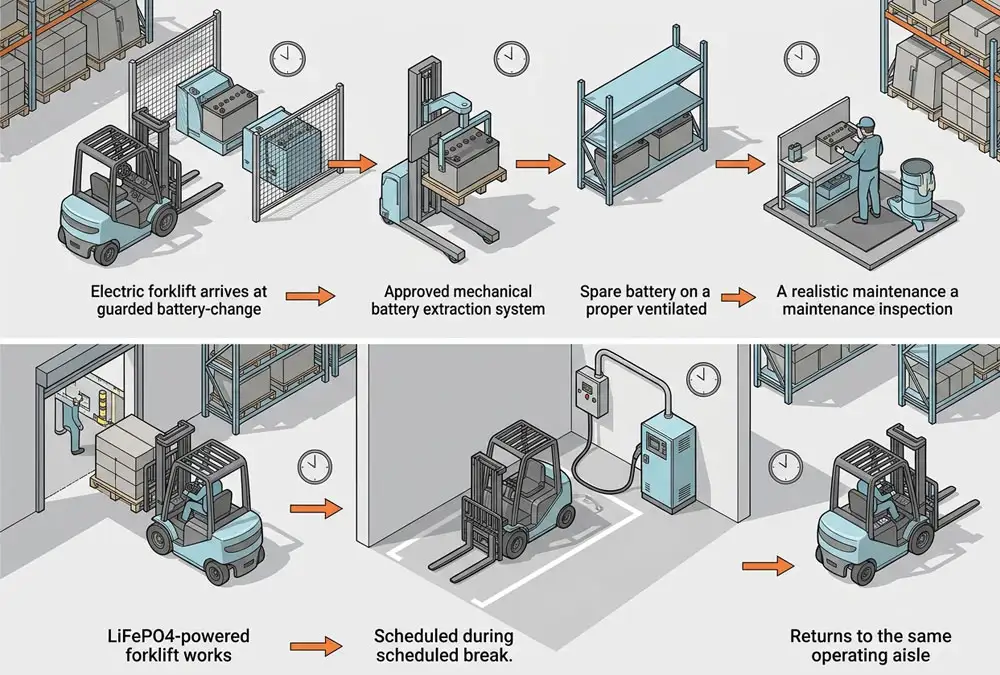
Opportunity charging must pass an energy-balance test
Opportunity charging means adding energy during scheduled pauses such as meal breaks and shift changes. It can reduce the need for spare batteries and change-out equipment, but only if those pauses restore enough energy for the next operating block. Toyota’s current charging-method guidance similarly describes opportunity charging as using breaks and shift changes without interrupting productivity, while noting that charging strategy depends on utilisation.
A site that merely records “plugged in for 45 minutes” is missing the decisive number: how many kilowatt-hours actually returned to the battery? Charger nameplate power may not equal average DC power because temperature limits, BMS requests, high-SOC taper, cell balancing, input constraints or interruptions can reduce the session average.
Screening calculation
Baseline charging time = energy to restore ÷ measured average DC charging power
The table below turns a charging break into something an operator can picture. It assumes a 51.2V pack, the stated current remains constant for the whole session, and the truck averages 6kW DC while actively working. It ignores losses, taper, balancing and temperature derating, so it is a screening illustration—not a charger recommendation.
| Charging break | Energy added at 100A | Approx. 6kW work equivalent | Energy added at 200A | Approx. 6kW work equivalent |
|---|---|---|---|---|
| 15 minutes | 1.28kWh | About 13 active minutes | 2.56kWh | About 26 active minutes |
| 30 minutes | 2.56kWh | About 26 active minutes | 5.12kWh | About 51 active minutes |
| 45 minutes | 3.84kWh | About 38 active minutes | 7.68kWh | About 77 active minutes |
The result is deliberately revealing: a 30-minute break does not automatically buy 30 minutes of work. At an average 100A charge and an illustrative 6kW workload, it returns about 26 active minutes before losses; at 200A it returns about 51 minutes. If the next work block is 90 minutes, neither plan fully covers it. If the next block is 40 minutes, the 200A scenario may work—but only when the battery, BMS, cable, connector, charger and site supply all support that current.
For the 51.2V, 412Ah example, restoring 60% of nominal energy means replacing about 12.66kWh. At a measured average of 8kW DC, the mathematical baseline is about 1.58 hours. Two 25-minute breaks would therefore be insufficient on their own. The full method for measuring actual returned energy is covered in our guide to forklift battery charging.
Avoided change-outs have value only when they exist today
For a fleet that changes heavy lead-acid batteries between shifts, the benefit is easier to feel when it is expressed as time. Consider a clearly labelled example: 10 trucks, two changes per truck per day, 12 minutes per change and 250 operating days.
Illustrative annual change-out time
10 trucks × 2 changes × 12 minutes × 250 days ÷ 60 = 1,000 truck-hours per year
If one trained employee is occupied during every change, the same example also represents 1,000 labour-hours. This does not mean LiFePO4 automatically saves all 2,000 resource-hours: charging, inspections and occasional service remain. It shows the size of the problem that a one-battery-per-truck strategy could attack.
Replace the four assumptions with your own numbers. If the result is 80 hours rather than 1,000, the investment case is naturally weaker. If trucks queue behind one change station and the result exceeds 1,000, the operational value may be larger than the battery-price comparison suggests.
Why Consistent Forklift Power Depends on More Than Amp-Hours
A battery’s amp-hour rating describes charge capacity, not its ability to supply every demand that a forklift can create. Travel motors, hydraulic pumps, high lifts, ramps and simultaneous travel-and-lift events create different current profiles. A pack may contain sufficient nominal energy for the shift and still trip protection during a short high-current event.
This is the cause behind a frustrating pattern: the truck performs normally at high state of charge, then stops or reduces performance late in the shift when lifting a heavy load. Increasing Ah without identifying the fault can waste money. The evidence that separates insufficient energy from insufficient power is a time-stamped current, voltage, SOC, temperature and fault record during the event.
| Question | Evidence needed | Buyer consequence |
|---|---|---|
| Will the pack last between reliable charges? | Measured kWh per operating block plus an agreed reserve | Select nominal energy and Ah from the duty cycle |
| Will it lift and travel without a protection trip? | Continuous current, peak current, duration and low-SOC event data | Size the cells, BMS, contactors, fuse, connector and cables as one current path |
| Will regenerative braking be accepted? | Controller behaviour, maximum charge current and high-SOC limits | Prevent a BMS/vehicle conflict during deceleration |
For detailed capacity selection, use the duty-cycle method in our electric forklift battery Ah guide. Capacity and current capability should be approved separately before the supplier recommends a pack.
What Maintenance and Safety Work Does LiFePO4 Remove—and Add?
LiFePO4 eliminates routine watering and the conventional equalisation process required by flooded lead-acid batteries. It can also remove exposure associated with regular battery changes. These are meaningful improvements where those tasks are frequent and properly recorded.
The risk reduction should still be described accurately. The UK Health and Safety Executive’s Using Electric Storage Batteries Safely explains the corrosive-electrolyte, gas, short-circuit and handling risks associated with large workplace batteries, including lead-acid batteries used in forklifts. Replacing a vented lead-acid system changes several of those tasks, but it does not turn a high-energy traction battery into risk-free equipment.
A LiFePO4 system still needs connector and cable inspections, secure restraint, damage and abnormal-temperature checks, correct charging, event-log review, isolation procedures and trained responses to alarms. The BMS monitors electrical and thermal conditions, but it cannot compensate for a crushed enclosure, an incompatible charger, a loose high-current connector or an unapproved installation.
This distinction matters to operators. If “maintenance-free” is understood as “no one needs to look at it,” a damaged charging lead may remain in service until it creates a failure. A better operating instruction is: no routine watering, but a defined inspection and fault-response programme remains.
Temperature makes a life claim real—or meaningless
“3,000 cycles” sounds impressive but gives a buyer little information without temperature and end-of-life conditions. Hyster’s published warranty provides a useful model-specific example of how those conditions can be expressed. It links 75% state of health to months, cycles, operating hours and lifetime average battery temperature.
| Hyster-published lifetime average temperature | 75% SOH warranty limit | How the number changes | Buyer lesson |
|---|---|---|---|
| ≤95°F / 35°C | 60 months, 3,000 cycles or 10,000 hours | Reference condition | Temperature history is part of the warranty evidence |
| 95–113°F / 35–45°C | 60 months, 2,500 cycles or 8,000 hours | 500 fewer cycles and 2,000 fewer hours | A calendar-year claim alone hides the usage limit |
| 113–140°F / 45–60°C | 60 months, 2,000 cycles or 6,000 hours | 1,000 fewer cycles and 4,000 fewer hours | Heat can materially change the covered operating life |
These are Hyster-specific warranty conditions, not an industry benchmark and not an AnengJi warranty statement. Their value is the format: when comparing suppliers, ask for the temperature band, state-of-health threshold, cycles, hours and “whichever comes first” rule on one line.
When Does a LiFePO4 Forklift Battery Lower Total Cost?
The purchase price cannot answer this question. Two quotations that both say “48V lithium battery” may include different trays, ballast, chargers, displays, commissioning, transport terms and service coverage. A low battery-only price can become the expensive option when the truck remains idle while missing components or approvals are resolved.
A buyer-side TCO structure
TCO = landed battery-and-charger system + installation and infrastructure + energy + routine work + battery handling + downtime + service and spares + replacements + end-of-life cost − verified residual value
Cost per productive truck hour = net TCO ÷ verified productive truck hours
Put an annual value on the interruptions your team already sees
Imagine a ten-truck warehouse where a supervisor regularly loses sight of an operator during a battery change, and the maintenance team still schedules watering and corrosion checks. The interruptions feel small one at a time. Annualising them shows why the operating pattern matters more than a battery brochure.
| Illustrative site input | Annual calculation | Result to value | What not to assume |
|---|---|---|---|
| 10 trucks; 2 battery changes per truck per day; 12 minutes per change; 250 days | 10 × 2 × 12 × 250 ÷ 60 | 1,000 truck-hours/year involved in change events | Not every minute becomes productive time; record actual waiting, travel and queue time |
| 10 lead-acid batteries; 20 minutes of logged routine battery work per battery per week; 50 weeks | 10 × 20 × 50 ÷ 60 | About 167 labour-hours/year of recorded routine work | This is an example input, not a universal watering interval; use your maintenance log |
| 30-minute lunch charge; 51.2V pack; 200A average charge current | 51.2 × 200 × 0.5 ÷ 1,000 | 5.12kWh added before losses and charge taper | Do not value the break until the approved charger, connector, temperature and power supply can sustain it |
Now insert the site’s own money values. If one idle truck-hour is worth V and one loaded labour-hour costs L, the gross annual value in this example starts with (verified avoidable truck-hours × V) + (verified avoidable labour-hours × L). Then subtract charger and electrical work, remaining lithium inspections, service, financing and any production time that opportunity charging cannot cover. This produces a defendable range instead of a headline payback promise.
What the operator should notice after a successful conversion
The truck reaches the next break without voltage-related sluggishness, the approved charger adds enough energy for the next work block, no battery-change queue forms, and the operator returns to the same truck. If the site cannot observe those changes—or the charger cannot recover the energy used—the business case is not yet proven.
Build at least three scenarios: a normal operating year, a high-demand year and a stress case in which a charging window or service response is missed. Use the site’s own electricity tariff, labour rate, maintenance records, shift plan and truck utilisation. Treat cycle-life figures as conditional: request the depth of discharge, temperature, C-rate, charge protocol, capacity-retention threshold and reference test behind the number.
A single-shift fleet may still choose LiFePO4 for cleanliness, process control or reduced routine work, but those preferences should be visible in the decision rather than hidden inside an unsupported payback claim. Our separate forklift battery cost framework shows how to normalise battery-only, landed, installed and operating costs.
Which Integration Details Can Cancel the LiFePO4 Advantages?
A lighter battery can create a stability problem
In a counterbalanced forklift, the battery may be part of the approved mass and balance configuration. This is the industry detail that generic “lithium is lighter” lists often miss. The current Illinois Statewide Technical Reference Manual describes a lithium retrofit battery case with appropriate ballast to meet the fork truck’s weight and balance specifications.
The operational trigger is a proposed lithium pack that fits the compartment but weighs less than the truck’s permitted minimum. The consequence is not simply “a lighter truck”; it may be an unacceptable stability configuration. Collect the truck data plate, OEM documentation, permitted battery-weight range, compartment drawing and complete installed battery mass. Then obtain an engineered enclosure, restraint and ballast solution through the responsible approval path. Loose steel, concrete blocks or other improvised weight is not a substitute.
For the complete fit-and-mass method, see how to verify forklift battery weight and stability.
A familiar plug does not prove charger compatibility
The old charger is often the first saving a buyer hopes to keep. Yet a connector can physically fit while the charge profile, limits, termination or communication remain wrong. Hyster provides a useful OEM example: its lithium-ion battery and charger documentation states that its BMS communicates with the charger via CAN and that its lead-acid chargers cannot charge those Hyster lithium batteries. That does not mean every brand uses the same proprietary protocol; it demonstrates why charger reuse requires model-level approval.
Ask for the allowed voltage window, charge current, profile, temperature limits, CAN or hardwired controls, wake/sleep logic, interlock, connector and fault-stop behaviour. If the supplier’s answer is only “same voltage,” the charging interface is not yet defined.
The original battery gauge may mislead the operator
Lead-acid battery discharge indicators often infer charge from a voltage behaviour that differs from the relatively flat LiFePO4 voltage curve. A truck can therefore run while the original gauge gives a poor estimate of remaining energy. The visible symptom is a driver who sees an acceptable reading and then experiences a rapid warning, power reduction or BMS shutdown.
Commission the displayed SOC across a representative operating window. Test the low-SOC warning, power-limiting strategy, lift lockout if applicable and safe fault recovery. Define who can read logs and change parameters. A minor communication fault should not require several days of waiting for an overseas engineer before the site can identify the cause.
Cold storage requires separate charge and discharge evidence
A battery may be allowed to discharge below freezing while charging is restricted at a higher temperature. Never infer charging capability from a discharge-temperature claim. Cold-store projects need evidence for low-temperature charge lockout, preheating where used, condensation control, enclosure protection, the transition between warm and cold zones, and charger location.
The same principle applies to hot, dusty or remote sites: use a model-specific operating envelope, not a chemistry-wide statement. If a supplier cannot provide the test conditions behind its temperature range, treat the range as unverified.
Low-friction compatibility check
Send the truck and existing battery data plates, compartment dimensions, permitted battery mass, connector photos, charger label and shift profile. The review can identify missing inputs before a quotation is prepared.
When Might Lead-Acid Still Be the More Economical Choice?
A technically possible conversion can still be the wrong business decision. Lead-acid may remain reasonable when the forklift is used infrequently, the current battery is maintained well, battery changes are not required and local repair support is fast and inexpensive. It may also be preferable while an ageing truck is approaching replacement or when an approved battery-mass and communication solution cannot be established.
Site power can change the answer. A fleet may have attractive break periods but insufficient electrical capacity to operate the proposed chargers together. If the distribution upgrade costs more than the avoided battery-handling and maintenance burden, a staged project, lower charging power or another battery strategy may be more practical.
This balanced section is not an argument against LiFePO4. It protects the buyer from purchasing the correct chemistry for the wrong duty. The best supplier should be able to identify a no-go condition before taking an order.
What Should Buyers Verify in Europe, the United States and Export Markets?
Europe: verify the battery model, operator role and destination
The European Commission explains that the EU battery framework under Regulation (EU) 2023/1542 covers the battery lifecycle and establishes requirements involving sustainability, safety, labelling, supply-chain responsibility and end of life. The exact obligations depend on battery category, economic-operator role, implementation date and destination market.
European importers should request the model identification, applicable technical documentation, EU declaration of conformity, instructions and safety information, traceability details and evidence supporting each claimed standard. A logo or the statement “CE available” is not a model-level evidence package. Vehicle integration, workplace risk assessment, charger input and national implementation still need separate review.
United States: control vehicle modification and workplace charging
The OSHA powered-industrial-truck standard states that modifications affecting capacity or safe operation require the manufacturer’s prior written approval. It also addresses battery positioning and securing, designated charging arrangements and additional counterweighting. Product listing, insurer and authority-having-jurisdiction expectations may add project-specific requirements.
Central Asia, Africa and other destinations: plan for support distance
These regions are not one regulatory market. Confirm the destination country’s import, transport, installation, workplace and recycling rules. Add input voltage and frequency, generator use, power quality, temperature, dust, humidity, network coverage, language, customs scope, inland unloading and spare-parts lead time to the RFQ.
Service distance is a commercial specification. If a failed display, contactor or communication cable can idle a truck for weeks, the spares kit, diagnostic access and response process deserve the same attention as capacity.
How AnengJi Configures LiFePO4 Forklift Battery Solutions
AnengJi is a China-based lithium-ion forklift battery manufacturer serving U.S. and international buyers. Our selection process starts with the truck and duty rather than a voltage-only quotation: permitted battery mass, compartment, measured energy use, continuous and peak current, charging windows, connector, charger/BMS interface, temperature and destination documents.
Our forklift direction includes application-specific enclosures and broader battery platforms. A purpose-built enclosure can address a particular truck’s geometry, restraint and ballast requirements. A general or standard-format pack remains only a candidate until voltage window, power, dimensions, mass, connector, communication and approval are verified. Buyers can explore our LiFePO4 forklift battery options before submitting the exact truck data.
| Reference application | AnengJi reference configuration data | What the buyer should learn |
|---|---|---|
| E20 counterbalanced truck | 51.2V; 277Ah or 412Ah; 1030 × 500 × 507mm; 210kg | Two capacity choices do not remove the need to validate complete installed mass and peak demand |
| Reach-truck configuration | 51.2V; 277Ah or 412Ah; 1216 × 355 × 744mm; 1200kg | The same voltage and Ah choices can require a radically different enclosure and mass target |
| Linde-specific KGCB configuration | 76.8V; 412Ah; 980 × 688 × 700mm; 210kg | An 80V-class project still needs exact vehicle, environment and interface review |
| Fuel-to-electric project | 76.8V; 280Ah; 730 × 600 × 340mm; 210kg | A custom battery is one component of a vehicle-conversion project, not the complete approval |
These configurations list 200A continuous charge and discharge at 25°C, a discharge operating range of −20°C to 60°C and a charging range of 0°C to 55°C. They are model-specific reference values—not a statement that every AnengJi battery has the same limits. The 200A figure is also not an instruction to select a 200A charger and does not define peak-current capability. Final selection requires the exact truck and operating profile.
What Evidence Should a LiFePO4 Forklift Battery RFQ Include?
- Forklift make, model, serial number and clear data-plate photo.
- Existing battery voltage, Ah, complete mass, dimensions and label.
- Permitted battery-mass range, compartment drawing and restraint method.
- Connector, cable exit, polarity and charging connection.
- Measured energy used between reliable charging opportunities.
- Continuous, peak and regenerative current profile.
- Loads, lift frequency and height, ramps, attachments and busiest shift.
- Charging windows, charger label and facility input power.
- BMS/CAN/BDI, wake/sleep, interlock and low-SOC behaviour.
- Operating, charging and storage temperatures.
- Destination, required model-level test and conformity evidence.
- Commissioning plan, diagnostics, spares, warranty labour and service response.
A supplier can then return a candidate configuration, list the unresolved interfaces and state the acceptance tests. That is more useful than a firm price issued from “48V forklift” alone.
Frequently Asked Questions About LiFePO4 Forklift Batteries
Is a LiFePO4 forklift battery better than lead-acid?
It is often a stronger fit for high-utilisation fleets that can use opportunity charging and want to reduce watering, battery changes and voltage-related performance loss. Lead-acid may remain economical for low-use equipment with inexpensive local support. Compare complete system cost and productive hours, not chemistry alone.
How long does a LiFePO4 forklift battery last?
There is no responsible universal answer in years. Ask for cycle-life evidence with depth of discharge, temperature, C-rate, charge method and end-of-life capacity threshold. Then combine that evidence with the operation’s annual cycles and calendar-ageing conditions.
Can I use the existing lead-acid charger?
Do not assume so because the plug and nominal voltage match. Reuse is acceptable only when the exact battery and charger are approved together for voltage, current, charge profile, termination, temperature limits and any required communication.
Does a LiFePO4 forklift battery need counterweight?
It depends on the truck’s permitted battery mass and centre-of-gravity requirements. A lithium battery may require an engineered enclosure and ballast. Do not add counterweight without the appropriate vehicle-manufacturer or responsible approval route.
Can LiFePO4 forklift batteries work in cold storage?
Cold-storage solutions exist, but the proposed model must separately support the site’s discharge and charging temperatures. Review low-temperature charge lockout or heating, condensation control, sealing, transitions between temperature zones and charger placement.
What should I send a supplier for accurate sizing?
Send the truck and battery data plates, compartment and mass limits, connector photos, measured energy use, load and current profile, charging windows, charger and facility power, temperatures, destination and service requirements. These inputs allow the supplier to identify both a candidate pack and the remaining no-go conditions.
The Best Battery Is the One That Proves Its Value in Your Duty Cycle
A LiFePO4 forklift battery can be an excellent business investment, particularly where multi-shift utilisation, battery handling and routine lead-acid work already consume productive time. Its value should appear in charging logs, completed tasks, maintenance records and cost per productive truck hour—not only in a list of specifications.
Start with the busiest duty cycle. Prove the energy balance, low-SOC power, battery mass, charger/BMS interface, temperature boundary, documentation and service route. When those elements are controlled, LiFePO4’s advantages become operational results rather than marketing promises.
Receive a truck–battery compatibility review
Provide the truck, battery and charger labels, dimensions, permitted mass, duty profile and destination. The review can return a candidate configuration, missing inputs and the evidence needed before a comparable quotation.
Related Articles

Related Posts
 https://anengjibattery.com/wp-content/uploads/2026/11/AnengjiBattery-LiFePO4-Forklift-Charging-During-a-Scheduled-Break.webp
675
1000
Battery Expert Team
https://anengjibattery.com/wp-content/uploads/2025/06/logo2-300x138.png
Battery Expert Team2026-11-03 08:12:112026-11-03 08:12:44When Is a LiFePO4 Forklift Battery the Best Choice for Your Business?
 https://anengjibattery.com/wp-content/uploads/2026/11/AnengjiBattery-Correct-Forklift-Battery-Charging-in-Practice.webp
675
1000
Battery Expert Team
https://anengjibattery.com/wp-content/uploads/2025/06/logo2-300x138.png
Battery Expert Team2026-11-02 07:02:512026-11-02 07:03:12How to Charge a Forklift Battery: Time and Safety Guide
 https://anengjibattery.com/wp-content/uploads/2026/10/AnengJIBattery-U.S.-Forklift-Battery-Supplier-Evaluation.webp
675
1000
Battery Expert Team
https://anengjibattery.com/wp-content/uploads/2025/06/logo2-300x138.png
Battery Expert Team2026-10-30 03:16:252026-10-30 03:16:42Top 10 Forklift Battery Manufacturers for U.S. Buyers in 2026
 https://anengjibattery.com/wp-content/uploads/2026/10/AnengJIBattery-Lithium-Ion-Power-in-Industrial-Operation.webp
675
1000
Battery Expert Team
https://anengjibattery.com/wp-content/uploads/2025/06/logo2-300x138.png
Battery Expert Team2026-10-29 03:43:242026-10-29 03:46:52How Does a Lithium-Ion Battery Work and Stay Protected?



Leave a Reply
Want to join the discussion?Feel free to contribute!