
Top 10 Forklift Battery Manufacturers for Cold Storage
October 26, 2026 / Battery Expert Team / Battery Basics
Introduction
Comparing cold storage forklift battery manufacturers is easier on a brochure than in a freezer. The difficult part is finding one that can keep a truck productive after hours of cold exposure—and prove how the battery, charger and forklift work together.
A brochure may say “operates at −20°C,” yet leave five questions unanswered: Is that ambient or cell temperature? Does it apply to charging or only discharging? How long was the battery cold-soaked? Was the internal heater running? Could the pack still supply a loaded lift at low state of charge? Those omissions are where an attractive quotation can turn into a truck that will not charge before the next shift.
Quick answer: This shortlist prioritises manufacturers with public cold-storage product documentation, a documented cold-chain deployment, or buyer-supplied model data that can be checked against the application. It is not a market-share or laboratory-performance ranking. Regional order reflects the article’s Europe-first focus, followed by North America and globally available suppliers. A buyer should still approve only the exact battery, charger, truck and site configuration after document review and a representative cold-condition test.
How We Evaluated Cold Storage Forklift Battery Manufacturers
Generic manufacturer lists often compare company age, revenue and product breadth. Those details do not tell a cold-chain operator whether a battery will recover during a 30-minute break, whether moisture can reach a connector after the truck leaves a freezer, or whether a local technician can read the BMS fault that stopped the truck.
We therefore used four buyer gates:
- Cold-condition evidence: a model-level product page, technical document or identifiable cold-storage deployment—not simply a generic statement that lithium works in winter.
- System integration: evidence that the supplier addresses voltage, energy, continuous and peak current, charger, communications, connector, enclosure, truck fit and battery mass.
- Thermal and moisture strategy: defined charge/discharge limits, heating or insulation where applicable, and attention to condensation during cold-to-warm transitions.
- Commercial recovery: diagnostics, spare parts, commissioning, warranty responsibilities and regional service—not merely the ability to ship a battery.
Manufacturer-published information is useful for identifying candidates, but it is not independent comparative testing. Every temperature, runtime, cycle-life or energy-saving statement below remains subject to the source’s conditions and the exact offered model.
Disclosure: AnengJi Battery, the company publishing this guide, appears as the final manufacturer profile. Its inclusion is based on its public product portfolio and the forklift-battery sheets supplied for this article; it should not be interpreted as an independent endorsement or proof of freezer performance. The same model-level verification rules applied to every other supplier also apply to AnengJi.
Top 10 Cold Storage Forklift Battery Manufacturers at a Glance
| Manufacturer | Public cold-storage evidence | Main product direction | Potential buyer fit | What still needs verification |
|---|---|---|---|---|
| HOPPECKE | UK cold-storage distribution case | Battery, charger, fleet energy and service | European multi-shift fleets | Exact model, site temperature and measured duty |
| Exide Technologies | UK cold-store deployment with pack configurations | Gel, lead-acid and lithium motive power | European fleets comparing chemistry and service | Project temperature and source-defined savings |
| EnerSys / HAWKER | Cold-storage product positioning | AGM, flooded, TPPL and lithium portfolios | Operators wanting a broad technology and service choice | Country-specific model, charger and service coverage |
| Sunlight Group / TRIATHLON | Model-level temperature and freezer data | Lithium systems, chargers and fleet data | European high-utilisation fleets | Offered configuration and heater-energy assumptions |
| Electrovaya | Repeat order for a US cold-storage operator | Lithium-ion material-handling systems | North American multi-facility fleets | Model data and site-level results |
| Flux Power | Heated cold-storage product specifications | LiFePO4 packs for Class I–III equipment | US fleets needing integration and telematics | Exact UL/listing scope, truck and charger match |
| OneCharge | FROST cooler/freezer technical document | Lithium packs across industrial-truck classes | US cold stores wanting opportunity charging | Capacity-retention test and local support |
| Stromcore | Freezer-focused product and BMS information | Modular lithium and high-rate charging | North American fleets prioritising remote diagnostics | Model sheet, test conditions and field-service reach |
| ROYPOW | Detailed anti-freeze product page and brochure | 24–96V cold-storage LiFePO4 systems | Export projects needing broad voltage coverage | Ambient, discharge and charge ranges separately |
| AnengJi Battery | User-supplied forklift model sheets; no public freezer case identified | Custom LiFePO4 forklift packs plus mobility and energy-storage batteries | Importers and OEM/ODM buyers needing a tailored pack | Cold-soak test, heating, condensation controls and model-specific certificates |
This table is a research shortcut, not an approval. The manufacturer with the strongest public case study may not have the best local service in your country, while the manufacturer with the broadest voltage range may not support your forklift’s communication protocol or minimum battery mass.
European-Focused Forklift Battery Manufacturers for Cold Storage
1. HOPPECKE
HOPPECKE earns a high position because its public evidence goes beyond a temperature badge. In its Bidfood cold-storage distribution case, the company describes a mixed frozen-and-ambient materials-handling fleet, day-and-night availability, opportunity charging and ongoing technical support.
Its broader trak motive-power portfolio spans flooded and low-maintenance lead-acid, lithium-ion and FNC battery technologies for forklifts, AGVs and other industrial vehicles. HOPPECKE also presents chargers, manual and automatic battery-changing equipment, fleet monitoring and turnkey charging-station engineering. That breadth is useful for a European group deciding between improving an existing lead-acid operation and converting selected trucks to lithium rather than forcing one chemistry across every site.
That system perspective matters when a warehouse’s real complaint is not “the battery is cold,” but “the trucks must return after overnight picking and be ready again during the day.” A buyer should still request the exact proposed battery and charger models, the lowest cell temperature reached, cold-soak duration, operating-hour data and responsibility for service at each facility.
2. Exide Technologies
Exide’s JS Davidson cold-storage case is useful because it identifies installed battery configurations rather than offering only general claims. Exide reports six 24V 380Ah, six 48V 750Ah and four 48V 870Ah Gel Tensor batteries for the UK operation, together with manufacturer-reported improvements in maintenance, operating time and energy use.
Exide’s current forklift portfolio includes Solition Material Handling LiFePO4 systems, Tensor and Gel Tensor traction batteries, Sonnenschein gel products, vented lead-acid ranges, chargers and Motion+ fleet-management tools. The company states that these solutions are designed and assembled in Europe and supported across Europe and the Middle East and Africa. For multi-country buyers, the practical advantage is the ability to compare lithium, gel and flooded options within one service conversation.
This also prevents a common purchasing mistake: assuming cold storage automatically means lithium. A sealed or gel lead-acid solution may remain commercially relevant when it fits the duty, maintenance plan, charging window and regional service model. Exide’s product breadth is not a blanket certification: ask for the offered model’s declaration, transport documents, test reports and charger compatibility, plus the case project’s actual temperature, load profile and measurement boundary before treating a supplier result as a forecast for your warehouse.
3. EnerSys / HAWKER
EnerSys offers several motive-power technologies and a large service portfolio. Its official HAWKER Water Free product page describes an AGM battery range with low-temperature discharge performance and explicitly identifies cold storage as an application.
The wider offering includes HAWKER flooded, gel and ATEX products, NexSys thin-plate pure-lead batteries, NexSys iON lithium systems, high-frequency chargers and monitoring tools for forklifts, pallet trucks, AGVs, floor-care equipment and ground-support equipment. EnerSys’s current NexSys iON technical data states that UL listing applies to certain models only; its owner documentation also makes clear that truck harness sizing and compliance remain the OEM or integrator’s responsibility. HAWKER Evolution ATEX is a separate certified range for gas- or dust-hazard zones and should not be confused with a generic cold-store requirement.
For fleets that already understand lead-acid maintenance and want to reduce watering or spillage risk, that breadth can be valuable. It does not remove the need to match capacity, charger, cable harness, truck compartment and shift. Request the precise country-specific model, listing or declaration, monitoring option and service route: a global company name does not guarantee that every product or spare is stocked near every cold store.
4. Sunlight Group / TRIATHLON
Sunlight provides unusually clear public specifications for the LiONFORCE TC100. The page lists 24V to 120V, 74Ah to 2,000Ah, single-cell temperature and voltage monitoring, data logging, and manufacturer-stated charge/discharge and freezer ranges.
Beyond the TC100, Sunlight’s industrial portfolio includes other Li.ON FORCE lithium platforms, tubular PzS/PzB lead-acid products, XtremeForce and MotionGel traction batteries, chargers and connected fleet services. The group also supplies stationary energy-storage products, including Li.ON ESS and OPzS/OPzV ranges. The TC100 page lists CE marking and UN 38.3, while Sunlight’s broader Li.ON FORCE documentation publishes UL 2580, IEC 62619, CE and regional EMC files. A buyer should still match the certificate annex and model identifier to the battery on the quotation.
The page also illustrates why buyers must read labels carefully. A general charge/discharge range and a separate freezer-application line are not automatically the same claim for every configuration. Require the datasheet for the offered model, heating or derating logic, data-field access and a duty-specific calculation. A data logger has little operational value if the customer cannot export the events needed to diagnose a mid-shift shutdown.
North American Forklift Battery Manufacturers with Cold-Storage Evidence
5. Electrovaya
Electrovaya’s strongest public signal is repeat business. In March 2025, the company announced an additional US$4.2 million order from an existing US cold-storage operator that used its technology across six facilities. A repeat order can indicate commercial acceptance, but this remains a company announcement and the end user is not identified.
Electrovaya’s Infinity platform covers walkie pallet jacks and Class I, II and III material-handling equipment, with 24V, 36V and 48V configurations shown in current product literature. The company is also extending its battery technology into robotics, airport ground-support equipment, heavy-duty and high-voltage vehicles, and stationary energy storage. Its official records state that more than 25 models in the 24V and 36V forklift lines achieved UL 2580 listing, while newer high-voltage systems have separate listings.
Use the deployment as a reason to request relevant references and model data—not as proof that the same system fits another fleet. Buyers should ask which truck classes, ambient temperatures, charge windows, peak loads and support arrangements match their own site, then verify that the quoted model is within the published listing rather than relying on a brand-level UL statement.
6. Flux Power
Flux Power’s X-Series product information identifies integrated heaters, precision cooling, weight adaptors and a manufacturer-stated operating range of −30°C to 55°C for cold-storage and high-temperature warehouse environments.
The US product family also includes S-Series packs for walkie pallet jacks, M-Series for end/centre riders and narrow-aisle trucks, L-Series for three-wheel counterbalance forklifts, X-Series for four-wheel counterbalance trucks, C-Series for AGVs and AMRs, and G-Series for airport ground support. SkyBMS/SkyEMS adds fleet-level battery health and event monitoring. Flux states that the X-Series is UL 2580 listed and that manufacturing is certified to ISO 9001:2015; its own FAQ correctly notes that certification scope varies by family, model, voltage and application.
The mention of weight adaptors is important. A lighter lithium pack is not automatically an upgrade in a counterbalanced forklift; battery mass can be part of the truck’s approved stability configuration. A supplier proposal should state the delivered mass, engineered ballast, restraint and approval path—not leave the site to add steel after the battery arrives. The same review must match CAN communication, state-of-charge display, peak current and charger.
7. OneCharge
OneCharge separates cooler and freezer duties in its FROST product document. The document describes a FROST I configuration for cooler use and a FROST II configuration with insulation, a thermostatically controlled heater and a sealed case for freezer operation.
Its broader catalogue describes lithium packs for Class I, II and III industrial trucks as well as floor-cleaning equipment, ground-support equipment and AGVs. OneCharge also offers compatible chargers, charger retrofits, CAN integration, battery-discharge indicators, ballast options and a TS1 sealing package for damp or dusty environments. That configurability is useful for mixed US fleets, but a large catalogue is not the same as a single approval package: obtain the exact model datasheet, current safety and transport documents, charger record and truck-compatibility sign-off.
That distinction is more useful than one generic “cold-ready” label. It prompts the right site question: will the forklift make short trips into a freezer, stay there for an entire shift, or be charged there? Those patterns create different cold-soak, heating and condensation demands. Ask the supplier to model the actual route and include heater energy and warm-up time in the shift-energy budget.
8. Stromcore
Stromcore focuses its public message on freezer operation, high-rate charging, modular configuration and remote battery monitoring. Its official forklift battery information states −20°F cold-storage performance and cloud-connected BMS diagnostics.
The company publishes 36V, 48V and higher-voltage forklift platforms, adjustable ballast and a Turbo Charger concept for North American Class I and II applications. In a 2021 company announcement, Stromcore reported UL 2580 listing for more than 500 Class I and II battery models in the United States and Canada. Buyers should confirm the current UL file and the exact quoted model rather than assuming every later configuration inherits that scope.
Remote diagnostics can reduce fault-finding time, but only when the commercial agreement answers practical questions: Who owns the data? Can the customer and local technician see cell temperatures and event logs? What happens if the site has poor connectivity? Which faults can be recovered locally, and which require factory intervention? A remote dashboard without an escalation and spare-parts route does not protect uptime.
Global Manufacturers to Compare for Export Projects
9. ROYPOW
ROYPOW publishes a detailed anti-freeze forklift battery brochure covering thermal insulation, preheating, moisture control, waterproof cable glands, intelligent BMS functions and 24V to 96V platforms.
Its forklift catalogue also covers DIN-format packs for European trucks, model-specific UL-certified products for North America, air- and liquid-cooled systems, explosion-protected configurations, chargers and packs for pallet jacks, reach trucks, stackers and counterbalance forklifts. Outside forklifts, ROYPOW markets motive batteries for aerial work platforms, floor-cleaning machines and golf carts. The company reports UL 2580 certification for selected 24V, 36V, 48V and 80V forklift models; procurement should verify the certificate number and model on the exact offer, especially where a DIN, BCI, anti-freeze or explosion-protected version changes the construction.
The brochure contains one of the most instructive details in this comparison: it lists a cold-storage range that extends lower than its stated discharge-temperature range, and it separately gives the charger’s operating range. A buyer who copies only the lowest number could create a false expectation. Require the supplier to label ambient, cell, charging, discharging and storage limits separately and explain what the system does at each boundary. The same document notes that the charger should be placed outside the cold-storage warehouse, so the route and condensation implications need to be designed around that instruction.
10. AnengJi Battery
AnengJi Battery designs custom LiFePO4 and NMC packs for industrial, commercial and residential applications. Its stated product scope covers forklift batteries, golf-cart and light electric-vehicle packs, RV and outdoor batteries, and home energy-storage products, including rack-mount and stackable directions. For a buyer, the relevant distinction is not simply that the factory makes several battery types; it is whether engineering can translate a truck data plate, compartment drawing, minimum battery mass and duty log into one controlled battery-and-charger specification.
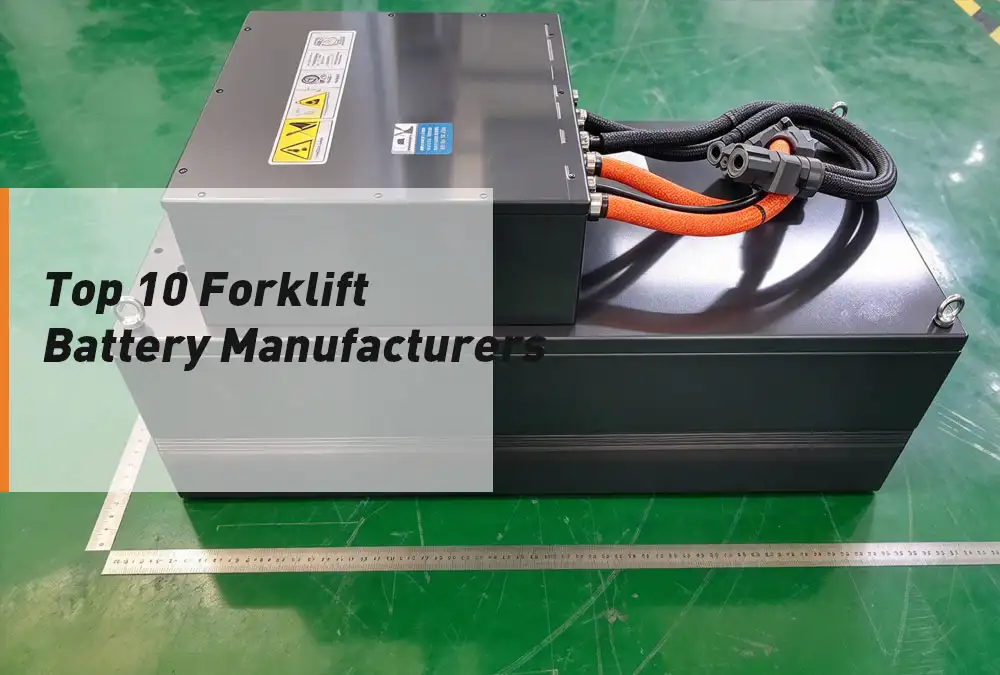
User-supplied forklift sheets show 51.2V examples at 277Ah and 412Ah and 76.8V examples at 280Ah and 412Ah, with 200A continuous charge and discharge ratings at 25°C for the shown products. They include configurations for counterbalanced trucks, reach trucks and a fuel-to-electric conversion project. This makes AnengJi most relevant to importers, wholesalers, OEM/ODM buyers and fleet owners who need a custom enclosure, ballast, connector, communication interface or voltage/capacity combination instead of a catalogue-only replacement.
The company website states that certain 12V to 72V packs carry CE, UL and TLC certifications. That statement should be treated as a starting point, not proof for every forklift pack. The product sheets supplied for this article do not identify certificate numbers, and a 76.8V custom configuration may fall outside a general 12V–72V claim. Before approval, request the exact model’s declaration or listing, UN 38.3 transport test summary, cell and pack reports, quality-system scope and destination-specific documents. For cold storage, also require a cold-soak test, heater logic where needed, condensation controls and charge permission at the minimum cell temperature.
For retrofit projects, truck mass, compartment fit, connector, charger, BMS communication, low-state-of-charge performance and vehicle approval must be decided in writing. Use the site’s forklift conversion checklist rather than treating voltage as the only compatibility test.
Why a “−20°C Rated” Battery May Still Fail the Shift
Ambient temperature is not cell temperature
A demonstration truck can enter a −20°C room with warm cells and run normally for a short period. The same battery may behave differently after standing in the freezer overnight. That is why a credible cold test identifies starting cell temperature, cold-soak time, starting SOC, duty cycle, cutoff and heater status.
If a truck works at the beginning of a shift but slows or trips during a loaded lift later, collect BMS cell temperatures, pack voltage, current, SOC and fault codes at the event. These data separate insufficient energy from a current limit, thermal protection, voltage sag or a truck-side problem. Replacing the battery with a larger Ah number before identifying the trigger may add cost without solving the shutdown.
Low-temperature discharge does not prove low-temperature charging
A battery may be able to deliver power below 0°C while the BMS correctly blocks charging until the cells warm. If operations discovers this only at the first break, the charger may appear defective and the truck may miss the next dispatch window.
The remedy is not to bypass the BMS. Put four items in the RFQ: minimum cell temperature for charging, heater activation threshold, heater power and estimated warm-up time from the agreed cold-soak condition. Then verify those values during commissioning with battery and charger logs.
Heater energy belongs in the capacity calculation
Energy consumed by heaters, BMS electronics and other auxiliaries is not available for travel and lift. A nominally adequate battery can therefore reach the last hour with less operational reserve than expected. Record or obtain the heater watt-hours for the real shift pattern and include them in the site’s duty-cycle capacity calculation.
Peak hydraulic demand can expose a marginal system
Average current does not represent a hydraulic pump start, a loaded lift or simultaneous travel and lift. Validate continuous current, peak current, peak duration, regenerative current and the BMS response at low SOC and the lowest expected cell temperature. The truck should complete the difficult event without an unsafe workaround, unexpected contactor opening or misleading state-of-charge indication.
Condensation, Charging and Service: Three Risks Most Lists Miss
Condensation often becomes visible after the truck leaves the freezer
A cold truck entering a warm, humid dock can collect moisture on the enclosure, connectors, cable entries and electrical components. Intermittent faults or corrosion may appear later, making the battery seem unpredictable. Ask for the enclosure strategy, cable-gland and connector protection, coating where applicable, pressure equalisation, drainage and cold-to-warm cycling evidence. An IP number alone does not describe every condensation pathway.
Charger placement is a system decision
Some systems are designed for charging inside a freezer; other manufacturer instructions place the charger outside. The correct arrangement depends on the battery and charger ratings, humidity, route, impact protection, facility safety and local requirements. The UK Health and Safety Executive’s storage-battery guidance emphasises following manufacturer charging instructions and using suitable charging arrangements. In the United States, OSHA 29 CFR 1910.178 addresses designated charging areas, battery handling and related precautions.
Do not solve a cold-charging problem with a temporary cable across a forklift route. Define the power source, protected cable route, charger clearances, traffic protection, connection procedure and emergency response as part of the project.
Local service is a technical specification
When a battery stops in a remote facility, an impressive global brand list does not retrieve the logs or replace a contactor. Put support into measurable terms: named service entity, BMS and charger access, languages, remote-response time, on-site response where offered, stocked parts, warranty labour, travel, return freight and escalation.
This is particularly important for Central Asia and Africa, where each project may face a different grid, generator, inland transport route, customs process, dust level, network connection and service distance. Do not treat either region as one compliance market. Ask who can restore the truck if the original factory is several borders away.
Build a comparable cold-storage RFQ
Prepare the truck data plate, existing battery, compartment, permitted mass, connector, temperature profile, cold-soak time, shift energy and charging windows before requesting quotations. This turns ten manufacturer brochures into comparable proposals.
How to Compare Cold Storage Forklift Battery Quotations
Give every bidder the same data and require every response to mark each item as included, excluded or pending. Otherwise, the lowest quotation may simply be the one with the largest number of unanswered responsibilities.
| RFQ field | Evidence to request | Buyer consequence if missing |
|---|---|---|
| Cold limits | Ambient and cell charge/discharge/storage limits; cold-soak method | A minimum-temperature headline is interpreted incorrectly |
| Thermal system | Heater/cooling logic, power, warm-up time, sensor positions and faults | The pack cannot recover during the available break |
| Energy and power | Usable energy plus continuous, peak and regenerative current under cold conditions | The truck passes an idle test but trips during a loaded lift |
| Truck integration | Dimensions, mass/ballast, restraint, cable position, connector, BDI/CAN and approval route | The battery powers the truck but cannot be safely commissioned |
| Moisture protection | Enclosure, glands, vents, coating, connector and thermal-cycle evidence | Condensation creates intermittent faults or corrosion |
| Charger/site | Charger model, input, output, profile, communications, location and environmental range | A correct battery arrives without a workable charging system |
| Support | Log access, parts, training, remote/on-site response, labour and freight responsibility | A minor fault becomes extended downtime |
| Evidence | Model-specific reports, documents, revision, issuing body and covered configuration | A cell report or company certificate is mistaken for pack approval |
For lithium systems, IEC 62619:2022 covers safety requirements and tests for industrial secondary lithium cells and batteries and explicitly includes forklift trucks among its motive-application examples. The standard’s scope does not prove that a particular offered model complies. Ask for the document, model coverage, edition, issuing organisation and verification route.
European importers should also assess their responsibilities under the EU Batteries Regulation 2023/1542. US projects should account for OSHA rules, the truck manufacturer’s approval requirements and any model-specific NRTL or authority-having-jurisdiction expectations. These are project checks, not universal claims that one certificate covers every country, configuration and installation.
Where AnengJi Can Fit a Custom Cold-Storage Project
AnengJi can be considered when the project needs a custom forklift battery configuration rather than an off-the-shelf catalogue replacement. User-supplied product sheets include 51.2V packs in 277Ah and 412Ah configurations and 76.8V examples in 280Ah and 412Ah configurations. The sheets list 200A continuous charge and discharge at 25°C for the shown products, together with different dimensions and masses for counterbalanced trucks, reach trucks and a fuel-to-electric conversion configuration.
These figures illustrate why the product discussion must start with the exact truck. A 51.2V pack listed at 210kg and another 51.2V reach-truck configuration listed at 1,200kg are not interchangeable simply because their voltage and Ah overlap. Weight, enclosure, truck geometry and application are part of the system.
The same user-supplied sheets state a discharge range of −20°C to 60°C and a charge range of 0°C to 55°C. They do not by themselves prove sub-zero charging, heating performance, condensation resistance or full-shift runtime in a freezer. A cold-storage proposal therefore needs additional model-specific evidence and a duty-based validation plan before those capabilities can be promised.
Buyers can review the available forklift battery product direction, then provide the truck data plate, battery compartment, required battery mass, connector, load, temperature profile and charging windows for a configuration review. This is more reliable than selecting a pack from voltage and capacity alone.
Request a cold-storage compatibility review
Send the forklift model, current battery, minimum temperature, cold-soak time, shifts, charging windows and destination. The review should identify the required electrical, thermal, mechanical, charger and documentation inputs before a quotation is finalised.
Frequently Asked Questions
Which forklift battery manufacturers publish cold-storage evidence?
HOPPECKE, Exide, EnerSys/HAWKER, Sunlight/TRIATHLON, Electrovaya, Flux Power, OneCharge, Stromcore and ROYPOW publish cold-storage product information, model data or deployment evidence of different depth. AnengJi is included with user-supplied forklift model sheets, but no public freezer deployment was identified during this review. A product page, model datasheet, company case study and independent test answer different questions, so approve the offered model only after matching it to the truck and duty.
Can a lithium forklift battery be charged below 0°C?
Only when the exact cells, BMS, thermal system and charger allow it under the specified conditions. Some systems use controlled preheating before accepting charge; others require a warmer charging location. Low-temperature discharge capability does not prove low-temperature charging capability.
Does every freezer forklift need a heated battery?
Not necessarily. The answer depends on cell temperature, minimum ambient temperature, time spent cold-soaked, idle periods, charging location and recovery time. A truck making brief freezer entries has a different thermal profile from one parked inside at −20°C overnight.
Should the charger be inside or outside the cold store?
There is no universal answer. Follow the battery and charger manufacturers’ environmental limits and the applicable facility-safety requirements. Consider humidity, condensation, impact protection, cable routing, electrical input, traffic and the number of cold-to-warm transitions the proposed route creates.
How should two cold-storage battery quotations be compared?
Normalise the truck, temperature, cold-soak duration, usable energy, heater energy, peak current, charging window, charger, battery mass, connector, communications, documentation, commissioning and service. Treat every blank field as an unresolved project risk—not as zero cost.
What should a cold-storage acceptance test include?
At minimum, use an agreed cold-soak period, starting cell temperature and SOC; representative travel and loaded-lift events; low-SOC peak-current checks; preheating and charging verification; BMS/charger log review; and inspection after repeated cold-to-warm transitions. Also confirm battery mass, restraint, interfaces and the required truck approval.
Choose Evidence, Not the Lowest Temperature on a Brochure
The best cold-storage supplier is not automatically the company with the largest product catalogue or the lowest published temperature. It is the supplier that can connect a specific battery and charger to your truck, work pattern, environment, approval route and recovery plan—and then demonstrate that system under agreed conditions.
Use the ten manufacturers above as a shortlist. Then ask the questions that expose the difference between a cold-room marketing claim and a cold-chain power system: How cold were the cells? How long were they soaked? Can the pack charge safely? How much energy does heating use? Will it complete a loaded lift at low SOC? What happens when moisture or a fault appears? Who restores the truck locally?
Those answers protect uptime far better than a logo table.
Related Posts
 https://anengjibattery.com/wp-content/uploads/2026/10/AnengJIBattery-Top-10-Forklift-Battery-Manufacturers-for-Cold-Storage.webp
675
1000
Battery Expert Team
https://anengjibattery.com/wp-content/uploads/2025/06/logo2-300x138.png
Battery Expert Team2026-10-26 09:12:412026-10-26 09:13:00Top 10 Forklift Battery Manufacturers for Cold Storage
 https://anengjibattery.com/wp-content/uploads/2026/10/AnengjiBattery-Cell-to-Pack-Energy-Density-Comparison.webp
675
1000
Battery Expert Team
https://anengjibattery.com/wp-content/uploads/2025/06/logo2-300x138.png
Battery Expert Team2026-10-23 06:58:392026-10-23 06:58:41What Does Lithium-Ion Battery Energy Density Really Mean?
 https://anengjibattery.com/wp-content/uploads/2026/10/AnengjiBattery-Lithium-Battery-Management-in-Daily-Operation.webp
675
1000
Battery Expert Team
https://anengjibattery.com/wp-content/uploads/2025/06/logo2-300x138.png
Battery Expert Team2026-10-22 08:17:332026-10-23 06:58:57How Does a Lithium BMS Improve Battery Longevity?
 https://anengjibattery.com/wp-content/uploads/2026/10/AnengjiBattery-Industrial-Power-Under-Real-Load.webp
675
1000
Battery Expert Team
https://anengjibattery.com/wp-content/uploads/2025/06/logo2-300x138.png
Battery Expert Team2026-10-22 07:04:542026-10-22 07:05:30How Does a 48V LiFePO4 BMS Protect Industrial Power?



Leave a Reply
Want to join the discussion?Feel free to contribute!