
How Long Does a 48V Forklift Battery Last?
October 13, 2026 / Battery Expert Team / Battery Basics
Introduction
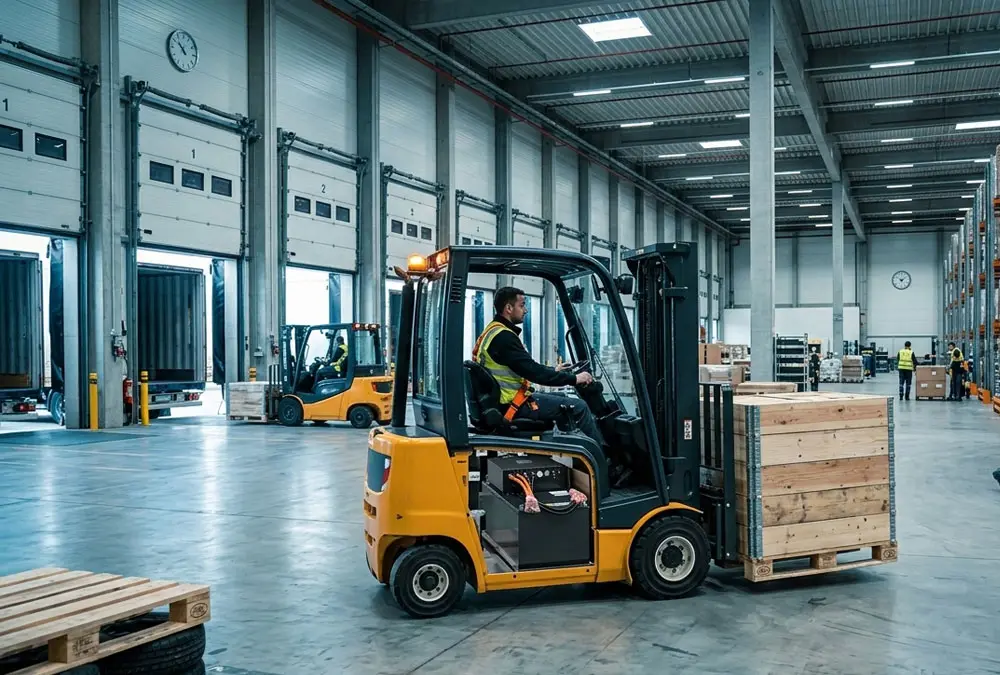
A 48V forklift battery that stops before the final loading window can leave operators waiting, create a charging queue, and delay outbound work. Replacing it with a higher-Ah pack does not automatically solve the problem: the battery may be ageing, the workload may have changed, or the charger may not be restoring the expected energy.
That is why “How long does it last?” needs three answers. Buyers must separate runtime per charge, cycle or energy-throughput life, and calendar service life. Voltage identifies the general electrical class; it does not reveal how many hours the truck will run or how many years the pack will remain useful.
How Long Does a 48V Forklift Battery Last Per Charge?
An eight-hour shift is not the same as eight hours of continuous battery demand. A truck may spend part of the shift parked, travelling empty, or waiting at a workstation. Another may repeatedly lift near its rated load, climb ramps, operate attachments, or travel long routes. Those trucks can consume very different amounts of energy even when their battery labels show the same voltage and Ah.
The US Occupational Safety and Health Administration states in its Powered Industrial Trucks eTool: Electric Power Sources that heavy loads drain forklift batteries more quickly. For a fleet manager, the practical consequence is that a runtime estimate made from a light demonstration may fail during the busiest part of a real shift.
When a battery no longer finishes the same shift
Do not begin by ordering more capacity. First compare the current shift with the conditions under which the battery previously worked. A new route, heavier pallets, higher lift frequency, worn tyres, cold-room operation, or an added attachment can raise energy demand. If the work has not changed, inspect charge completion, connector temperature, BMS alarms, voltage under load, and measured delivered energy. This separates an undersized battery from a charging, resistance, or ageing problem before money is committed to a replacement.
A one-week operating log is usually more useful than a supplier’s unsupported “full-shift” promise. Record starting and ending state of charge, operating hours, charging events, payload range, lift height, ramps, attachments, ambient temperature, and any late-shift power reduction. The log turns a vague complaint—“the battery runs down too fast”—into evidence that can be sized and tested.
Why Voltage Alone Cannot Predict 48V Forklift Battery Runtime
Voltage, capacity, energy, current, and power answer different questions:
- Voltage (V) identifies the electrical potential and general system class.
- Ampere-hours (Ah) describe charge capacity under stated test conditions.
- Kilowatt-hours (kWh) describe nominal stored energy.
- Current (A) shows the rate of electrical flow and must cover continuous, peak, and regenerative demand.
- Power (kW) shows how quickly the truck uses or receives energy.
A seller who says Ah does not matter gives an incomplete answer; a seller who recommends a pack from Ah alone does the same. Ah contributes to stored energy, but buyers also need the permitted voltage window, usable state-of-charge range, average and peak demand, operating reserve, temperature, and charging plan.
The user-supplied examples in this article are rated at 51.2V and are treated as 48V-class lithium configurations. That description does not make them universal drop-in replacements. Before installation, the truck’s controller voltage limits, maximum charge voltage, state-of-charge display, BMS communication, connector, polarity, compartment, restraint, required battery mass, charger profile, and manufacturer or integrator requirements must agree.
How to Calculate 48V Forklift Battery Runtime
1. Convert voltage and Ah into nominal energy
Nominal energy (kWh) = Nominal voltage (V) × Rated capacity (Ah) ÷ 1,000
Nominal energy is a comparison value, not guaranteed energy at the truck. BMS settings, voltage cut-offs, current, temperature, ageing, and vehicle behaviour determine how much energy is usable.
2. Apply the approved usable-energy window
Usable energy = Nominal energy × Approved usable fraction
Use the value documented for the specific battery, vehicle, warranty, and operating plan. Do not insert a generic lithium percentage simply to produce a more attractive runtime.
3. Compare usable energy with measured shift demand
Estimated runtime (hours) = Usable energy (kWh) ÷ Measured average power demand (kW)
Required shift energy ≤ Starting usable energy + Approved energy restored during breaks − Operating reserve
For example, if a site measures 11.5kWh of battery energy used during a representative shift and requires a 15% planning reserve, its planning requirement would be approximately 13.23kWh before considering approved break charging. This is an illustrative calculation, not a performance statement for either product below. The buyer must replace the example inputs with measured site data and the supplier’s approved usable-energy limits.
48V 277Ah vs 412Ah Forklift Battery: Which Capacity Fits?
The following values come from specifications supplied by the user and have not been independently verified. Calculated nominal energy does not establish usable energy, actual runtime, warranty life, or truck compatibility.
| User-supplied configuration | Calculated nominal energy | Continuous current at 25°C | When it remains a candidate | What can reject it |
|---|---|---|---|---|
| 51.2V 277Ah | 14.18kWh | 200A charge / 200A discharge | Measured shift energy, reserve, and approved charging fit within its verified usable window. | Insufficient usable energy, current capability, mass, fit, charger match, or environmental suitability. |
| 51.2V 412Ah | 21.09kWh | 200A charge / 200A discharge | The operation needs more energy or reserve and can restore the required energy within its charging plan. | Unused capacity adds cost or charging burden, or any integration limit remains unresolved. |
The 412Ah option contains about 49% more nominal energy than the 277Ah option at the same stated voltage. That difference may prevent a mid-shift stop when measured demand requires it, but extra Ah is not automatically better. If the operation consumes less energy, has reliable opportunity charging, or cannot restore the larger energy requirement in the available window, paying for unused capacity may not improve availability.
The 990kg warning: why capacity is not a fit check
The supplied material shows one 1030 × 500 × 507mm, 210kg package for a 2-ton E20 example and a separate 1216 × 355 × 744mm, 1,200kg package for a warehouse R-truck example. That is a 990kg mass difference within the supplied 48V-class material. It is the clearest reason not to buy from voltage and Ah alone.
If the truck requires a minimum battery mass, a lighter pack that powers the truck may still be mechanically unacceptable. Obtain the truck manufacturer’s permitted dimensions and mass range, verify restraint and approved ballast arrangements, and require the supplier or qualified integrator to document the exact configuration. The supplied images list REMA160 discharge and REMA320 charge connectors; type, rating, polarity, cable size, and interface still need model-specific confirmation.
Why a 48V Forklift Battery Starts Losing Runtime
When runtime declines, use a diagnostic order instead of replacing the battery from age alone:
- Confirm the workload. Compare routes, payloads, lifts, ramps, attachments, tyre condition, and temperature with the original sizing conditions.
- Confirm energy restored. Review completed-charge records, charger faults, settings, BMS limits, input power, and the energy delivered during the charge window.
- Inspect the power path. Look for abnormal heat, looseness, corrosion, damaged cables, or voltage drop at connectors. Use qualified personnel and approved test procedures.
- Compare battery condition with its baseline. Review measured capacity or delivered energy, cell balance, voltage under a known load, state-of-health data, temperatures, and recorded BMS events.
- Choose the least disruptive validated remedy. This may be workload correction, charger correction, connector repair, supported module service, reassignment to lighter duty, or complete replacement.
This sequence matters because the same symptom—an early low-SOC warning—can come from higher demand, incomplete charging, electrical resistance, capacity loss, or inaccurate SOC estimation. A larger battery may hide the symptom temporarily while leaving the actual fault in place.
How Many Years Does a 48V Lithium Forklift Battery Last?
A credible service-life statement must separate cycle ageing from calendar ageing. In the open-access study Predicting Battery Capacity from Impedance at Varying Temperature and State of Charge, researchers working with the US National Renewable Energy Laboratory evaluated cells under varied calendar- and cycle-ageing conditions, including temperature, state of charge, depth of discharge, duty cycle, and C-rate. The study does not establish the life of a forklift pack; it demonstrates why a service-life claim must state its test conditions.
For procurement, this means a cycle number without its test conditions is not decision-grade evidence. Request the chemistry and model tested, depth of discharge, temperature, charge and discharge rate, charge protocol, balancing conditions, storage conditions, and remaining-capacity threshold used to define end of life. Then compare those conditions with the proposed warranty, which may be limited by calendar years, cycles, operating hours, or total energy throughput.
OSHA’s electric-forklift guidance notes that powered-industrial-truck batteries under normal operating conditions may remain in service for approximately 2,000 work shifts or charge/discharge cycles. The surrounding OSHA material is lead-acid oriented, so this figure should not be transferred to every lithium model. It is useful as an example of why chemistry, maintenance system, test definition, and duty cycle must accompany a life claim.
A three-shift fleet may consume warranted throughput much faster than an intermittently used truck. Conversely, a low-use battery still ages with time and storage conditions. The purchasing question is therefore not “How many years does lithium last?” but “Which limit—time, throughput, measured capacity, or operating stress—is most likely to be reached first at this site?”
48V Forklift Battery Charging and Charger Compatibility
A buyer converting from lead-acid often wants to keep the existing charger to reduce project cost. The risk is that matching “48V” labels can hide an incompatible voltage window, charge profile, current limit, connector, polarity, communication method, temperature control, or termination logic. The immediate consequence may be an incomplete charge or BMS shutdown; the longer-term consequence may be recurring downtime or operation outside the battery supplier’s approved conditions.
The UK Health and Safety Executive’s Using Electric Storage Batteries Safely (INDG139) advises users not to exceed the battery manufacturer’s maximum charging rate and to use charging equipment suitable for the battery. For a retrofit, request written battery–charger compatibility from the battery supplier or qualified integrator, then validate output voltage, profile, current, connector, polarity, communications, site input supply, and simultaneous fleet demand.
Charging time should be calculated from the energy that must be restored, the charger’s actual output, battery and BMS limits, temperature, conversion losses, taper, and balancing—not from charger current alone. If a break is only long enough to connect the truck but not long enough to restore meaningful approved energy, it should not be counted as an opportunity-charging solution.
How Temperature and Location Change 48V Forklift Battery Life
The user-supplied configurations state a discharge range of −20 to 60°C and a charge range of 0 to 55°C. These are model inputs, not promises of unchanged power, capacity, charge acceptance, or life throughout the range. Ask whether heating, cooling, derating, or charge inhibition applies at the actual cell temperature.
Europe: cold storage, documentation, and lifecycle planning
A truck moving repeatedly between a freezer and an ambient warehouse may face reduced available energy, restricted charging, and condensation. The buyer should document temperatures in both the work and charging locations, transition frequency, dwell time, and whether the battery includes validated low-temperature controls. Otherwise, a battery sized from an ambient demonstration can still fail the final cold-room picking period.
For industrial lithium batteries, IEC 62619:2022 provides relevant safety requirements and tests, including motive applications such as forklift trucks. A reference to the standard is not proof that a quoted model complies; request the applicable report or certificate, model coverage, edition, issuing organisation, and verification route.
The EU Batteries Regulation (EU) 2023/1542 introduces battery-passport obligations from 18 February 2027 for applicable categories, including industrial batteries above 2kWh. Both supplied capacity examples exceed 2kWh by calculation, but the final category and obligations must be confirmed for the battery placed on the EU market.
United States: site procedures and charging arrangements
Use the actual state, site, truck, battery chemistry, and charging method to define requirements. OSHA’s forklift guidance is particularly relevant to trained personnel, charging locations, battery handling, and lead-acid hazards, but product standards, electrical installation, fire review, transport, and recycling still require project-specific confirmation.
Central Asia and African countries: availability can matter as much as capacity
Do not treat either region as one climate or regulatory market. For the destination city and site, assess winter cold, summer heat, dust, moisture, charger input quality, enclosure protection, remote diagnostics, spare parts, technician access, and customs lead time. A pack may have adequate nominal energy but still be a poor commercial choice if a connector or communication fault leaves the truck idle while parts travel across borders.
What to Request Before Buying a 48V Forklift Battery
| Buyer input or supplier evidence | Decision it supports | Reject or pause the quotation when |
|---|---|---|
| Truck and existing-battery data plates | Voltage class and starting compatibility scope | The recommendation relies only on truck model or “48V” |
| Measured shift energy, reserve, and charging windows | 277Ah versus 412Ah and charging strategy | Runtime is promised without assumptions or site data |
| Continuous, peak, regenerative current and duration | BMS, cable, connector, and power capability | Only a continuous-current number is supplied |
| Compartment, restraint, removal method, and required battery mass | Mechanical fit and permitted counterweight arrangement | Dimensions fit but mass or restraint remains unverified |
| Charger output, profile, connector, polarity, and communications | Safe, complete, repeatable charging | Compatibility is based only on a 48V label |
| Cycle/throughput evidence, warranty, diagnostics, reports, service and spares | Service-life and downtime risk | Large life claims lack test conditions or model coverage |
This information protects both sides of the transaction. The buyer receives a defensible recommendation; the supplier avoids quoting a battery that fits the voltage class but fails the shift, charger, compartment, mass, or service requirement.
Frequently Asked Questions About 48V Forklift Battery Life
Will a 48V forklift battery last an eight-hour shift?
Only when verified usable energy plus approved charging during breaks covers measured shift demand and reserve. Scheduled shift length alone does not reveal energy use.
Is a 412Ah forklift battery always better than 277Ah?
No. At the same stated voltage it stores more nominal energy, but duty cycle, usable window, current, mass, fit, charger, charging window, temperature, and cost determine whether that extra capacity solves a real requirement.
Can a 48V lead-acid battery be replaced with a 51.2V lithium battery?
Only after the truck’s operating-voltage window, controller, charger, connector, communication, continuous and peak current, compartment, restraint, minimum battery mass, temperature, and manufacturer or qualified-integrator requirements are confirmed.
What makes a supplier’s runtime estimate unreliable?
Warning signs include an hour promise based only on voltage and Ah, no usable-energy limit, no measured duty cycle, no reserve, no temperature condition, and no explanation of opportunity charging or battery ageing.
Should an ageing battery be replaced as soon as runtime falls?
Not automatically. First compare the current workload and charge completion with the baseline, then inspect the power path and perform approved battery-condition testing. Replacement is justified when the verified fault or capacity condition cannot be corrected economically or no longer meets the documented duty cycle and safety requirements.
Final Answer: Measure the Shift Before Choosing the Battery
A 48V forklift battery has no universal runtime or service-life figure. Runtime comes from usable energy versus measured demand. Cycle and throughput life depend on how the battery is used. Calendar life continues with time and storage conditions. Compatibility depends on the entire truck–battery–charger system, not the voltage label.
For a reliable purchase decision, measure the representative shift, preserve an operating reserve, verify current and charging requirements, and confirm compartment dimensions, required mass, restraint, connector, communications, temperature, evidence, warranty, and local support. That process identifies whether the correct answer is 277Ah, 412Ah, a charger correction, a repair, or a different battery configuration altogether.
Request a 48V Forklift Battery Sizing Pack
Submit the truck and battery data plates, one-week shift profile, payload and lift conditions, temperatures, compartment dimensions, required battery mass, connector, and charger information. The review should return a documented runtime worksheet, 277Ah-versus-412Ah capacity check, fit-and-mass review, charger compatibility checklist, and a list of any missing evidence before quotation.
Related Posts
 https://anengjibattery.com/wp-content/uploads/2026/10/AnengjiBattery-48V-Forklift-Battery-in-Warehouse-Operation.webp
675
1000
Battery Expert Team
https://anengjibattery.com/wp-content/uploads/2025/06/logo2-300x138.png
Battery Expert Team2026-10-13 08:16:552026-10-13 08:17:14How Long Does a 48V Forklift Battery Last?
https://anengjibattery.com/wp-content/uploads/2026/10/AnengjiBattery-48V-Forklift-Battery-in-Warehouse-Operation.webp
675
1000
Battery Expert Team
https://anengjibattery.com/wp-content/uploads/2025/06/logo2-300x138.png
Battery Expert Team2026-10-13 08:16:552026-10-13 08:17:14How Long Does a 48V Forklift Battery Last? https://anengjibattery.com/wp-content/uploads/2026/09/anengjiBattery-Lithium-Ion-and-Lead-Acid-Forklift-Battery-Comparison.webp
675
1000
Battery Expert Team
https://anengjibattery.com/wp-content/uploads/2025/06/logo2-300x138.png
Battery Expert Team2026-09-30 07:57:172026-09-30 07:57:31Lithium-Ion vs Lead-Acid Forklift Batteries: Which Is Better?
https://anengjibattery.com/wp-content/uploads/2026/09/anengjiBattery-Lithium-Ion-and-Lead-Acid-Forklift-Battery-Comparison.webp
675
1000
Battery Expert Team
https://anengjibattery.com/wp-content/uploads/2025/06/logo2-300x138.png
Battery Expert Team2026-09-30 07:57:172026-09-30 07:57:31Lithium-Ion vs Lead-Acid Forklift Batteries: Which Is Better? https://anengjibattery.com/wp-content/uploads/2026/09/anengjibattery-Electric-Forklift-Operations-in-a-European-Warehouse.webp
675
1000
Battery Expert Team
https://anengjibattery.com/wp-content/uploads/2025/06/logo2-300x138.png
Battery Expert Team2026-09-29 08:53:352026-09-29 08:53:35Which Are the Top Forklift Battery Manufacturers in Europe
https://anengjibattery.com/wp-content/uploads/2026/09/anengjibattery-Electric-Forklift-Operations-in-a-European-Warehouse.webp
675
1000
Battery Expert Team
https://anengjibattery.com/wp-content/uploads/2025/06/logo2-300x138.png
Battery Expert Team2026-09-29 08:53:352026-09-29 08:53:35Which Are the Top Forklift Battery Manufacturers in Europe https://anengjibattery.com/wp-content/uploads/2026/09/anengjiBattery-Integrated-Freezer-Forklift-Battery-Operation-and-Charging.webp
675
1000
Battery Expert Team
https://anengjibattery.com/wp-content/uploads/2025/06/logo2-300x138.png
Battery Expert Team2026-09-24 08:18:192026-09-24 08:18:38How Does a Lithium Battery for Freezer Forklift Work?
https://anengjibattery.com/wp-content/uploads/2026/09/anengjiBattery-Integrated-Freezer-Forklift-Battery-Operation-and-Charging.webp
675
1000
Battery Expert Team
https://anengjibattery.com/wp-content/uploads/2025/06/logo2-300x138.png
Battery Expert Team2026-09-24 08:18:192026-09-24 08:18:38How Does a Lithium Battery for Freezer Forklift Work?


Leave a Reply
Want to join the discussion?Feel free to contribute!