
100Ah vs 200Ah Lithium Battery: Complete Capacity & Runtime Guide
August 3, 2026 / Battery Expert Team / Battery Basics
Introduction
Choosing between a 100Ah vs 200Ah lithium battery is easily one of the most frustrating decisions when upgrading an off-grid rig or industrial fleet. Many buyers assume bigger is always better. They buy a massive 200Ah unit, only to realize it doesn’t fit in the battery tray. Others try to save cash with a 100Ah pack, only to get stranded on a golf course with a dead motor.
Let’s cut through the marketing noise. Selecting the right energy storage isn’t just about grabbing the biggest number on the shelf. You need to balance device power draw, daily energy consumption, physical space, weight limits, total budget, and future expansion plans.
In this deep dive, we’ll break down the practical differences between 100Ah and 200Ah LiFePO4 battery options. You’ll get clear calculations, application breakdowns, and hard data so you can pick the exact capacity your system requires.
💡 Buyer’s Reality Check: “Why is my 100Ah battery dying faster than calculated?”
If your load pulls heavy current, voltage sag can trigger early BMS low-voltage cutoffs. While a 100Ah battery handles light continuous loads easily, running high-draw gear like an RV air conditioner or a heavy forklift hydraulic lift forces the battery to discharge at high C-rates. This generates extra heat and reduces effective runtime. In these high-power scenarios, a 200Ah battery handles the current stress far better.
Understanding Lithium Battery Capacity: What Does Ah Mean?
What Is Amp Hour (Ah) in a Lithium Battery?
Ampere-hour (Ah) measures electric charge capacity over time. It tells you how much current a battery can supply for a specific duration. The standard formula is straightforward:
A 100Ah lithium battery can theoretically output 100 Amps for 1 hour, or 10 Amps for 10 hours. A 200Ah lithium battery doubles that output, delivering 200 Amps for 1 hour or 20 Amps for 10 hours.
From Amp Hours to Watt Hours: Measuring Real Battery Energy
Amp-hours alone don’t tell the full story because they ignore system voltage. To find actual energy storage, you must calculate Watt-hours (Wh) or Kilowatt-hours (kWh).
- 12V 100Ah lithium battery: 12.8V × 100Ah = 1,280Wh (1.28kWh usable energy)
- 12V 200Ah lithium battery: 12.8V × 200Ah = 2,560Wh (2.56kWh usable energy)
Looking at energy in Watt-hours makes direct comparisons easy. A 200Ah lithium battery provides exactly twice the total stored energy of a 100Ah model at the same system voltage.
Why Voltage Matters When Comparing 100Ah and 200Ah Batteries
Comparing a 12V 200Ah pack to a 48V 100Ah pack gets tricky if you only look at the Ah rating. System voltage changes everything.
- 12V 200Ah Pack: 12.8V × 200Ah = 2,560Wh (2.56kWh)
- 48V 100Ah Pack: 51.2V × 100Ah = 5,120Wh (5.12kWh)
Even though the 12V unit has a higher Ah rating, the 48V 100Ah battery stores twice as much usable power. Always multiply voltage by capacity before making sizing decisions.
100Ah vs 200Ah Lithium Battery: Core Differences Explained
Energy Capacity and Runtime Comparison
The primary difference between a 100Ah and 200Ah battery comes down to total energy density, runtime under load, physical size, and cost per cycle.
| Feature Parameter | 100Ah Lithium Battery | 200Ah Lithium Battery | User Benefit & Value Realized |
|---|---|---|---|
| Stored Energy (12.8V) | 1,280 Wh (1.28 kWh) | 2,560 Wh (2.56 kWh) | Doubles equipment runtime without requiring extra battery bays. |
| Average Weight | 11 – 13 kg (24 – 28 lbs) | 20 – 24 kg (44 – 53 lbs) | 100Ah is easy for solo installation; 200Ah cuts down total system footprint. |
| Continuous Discharge | 100A (BMS limited) | 100A – 200A (BMS limited) | Higher discharge support runs big power inverters without tripping protections. |
| Charging Time (at 50A) | ~2 Hours | ~4 Hours | 100Ah charges fast on low solar setups; 200Ah soaks up high solar input without waste. |
Runtime Comparison: How Long Can 100Ah and 200Ah Batteries Run?
You can easily estimate how long a 200Ah lithium battery lasts compared to a 100Ah unit. Use this quick math formula:
Let’s compare real-world discharge times for common loads on a 12.8V system:
- 100W RV Refrigerator:
- 100Ah (1,280Wh × 0.9 / 100W) ≈ 11.5 Hours
- 200Ah (2,560Wh × 0.9 / 100W) ≈ 23 Hours
- 800W Air Conditioner:
- 100Ah (1,280Wh × 0.9 / 800W) ≈ 1.4 Hours
- 200Ah (2,560Wh × 0.9 / 800W) ≈ 2.8 Hours
- 50W Industrial AGV Controller + Motors:
- 100Ah (1,280Wh × 0.9 / 50W) ≈ 23 Hours
- 200Ah (2,560Wh × 0.9 / 50W) ≈ 46 Hours
Physical Size, Weight and Installation Differences
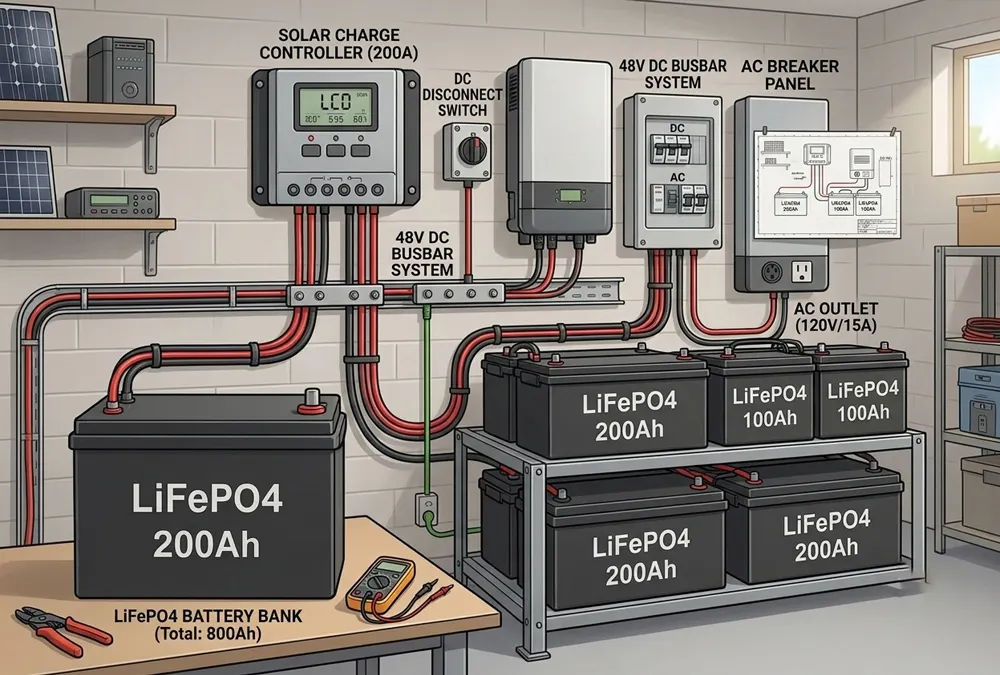
Space restrictions kill off-grid projects fast. A standard Group 31 100Ah lithium battery weighs about 11 to 12kg and fits easily in standard battery trays. A single 200Ah battery weighs between 20 and 24kg. While heavy, it takes up less total space than wiring two separate 100Ah batteries side by side.
Battery Configuration and System Scalability
Should you buy two 100Ah batteries or one 200Ah battery? Here is a direct breakdown of how system design changes with each choice:
| Evaluation Factor | Two 100Ah Batteries (Parallel/Series) | Single 200Ah Battery | User Benefit Comparison |
|---|---|---|---|
| Wiring Complexity | High (Needs heavy interconnect cables) | Low (Single positive/negative run) | 1x200Ah reduces loose connection risks and voltage drop points. |
| Redundancy & Safety | High (One fails, the other keeps running) | Low (Single BMS point of failure) | 2x100Ah provides backup power if one unit shuts down off-grid. |
| BMS Cell Balancing | Requires manual pack balancing over time | Managed internally by single BMS board | Single 200Ah battery avoids current imbalance issues entirely. |
Choosing Between 100Ah and 200Ah Lithium Batteries for Off-Grid Applications
Calculate Your Daily Energy Consumption Before Choosing Battery Capacity
Don’t guess your capacity needs. Map out your load profiles step by step:
- List every piece of electrical equipment you plan to power.
- Note the operating wattage for each device.
- Multiply power draw by estimated daily usage hours.
- Add up total daily Watt-hours to find your baseline requirement.
| Equipment Name | Power Draw (Watts) | Daily Usage (Hours) | Total Consumption (Wh) |
|---|---|---|---|
| LED Cabin Lights | 20W | 5 Hours | 100 Wh |
| 12V Compressor Fridge | 45W | 12 Hours (Duty Cycle) | 540 Wh |
| Laptop & Phone Chargers | 65W | 4 Hours | 260 Wh |
| Water Pump & Accessories | 100W | 0.5 Hours | 50 Wh |
| Estimated Daily Total Energy Requirement: | 950 Wh / Day | ||
In this setup, a single 12V 100Ah battery (1,280Wh capacity) covers daily power needs with a small safety buffer. But if you add a microwave or coffee maker, you’ll need a 200Ah battery to prevent over-discharging.
Consider Battery Autonomy and System Efficiency Loss
Never size your battery system right at 100% of daily consumption. Cold weather, inverter idle draw, and conversion losses quickly drain reserve power.
📊 Technical Insight: Inverter Losses & Operational Safety Margins
Recent energy storage testing shows DC-to-AC inverters average 88% to 92% efficiency. That means 8% to 12% of stored battery power turns into waste heat. On top of that, running LiFePO4 cells in freezing temperatures temporary cuts usable capacity by 15% to 20%. Always add a 20% to 30% capacity safety margin when picking your battery setup.
Practical Battery Selection Examples by Application
- 100Ah or 200Ah LiFePO4 battery for RV: If you stay at campsites with shore power and only run lights, pumps, and water heaters, a 100Ah pack works great. If you boondock off-grid and run induction cooktops or roof AC units, go with a 200Ah battery or multiple 200Ah units.
- 100Ah vs 200Ah lithium battery for golf cart: A standard 48V 100Ah lithium battery pack replaces heavy lead-acid sets easily, offering 30 to 45 miles of flat course range. But for heavy-duty 4-seater carts on steep hills or 18-hole resort runs, a 48V 200Ah pack prevents thermal cutoffs and doubles total drive range.
- Best 100Ah 200Ah LiFePO4 battery for solar storage: Small shed lights and telecommunications stations do fine on a 100Ah pack. For full home backup solar storage, 200Ah modules (or multi-pack 48V rack designs) handle heavy surge currents reliably.
- AGV and Industrial Forklift Equipment: Automated guided vehicles (AGVs) operating multi-shift warehouse routines rely on 200Ah lithium batteries for opportunity charging during break times. This keeps production lines running without long charging stops.
Performance Comparison: 100Ah vs 200Ah Lithium Battery Lifespan and Efficiency
Does a Larger Capacity Battery Last Longer?
Cell chemistry determines ultimate cycle ratings. High-grade LiFePO4 cells deliver between 4,000 and 6,000 discharge cycles before capacity drops to 80%.
However, a 200Ah battery often lasts longer in real-world use than a 100Ah battery powering the exact same load. Why? Because pulling 50A from a 200Ah battery is only a 0.25C rate, whereas pulling 50A from a 100Ah battery is a 0.5C rate. Lower discharge stress reduces internal heat build-up and slows cell degradation over time.
Depth of Discharge (DoD) and Battery Cycle Life
LiFePO4 chemistry lets you safely use 80% to 100% of rated capacity without instant cell damage. However, keeping depth of discharge shallower extends lithium iron phosphate battery lifespan significantly.
| Depth of Discharge (DoD) | Average Life Cycles (LiFePO4) | Estimated Service Life | Operational Advantage |
|---|---|---|---|
| 100% DoD (Full Drain) | ~3,000 – 3,500 Cycles | 8 – 10 Years | Gives maximum runtime when space is limited. |
| 80% DoD (Recommended) | ~5,000 – 6,000 Cycles | 12 – 15 Years | Balances high usable power with long cell life. |
| 50% DoD (Shallow Cycle) | ~8,000+ Cycles | 15+ Years | Using a 200Ah battery at 50% DoD yields exceptional long-term value. |
Energy Efficiency and Discharge Performance Comparison
Under heavy discharge, smaller batteries suffer from voltage sag earlier in the cycle. A 200Ah battery maintains a flatter discharge voltage curve under high loads. That means golf cart motors run at full speed longer and solar inverters avoid low-voltage shutdown alerts.
Cost Analysis: 100Ah vs 200Ah Lithium Battery Long-Term Value
Initial Purchase Cost Difference
Upfront price is often the biggest hurdle for buyers. A quality 12V 100Ah LiFePO4 battery generally costs between $250 and $450 depending on BMS features, heating functions, and internal cell grades. A 12V 200Ah battery usually runs between $500 and $850.
Long-Term Cost per kWh Comparison
Don’t judge value on purchase price alone. Calculate your long-term energy cost per kWh using this standard formula:
Because a 200Ah battery operates under lower average thermal stress, it delivers more total lifetime energy. This makes its lifetime cost per kWh lower than buying multiple undersized batteries over time.
Maintenance and Replacement Considerations
LiFePO4 batteries need zero routine maintenance compared to flooded lead-acid units—no watering, no equalizing, and no acid cleanup. Choosing a single 200Ah unit over two 100Ah units also eliminates half your terminal connections, reducing potential loose cables and voltage drop issues.
Which Lithium Battery Capacity Is Right for You: 100Ah or 200Ah?
Choose a 100Ah Lithium Battery If:
- Your daily energy needs stay under 1,000Wh (1kWh).
- You have strict space or tray dimensions (Group 31 size limits).
- You need a lightweight battery that one person can easily carry.
- You operate light loads like LED lights, small 12V fridges, or electronics.
- You want to start off-grid builds with a lower initial budget.
Choose a 200Ah Lithium Battery If:
- Your daily power draw exceeds 1,500Wh to 2,500Wh.
- You run heavy loads like air conditioners, microwaves, or big power tools.
- You power heavy-duty industrial gear like forklifts, AGVs, or commercial golf carts.
- You want fewer battery wiring connection points for clean installations.
- You want extended autonomy during cloudy off-grid weather.
How ENERGYSPLENDOR Provides Customized 100Ah and 200Ah LiFePO4 Battery Solutions
Off-the-shelf batteries don’t always fit specialized commercial products or custom vehicle bays. As a dedicated lithium battery pack manufacturer, ENERGYSPLENDOR builds custom LiFePO4 battery solutions tailored to exact application requirements.
Customized Voltage and Capacity Options
We offer flexible, fully customizable pack configurations across all standard operating voltages:
- 12V & 24V Systems: Marine auxiliary, RV house power, and small sweeper machines.
- 48V Systems: Commercial golf carts, industrial AGVs, and residential solar energy storage.
- 60V & 72V Systems: Heavy electric tricycles, delivery tuk-tuks, and high-speed utility vehicles.
Battery Solutions for Different Applications
Whether you need drop-in replacement packs or integrated OEM power modules, our custom engineering covers a wide range of industries:
| Target Application | Recommended Configuration | Engineering Customization Options | Client Operational Benefit |
|---|---|---|---|
| Golf Cart Battery | 48V 100Ah / 48V 200Ah | Custom drop-in steel casing, CANbus controller integration | Replaces heavy lead-acid sets directly; cuts weight by 60%. |
| AGV & Forklift Battery | 24V 200Ah / 48V 200Ah | High C-rate cell sorting, fast charging BMS, anti-vibration framing | Supports 1C fast charging for continuous multi-shift operation. |
| Electric Tricycle / Tuk-Tuk | 60V 100Ah / 72V 100Ah | IP67 waterproof metal housing, active thermal management | Withstands harsh tropical weather and heavy urban passenger loads. |
| Solar Energy Storage | 51.2V 100Ah / 51.2V 200Ah | Server rack enclosures, RS485/CAN inverter communication | Seamlessly pairs with major hybrid off-grid solar inverters. |
Professional Battery Engineering and OEM Capability
At ENERGYSPLENDOR, every pack starts with strict cell sorting. We match voltage deltas under ±2mV and internal resistance under ±0.5mΩ before automated laser welding. Our engineers customize BMS hardware, sheet metal enclosures, and wiring harnesses so your battery packs arrive ready for instant installation.
Need a Custom Lithium Battery Solution for Your Project?
Our engineering team helps you size capacity, configure BMS parameters, and design custom enclosures for commercial OEM builds.
Frequently Asked Questions About 100Ah vs 200Ah Lithium Battery
Q1: Is a 200Ah lithium battery twice as powerful as a 100Ah battery?
A 200Ah battery holds twice as much energy (Watt-hours) as a 100Ah battery at the same voltage. However, total power output (Watts) depends on the continuous discharge current rating of the built-in Battery Management System (BMS). If both batteries use a 100A BMS, they output the same maximum peak power, but the 200Ah battery runs twice as long.
Q2: Can I replace two 100Ah batteries with one 200Ah battery?
Yes! Replacing two 100Ah batteries wired in parallel with a single 200Ah battery gives you the exact same total capacity while simplifying your wiring, reducing voltage drop points, and saving installation space.
Q3: How long will a 200Ah LiFePO4 battery last?
In daily off-grid use, a quality 200Ah LiFePO4 battery providing 4,000 to 6,000 deep cycles will last between 10 and 15 years.
Q4: Is a 200Ah lithium battery worth the extra cost?
If your daily power demand exceeds 1.2kWh or you run high-draw appliances like RV air conditioners and electric motors, a 200Ah battery is worth every penny. It avoids deep discharge stress and delivers a lower lifetime cost per kWh.
Q5: What size lithium battery do I need for my application?
Calculate your daily power draw in Watt-hours (Watts × Hours). If your consumption stays under 1,000Wh, a 100Ah battery is plenty. If your usage hits 1,500Wh to 2,500Wh or more, go with a 200Ah battery or a custom multi-pack layout.
Related Posts
 https://anengjibattery.com/wp-content/uploads/2026/09/AnengJIBattery-Best-LiFePO4-Battery-How-to-Choose-the-Right-One.webp
675
1000
Battery Expert Team
https://anengjibattery.com/wp-content/uploads/2025/06/logo2-300x138.png
Battery Expert Team2026-09-17 08:52:142026-09-18 09:19:29How to Choose the Best LiFePO4 Battery
https://anengjibattery.com/wp-content/uploads/2026/09/AnengJIBattery-Best-LiFePO4-Battery-How-to-Choose-the-Right-One.webp
675
1000
Battery Expert Team
https://anengjibattery.com/wp-content/uploads/2025/06/logo2-300x138.png
Battery Expert Team2026-09-17 08:52:142026-09-18 09:19:29How to Choose the Best LiFePO4 Battery https://anengjibattery.com/wp-content/uploads/2026/09/anengjiBattery-lifepo4-battery-cell-packaging-wholesale.webp
675
1000
Battery Expert Team
https://anengjibattery.com/wp-content/uploads/2025/06/logo2-300x138.png
Battery Expert Team2026-09-16 09:52:342026-09-18 09:20:12LiFePO4 Battery Wholesale Guide: Best Suppliers in Spain
https://anengjibattery.com/wp-content/uploads/2026/09/anengjiBattery-lifepo4-battery-cell-packaging-wholesale.webp
675
1000
Battery Expert Team
https://anengjibattery.com/wp-content/uploads/2025/06/logo2-300x138.png
Battery Expert Team2026-09-16 09:52:342026-09-18 09:20:12LiFePO4 Battery Wholesale Guide: Best Suppliers in Spain https://anengjibattery.com/wp-content/uploads/2026/09/anengjibattery-Top-Lithium-Ion-Battery-Producers-for-Spain-Market-Growth.webp
675
1000
Battery Expert Team
https://anengjibattery.com/wp-content/uploads/2025/06/logo2-300x138.png
Battery Expert Team2026-09-16 01:13:392026-09-16 01:14:05Top Lithium Ion Battery Producers for Spain’s Market Growth
https://anengjibattery.com/wp-content/uploads/2026/09/anengjibattery-Top-Lithium-Ion-Battery-Producers-for-Spain-Market-Growth.webp
675
1000
Battery Expert Team
https://anengjibattery.com/wp-content/uploads/2025/06/logo2-300x138.png
Battery Expert Team2026-09-16 01:13:392026-09-16 01:14:05Top Lithium Ion Battery Producers for Spain’s Market Growth https://anengjibattery.com/wp-content/uploads/2026/09/Bulk-Lithium-Ion-Battery-Cells-Procurement-Guide-B2B-Sourcing.webp
675
1000
Battery Expert Team
https://anengjibattery.com/wp-content/uploads/2025/06/logo2-300x138.png
Battery Expert Team2026-09-14 09:47:322026-09-14 09:47:48Bulk Lithium-Ion Battery Cells Procurement Guide | B2B Sourcing
https://anengjibattery.com/wp-content/uploads/2026/09/Bulk-Lithium-Ion-Battery-Cells-Procurement-Guide-B2B-Sourcing.webp
675
1000
Battery Expert Team
https://anengjibattery.com/wp-content/uploads/2025/06/logo2-300x138.png
Battery Expert Team2026-09-14 09:47:322026-09-14 09:47:48Bulk Lithium-Ion Battery Cells Procurement Guide | B2B Sourcing


Leave a Reply
Want to join the discussion?Feel free to contribute!