
How to Choose a LiFePO4 Battery Manufacturer (Buyer Guide)
August 1, 2026 / Battery Expert Team / Battery Basics
Introduction
Finding a reliable LiFePO4 Battery Manufacturer is harder than ever today. Every factory promises low prices and top quality. But talk is cheap when equipment stops working in the field.
Price alone cannot solve technical issues. You need an agile manufacturing partner with real application experience. You need a team that understands cell sorting, BMS engineering, and pack building.
Whether you manufacture golf carts, AGVs, forklifts, or solar systems, you must look closely at technical competence. This guide reveals how to evaluate suppliers and build lasting engineering partnerships.
📊 Global Market Context & Industry Benchmarks
Recent market research from Grand View Research shows the global LFP battery market expanding rapidly past $47 Billion. Meanwhile, BloombergNEF (BNEF) reports that average lithium storage pack prices dropped below $80/kWh. While lower cell costs open new business opportunities, manufacturing overcapacity also floods the market with poor-quality pack assemblers. Choosing the right factory partner is critical to surviving this transition.
❓ Buyer’s Dilemma: “Why are battery pack quotes so wildly different?”
The Hard Truth: Vendor A quotes $1,200 while Vendor B quotes $850 for a “48V 100Ah pack”. Why the gap?
Unscrupulous suppliers cut costs by using recycled B-grade cells. They install cheap BMS boards with no communication chips. When those packs overheat or shut down on steep hills, warranty claims and brand damage will destroy your profit margins.
Understand Your Application Requirements Before Choosing a LiFePO4 Battery Manufacturer
Never request quotes without defining operational specs. A qualified custom LiFePO4 battery manufacturer China needs precise engineering data before recommending a battery pack layout.
Define Your Battery Voltage and Capacity Requirements
Matching vehicle electrical architecture requires picking the right system voltage. Working with an experienced 12V 24V 48V 72V LiFePO4 battery manufacturer allows you to tailor power configurations easily:
- 12V & 24V Systems: Built for floor sweepers, small industrial AGVs, marine power, and RV auxiliary setups.
- 36V & 48V Systems: The main choice for commercial golf carts, utility vehicles, yard trucks, and residential solar storage.
- 60V & 72V Systems: Engineered for heavy electric tricycles, delivery tuk-tuks, and fast-moving low-speed vehicles.
Calculating battery capacity involves calculating total energy in Watt-hours (Wh):
Battery Energy (Wh) = System Nominal Voltage (V) × Rated Capacity (Ah)
A 48V 100Ah pack delivers 4,800Wh (4.8kWh) of energy. Factoring in an 80% Depth of Discharge (DoD) gives you roughly 3.84kWh of usable daily power without stressing individual cells.
Evaluate Continuous and Peak Discharge Current Requirements
Different equipment puts unique stress on internal electronics. Continuous cruising current differs vastly from brief motor acceleration surges.
| Application Sector | Continuous Discharge Focus | Peak Current Demands | Buyer Benefit & Value Realized |
|---|---|---|---|
| Golf Cart Battery | 1C – 1.5C continuous draw | 3C – 5C surge (3 to 5 seconds) | Climbs steep hills with 4 passengers without BMS tripping. |
| AGV & Forklift Battery | 0.5C – 1C smooth delivery | 2.5C – 3C hydraulic lifts | Keeps multi-shift factory robots running 24/7 without power cutoffs. |
| Electric Tricycle / Tuk-Tuk | 1C continuous load | 3C acceleration spikes | Prevents battery pack overheating in tropical city stop-and-go traffic. |
| Solar Energy Storage | 0.2C – 0.5C steady discharge | 1C inverter startup spikes | Maximizes cell life past 5,000 cycles by keeping operating temperatures low. |
Determine Expected Battery Life and Cycle Requirements
Lead-acid batteries die in 12 months under heavy commercial use. Quality LFP cells sourced from a reliable lithium iron phosphate battery supplier offer 3,500 to 6,000 deep cycles. That means 8 to 10 years of reliable service.
Confirm Certification and Compliance Requirements
Without proper transport test papers, customs officers will hold your containers. Always verify international shipping and safety papers:
- Transport Compliance: UN38.3, MSDS, DG safe packaging certification.
- European Access: CE mark, RoHS approval, IEC 62619 safety standard.
- North American Access: UL 1973, UL 2580, or FCC marks.
❓ Buyer’s Concern: “Can I skip UN38.3 certification to save initial development costs?”
Expert Advice: Never skip transport testing. Shipping lines refuse uncertified lithium cargo. If an uncertified shipment gets seized at the destination port, local fines and demurrage fees will far exceed certification testing costs.
Evaluate LiFePO4 Battery Manufacturer Technical Capability and Engineering Expertise
Trading brokers usually hand buyers fixed catalog items. A true OEM lithium battery manufacturer works directly with your engineers to build custom battery shapes.
Engineering Team and Battery R&D Capability
A complete engineering division needs electrical experts, structural designers, and BMS programmers. They evaluate internal space, heat dissipation, and chassis vibration rather than forcing you to accept standard boxes.
Cell Selection and Battery Chemistry Expertise
Cell grading determines battery longevity. Premier factories buy Grade-A prismatic or cylindrical cells directly from Tier-1 foundries like CATL, EVE, or Gotion. They sort cells automatically, matching voltage within ±2mV and internal resistance within ±0.5mΩ before spot welding.
BMS Development and Battery Management Expertise
The BMS acts as the brain of your battery pack. Simple protection boards only stop short circuits. Advanced custom lithium battery solutions require smart BMS hardware supporting CANbus, RS485, or Bluetooth monitoring. This allows your vehicle controller to read individual cell voltages and temperatures in real time.
Structural Design and Custom Battery Pack Capability
Heavy machinery faces constant vibration. Exceptional LiFePO4 battery pack design relies on laser-welded copper busbars, shock-absorbing internal silicone frames, and heavy sheet-metal enclosures built to IP65/IP67 waterproof ratings.
Check LiFePO4 Battery Manufacturer Production Capacity and Quality Control System
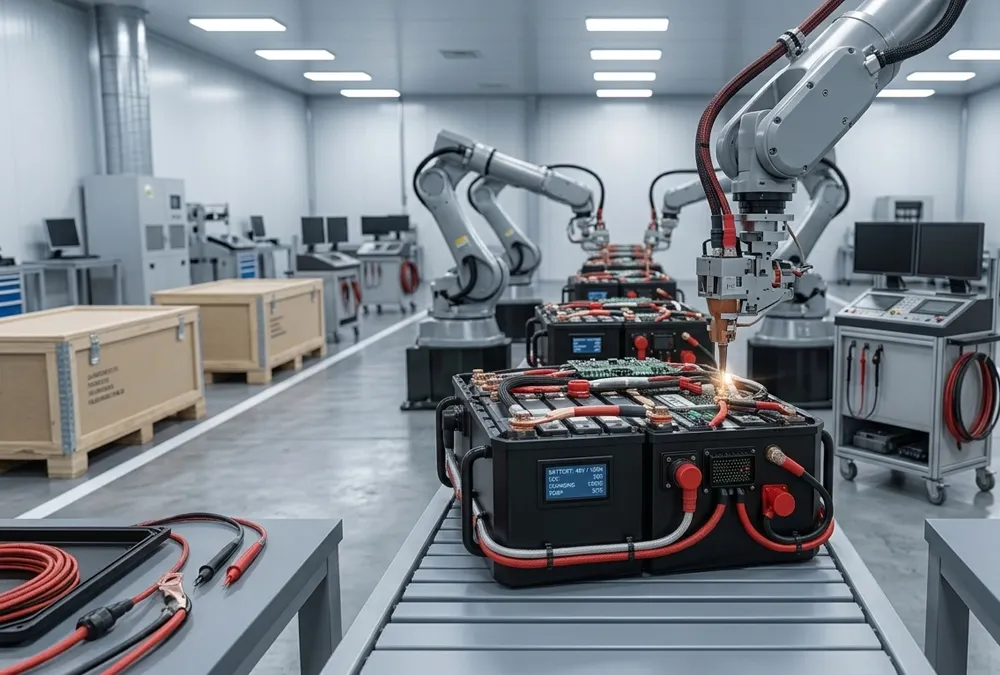
Building sample packs by hand is easy. Producing 1,000 consistent packs monthly requires automated assembly gear at a legitimate LiFePO4 battery factory.
Advanced Battery Production Equipment
High-end factories use automatic cell sorters, fiber laser welding stations, multi-channel aging cabinets, and environmental testing chambers.
| Manufacturing Phase | Equipment & Inspection Method | Quality Control Standard | Buyer Value Delivered |
|---|---|---|---|
| 1. Cell Sorting (IQC) | Automated voltage & IR capacity sorters | Voltage delta ≤ 2mV, IR delta ≤ 0.5mΩ | Prevents weak cells from ruining overall pack capacity. |
| 2. Laser Welding | High-precision fiber laser welder | 100% weld penetration & pull testing | Eliminates loose terminal joints that cause high resistance fires. |
| 3. BMS Testing | Automated BMS functionality tester | 100% protection parameter check | Guarantees safety cutoffs trigger under overcharge or short circuits. |
| 4. Burn-in Cycle Test | Charge-discharge testing cabinets (100% DoD) | Full 100% burn-in cycle with thermal imaging | Catches early electronic component flaws before shipping overseas. |
Multi-Stage Quality Control Process
A reliable production flow follows strict testing steps:
- Cell Inspection: Sorting raw cells for voltage, internal resistance, and capacity consistency.
- Module Assembly: Laser welding busbars and securing cell holders inside outer cases.
- Electrical Testing: Checking BMS protection points, temperature sensors, and wiring harness continuity.
- Burn-in Aging Test: Running complete charge-discharge cycles to ensure thermal stability under load.
- Final Inspection: Conducting IP67 water seal testing, exterior checks, and shipping packaging certification.
Review LiFePO4 Battery Manufacturer Certifications and Compliance Standards
Understanding certification requirements protects your business from legal liabilities, transit delays, and property damage risks.
Key Safety & Transport Standards Decoded
UN38.3: Mandatory international safety standard covering altitude simulation, shock, impact, vibration, and thermal testing for air/sea transit.
IEC 62619: The core safety standard for industrial and stationary energy storage batteries operating in industrial environments.
UL 1973: Strict North American standard evaluating battery safety in stationary energy storage systems and motor vehicles.
❓ Buyer’s Concern: “The supplier claims their cells are UL certified, is that enough?”
The Catch: Having UL certified *cells* is not the same as having a UL certified *battery pack*. Custom enclosures, wiring, and BMS boards must be evaluated as a complete system to satisfy customs inspectors and commercial insurers.
Evaluate LiFePO4 Battery Manufacturer Technical Support and After-Sales Service
When a customer encounters a BMS fault in the field, you need quick answers. Work with a LiFePO4 battery supplier that delivers clear engineering feedback, fast spare parts delivery, and straightforward warranty terms.
Response Time and Engineering Communication
Good suppliers assign dedicated engineers to your account. They help you analyze controller fault logs, adjust BMS software parameters remotely, and solve installation issues quickly.
Warranty Policy and Replacement Support
Read warranty terms carefully. Look for clear replacement procedures, local spare parts support, and realistic coverage terms instead of vague promises.
Consider LiFePO4 Battery Manufacturer Supply Capability and Delivery Time
Scaling up production requires flexible manufacturing lines. Your factory partner should accommodate small trial orders for prototyping while maintaining capacity for large production runs.
Furthermore, experienced exporters understand Dangerous Goods (DG) shipping regulations, UN-approved carton packing, and maritime logistics bookings to ensure on-time delivery.
OEM and Custom LiFePO4 Battery Solutions for Different Applications
Custom pack architecture adapts to distinct industry requirements:
LiFePO4 Battery Solutions for Golf Carts and Utility Vehicles
Replacing old lead-acid golf cart batteries with a single 48V drop-in LFP pack cuts vehicle weight by over 200 lbs. This improves acceleration, extends drive range, and eliminates acid maintenance completely.
LiFePO4 Battery Solutions for AGV and Industrial Equipment
Automated Guided Vehicles require fast opportunity charging during breaks. LFP batteries accept rapid 1C charging rates without thermal stress, enabling 24/7 continuous operation in automated warehouses.
LiFePO4 Battery Solutions for Electric Tricycles and Low-Speed EVs
Electric tuk-tuks operating in hot climates require thermal protection. Durable 60V and 72V packs with integrated heat-dissipating aluminum cases maintain safe operating temperatures under heavy passenger loads.
LiFePO4 Energy Storage Battery Solutions
From 2kWh home energy modules to 30kWh residential solar storage banks, stationary systems demand long cycle life and seamless communication with leading hybrid inverters.
Why AnengJi Stands Out as a Reliable LiFePO4 Battery Manufacturer
When searching for the best LiFePO4 battery manufacturer for OEM projects, AnengJi bridges the gap between raw cell foundries and custom equipment builders. Operating as a dedicated industrial lithium battery manufacturer, AnengJi delivers customized power solutions for global B2B clients.
| AnengJi Core Engineering Pillar | Manufacturing Capability | Direct Buyer Benefit |
|---|---|---|
| Application Knowledge | Deep expertise across e-mobility, golf carts, AGVs, and solar storage | Reduces development risk with proven load profiles and cell choices. |
| Custom Engineering | Full OEM/ODM design for custom voltages, sheet metal, & BMS protocols | Delivers drop-in battery packs that fit your vehicle chassis perfectly. |
| Quality Management | 100% Grade-A cells, automated laser welding, full burn-in cycle testing | Achieves field failure rates below 0.1%, protecting your brand reputation. |
| Compliance & Transport | Complete UN38.3, MSDS, CE, and IEC certification test reports | Ensures smooth customs clearance and safe global dangerous goods transit. |
Comprehensive Engineering Capabilities
AnengJi offers full flexibility across voltage customization, capacity sizing, sheet-metal enclosure design, and custom BMS communication setups. Our engineering support helps you bring better electric equipment to market faster.
Why AnengJi Is the Right LiFePO4 Battery Manufacturing Partner
Selecting a battery supplier is a strategic decision. You need an engineering partner who understands your operational needs, builds reliable packs, and supports your team long after delivery. AnengJi combines custom flexibility, automated assembly, strict quality control, and direct engineering support to help your business grow.
Ready to Build Your Custom LiFePO4 Battery Solution?
Contact our engineering team today to review your project specifications, request sample packs, or get a direct factory quote.
Frequently Asked Questions About Choosing a LiFePO4 Battery Manufacturer
What should I check before choosing a LiFePO4 battery supplier?
Verify whether they are a real factory or a trading company, confirm they use Grade-A cells with matching capacity, check their BMS engineering capabilities, and review their UN38.3 and IEC test reports.
What is the difference between a battery manufacturer and battery assembler?
A true manufacturer or full-system pack engineering partner designs custom BMS hardware, builds anti-vibration housing, runs automated laser welding lines, and conducts full cycle testing. An assembler merely pastes pre-made components together without deep testing or engineering support.
Can LiFePO4 manufacturers customize voltage and capacity?
Yes. A professional LiFePO4 battery manufacturer with OEM ODM service can customize voltage (12V to 72V+), capacity (20Ah to 300Ah+), physical dimensions, enclosure waterproofing, and BMS communication protocols (CAN/RS485) to match your host controller.
Which certifications are required for LiFePO4 batteries?
UN38.3 and MSDS are mandatory for international transport. CE, IEC 62619, and UL standards are required for European and North American market access and commercial insurance compliance.
How long does it take to manufacture custom lithium batteries?
Prototype samples usually take 2 to 3 weeks for engineering design, housing production, and testing. Full production batch orders typically ship within 3 to 4 weeks depending on order volume and custom tooling needs.
Related Article
Related Posts
 https://anengjibattery.com/wp-content/uploads/2026/09/AnengJIBattery-Best-LiFePO4-Battery-How-to-Choose-the-Right-One.webp
675
1000
Battery Expert Team
https://anengjibattery.com/wp-content/uploads/2025/06/logo2-300x138.png
Battery Expert Team2026-09-17 08:52:142026-09-17 08:52:31How to Choose the Best LiFePO4 Battery
https://anengjibattery.com/wp-content/uploads/2026/09/AnengJIBattery-Best-LiFePO4-Battery-How-to-Choose-the-Right-One.webp
675
1000
Battery Expert Team
https://anengjibattery.com/wp-content/uploads/2025/06/logo2-300x138.png
Battery Expert Team2026-09-17 08:52:142026-09-17 08:52:31How to Choose the Best LiFePO4 Battery https://anengjibattery.com/wp-content/uploads/2026/09/anengjiBattery-lifepo4-battery-cell-packaging-wholesale.webp
675
1000
Battery Expert Team
https://anengjibattery.com/wp-content/uploads/2025/06/logo2-300x138.png
Battery Expert Team2026-09-16 09:52:342026-09-16 09:52:57LiFePO4 Battery Wholesale Guide: Best Suppliers in Spain
https://anengjibattery.com/wp-content/uploads/2026/09/anengjiBattery-lifepo4-battery-cell-packaging-wholesale.webp
675
1000
Battery Expert Team
https://anengjibattery.com/wp-content/uploads/2025/06/logo2-300x138.png
Battery Expert Team2026-09-16 09:52:342026-09-16 09:52:57LiFePO4 Battery Wholesale Guide: Best Suppliers in Spain https://anengjibattery.com/wp-content/uploads/2026/09/anengjibattery-Top-Lithium-Ion-Battery-Producers-for-Spain-Market-Growth.webp
675
1000
Battery Expert Team
https://anengjibattery.com/wp-content/uploads/2025/06/logo2-300x138.png
Battery Expert Team2026-09-16 01:13:392026-09-16 01:14:05Top Lithium Ion Battery Producers for Spain’s Market Growth
https://anengjibattery.com/wp-content/uploads/2026/09/anengjibattery-Top-Lithium-Ion-Battery-Producers-for-Spain-Market-Growth.webp
675
1000
Battery Expert Team
https://anengjibattery.com/wp-content/uploads/2025/06/logo2-300x138.png
Battery Expert Team2026-09-16 01:13:392026-09-16 01:14:05Top Lithium Ion Battery Producers for Spain’s Market Growth https://anengjibattery.com/wp-content/uploads/2026/09/Bulk-Lithium-Ion-Battery-Cells-Procurement-Guide-B2B-Sourcing.webp
675
1000
Battery Expert Team
https://anengjibattery.com/wp-content/uploads/2025/06/logo2-300x138.png
Battery Expert Team2026-09-14 09:47:322026-09-14 09:47:48Bulk Lithium-Ion Battery Cells Procurement Guide | B2B Sourcing
https://anengjibattery.com/wp-content/uploads/2026/09/Bulk-Lithium-Ion-Battery-Cells-Procurement-Guide-B2B-Sourcing.webp
675
1000
Battery Expert Team
https://anengjibattery.com/wp-content/uploads/2025/06/logo2-300x138.png
Battery Expert Team2026-09-14 09:47:322026-09-14 09:47:48Bulk Lithium-Ion Battery Cells Procurement Guide | B2B Sourcing


Leave a Reply
Want to join the discussion?Feel free to contribute!