
How Fast Is a 72V Battery? Speed, Range & Performance Guide
July 27, 2026 / Battery Expert Team / Battery Basics
Introduction
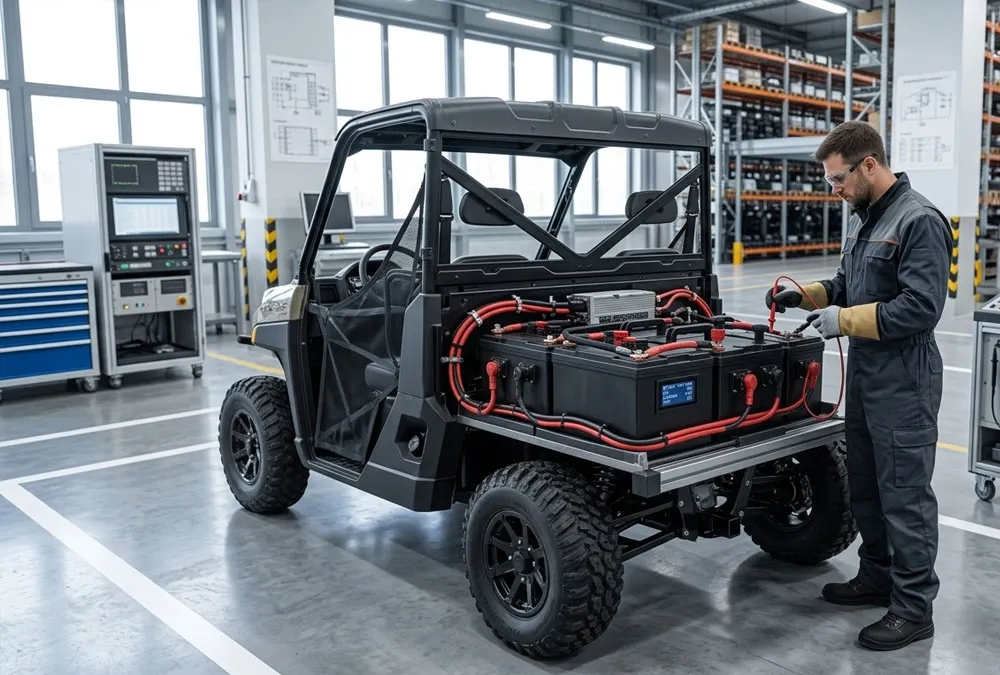
When B2B fleet managers or electric vehicle builders ask me how fast is a 72v battery, I always answer with a piece of hard-earned engineering reality: voltage sets your theoretical speed ceiling, but it never pushes the vehicle down the road on its own. On a standard light commercial rig or high-speed cart, a properly matched 72V battery setup typically hits speeds between 35 mph and 60 mph (55 to 96 km/h).
But here is where most buyers get burned: they throw a high-spec 72V lithium battery into a chassis without checking their controller’s continuous current limit or motor stator thermal bounds. The result? Scorched phase wires, constant thermal cutoffs, and speed that drops off a cliff after just five minutes of hard driving. Straight talk? The battery provides the electrical pressure, but true top velocity requires every component in your drivetrain to speak the exact same language.
If you’re building or sourcing vehicles at scale, focusing solely on pack voltage is a recipe for expensive field failures. Your real-world speed and daily vehicle throughput come down to balancing six core variables. Miss just one, and your real-world performance collapses:
- Motor Power & RPM Constant (Kv): Defines how many RPMs your motor stator turns per applied volt, directly driving mechanical torque at the wheel axle.
- Controller Current Limit (Amps): Acts as the system brain. It regulates phase current flowing into the coils, setting your real acceleration curve.
- Battery Capacity (Ah) & Discharge Rate: Controls how long you can sustain top speed without experiencing severe voltage sag under load.
- Internal Resistance (Ri) & C-Rating: Determines how cold or hot your cells run during prolonged full-throttle bursts. Lower internal resistance keeps voltage stable under heavy amp draws.
- Gross Vehicle Weight & Payload Resistance: Directly dictates how much torque is required to overcome inertia and climb municipal grades.
- Aerodynamic Drag & Rolling Resistance: Once your vehicle crosses 30 mph (48 km/h), wind resistance scales exponentially, consuming energy faster than pure rolling friction.
To analyze exact electrical power delivery, engineers rely on the foundational power formula:
\(Power(W) = Voltage(V) \times Current(A)\)
Stepping up to a 72V architecture gives your fleet three massive engineering advantages over traditional low-voltage setups:
- Higher Total Output Wattage: Achieves high mechanical horsepower without forcing high amperage through thin cable harnesses.
- Lower Thermal Losses Across Wiring: Reduces resistive heat waste across your main contactors and busbars, letting your system run cooler.
- Sustained High-Speed Stability: Keeps speed rock-solid on steep 10% inclines where 48V systems bog down and overheat.
How Fast Can a 72V Electric Bike Go? | 72V Battery Speed Performance Explained
Let’s strip away theoretical bench-test numbers and talk about practical road conditions. On an open circuit with no load, a fresh 72V battery pack reads around 84V fully charged. But once those wheels hit asphalt with a 200 lb driver onboard, 72V battery performance becomes a game of thermal management and current delivery. Many buyers assume upgrading from 48V to 72V automatically doubles speed. It doesn’t—unless your motor winding can handle the higher voltage without saturation.
Typical Speed Range of 72V Electric Vehicles
To give you a real baseline, here is how different motor wattages perform when paired with a commercial-grade 72V lithium battery in real-world fleet conditions:
| Motor Power Rating | 72V System Typical Speed | Primary Vehicle Application | User Benefit & Pain Point Solved |
|---|---|---|---|
| 500W – 800W | 35 – 45 km/h (22 – 28 mph) | Light Tuk-Tuks, urban cargo trikes | Prevents battery thermal stress while keeping daily city delivery routes predictable and smooth. |
| 1000W | 45 – 55 km/h (28 – 34 mph) | Last-mile logistics scooters | Navigates dense traffic safely without overheating motor coils during constant stop-and-go runs. |
| 1200W | 50 – 65 km/h (31 – 40 mph) | Resort passenger carts, AGVs | Maintains target speed on resort ramps without dropping passenger comfort or bogging down under weight. |
| 1500W | 60 – 75 km/h (37 – 47 mph) | Utility task vehicles (UTVs), patrol carts | Delivers immediate overtaking torque, keeping utility vehicles up to pace with regular city traffic seamlessly. |
| 2000W+ | 75 – 90+ km/h (47 – 56+ mph) | Express e-motorcycles, custom haulers | Unlocks maximum speed potential while holding full voltage stability during steep highway acceleration. |
A common pain point I hear from fleet operators is: “Why is my vehicle capped at 25 mph when I installed a 72V battery?” In 90% of cases, the bottleneck isn’t the battery. It’s either an active speed governor in the controller firmware, restricted wheel gear ratios, or thin factory gauge wiring (10 AWG instead of 4 AWG) choking amperage flow under load.
How Motor Power Affects 72V Battery Speed
Think of your 72V battery as a pressurized water tank, and the controller as the discharge valve. If the valve is small, flow is restricted regardless of tank pressure. Look at how controller amperage settings dictate real wattage output:
- 72V Pack with a 20A Controller: 72V × 20A = 1,440W Peak Output Power
- 72V Pack with a 40A Controller: 72V × 40A = 2,880W Peak Output Power
- 72V Pack with a 60A Controller: 72V × 60A = 4,320W Peak Output Power
Notice the pattern? By doubling the controller amperage, you double the mechanical power sent to your motor. This is why two vehicles using the exact same 72V pack can have completely different acceleration curves and top speeds on the road.
Real-World Examples of 72V Electric Vehicle Speed
Let’s look at two commercial operational profiles to see how component matching plays out in the field:
- 72V 20Ah Battery + 1000W Motor + 30A Controller: Designed for lightweight urban delivery fleets. Cruising speed tops out at 50 km/h (31 mph). It offers enough range to handle a full 6-hour dispatch shift without adding unnecessary battery pack deadweight to the chassis.
- 72V 40Ah Battery + 2000W Motor + 60A Controller: Engineered for industrial AGVs, heavy golf carts, and off-road utility buggies. Easily hits 70 km/h (43 mph) on flat pavement and climbs 15-degree industrial loading docks with zero voltage sag or motor bogging.
What Factors Affect 72V Battery Speed and Electric Vehicle Performance?
Pushing high speeds consistently demands strict electrical efficiency. According to recent technical findings in the 2025 ICCT Fleet Electrification Report, up to 18% of stored energy in high-voltage light commercial vehicles is lost as waste heat across mismatched controllers and connectors. Knowing where those thermal bottlenecks hide keeps your fleet out of the repair bay.
Motor Efficiency, Windings, and Kv Rating
A motor’s internal copper winding determines its speed capability. A high Kv winding gives higher top speeds per volt, but sacrifices low-end startup torque. Modern Brushless DC (BLDC) and Permanent Magnet Synchronous Motors (PMSM) achieve 88% to 95% efficiency, whereas older brushed DC setups convert nearly 25% of your power directly into waste heat. High efficiency ensures more battery energy goes directly into turning the wheels.
Controller Specifications, MOSFET Quality, and Heat Sinking
Your controller modulates battery current thousands of times per second using internal switching transistors (MOSFETs). Cheap controllers use low-grade MOSFETs that generate high internal resistance, causing thermal throttling when driving up hills or carrying full payloads. High-performance controllers with heavy aluminum heat sinks maintain full current output without tripping over-temperature alarms.
Battery Capacity, Internal Resistance (Ri), and Voltage Sag
Here is a classic buyer dilemma: two battery packs can both read 72V on a voltmeter, but one drops the vehicle’s speed by 30% after just two minutes of climbing a hill. Why? The answer is Voltage Sag caused by high internal resistance (Ri). When current (I) flows out of high-resistance cells, voltage drops instantly inside the pack according to Ohm’s Law:
\(Voltage\ Sag = Current \times Internal\ Resistance\)
If your battery experiences a 10V sag under full load, your motor effectively runs on 62V instead of 72V, cutting speed instantly. Utilizing high-rate 72V LiFePO4 battery cells equipped with thick copper interconnect busbars keeps internal resistance low, preserving full operating voltage and top speed from 100% down to 20% state of charge.
Vehicle Weight, Aerodynamics, and Tire Pressure
Total payload plays a massive role in performance. Every 100 lbs of added chassis weight increases rolling friction and demands extra startup current. Furthermore, running underinflated tires increases rolling resistance by up to 15%, needlessly depleting battery reserves and lowering top speed on long runs.
72V Battery vs 48V and 60V Battery: Which System Is Faster?
When engineering fleet upgrades, procurement officers constantly ask: “Is moving up to a 72V platform worth the extra hardware cost, or is a 48V system sufficient?” Comparing a 72V battery vs 48V battery speed profile requires analyzing power efficiency alongside upfront component costs.
Voltage Comparison Between 48V, 60V and 72V Systems
| System Voltage | Typical Vehicle Application | Speed & Torque Characteristics | Operational Advantage & Buyer ROI |
|---|---|---|---|
| 48V System | Standard Golf Carts, Warehouse AGVs | Economical, reliable, top speeds around 19 – 24 mph (30 – 38 km/h). | Lowest initial procurement cost; widely available off-the-shelf chargers and components. |
| 60V System | Cargo Tricycles, Medium Scooters | Enhanced climbing torque, speeds up to 28 – 34 mph (45 – 55 km/h). | Step-up acceleration power without needing heavy industrial high-voltage switchgear. |
| 72V System | High-Speed Carts, UTVs, E-Motorcycles | Maximum speed, minimal heat loss, speeds up to 45 – 55+ mph (72 – 90 km/h). | Sustained speed under full payload, minimal heat buildup, and maximum long-distance efficiency. |
Speed and Efficiency: The Mathematical Reality
Why is a 72V setup fundamentally superior for high-speed operation? It comes down to current draw and resistive heat generation (where Heat = Current² × Resistance). To output 3,600 Watts of mechanical work:
- A 48V System draws: 3,600W / 48V = 75 Amps
- A 72V System draws: 3,600W / 72V = 50 Amps
Because resistive heating scales with the square of the current (75² vs 50²), running 75A through a 48V harness produces 2.25 times more waste heat than running 50A through a 72V harness. A 72V system runs significantly cooler, protects wiring insulation from melting, and routes more power directly to the drive tires.
72V Battery Speed vs Range: Finding the Right Balance
High speed comes at a direct cost: accelerated energy consumption. Aerodynamic drag force increases with the square of speed, meaning pushing a golf cart or utility vehicle from 20 mph up to 40 mph requires four times the aerodynamic force.
Why High Speeds Deplete Battery Range Quickly
Cruising continuously at 50 km/h consumes almost double the Watt-hours per kilometer compared to cruising at 25 km/h. High current draws also raise internal cell temperatures, dissipating valuable energy as heat rather than movement. If long operational range is essential for your fleet, you must size your battery’s amp-hour (Ah) capacity accordingly.
How Battery Capacity (Ah) Dictates Usable Range
Total stored energy in a lithium pack is measured in Watt-hours (Wh):
\(Energy(Wh) = Voltage(V) \times Capacity(Ah)\)
- 72V 20Ah Battery Pack: 72V × 20Ah = 1,440 Wh (1.44 kWh)
- 72V 50Ah Battery Pack: 72V × 50Ah = 3,600 Wh (3.60 kWh)
- 72V 100Ah Battery Pack: 72V × 100Ah = 7,200 Wh (7.20 kWh)
Example: Motor and Battery Range Profiles
| Battery Configuration | Motor Rating | Primary Vehicle Application | Estimated Real-World Range |
|---|---|---|---|
| 72V 20Ah (1.44 kWh) | 1000W | City Delivery Scooters | 35 – 50 km per charge (at moderate speed) |
| 72V 40Ah (2.88 kWh) | 1500W | Resort Passenger Shuttles | 60 – 85 km per charge (mixed terrain) |
| 72V 100Ah (7.20 kWh) | 3000W+ | Heavy Utility Vehicles / UTVs | 120 – 160 km per charge (full commercial shift) |
Who Should Choose a 72V Battery System?
Upgrading to a 72V powertrain involves replacing your motor, controller, wiring, and charger. Here is where the performance gains justify the investment:
Commercial Fleets and Long-Distance Commuters
If your daily operations involve routes exceeding 40 km with continuous stopping and starting, a 72V lithium pack provides the high energy reserve needed to finish dispatches without deep discharge stress.
Heavy Cargo and High-Payload Operations
For commercial cargo tricycles, resort passenger shuttles, and industrial tow tugs, 72V systems deliver high startup torque, allowing vehicles to haul heavy loads without tripping controller protection limits.
Vehicles Operating in Hilly or Mountainous Terrain
If your operation includes steep access roads or mountain routes, 72V architectures keep motor RPM high up the slope, minimizing heat buildup and maintaining vehicle speed.
Who Should Avoid a 72V Battery System?
As a battery engineer, I advise against over-specifying systems when simpler setups satisfy daily operational needs. You should skip a 72V upgrade in these scenarios:
Short-Distance Fleet Operators
If your vehicles travel less than 5 km per day across flat warehouse floors, standard 48V systems deliver reliable performance at a fraction of the hardware cost.
Strictly Budget-Constrained Projects
Upgrading to 72V requires replacing every linked powertrain component. High-voltage controllers, heavy contactors, and specialized chargers add initial cost across your equipment fleet.
Technicians Lacking High-Voltage Electrical Training
DC voltages above 60V require strict insulation safety, proper fused disconnects, and trained technicians. If your service team lacks high-voltage training, stick with standard 48V platforms.
72V Battery Technology Comparison: Lead-Acid vs LiFePO4 vs NMC
The chemical construction of your pack dictates its weight, operational life, safety profile, and total cost of ownership (TCO). Let’s evaluate the primary battery chemistries available for 72V applications:
72V Lead-Acid / AGM Batteries
Connecting six 12V lead-acid batteries in series gives you a basic 72V pack, but performance drops quickly. Lead-acid options are heavy, suffer from severe voltage sag under load, offer limited usable depth of discharge (50%), and last only 300 to 500 charge cycles. Continuous maintenance and replacement downtime quickly erase initial purchasing savings.
72V LiFePO4 (Lithium Iron Phosphate) Battery
In my professional opinion, a high-quality 72V LiFePO4 battery represents the gold standard for commercial utility vehicles, golf carts, and industrial platforms. Key advantages include:
- Long Cycle Life: Delivers 3,500 to 6,000+ full charge cycles before reaching 80% capacity.
- Superior Thermal Safety: Chemically stable structure resists thermal runaway under heavy usage.
- Zero Maintenance: Eliminates watering, cell equalization, and acid corrosion cleanup.
- Lightweight Efficiency: Weighs up to 60% less than an equivalent lead-acid array, improving acceleration and top speed.
72V NMC (Nickel Manganese Cobalt) Battery
NMC chemistry offers high energy density, making it a popular choice for high-speed electric motorcycles where fitting maximum power into tight frame spaces is critical. However, NMC packs require complex thermal management and offer shorter overall cycle life (1,000 to 2,000 cycles) compared to LiFePO4 chemistry.
How to Choose the Right 72V Battery System for Your Vehicle
A high-voltage power system requires proper component matching across the entire electrical layout. Before placing a fleet order, walk through this engineering checklist:
1. Match Battery Voltage With Motor and Controller
Verify that your controller MOSFETs and capacitors are rated to handle fully charged 72V pack voltages. A 72V LiFePO4 pack reaches approximately 87.6V at full charge, while 72V NMC reaches 84V. Connecting these to a controller rated for a maximum of 60V will damage internal circuitry immediately.
2. Choose the Correct Battery Capacity and Discharge BMS
Calculate your peak current needs before selecting a pack. If your 2000W motor pulls 60A peak during hill climbs, choose a pack with a smart Battery Management System (BMS) rated for at least 80A continuous discharge. Sizing your BMS with headroom prevents unexpected power cutoffs under heavy acceleration.
3. Select a High-Quality Battery Management System (BMS)
A high-grade commercial BMS actively protects your investment through:
- Individual cell voltage balancing across all series strings.
- Over-charge, over-discharge, and high-current safety cutoffs.
- Multi-point thermal sensors for charge and discharge monitoring.
- Integrated CANbus or RS485 communication for real-time fleet diagnostic telemetry.
4. Evaluate Supplier Certifications and Technical Warranty
Partner with established manufacturers who provide full UN38.3, CE, UL, and IEC certifications. Clear warranty coverage and direct engineering support ensure long-term operational peace of mind.
Is a 72V Battery Worth Upgrading? Final Conclusion
Upgrading to a 72V powertrain delivers clear advantages when you need extra speed, high climbing torque, and reliable thermal efficiency. Choosing a 72V system makes practical sense if your application demands:
- Top speed performance above 30 mph (50 km/h).
- Reliable heavy payload towing or high passenger capacity.
- Consistent hill-climbing power on steep incline routes.
- Reduced system heating during extended operating shifts.
A 72V battery setup isn’t just about chasing higher top speeds. When paired with a matching motor and controller, it provides stable power delivery, efficient electrical performance, and dependable long-term system operation.
Upgrade Your Vehicle with Custom 72V LiFePO4 Battery Solutions
Looking to upgrade your fleet, streamline industrial operations, or develop a custom vehicle platform? We design and build high-performance 72V lithium battery solutions tailored to your operational requirements.
Custom 72V Lithium Battery Pack Manufacturing
We build tailored commercial packs optimized for your exact space and performance needs:
- Custom casing configurations (sheet metal, stainless steel, or IP67 enclosures).
- Flexible capacity sizing from 20Ah to 300Ah+.
- Programmable CANbus / RS485 / Bluetooth smart BMS integration.
72V Battery Solutions Across Commercial Fleets
We supply reliable lithium power systems built for demanding applications:
- Commercial Golf Carts & Resort Shuttles
- Industrial AGVs & Warehouse Tow Tuggers
- Low-Speed Electric Utility Vehicles (LSVs)
- Electric Cargo Tricycles & Tuk-Tuks
- Parking Air Conditioner & Auxiliary Power Packs
Get a Custom 72V Battery Solution Quote
Frequently Asked Questions
How fast can a 72V battery go?
In most commercial setups, a 72V battery system achieves speeds between 35 mph and 60 mph (55 to 96 km/h). Your precise speed depends on motor wattage, controller amperage limits, total payload, and vehicle aerodynamics.
Is 72V faster than 48V?
Yes, a 72V system is inherently faster than a 48V system when paired with a matching drivetrain. Higher voltage allows the motor to spin at higher RPM without pulling excessive amperage, resulting in faster acceleration, higher top speed, and less heat loss.
How far can a 72V lithium battery travel?
Range depends on amp-hour capacity and operating speed. A 72V 20Ah pack (1.44 kWh) typically covers 35 to 50 km, while a high-capacity 72V 100Ah pack (7.2 kWh) can cover 120 to 160 km on a single charge under moderate driving conditions.
What motor is best for a 72V battery?
A Brushless DC (BLDC) or Permanent Magnet Synchronous Motor (PMSM) rated between 1500W and 5000W works best with a 72V battery. Ensure your motor’s maximum RPM rating and voltage limits match your pack’s full-charge voltage.
Can I upgrade my 48V vehicle to 72V?
Yes, but you must upgrade the motor controller, solenoids, main wiring harness, charger, and voltage reducer alongside the battery. Connecting a 72V battery directly to a 48V rated controller will damage the electronics.
Related Posts
 https://anengjibattery.com/wp-content/uploads/2026/09/AnengJIBattery-Best-LiFePO4-Battery-How-to-Choose-the-Right-One.webp
675
1000
Battery Expert Team
https://anengjibattery.com/wp-content/uploads/2025/06/logo2-300x138.png
Battery Expert Team2026-09-17 08:52:142026-09-17 08:52:31How to Choose the Best LiFePO4 Battery
https://anengjibattery.com/wp-content/uploads/2026/09/AnengJIBattery-Best-LiFePO4-Battery-How-to-Choose-the-Right-One.webp
675
1000
Battery Expert Team
https://anengjibattery.com/wp-content/uploads/2025/06/logo2-300x138.png
Battery Expert Team2026-09-17 08:52:142026-09-17 08:52:31How to Choose the Best LiFePO4 Battery https://anengjibattery.com/wp-content/uploads/2026/09/anengjiBattery-lifepo4-battery-cell-packaging-wholesale.webp
675
1000
Battery Expert Team
https://anengjibattery.com/wp-content/uploads/2025/06/logo2-300x138.png
Battery Expert Team2026-09-16 09:52:342026-09-16 09:52:57LiFePO4 Battery Wholesale Guide: Best Suppliers in Spain
https://anengjibattery.com/wp-content/uploads/2026/09/anengjiBattery-lifepo4-battery-cell-packaging-wholesale.webp
675
1000
Battery Expert Team
https://anengjibattery.com/wp-content/uploads/2025/06/logo2-300x138.png
Battery Expert Team2026-09-16 09:52:342026-09-16 09:52:57LiFePO4 Battery Wholesale Guide: Best Suppliers in Spain https://anengjibattery.com/wp-content/uploads/2026/09/anengjibattery-Top-Lithium-Ion-Battery-Producers-for-Spain-Market-Growth.webp
675
1000
Battery Expert Team
https://anengjibattery.com/wp-content/uploads/2025/06/logo2-300x138.png
Battery Expert Team2026-09-16 01:13:392026-09-16 01:14:05Top Lithium Ion Battery Producers for Spain’s Market Growth
https://anengjibattery.com/wp-content/uploads/2026/09/anengjibattery-Top-Lithium-Ion-Battery-Producers-for-Spain-Market-Growth.webp
675
1000
Battery Expert Team
https://anengjibattery.com/wp-content/uploads/2025/06/logo2-300x138.png
Battery Expert Team2026-09-16 01:13:392026-09-16 01:14:05Top Lithium Ion Battery Producers for Spain’s Market Growth https://anengjibattery.com/wp-content/uploads/2026/09/Bulk-Lithium-Ion-Battery-Cells-Procurement-Guide-B2B-Sourcing.webp
675
1000
Battery Expert Team
https://anengjibattery.com/wp-content/uploads/2025/06/logo2-300x138.png
Battery Expert Team2026-09-14 09:47:322026-09-14 09:47:48Bulk Lithium-Ion Battery Cells Procurement Guide | B2B Sourcing
https://anengjibattery.com/wp-content/uploads/2026/09/Bulk-Lithium-Ion-Battery-Cells-Procurement-Guide-B2B-Sourcing.webp
675
1000
Battery Expert Team
https://anengjibattery.com/wp-content/uploads/2025/06/logo2-300x138.png
Battery Expert Team2026-09-14 09:47:322026-09-14 09:47:48Bulk Lithium-Ion Battery Cells Procurement Guide | B2B Sourcing


Leave a Reply
Want to join the discussion?Feel free to contribute!