
NMC vs LFP Battery: Complete Lithium Battery Chemistry Comparison Guide
July 17, 2026 / Battery Expert Team / Battery Basics
Introduction
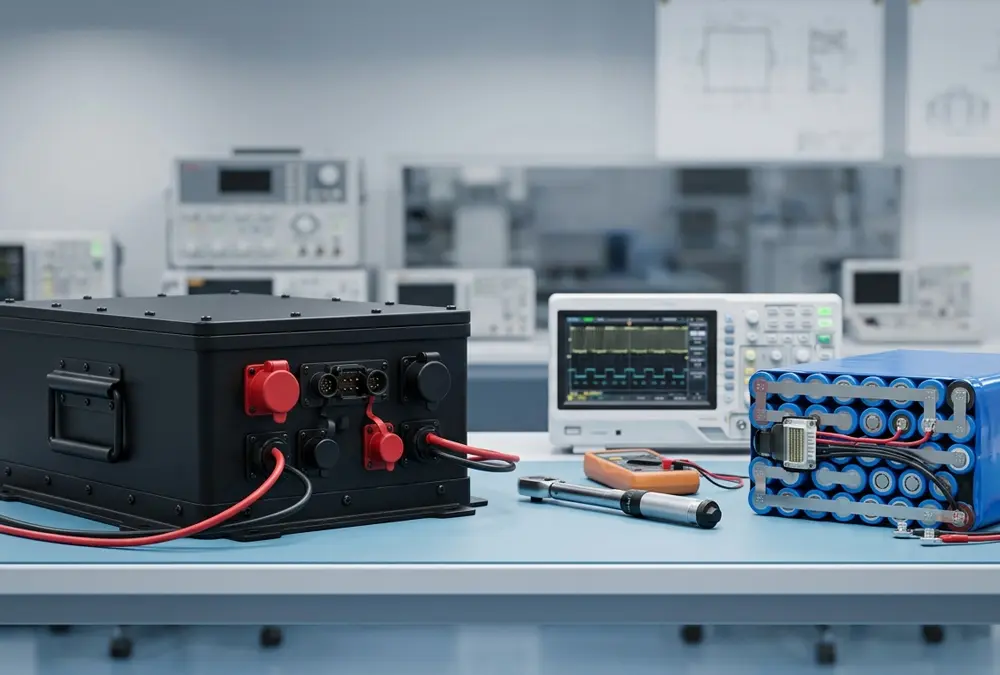
Choosing the right industrial power source isn’t about finding the absolute “best” cell on the market; it’s about matching your specific operational layout with the realities of lithium battery chemistry. If you are tearing down equipment specifications or designing a fleet architecture, you’ve likely hit the massive wall of the nmc vs lfp battery debate. Let’s get straight to the point: Nickel Manganese Cobalt (NMC) packs an incredible punch in a lightweight, energy-dense frame, while the lithium iron phosphate battery (LFP) owns the floor on raw safety, lifespan, and hard-nosed cost efficiency. It’s exactly why the International Energy Agency (IEA) highlighted that in 2025, LFP seized over 90% of global stationary energy storage systems and pushed past 55% of the global EV market. Whether you’re configuring a heavy-duty commercial BESS, optimizing industrial AGVs, or trying to stop your golf cart fleet from degrading under high thermal stress, understanding this nickel manganese cobalt battery versus iron-phosphate comparison is the single most critical factor in protecting your capital expenditure.
What Are LFP and NMC Batteries? | Understanding Lithium Battery Chemistry
At their core, both systems are lithium-ion variants that move lithium ions back and forth between an anode and a cathode to store and release electrical energy. But when we perform a deep-dive lithium battery chemistry comparison, the real differentiator boils down to the molecular structure of the cathode material itself. That crystalline structure dictates exactly how much heat the pack can handle, how many hundreds of times it can cycle without dropping capacity, and how heavy the final assembly will feel on your machinery chassis.
What Is a Lithium Iron Phosphate (LFP) Battery?
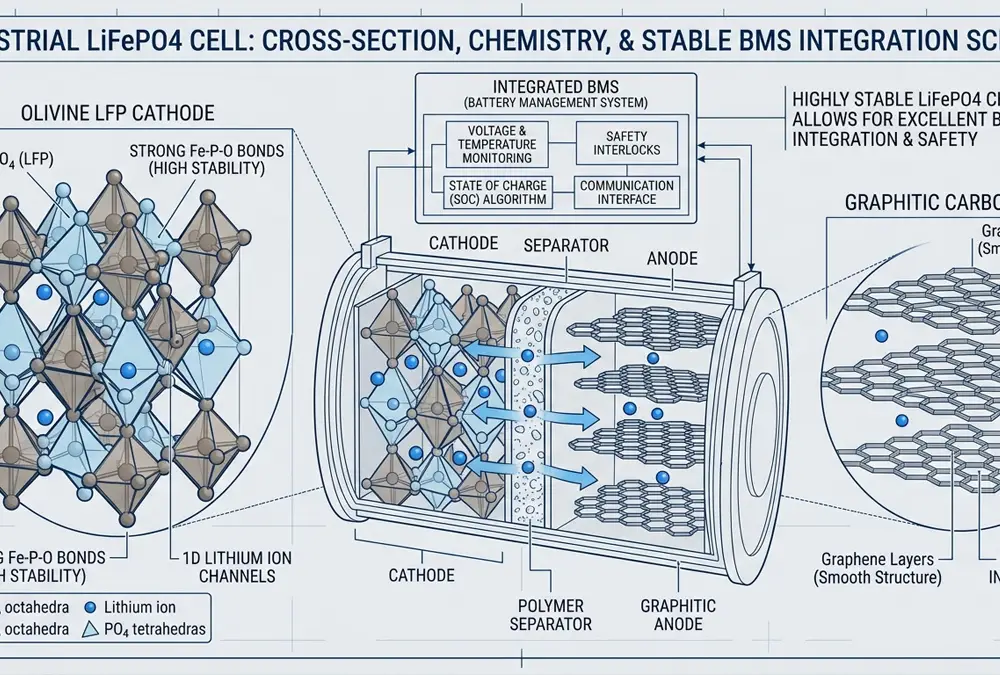
An LFP battery utilizes lithium iron phosphate ($LiFePO_4$) as its primary cathode material, paired with a typical graphitic carbon anode. The olivine crystalline structure of $LiFePO_4$ features exceptionally strong chemical bonds between iron, phosphorus, and oxygen atoms. This atomic arrangement is incredibly stable, resisting structural breakdown even when subjected to intense electrical or thermal loads. In industrial operations, LFP translates directly to a predictable formula: High Safety + Ultra-Long Cycle Life + Low Material Volatility. Because it bypasses highly volatile and expensive commodities, it has rapidly become the default option for heavy commercial applications like microgrid solar energy storage, automated guided vehicles (AGVs), baggage tow tractors, airport shuttle carts, and commercial floor scrubbers where the physical weight of the pack is actually an asset for traction rather than a penalty.
How Does a Lithium Iron Phosphate Battery Work?
During the charging cycle, lithium ions deintercalate from the iron phosphate cathode, migrating through an organic liquid electrolyte layer and a porous polymer separator to embed themselves within the layered graphite anode. When your machine draws power, the process reverses. Because the $LiFePO_4$ framework undergoes minimal structural distortion during this structural breathing process, the mechanical strain inside the cell is nearly zero. However, to keep this process safe, a highly sophisticated battery management system BMS is mandatory. The BMS constantly monitors cell-level voltages, balancing the low nominal 3.2V cells and preventing over-discharge situations that could damage the copper current collectors.
What Is an NMC (Nickel Manganese Cobalt) Battery?
NMC cells rely on a complex layered oxide cocktail of Nickel, Manganese, and Cobalt ($LiNi_xMn_yCo_zO_2$) at the cathode. This combination creates a significantly more compact atomic lattice that allows for a much higher concentration of lithium ions within a small volume. The result is a radically elevated battery energy density and supreme specific power delivery. If your equipment operates under constraints where every single pound of chassis weight kills performance, or if you require long, continuous runtime without a single chance for opportunity charging, NMC provides a dense energy reservoir that LFP simply cannot match in physical size.
How Does an NMC Battery Work?
Inside an NMC cell, each element inside the cathode does a specific job. Nickel is the heavy lifter for capacity—more nickel means you pack more energy per cubic centimeter. Cobalt acts as the internal anchor, stabilizing the layered atomic sheets so they don’t collapse during rapid high-current cycling. Manganese steps in to bolster thermal structural integrity. As lithium ions shuttle between the oxide lattice and the graphite anode, the high operating voltage (typically 3.6V to 3.7V per cell nominal) allows the system to discharge immense amounts of current rapidly. The catch? The bonds holding oxygen to the metals inside an NMC cathode are far weaker than the iron-phosphate bonds, meaning they release oxygen at much lower internal temperatures during an electrical failure.
LFP vs NMC Battery Advantages and Disadvantages | Key Technology Differences
To truly understand how these systems diverge under real industrial workloads, we have to look past the marketing spec sheets. Each chemistry has strict operational boundaries that will either optimize your fleet utility or force you into early pack replacements.
Main Advantages of LFP Batteries
- Unmatched Thermal Stability: LFP cells have a thermal runaway threshold up to 270°C and won’t release volatile oxygen even if punctured or externally shorted, drastically cutting down field fire risks.
- Massive Operational Lifespan: It is normal to see an LFP pack deliver 3,000 to over 6,000 full depth-of-discharge cycles before its nominal capacity drops to 80%.
- No Cobalt Pricing Whiplash: Eliminating nickel and cobalt removes your supply chain from global commodity price spikes, resulting in predictable upfront contract pricing.
- 100% State of Charge (SoC) Resilience: Unlike other lithium variants, LFP can sit at a full 100% charge day after day without accelerating the chemical degradation pathways inside the cell.
Main Advantages of NMC Batteries
- Superior Specific Energy: NMC easily achieves cell-level energy densities between 200 to 260 Wh/kg, allowing for compact, space-saving layouts.
- Excellent Low-Temperature Discharge: Maintains a significantly flatter voltage curve and retains more usable capacity when operating in deep cold environments down to -20°C.
- High Discharge C-Rates: Capable of pumping out massive surge currents for high-torque industrial demands or high-speed peak acceleration.
Limitations and Considerations of NMC Batteries
If you are deploying NMC, your engineering group must plan for extensive thermal management infrastructure. Because these cells generate more heat during heavy draws, active cooling loops are frequently required. Furthermore, keeping an NMC pack sitting at 100% state-of-charge under high ambient temperatures acts like a chemical aging accelerator. For operators, this means implementing strict charging protocols—usually capping regular top-offs at 80% to 90% SoC—which effectively shrinks your usable day-to-day energy envelope unless you are prepared to accept a severely compressed lithium battery cycle life.
NMC vs LFP Battery Comparison: Energy Density, Safety, Cost and Lifespan
Let’s map out the definitive raw engineering metrics side-by-side. The table below outlines how these two cathode materials perform across crucial operating benchmarks, paired with the direct bottom-line advantages these differences deliver to your daily procurement and operation decisions.
| Engineering Metric | LFP Chemistry ($LiFePO_4$) | NMC Chemistry ($LiNiMnCoO_2$) | Direct Value & Benefit to the Fleet Operator |
|---|---|---|---|
| Cell Energy Density | 140 – 170 Wh/kg (Medium) | 200 – 260 Wh/kg (High) | NMC Advantage: Cuts overall battery weight by 30-40%. Keeps high-speed automated machinery agile and extends single-charge travel ranges for payload-sensitive transportation. |
| Thermal Runaway Temperature | ~270°C (Extremely Stable) | ~210°C (Sensitive) | LFP Advantage: Simplifies fire suppression design. Allows hassle-free installation in indoor facilities, warehouse floors, and occupied municipal buildings. |
| Standard Cycle Life (80% DoD) | 3,000 – 6,000+ Full Cycles | 1,000 – 2,000 Full Cycles | LFP Advantage: Eliminates replacement costs. A machine running one full cycle every single day can operate for over 10 years without requiring a pack teardown. |
| Average 2025/2026 Cell Cost | ~$60 – $75 per kWh | ~$95 – $115 per kWh | LFP Advantage: Delivers 30% to 40% lower initial capital expenditure per kilowatt-hour, drastically freeing up project development cash flow. |
| Daily Charging Protocol | Safe to charge to 100% daily | Recommended limit to 80-90% | LFP Advantage: Zero-anxiety operation. Floor staff can plug in equipment at any time without worrying about accelerated chemical wear. |
Energy Density Comparison Between LFP and NMC Batteries
The numbers don’t lie: if your core project constraint is limited physical space, NMC wins the day. Because an NMC cathode holds more energy per kilogram, you can slide a high-capacity pack into a narrow vehicle belly pan or tight industrial compartment. If you tried to achieve that exact same kilowatt-hour footprint using LFP, the pack would be roughly one-third larger and significantly heavier. For utility-scale LFP vs NMC battery which is better for BESS calculations, this volumetric difference is usually secondary; land is relatively cheap, and containers don’t mind sitting firmly on concrete pads. But if you’re building an electric delivery vehicle or an aerial work platform that must lift its own weight up a steep incline, that weight savings provides massive systemic efficiency dividends.
Safety Comparison: Thermal Stability and Thermal Runaway Risk
From an operations standpoint, LFP battery safety is a total game-changer. When a battery cell experiences a severe internal short-circuit due to mechanical damage or manufacturing defects, it enters a state called thermal runaway. Because the oxygen atoms in an LFP cathode are anchored by incredibly tough covalent bonds to phosphorus, the cell requires an massive amount of internal energy input before it will decompose. If an LFP cell does give out, it vents slowly, releasing non-combustible gases with almost zero flame projection. NMC oxides, by comparison, break apart at lower internal temperatures, generating self-sustaining exothermic reactions that release free oxygen into the cell structure. This free oxygen can fuel intense, fast-moving fires that are incredibly difficult to extinguish without massive water drenching protocols.
Cycle Life and Battery Degradation Comparison
Think about battery degradation like mechanical friction: it happens every time the system works, but the rate of wear varies wildly between chemistries. NMC cells suffer faster capacity fade primarily because the repeated structural expansion and contraction of the nickel sheets causes microscopic fracturing inside the active particles. Over hundreds of cycles, these micro-cracks isolate areas of the cathode, permanently locking away lithium ions. LFP’s rigid framework doesn’t shift, meaning the structural pathways stay pristine for thousands of rounds. If your operation demands high-utilization assets that run multiple shifts a day, choosing a system with an exceptional lithium battery cycle life prevents you from having to purchase replacement packs halfway through the equipment’s useful service life.
Cost Comparison: Price Per kWh and Total Ownership Cost
Upfront acquisition cost is where the LFP battery advantages become painfully obvious to anyone managing a balance sheet. According to data tracked across the energy sector in 2025 and early 2026, overcapacity in iron-phosphate manufacturing lines has pushed LFP cell costs down into the $60-$75/kWh range. NMC cells remain tied to the volatile mining economics of nickel and cobalt, keeping cell-level acquisition costs closer to $100/kWh. When you look at Total Cost of Ownership (TCO) over a ten-year cycle, the financial gap widens even more. Because an LFP pack outlasts NMC by a factor of three, the cost-per-cycled-kilowatt-hour of LFP is a mere fraction of its三元三元 (ternary) competitor.
LFP vs NMC Battery Cycle Life and Long-Term Performance Analysis
To forecast exactly when a fleet will require a battery overhaul, we have to look closely at the long-term degradation curves under varied climate realities and everyday charging habits.
How Long Does an LFP Battery Last?
In a standard industrial setting—think a commercial golf cart fleet or material handling tugs doing opportunity charging during breaks—an LFP pack easily spans 8 to 12 years of service before dropping to 80% original capacity. Even when it hits that 80% threshold, the battery isn’t dead; it simply has a shorter runtime, making it perfect for secondary deployment or stationary grid backup roles.
How Long Does an NMC Battery Last?
Under a typical heavy-use operational framework, an NMC battery pack will generally maintain peak performance for 3 to 5 years, or roughly 1,500 full cycles, before its internal resistance spikes and usable capacity drops off noticeably. If the pack is consistently exposed to aggressive ultra-fast charging or deep discharges below 10%, that timeline can shorten rapidly, forcing early service interventions.
Battery Degradation Under Different Conditions
Ambient temperature acts as a primary catalyst for internal degradation. Let’s look at how these chemistries behave across distinct thermal operational zones:
- 15°C to 25°C (The Ideal Zone): Both chemistries perform flawlessly here. Parasitic chemical reactions are minimal, and cycle life matches the manufacturer’s maximum spec sheet ratings.
- 45°C (High Heat Environments): At elevated temperatures, NMC packs suffer from rapid growth of the Solid Electrolyte Interphase (SEI) layer on the anode, which consumes active lithium ions and increases internal resistance. LFP handles this thermal stress far better, maintaining structural cohesion, though it will still experience a mild increase in calendar aging.
Replacement Frequency Over 10–15 Years
Imagine managing a logistics hub running AGVs over a 12-year project horizon. If you choose NMC packs due to their light weight, you must budget for at least two complete battery replacement cycles per vehicle over that timeframe. Switching the asset spec to a professional OEM LFP battery pack manufacturer means you buy the battery once. The cells will outlast the mechanical chassis of the AGV itself, shifting your battery expenses from a recurring operational cost straight into a single, highly efficient capital investment.
Which Battery Chemistry Is Safer? | LFP vs NMC Thermal Runaway Comparison
Safety isn’t just a compliance box to tick; it’s a massive operational risk factor that can instantly impact your facility insurance premiums and liability profile.
Thermal Runaway Risk Comparison
The core difference in battery thermal stability comes down to a process called self-heating. If an NMC cell gets crushed or overheats to around 210°C, the cathode begins to break down endothermically, releasing heat that triggers adjacent cells in a rapid domino effect. An LFP cell doesn’t even begin structural breakdown until it hits 270°C, and because the chemical reaction generates significantly less heat energy, it is highly unusual for a single cell failure to propagate across the rest of the battery module.
Gas Release and Fire Safety Differences
If an NMC pack fails, it releases a thick, white smoke plume containing toxic and highly flammable gases like carbon monoxide, hydrogen, and vaporized solvents. This gas mixture can easily ignite if it encounters a single spark. LFP failures release primarily carbon dioxide and water vapor, drastically lowering the risk of secondary flash fires or explosive gas build-ups inside enclosed battery rooms.
Why LFP Is Preferred for Occupied Buildings and Energy Storage
Because of this intrinsic safety edge, municipal fire marshals and facility engineers are heavily favoring LFP for indoor setups. Whether you are installing a backup power wall next to a main office space, setting up a microgrid in a commercial basement, or deploying a fleet of indoor floor cleaners, LFP eliminates the need for complex, incredibly expensive automated clean-agent fire suppression systems.
LFP vs NMC Battery Cost and Supply Chain Comparison
Industrial procurement is always vulnerable to volatile raw material markets. Selecting your battery chemistry is ultimately a long-term play on global supply chain stability.
Material Cost Differences Between LFP and NMC
NMC production lines are constantly at the mercy of the global mining industry. Nickel requires intensive, energy-heavy refining, and cobalt mining is heavily concentrated in geopolitically volatile regions, leading to frequent market bottlenecks. LFP relies on industrial-grade iron ore and commodity phosphoric acid. These materials are abundant, widely distributed globally, and cheap to process, ensuring stable per-kwh cell pricing.
Supply Chain Risks and Raw Material Availability
As massive automotive and grid demands strain global mining outputs, the risk of commodity spikes remains high for nickel-reliant systems. Choosing LFP insulates your commercial project from these sudden market shocks, allowing you to sign long-term supply agreements with an OEM LFP battery pack manufacturer without worrying about raw material pricing surcharges breaking your budget downstream.
Long-Term Cost Advantage of LFP Batteries
When you look past the initial invoice and factor in the lack of complex thermal cooling systems, reduced structural fire protection requirements, and minimal maintenance intervals, the total cost of ownership for LFP is incredibly compelling. It routinely delivers a 50% net savings over an NMC equivalent when evaluated across a standard 10-year commercial operating window.
LFP vs NMC Battery Performance in Different Climate Conditions
How do these cells hold up when the weather turns extreme? Let’s look at how temperature shifts affect your daily uptime.
Performance in Hot Environments
In blistering warehouse environments or outdoor solar installations hitting 45°C, LFP is the undisputed king. Its rugged molecular structure prevents the cathode from degrading, ensuring your equipment keeps working shifts without needing prolonged cool-down periods between charging cycles.
Performance in Cold Weather
This is where NMC strikes back. In deep winter conditions, the internal chemical activity within an LFP cell slows down significantly, causing a temporary drop in capacity and making the battery highly sensitive to charging below 0°C without internal heating pads. NMC retains its internal mobility much better in the cold, maintaining solid power delivery without requiring massive amounts of energy to run auxiliary cell heaters.
Which Battery Is Better for Extreme Weather Applications?
For hot, humid, or temperate zones, LFP is the clear operational favorite due to its lower cost and robust safety layout. If you are running high-altitude equipment, deploying assets in northern winter climates, or managing unheated cold-storage warehouses, NMC’s cold-weather efficiency can offset its higher cost by eliminating the need for bulky insulated blankets and high-draw thermal management systems.
LFP vs NMC Battery Applications: Which Chemistry Is Better for Different Industries?
Let’s look at exactly how these performance profiles map to specific industrial equipment lines and commercial sectors.
LFP Battery Applications
- Home & Commercial Energy Storage: Where safety and absolute maximum cycle life override any weight concerns.
- Golf Cart & Sightseeing Fleets: Excellent for constant stop-and-go demands, opportunity charging, and outdoor operations in high summer heat.
- Automated Guided Vehicles (AGVs): Perfect for automated warehouses requiring 24/7 high-frequency opportunity charging without risking early pack wear.
- Tuktuks, Delivery Trikes & Cleaning Equipment: Rugged, low-maintenance power sources that handle daily deep discharges without breaking down.
NMC Battery Applications
- Premium Passenger Electric Vehicles: Where maximizing single-charge driving range is the primary selling point for consumers.
- High-Performance Tracking & Specialized Drones: Applications where every extra ounce of weight directly reduces payload capacity and flight times.
- Portable Emergency Medical Gear: Critical devices that must pack immense energy into a small, highly mobile handheld enclosure.
LFP vs NMC Battery for Energy Storage Systems (BESS)
The grid storage sector has made its choice crystal clear: iron-phosphate is the dominant force for modern installations.
Why LFP Is Becoming the Preferred Chemistry for BESS
For a massive grid-tied container system, the economics are driven entirely by safety, cycle life, and upfront cost per megawatt-hour. LFP hits the sweet spot for all three. Being able to cycle the facility twice a day for a decade without a drop in efficiency means project developers can reliably hit their long-term financial targets.
NMC Battery Use Cases in Energy Storage
NMC is now reserved almost exclusively for highly specialized urban installations where physical space is at a massive premium. If a data center or metropolitan substation only has a small, cramped room available for backup power, the high volumetric energy density of NMC allows engineers to pack the required megawatt capacity into a significantly smaller structural footprint.
LFP vs NMC Battery Selection for Solar Storage Projects
For commercial and industrial solar integration, LFP is almost always the right call. It pairs perfectly with the predictable daily cycle of the sun, soaking up energy all day and discharging it smoothly during peak pricing hours without suffering from structural or chemical fatigue.
How to Choose Between LFP and NMC Batteries for Your Application
Before you sign off on your next major industrial battery purchase order, take a moment to weigh these core operational priorities.
Choose LFP Battery If You Need:
- A target lifespan exceeding 3,000 to 5,000 full operational cycles.
- Absolute peace of mind regarding facility fire safety and simplified insurance audits.
- The lowest possible upfront capital expenditure per kilowatt-hour.
- A low-maintenance system that can safely sit at a full 100% charge everyday.
Choose NMC Battery If You Need:
- The absolute maximum amount of energy packed into a lightweight, highly compact frame.
- Consistent, reliable performance in sub-zero cold-storage facilities or extreme winter climates.
- High-drain surge currents to power heavy acceleration or extreme industrial torque demands.
Consider These Factors Before Selecting Battery Chemistry
Look closely at your exact vehicle or facility blueprints. Do you have strict weight limits? What does your daily shift schedule look like—can your team utilize opportunity charging, or does the asset need to run for 10 hours straight without a break? Answering these practical questions upfront ensures you choose the chemistry that optimizes your true daily operational flow.
How to Extend the Lifespan of LFP Batteries?
While LFP is an incredibly forgiving chemistry, a few basic maintenance steps will help you maximize your long-term return on investment.
Proper Charging Practices
Avoid exposing the cells to constant overcharging beyond their maximum rated voltage voltages. Ensure your smart chargers are correctly calibrated to the specific voltage curves of LFP cells rather than using generic lead-acid or standard lithium-ion charging profiles.
Temperature Management
Try to avoid charging your packs when cell temperatures drop below freezing (0°C). If your equipment operates in deep cold, choose a pack equipped with internal thermal blankets that warm the cells up to a safe temperature zone before the charging current kicks in.
BMS Protection and Monitoring
Never bypass or alter your system’s built-in BMS settings. The BMS is your front-line defense, keeping the individual cell strings perfectly balanced and protecting the pack from accidental over-currents or deep voltage drops.
Why Choose Professional OEM LFP Battery Solutions?
Buying generic off-the-shelf batteries often leaves you with mismatched internal components that can lead to early pack failures. Partnering with a dedicated industrial manufacturer ensures your power source is built to handle the exact demands of your operation.
Custom LFP Battery Pack Design
A true commercial-grade integration isn’t just about cells; it’s about matching the exact voltage, capacity, and physical shape your equipment requires. Professional designs tailor the internal configuration, cell matching, structural casing, and active CANbus communication protocols to integrate seamlessly with your existing industrial controllers.
Battery Solutions for Golf Cart, AGV and Energy Storage Applications
Industrial applications present unique challenges, from the constant heavy vibration of a warehouse forklift to the dusty, hot conditions of an outdoor utility cart fleet. Working with an experienced industrial partner ensures your battery packs are built with rugged internal bracing, high-grade busbars, and robust potting materials designed to handle years of heavy field abuse.
Reliable Manufacturing and Quality Control
Top-tier manufacturing relies on strict cell-matching protocols, ensuring every single cell in a series string shares the exact same internal resistance and capacity. Backed by rigorous quality control testing and key international safety certifications (like UL, CE, and UN38.3), a professional OEM solution delivers predictable, reliable performance you can count on shift after shift.
Frequently Asked Questions About NMC vs LFP Battery
Which is safer, LFP or NMC battery?
LFP is significantly safer due to its high thermal runaway threshold (~270°C) and stable olivine crystal structure, which doesn’t release free oxygen during thermal failure, minimizing the risk of intense fires.
Which battery lasts longer, LFP or NMC?
LFP batteries last much longer, routinely delivering 3,000 to 6,000+ full cycles before dropping to 80% capacity, whereas standard NMC batteries typically offer between 1,000 and 2,000 cycles.
Is LFP cheaper than NMC?
Yes, LFP is generally 30% to 40% cheaper per kilowatt-hour on an upfront cell basis because it uses abundant iron and phosphate instead of expensive, highly volatile commodities like cobalt and nickel.
Why are most BESS systems using LFP batteries?
Stationary grid storage systems value safety, long operational lifespans, and low cost-per-kWh over low pack weight, making LFP the ideal financial and technical choice for large-scale deployments.
Can LFP replace NMC batteries?
LFP can easily replace NMC in applications like golf carts, AGVs, and stationary storage systems where space and weight are flexible. For compact, long-range premium passenger EVs, NMC is still often preferred for its light weight.
Get the Right Lithium Battery Chemistry Solution for Your Project
Don’t leave your equipment performance and project budgets to guesswork. Whether you are expanding a utility-scale solar project, upgrading an industrial warehouse fleet, or designing a new electric vehicle line, choosing the right battery configuration requires deep technical expertise. Contact our engineering team today for a comprehensive project review, custom pack design proposal, or a volume production quote tailored to your exact operational requirements.
Related Article
Related Posts
 https://anengjibattery.com/wp-content/uploads/2026/09/AnengJIBattery-Best-LiFePO4-Battery-How-to-Choose-the-Right-One.webp
675
1000
Battery Expert Team
https://anengjibattery.com/wp-content/uploads/2025/06/logo2-300x138.png
Battery Expert Team2026-09-17 08:52:142026-09-17 08:52:31How to Choose the Best LiFePO4 Battery
https://anengjibattery.com/wp-content/uploads/2026/09/AnengJIBattery-Best-LiFePO4-Battery-How-to-Choose-the-Right-One.webp
675
1000
Battery Expert Team
https://anengjibattery.com/wp-content/uploads/2025/06/logo2-300x138.png
Battery Expert Team2026-09-17 08:52:142026-09-17 08:52:31How to Choose the Best LiFePO4 Battery https://anengjibattery.com/wp-content/uploads/2026/09/anengjiBattery-lifepo4-battery-cell-packaging-wholesale.webp
675
1000
Battery Expert Team
https://anengjibattery.com/wp-content/uploads/2025/06/logo2-300x138.png
Battery Expert Team2026-09-16 09:52:342026-09-16 09:52:57LiFePO4 Battery Wholesale Guide: Best Suppliers in Spain
https://anengjibattery.com/wp-content/uploads/2026/09/anengjiBattery-lifepo4-battery-cell-packaging-wholesale.webp
675
1000
Battery Expert Team
https://anengjibattery.com/wp-content/uploads/2025/06/logo2-300x138.png
Battery Expert Team2026-09-16 09:52:342026-09-16 09:52:57LiFePO4 Battery Wholesale Guide: Best Suppliers in Spain https://anengjibattery.com/wp-content/uploads/2026/09/anengjibattery-Top-Lithium-Ion-Battery-Producers-for-Spain-Market-Growth.webp
675
1000
Battery Expert Team
https://anengjibattery.com/wp-content/uploads/2025/06/logo2-300x138.png
Battery Expert Team2026-09-16 01:13:392026-09-16 01:14:05Top Lithium Ion Battery Producers for Spain’s Market Growth
https://anengjibattery.com/wp-content/uploads/2026/09/anengjibattery-Top-Lithium-Ion-Battery-Producers-for-Spain-Market-Growth.webp
675
1000
Battery Expert Team
https://anengjibattery.com/wp-content/uploads/2025/06/logo2-300x138.png
Battery Expert Team2026-09-16 01:13:392026-09-16 01:14:05Top Lithium Ion Battery Producers for Spain’s Market Growth https://anengjibattery.com/wp-content/uploads/2026/09/Bulk-Lithium-Ion-Battery-Cells-Procurement-Guide-B2B-Sourcing.webp
675
1000
Battery Expert Team
https://anengjibattery.com/wp-content/uploads/2025/06/logo2-300x138.png
Battery Expert Team2026-09-14 09:47:322026-09-14 09:47:48Bulk Lithium-Ion Battery Cells Procurement Guide | B2B Sourcing
https://anengjibattery.com/wp-content/uploads/2026/09/Bulk-Lithium-Ion-Battery-Cells-Procurement-Guide-B2B-Sourcing.webp
675
1000
Battery Expert Team
https://anengjibattery.com/wp-content/uploads/2025/06/logo2-300x138.png
Battery Expert Team2026-09-14 09:47:322026-09-14 09:47:48Bulk Lithium-Ion Battery Cells Procurement Guide | B2B Sourcing


Leave a Reply
Want to join the discussion?Feel free to contribute!