
How Do You Match Electric Fork Truck Batteries Correctly?
November 4, 2026 / Battery Expert Team / Battery Basics
Introduction
A replacement battery can have the right voltage and amp-hour rating and still leave an electric fork truck parked. The case may be too light for the truck’s approved battery-weight range, the cable may exit on the wrong side, or the existing charger may use an incompatible charge profile. For buyers comparing electric fork truck batteries, the real product is therefore not the battery alone. It is a matched truck–battery–charger system.
This guide is designed for warehouse, factory and 3PL procurement teams, fleet managers, maintenance engineers, forklift dealers and replacement buyers. It explains how to build a usable specification, compare lead-acid and lithium options, assess AnengJi reference configurations and request quotations that include the items most likely to be missed.
The practical answer
Do not order from “48V” or “80V” alone. Match the operating-voltage window, usable energy, continuous and peak current, complete installed mass, compartment and restraint, connector and cable routing, BMS interface, approved charger and actual charging window. Send the supplier the truck plate, battery plate, charger plate and battery-compartment details before asking for a final quote.
What Information Do You Need Before Buying an Electric Fork Truck Battery?
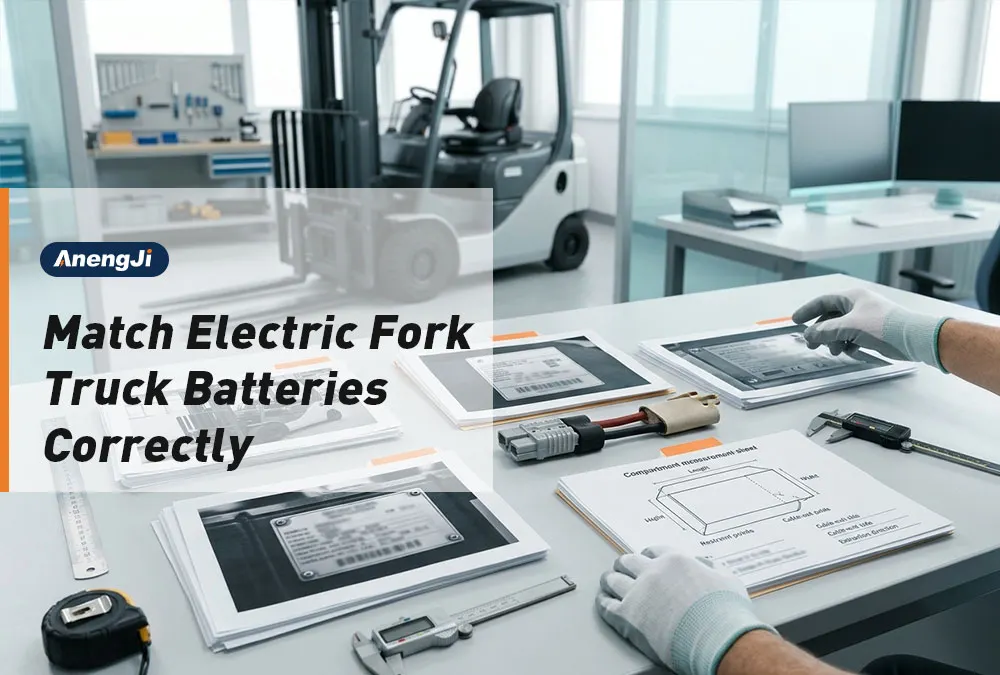
A common replacement problem starts with a rushed purchase: the old battery is weak, production needs the truck back, and the buyer sends only a photo showing voltage and Ah. The new pack arrives, but the truck remains idle because the weight, connector position or charger does not match. Avoid that sequence with a “three plates plus one compartment” purchase passport.
| Evidence to collect | Important fields | What it prevents |
|---|---|---|
| Truck data plate | Manufacturer, model, serial number, truck voltage, permitted battery mass and attachments | An electrically plausible battery that makes the truck mechanically or operationally non-compliant |
| Existing battery plate | Chemistry, voltage, Ah, mass, model, case and connector information | Assuming that voltage identifies a complete replacement |
| Charger plate | AC input, phase, DC output, charge profile, connector and communication | Buying a pack that the installed charger cannot charge correctly |
| Compartment and installation | Measured L×W×H, restraint, lifting points, extraction direction, cable exit, connector clearance and photographs | Case interference, trapped cables, blocked rollers or unusable lifting arrangements |
| Operating record | Loads, attachments, ramps, hours, start/end SOC, energy returned, temperature and available breaks | Oversizing from guesswork or undersizing a battery that cannot finish the shift |
The plate information should be supported by photographs and measurements, not copied from a similar truck. Two trucks in the same nominal class may have different compartments, attachment loads or approved battery-weight ranges. If the battery is being converted from lead-acid to lithium, ask the truck manufacturer or an authorised engineering party what approval and plate changes are required.
Want a fit review before requesting a quotation?
Send the three data plates, compartment dimensions, connector photos and duty information. The review can identify missing electrical, mechanical and charging inputs before a battery is configured.
Which Type of Fork Truck Battery Fits the Duty Cycle?
The “best” battery depends on how the truck is used and charged. Flooded lead-acid, thin-plate pure lead (TPPL) or other sealed lead-acid designs, and LiFePO4 systems solve different operating problems. A low-utilisation truck with a long overnight parking period does not have the same business case as a multi-shift truck with short scheduled breaks.
| Battery type | Where it can fit | Routine and charging implications | Buyer decision |
|---|---|---|---|
| Flooded lead-acid | Predictable single-shift use, established local maintenance and enough charging/cooling time | Watering, inspection and controlled charging are part of the operating plan; battery changing may be needed for intensive use | Compare the lower acquisition price with labour, charging space, spare batteries and change equipment |
| TPPL or sealed lead-acid | Selected fleets seeking a different maintenance or charging strategy | Requirements vary by product; do not assume every sealed design accepts the same fast-charge routine | Obtain the exact charge profile, duty and end-of-life criteria from the supplier |
| LiFePO4 | Multi-shift or opportunity-charged operations where breaks, site power and integration support are available | No watering, but BMS, charger, communication, temperature and truck integration become critical | Value depends on measured utilisation and avoided operating work—not chemistry claims alone |
For a detailed chemistry and economics decision, see how to compare forklift battery types by operating pattern. Treat published cycle-life or service-life figures as conditional: depth of discharge, temperature, charge rate, balancing, storage and the stated end-of-life threshold all affect the result.
Which Electric Fork Truck Battery Specifications Must Match?
Voltage is the first gate—not the final approval
Nominal voltage identifies a system class, but the truck controller and charger operate across a voltage window. A valid review also considers maximum charge voltage, low-voltage limits, regenerative current, controller behaviour and any communication used to enable drive or charge. A “48V” lead-acid system and a 51.2V LiFePO4 pack should never be treated as interchangeable from their labels alone.
Compare usable energy, not Ah alone
Amp-hours describe charge capacity; kilowatt-hours describe nominal energy. The screening calculation is:
Nominal energy (kWh) = nominal voltage (V) × capacity (Ah) ÷ 1,000
This is not guaranteed runtime. Payload, travel distance, lift height, ramps, attachments, temperature, tyre condition, driver behaviour, usable depth of discharge and ageing change the energy consumed. Use the full duty-cycle method for forklift battery capacity when sizing Ah.
Separate energy demand from current demand
A battery may contain enough kWh for a shift yet trip when the truck accelerates and lifts a load at the same time. Ask for continuous current, peak current, permitted peak duration and regenerative-current limits. When a truck slows or faults late in a shift, collect loaded voltage, current, SOC, cell spread, temperature and fault records. That evidence separates depleted energy, voltage sag, temperature limits and an underspecified current path.
Installed mass and restraint affect the truck, not just shipping
Traditional traction batteries may form part of the truck’s counterweight. A lighter lithium assembly is not automatically better if the truck requires a defined minimum battery mass. The complete installed solution may need an engineered steel case or ballast, and the restraint, centre of gravity, lifting points and extraction path must remain suitable. Use the truck data plate and manufacturer documentation rather than an online average. The detailed forklift battery weight and stability guide explains this gate.
The connector can fit while the installation still fails
This is one of the details most likely to be missed in a remote quotation. The correct connector family does not prove correct polarity, pinout, cable size or current rating. Even when those match, a cable exiting the wrong side can collide with the hood, cross an extraction roller or be forced into a pinch point. Record the connector model, polarity, cable length, cable-exit position, minimum bend path and battery extraction direction. Include photographs from above and from the connector side.
| Compatibility layer | Minimum evidence | Reject or pause the quote when… |
|---|---|---|
| Electrical | Voltage window, energy, continuous/peak current, regenerative limits | Only nominal voltage and Ah are stated |
| Mechanical | Drawing, complete mass, centre-of-gravity/ballast approach, restraint and lifting plan | The supplier gives cell weight or outside dimensions without installed configuration |
| Connection | Connector, polarity, pinout, cable, exit side, clearance and extraction route | “Same plug” is the entire compatibility statement |
| Control | BMS limits, SOC display, CAN or hardwired signals, interlocks and fault behaviour | No party accepts responsibility for the truck–battery interface |
| Environment | Charge/discharge temperature, condensation, dust/moisture, vibration and transition pattern | A generic operating range is offered without the exact model or charging limits |
How Do Fork Truck Battery Chargers Affect the Purchase?
The most expensive charger mistake often looks harmless: the old plug mates with the new battery. The battery then undercharges, reaches a timeout, refuses to close its contactor or finishes too late for the next shift. Collect the charger plate and charge profile before assuming it can be reused.
- Chemistry and profile: flooded lead-acid, TPPL and LiFePO4 do not automatically use the same finish, equalisation or termination logic.
- Voltage and current: compare the full charge-voltage window and approved current—not only nominal voltage.
- Communication: where CAN, charge-enable, wake/sleep or drive-away interlocks are used, obtain written support for the exact battery and charger models.
- Facility input: AC voltage, phase, frequency, breaker capacity, earthing and the number of simultaneous chargers determine whether the proposed system can operate at the site.
As a model-specific example, Hyster presents its lithium batteries and chargers as an integrated power-source system. That does not approve another brand or charger; it illustrates why voltage and connector fit alone are not system validation.
Illustrative charging-window calculation
Consider a 51.2V, 412Ah reference battery. Its nominal energy is approximately 21.09kWh. If a shift uses an assumed 65% of nominal energy, the nominal energy to restore is:
21.09kWh × 65% = 13.71kWh
13.71kWh ÷ 7.5kW average DC charging power = 1.83 hours
This 1.83-hour result is a screening baseline, not a promised completion time. Charging losses, ramp-up, high-SOC taper, cell balancing, temperature limits and interruptions can extend the session. If the real parking window is only two hours, the margin is too narrow to approve from the arithmetic alone. Review charger logs or test the proposed battery–charger pair under the intended starting SOC and temperature.
The same principle applies to an electric forklift charging plan: calculate energy removed, measure energy returned and compare both with the actual parking window. A larger battery does not solve an undersized charger or insufficient site power.
What Do AnengJi 51.2V and 76.8V Reference Configurations Mean?
AnengJi’s forklift battery configurations include purpose-built cases for different vehicle-integration needs. The following values are model-specific reference specifications, not universal replacements. The nominal energy figures are calculated from voltage × Ah and do not represent guaranteed usable energy or runtime.
| Reference application | Voltage / capacity | Nominal energy | Case size (L×W×H) | Listed mass | Buyer boundary |
|---|---|---|---|---|---|
| E20 2-ton counterbalance reference | 51.2V / 277Ah or 412Ah | 14.18 or 21.09kWh | 1030×500×507mm | 210kg | Truck model, permitted mass, connector and current demand still require confirmation |
| Reach-truck reference | 51.2V / 277Ah or 412Ah | 14.18 or 21.09kWh | 1216×355×744mm | 1200kg | The mass difference shows why application and case cannot be inferred from voltage and Ah |
| Fuel-to-electric reference | 76.8V / 280Ah | 21.50kWh | 730×600×340mm | 210kg | A conversion needs documented truck, controller, weight, charger and safety integration |
| Linde-specific KGCB reference | 76.8V / 412Ah | 31.64kWh | 980×688×700mm | 210kg | Exact truck and interface matching is required; the application label is not approval for other models |
These reference packs list 200A continuous charge and discharge at 25°C, a discharge range of −20°C to 60°C and a charging range of 0°C to 55°C. Those values are pack-interface specifications, not instructions to use a 200A charger or proof that a truck’s peak demand is covered. The proposed cells, BMS settings, cables, connector, truck controller, charging method and real environment must be reviewed together.
AnengJi also works with broader LiFePO4 platforms and standard-format battery concepts. A standard format can be a useful starting point for pallet trucks, stackers, AGVs or lifting equipment, but it is still only a candidate until voltage window, current, dimensions, installed mass, restraint, connector, charger/BMS interface and vehicle approval are confirmed.
How Should Buyers Compare Fork Truck Batteries for Sale?
A low headline price is not necessarily a low project cost. One quote may include only a battery; another may include the steel case, ballast, matching charger, connector, dangerous-goods documentation and commissioning. If the scopes are not normalised, procurement can select the apparently cheapest option and discover the missing items after the old battery has already failed.
| Quote line | Question to ask | Cost or uptime risk if omitted |
|---|---|---|
| Complete battery assembly | Does the price include case, lid, ballast, restraint, cables, connector, display and all installed hardware? | A battery that cannot be installed or meet the truck’s mass requirement |
| Charger and site interface | Is the charger included, and what AC supply, breaker, cable and communication are required? | Extra electrical work or a charger that cannot complete the next shift |
| Logistics | Which Incoterm, freight, dangerous-goods documents, customs responsibility and inland unloading are included? | Unplanned destination charges, delays or no equipment to unload the pack |
| Commissioning | Who installs, configures, tests and signs off the truck–battery–charger system? | Responsibility gaps when the system will not charge or drive |
| Diagnostics and support | Who can read logs, update settings, supply parts and respond across the buyer’s time zone? | A minor fault becomes extended downtime |
| Warranty and end of life | What is covered, excluded and required for a claim, and who handles the old battery? | A headline warranty that does not cover labour, freight, duty or the failure condition |
Compare the battery-only price, landed and installed cost, annual operating cost and cost per productive truck hour. The separate guide to complete forklift battery cost shows how to normalise public prices and supplier quotations without inventing a market average.
What Should Buyers Verify in Europe, the United States and Export Markets?
Europe
The European Commission’s battery framework covers the battery lifecycle, including sustainability, safety, labelling, supply-chain and end-of-life responsibilities under Regulation (EU) 2023/1542. The exact obligations depend on the battery category, model, role of the economic operator and applicable dates. Ask for model-specific documents, traceability, instructions and the planned end-of-life route; do not accept a logo list as proof that the offered model is covered.
United States
OSHA 29 CFR 1910.178 addresses powered industrial trucks, including manufacturer approval for modifications affecting capacity or safe operation and workplace battery-charging practices. Workplace rules, product listing/certification and truck-manufacturer approval are different questions; one does not substitute for the others. The employer and supplier should identify which documents apply to the exact truck, battery, charger and site.
Central Asia, Africa and other distant markets
These regions should not be treated as one regulatory market. Confirm the destination country’s import, transport, installation, workplace and recycling requirements. From an operating perspective, record AC voltage and frequency, phase availability, generator use, voltage stability, dust, temperature, charging location, network availability, language, customs responsibility and inland unloading.
Remote support also changes the spare-parts decision. A European warehouse near a service partner may tolerate a different spares strategy from a mine, port or factory several days from specialist support. Request the fault-recovery process before buying: which logs can be exported, who can interpret them, which parts can be changed locally, and what cannot be changed without factory authorisation?
How Do You Validate a Supplier Before a Fleet Order?
A technically attractive sample does not by itself prove repeatable fleet supply. The supplier should show how the exact configuration is controlled from the first approved drawing through production, commissioning and later service.
| Supplier review area | Evidence to request | Acceptance question |
|---|---|---|
| Model and document scope | Exact model numbers, drawings, manuals and applicable test/conformity documents | Do the documents cover the battery being quoted? |
| Traceability and quality control | Cell/module/pack traceability, incoming, in-process and end-of-line controls | Can a later fleet unit be tied to the approved configuration and test record? |
| Change control | Notification and approval process for cells, BMS, firmware, connector, case and charger changes | Will production remain equivalent to the validated sample? |
| Integration ownership | Responsibility matrix for truck, battery, charger, display, communication and installation | Who resolves a fault that crosses two suppliers? |
| Lifecycle support | Diagnostic access, service route, spare parts and warranty claim requirements | Can the buyer recover the truck without returning the complete battery? |
Before ordering a fleet quantity, pilot one representative truck. The acceptance test should cover full charge completion, travel and lift at lower SOC, display accuracy, connector temperature, fault recovery, restraint, cable routing and the actual kWh used and returned during a credible shift. Record the approved BMS and charger versions. If the pilot does not represent the fleet’s heaviest load, coldest location or shortest charging window, it is not yet the worst-case validation.
How AnengJi Supports Electric Fork Truck Battery Projects
AnengJi’s forklift direction includes LiFePO4 reference configurations at 51.2V and 76.8V, including cases developed around counterbalance, reach-truck, Linde-specific and fuel-to-electric application references. The examples above are starting points for an engineering conversation, not a claim of universal compatibility.
For a project review, AnengJi can use the truck, battery, charger, compartment, duty-cycle and destination inputs to define the unanswered fit questions before a quotation is finalised. The goal is a documented configuration covering the battery assembly, mass and case, connector and cable routing, charger interface and operating context. Customisation must still remain inside the truck’s approved integration boundaries and the destination’s applicable requirements.
Request a truck–battery–charger fit review
Provide the three data plates, compartment and connector photographs, operating pattern, charging windows, quantity and destination. The review can return a compatibility-input checklist and identify which drawings, measurements or charger decisions are still required.
Electric Fork Truck Battery RFQ Checklist
- Truck: manufacturer, model, serial, data plate, manual, attachments and clear photographs.
- Existing battery: chemistry, nominal voltage, Ah, model, dimensions, service mass and label.
- Mechanical fit: compartment L×W×H, permitted battery-weight range, restraint, lifting points and extraction direction.
- Connection: connector family, polarity, pinout, current rating, cable size, length and exit position.
- Charger: AC input, phase/frequency, DC output, profile, connector, communication and photographs of the plate.
- Duty: payloads, attachments, ramps, travel/lift pattern, operating hours, start/end SOC and measured energy use where available.
- Charging: reliable parking windows, number of simultaneous chargers and facility input constraints.
- Environment: operating and charging temperature, cold-store transitions, dust, moisture, vibration and indoor/outdoor use.
- Commercial scope: quantity, destination, Incoterm, delivery window, unloading, installation and commissioning.
- Evidence and support: required model documents, acceptance test, diagnostics, warranty scope, spares and service route.
Frequently Asked Questions About Electric Fork Truck Batteries
What kind of batteries do electric forklifts use?
Electric forklifts commonly use flooded lead-acid traction batteries, while selected fleets use TPPL or other sealed lead-acid designs and lithium-ion systems such as LiFePO4. The correct choice depends on truck approval, duty cycle, maintenance resources, charging windows, site power and the complete ownership model.
What is the average cost of an electric forklift battery?
There is no single defensible average for all fork truck batteries. Voltage, capacity, chemistry, case, ballast, connector, charger, freight, commissioning and service scope all change the price. Compare dated, like-for-like quotations with the same installed and delivered scope.
How much does a 48V forklift battery typically cost?
A voltage-only price can be misleading. At minimum, define Ah or kWh, chemistry, case dimensions, complete mass, connector, new/reconditioned status, charger, destination and service scope. A 48V price should be treated as a budgeting reference until those fields match the real truck.
What is the average lifespan of an electric forklift battery?
Service life depends on both cycle ageing and calendar ageing. Compare products using a stated depth of discharge, temperature, charge/discharge rate, maintenance method, test procedure and end-of-life capacity threshold. A cycle number or number of years without these conditions is not a reliable fleet forecast.
Can I use my existing fork truck battery charger?
Only when the exact battery, charger and truck interface have documented approval for voltage window, current, charge profile, termination, connector, communication and site input. A plug that fits or a matching nominal voltage is not enough.
What information is needed to quote a replacement battery?
Send the truck, battery and charger plates; battery compartment and connector photographs; permitted battery-weight range; duty and charging windows; operating temperature; quantity and destination. This information allows suppliers to quote a complete configuration rather than an unverified battery box.
Choose the Complete System, Not Just the Battery Label
The right electric fork truck battery is the one that can be installed, charged, supported and operated inside the truck’s approved boundaries. Voltage and Ah begin the conversation; installed mass, current, enclosure, restraint, connector, communication, charger and real duty complete it.
When these inputs are gathered before procurement, quotations become comparable and the supplier has fewer opportunities to make unsafe assumptions. More importantly, the buyer can test the proposed system against the real loading window, charging window and service environment before a fleet order turns a small specification gap into extended downtime.
Related Articles
Related Posts
 https://anengjibattery.com/wp-content/uploads/2026/11/AnengJIBattery-Forklift-Battery-Purchase-Passport.webp
675
1000
Battery Expert Team
https://anengjibattery.com/wp-content/uploads/2025/06/logo2-300x138.png
Battery Expert Team2026-11-04 06:47:322026-11-04 06:48:06How Do You Match Electric Fork Truck Batteries Correctly?
 https://anengjibattery.com/wp-content/uploads/2026/11/AnengjiBattery-LiFePO4-Forklift-Charging-During-a-Scheduled-Break.webp
675
1000
Battery Expert Team
https://anengjibattery.com/wp-content/uploads/2025/06/logo2-300x138.png
Battery Expert Team2026-11-03 08:12:112026-11-03 08:12:44When Is a LiFePO4 Forklift Battery the Best Choice for Your Business?
 https://anengjibattery.com/wp-content/uploads/2026/11/AnengjiBattery-Correct-Forklift-Battery-Charging-in-Practice.webp
675
1000
Battery Expert Team
https://anengjibattery.com/wp-content/uploads/2025/06/logo2-300x138.png
Battery Expert Team2026-11-02 07:02:512026-11-02 07:03:12How to Charge a Forklift Battery: Time and Safety Guide
 https://anengjibattery.com/wp-content/uploads/2026/10/AnengJIBattery-U.S.-Forklift-Battery-Supplier-Evaluation.webp
675
1000
Battery Expert Team
https://anengjibattery.com/wp-content/uploads/2025/06/logo2-300x138.png
Battery Expert Team2026-10-30 03:16:252026-10-30 03:16:42Top 10 Forklift Battery Manufacturers for U.S. Buyers in 2026



Leave a Reply
Want to join the discussion?Feel free to contribute!