
Is a Lithium-Ion Battery for 3PL the Right Fleet Choice?
October 28, 2026 / Battery Expert Team / Battery Basics
Introduction
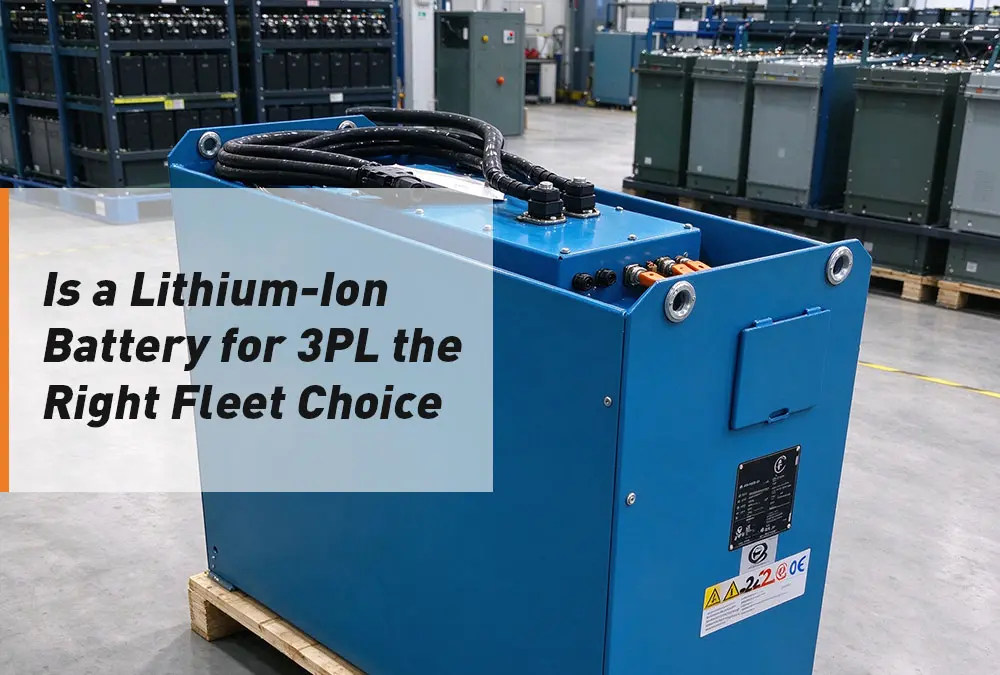
A lithium-ion battery for 3PL forklift fleets can remove battery changes, support charging during natural pauses and reduce routine lead-acid maintenance. But those benefits do not come from chemistry alone. They appear only when the battery, charger, truck, operator routine, facility power and customer contract work as one system.
That distinction becomes visible on a peak dispatch day. A reach truck that normally finishes its shift is approaching low state of charge before the last outbound wave. Another truck is waiting for a charger, while a pallet temporarily blocks the closest charging bay. Operations sees a service-level risk; finance sees the higher lithium-ion forklift battery cost; maintenance sees an ageing lead-acid fleet that consumes time through watering, equalisation, cleaning and battery changes.
Quick answer: lithium-ion usually deserves serious consideration in high-utilisation, multi-shift 3PL operations with dependable short charging windows and measurable battery-related downtime. It is not automatically the economical choice for a lightly used truck, a short customer contract, an unsuitable site electrical supply or a conversion with unresolved truck, weight, charger or service requirements.
Why 3PL Forklift Battery Decisions Are Different
A private warehouse may have a relatively stable product mix and production schedule. A third-party logistics provider can add a new account, absorb a promotion, handle seasonal returns or lose a contract while using the same building and material-handling fleet. The average workday therefore tells only part of the energy story. The battery system must cover the busiest dispatch window without becoming an oversized asset after the customer mix changes.
The Battery Council International’s forklift information brief says that no single solution fits every facility and identifies operating hours, environment, pallet weight, warehouse size, charging power, capital expenditure, end-of-life options and total cost of ownership as decision factors. BCI represents the battery industry and has a lead-battery perspective, so its product comparisons should be read in that context. Its central selection principle is nevertheless sound: analyse the facility before selecting the power source.
For a 3PL, the useful outcome is not the largest Ah value or the shortest advertised charge time. It is productive truck availability when contracted work must move. A practical baseline should therefore include productive truck hours, low-SOC interruptions, charge-queue minutes, battery-change events, maintenance tasks and tasks delayed during peak windows.
Where Is the Current Battery System Losing Capacity?
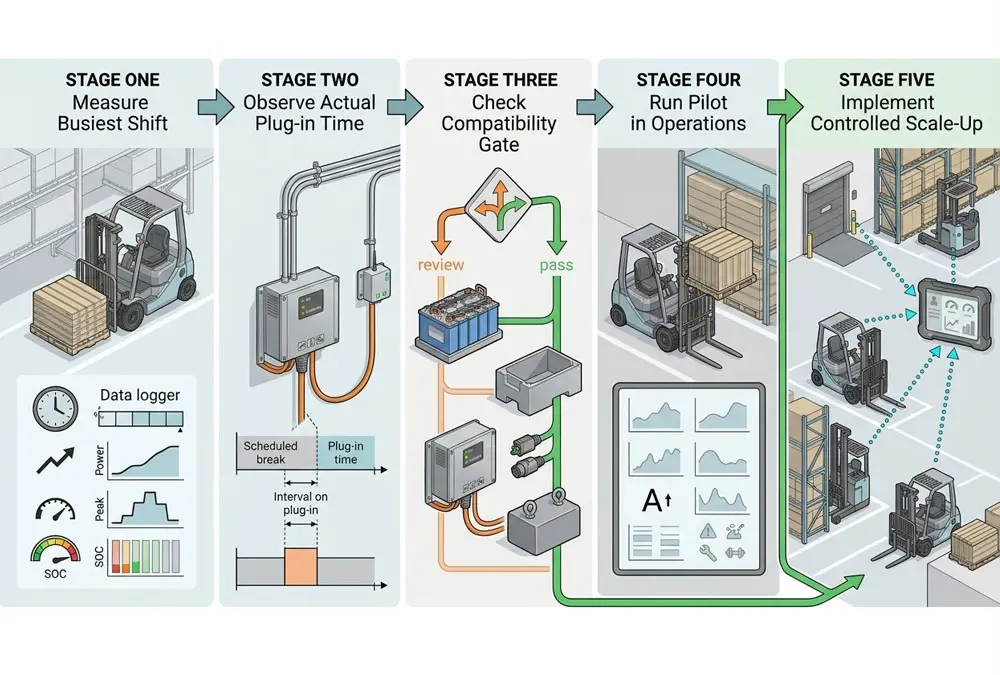
Do not start the project with a battery catalogue. Begin with two to four representative weeks of operational evidence, including at least one heavy day. Collect truck-level state of charge, energy use where available, charging start and stop times, battery changes, maintenance interventions and work interruptions. Separate counterbalanced trucks, reach trucks, order pickers and pallet trucks because their loads and charging opportunities can differ materially.
Suppose the next shift repeatedly receives a truck below the expected SOC. The cause may be insufficient battery energy, an ageing battery, a missed charging break, a charger fault, poor access to the charging position or an inaccurate dashboard indicator. Buying a larger pack addresses only the first possibility. The evidence path is more useful: compare BMS SOC with the truck display, inspect charger and fault logs, review actual connection time, and check whether the demanding truck uses more energy than the fleet average. The corrective action may be capacity, charger placement, training, battery health work or system integration—not always a bigger battery.
| What the team sees | Possible explanation | Evidence to collect | Next decision |
|---|---|---|---|
| Truck slows or stops near the last dispatch wave | Insufficient usable energy, ageing, high peak demand or protection trip | SOC trend, energy, current/fault logs, load and temperature | Diagnose before increasing Ah |
| The charger is installed but trucks still queue | Too much simultaneous demand or poor physical access | Arrival timestamps, bay occupancy and route observations | Change concurrency, placement or workflow |
| Operators do not trust the displayed SOC | BDI/BMS mismatch or poor calibration | Truck display, BMS SOC and low-SOC test results | Resolve the interface before rollout |
| Maintenance effort grows but is not visible in TCO | Battery age, watering, corrosion, cell or charger condition | Work orders, labour time, condition tests and downtime | Price continuing operation, repair and replacement separately |
Can Opportunity Charging Cover the Real 3PL Workday?
Opportunity charging means restoring energy during planned pauses instead of waiting for one long charging period. It is often the operational reason for considering lithium-ion. The common sizing mistake is to treat every scheduled break minute as a charging minute.
The detail an experienced warehouse team measures:
Effective plug-in minutes = scheduled pause − travel to the charger − queue time − parking and connector handling − return-to-work time.
Consider an illustrative 15-minute pause. If travel and queueing take three minutes, parking and connection take two, and the return to work takes two, only eight minutes remain connected. At a validated average DC charger output of 20kW during that interval, the arithmetic energy is approximately 2.67kWh: 20kW × 8/60 hours. This is not a product promise. The actual value can be lower because BMS limits, SOC, temperature, charge taper, balancing and charger behaviour affect accepted power.
The missed-charge case also matters. A model that works only when every operator connects at every break is fragile during a peak. Test what happens when one planned charging window is missed. The truck may need more reserve, a second accessible bay, a different break sequence or clearer SOC alerts. Charger placement should follow the work route; requiring a long detour reduces both plug-in time and operator compliance.
For the complete Ah and kWh method, use the site’s guide to size an electric forklift battery from the duty cycle. It separates voltage, energy, current and reserve rather than applying a fixed lead-acid-to-lithium Ah ratio.
Need a structured capacity check?
Use measured energy between dependable charging windows, then test the result against peak current, reserve, temperature and a missed charging opportunity.
How Many Chargers and Charging Bays Does a 3PL Need?
Charger planning is a concurrency problem. The key number is not the total truck count; it is how many trucks need energy during the same dependable window. A fleet of 20 vehicles may need only a subset connected simultaneously, while a smaller fleet with synchronised breaks can create a severe queue.
Count physical availability as well as electrical capacity. A charger behind stored pallets, inside a congested zone or exposed to truck impact is not reliably available. Review the route, floor markings, cable management, connector reach, parking position, protective barriers and the ability to keep the area clear during peak work. Permanent electrical feeds should be protected and installed to applicable local requirements; charger cables should have one safe route from the charger to the truck without crossing traffic unnecessarily.
The facility review must cover input voltage, phase, frequency, protective devices, available power and simultaneous demand. A battery-compatible charger can still be wrong for the building. Electricity tariffs and demand charges are site-specific, so use actual utility bills and a qualified electrical assessment rather than a regional average.
Yale’s warehouse energy strategy guidance explains that SOC, energy consumption, charging activity, temperature events and utilisation data can reveal workflow and operator-behaviour issues. That is a manufacturer perspective, not an independent performance guarantee, but it supports an important operational practice: battery telemetry becomes useful when it changes fleet deployment and charging decisions.
What Must Match Before a Lead-Acid-to-Lithium Conversion?
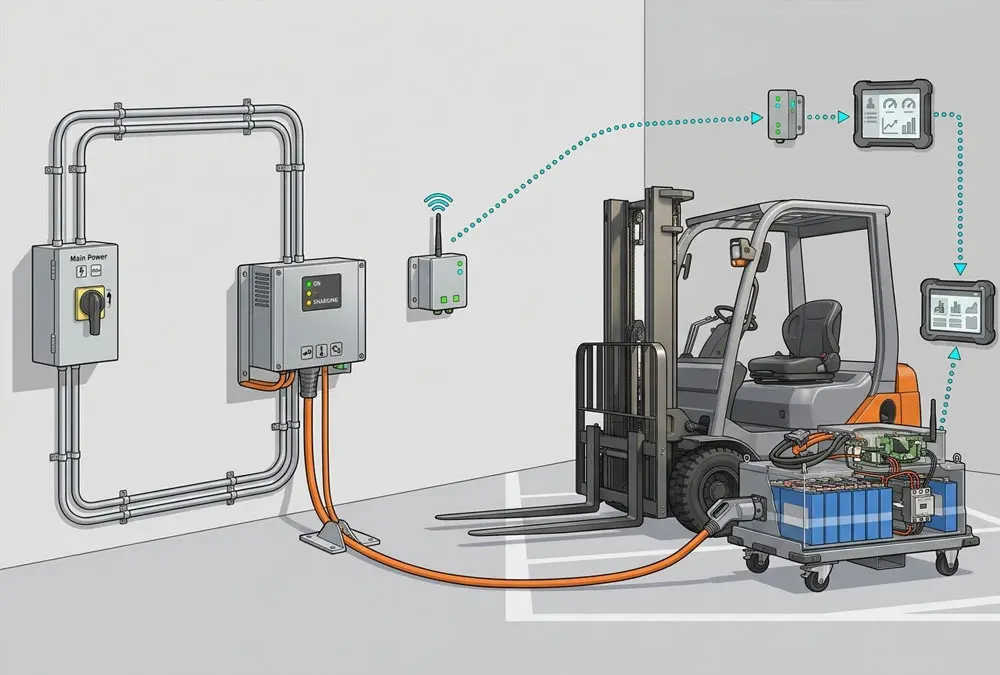
A lithium pack that fits the tray and powers the display can still fail under a loaded lift, regenerative braking, low SOC or high temperature. Treat the conversion as an interface-control project with three separate gates.
Electrical performance
Verify the truck’s operating-voltage window, continuous demand, peak current, peak duration and regenerative current. Nominal voltage and Ah do not answer these questions. The BMS, contactors, fuse, cables and connector must all support the validated duty without nuisance protection trips or unacceptable heating.
Mechanical fit and stability
Check compartment dimensions, removal route, minimum and maximum battery mass, restraint, enclosure strength, centre of gravity, connector position and lifting points. A lighter lithium cell assembly may require an engineered enclosure or fixed ballast for a particular truck. Loose steel and a matching scale weight do not constitute an approved configuration.
Charger, communication and SOC
A matching connector does not approve the old charger. Verify the exact battery and charger models, charge profile, maximum voltage, termination logic, communication, interlock, temperature behaviour and fault response. Test the truck’s SOC display against BMS data through the operating window. If operators stop trusting the display, they will change charging behaviour and invalidate the energy plan.
The detailed forklift lead-acid-to-lithium conversion review covers these interfaces and commissioning tests without assuming every existing truck can be converted.
AnengJi Battery Options for Mixed 3PL Fleets
A 3PL rarely operates only one vehicle class. AnengJi’s current forklift-battery reference configurations include application-specific 51.2V and 76.8V systems for counterbalanced trucks, reach trucks and conversion projects. The examples below use our product specifications and calculated nominal energy. They are starting points for engineering review—not universal drop-in replacements or measured runtime claims.
| Reference application | Voltage and capacity | Calculated nominal energy | Dimensions and listed mass | Buyer implication |
|---|---|---|---|---|
| 2-ton counterbalanced reference | 51.2V, 277Ah or 412Ah | 14.2kWh or 21.1kWh | 1030 × 500 × 507mm; 210kg | Truck mass range and peak demand still control approval. |
| Reach-truck reference | 51.2V, 277Ah or 412Ah | 14.2kWh or 21.1kWh | 1216 × 355 × 744mm; 1200kg | Equal voltage/Ah can require a radically different enclosure and mass. |
| Industrial truck reference | 76.8V, 412Ah | 31.6kWh | 980 × 688 × 700mm; 210kg | The exact truck, mass requirement and communication remain decisive. |
| Fuel-to-electric conversion reference | 76.8V, 280Ah | 21.5kWh | 730 × 600 × 340mm; 210kg | A conversion needs vehicle-level electrical and safety validation. |
The shown configurations list 200A continuous charge and discharge at 25°C. That rating does not prove that a pack can support the truck’s peak hydraulic event, regenerative current, temperature range or required charging rate. Those inputs must be verified for the offered model and duty. Alongside application-specific enclosures, buyers can review AnengJi’s forklift lithium battery options. Standard-format LiFePO4 products can also provide a starting point for some material-handling equipment, but any standard product remains only a candidate until the truck, charger, mass, connector, current and approval boundaries match.
Request a 3PL truck–battery–charger review
Send the truck data plates, existing batteries, shift profile, actual charging windows, site power and destination. The review can return a candidate configuration, missing inputs, no-go conditions and the information required for a comparable quotation.
How Should a 3PL Compare Forklift Battery Cost?
The search question “how much do forklift batteries cost?” cannot be answered responsibly from the pack price alone. A 3PL should normalise every quotation into four values:
- Battery-only price: the defined pack and included hardware.
- Landed-and-installed system cost: battery, charger, enclosure/ballast, freight, import scope, electrical work, installation and commissioning.
- Annual operating and support cost: energy, routine work, battery changes, service, diagnostics, spares and downtime.
- Cost per productive truck hour: net contract-period cost divided by the hours in which the fleet is available for productive work.
This approach keeps electric forklift battery cost connected to the operation. A higher lithium-ion forklift battery cost may be justified when it removes documented battery-management labour or prevents an otherwise necessary spare pack. It may not be justified when a truck runs lightly, the current battery system causes little disruption or the customer contract ends before the investment can be recovered.
Model at least three cases: the expected workload, the peak customer workload and a client-exit or fleet-change case. Include the cost and feasibility of moving chargers, reconfiguring packs or supporting equipment in another site. The site’s detailed forklift battery cost framework explains how to compare battery-only, installed, annual and productive-hour costs without averaging unlike public prices.
When Lithium-Ion May Not Be the Best 3PL Choice
Lithium-ion is not a default answer for every logistics site. Keep or renew a suitable lead-acid system, or delay the conversion, when the evidence points to one or more of the following:
- The truck has low utilisation and battery-related work does not constrain throughput.
- The remaining customer contract or truck ownership period is too short, with no credible redeployment plan.
- The site lacks dependable charging power, accessible bays or the required electrical work.
- The truck’s permitted battery mass, controller limits or approval route cannot be established.
- The supplier cannot document charger compatibility, diagnostics, warranty labour and the service route.
- The operating process cannot keep chargers accessible or make opportunity charging reliable.
The correct result of a feasibility study can be “not yet.” That conclusion is more valuable than replacing familiar lead-acid work with charger queues, BMS trips, inaccurate SOC or an unsupported truck configuration.
Europe First: What Evidence Should a 3PL Require?
Europe
The official IEC 62619:2022 page states that the standard specifies safety requirements and tests for industrial secondary lithium cells and batteries and explicitly lists forklift trucks and AGVs among motive-application examples. That scope does not prove that a proposed battery is certified. Request the test or certificate, issuing body or laboratory, edition, date and exact model coverage.
The EU Batteries Regulation 2023/1542 covers industrial batteries and establishes requirements relating to sustainability, safety, labelling, information, conformity, producer responsibility and waste batteries, with provisions applying on different dates. A buyer should identify the battery category, economic-operator roles, destination country and applicable dates instead of treating a CE mark as the complete procurement check.
The UK Health and Safety Executive’s Using Electric Storage Batteries Safely guidance addresses warehousing and materials handling and recommends trained personnel, suitable handling precautions and a dedicated, well-ventilated charging area. It is UK workplace guidance and should be combined with the destination country’s current electrical, fire, machinery, insurer and forklift-manufacturer requirements.
United States
The current eCFR text for 29 CFR 1910.178 requires manufacturer approval for modifications affecting capacity or safe operation and addresses designated battery-charging areas, charging-apparatus protection, battery handling equipment, correct positioning and securing, ignition controls and operator training. A specific site may also have state, local, insurer, truck-OEM and authority-having-jurisdiction requirements.
Central Asia, Africa and other export markets
These regions do not share one rulebook or service environment. Verify the destination country’s import, dangerous-goods transport, electrical, workplace, fire and waste-battery requirements. Add grid voltage, frequency, phase, generator use, temperature, dust, humidity, network coverage, inland transport, unloading equipment, local language, spare parts and warranty-labour responsibility to the RFQ.
Prove the Business Case With a Controlled Pilot
Before a fleet-wide purchase, select representative trucks from the most important duty clusters. Record the lead-acid baseline, then run the candidate system through normal and peak work. A credible pilot should include a heavy shift, a missed opportunity-charge window, loaded lift and travel, ramps where applicable, low-SOC operation, simultaneous charger demand and the expected operating temperature.
Acceptance criteria should be written before the pilot. Compare productive availability, energy restored, charger queues, SOC consistency, fault and temperature events, operator adherence, maintenance work and service response. Do not replace this evidence with a supplier case study showing a savings percentage at another warehouse.
Scale only after the battery, charger, truck and work process pass together. If one duty cluster succeeds and another fails, the correct answer may be different pack/charger configurations—not one standard battery forced across the entire fleet.
3PL Lithium-Ion Forklift Battery RFQ Checklist
- Truck make, model, serial number, data plate and ownership or lease status.
- Existing battery model, chemistry, voltage, Ah/kWh, complete mass, dimensions and connector.
- Truck type, load, attachments, ramps, temperature and peak-shift profile.
- Measured energy, SOC history, peak current and fault data where available.
- Actual plug-in windows and simultaneous charger demand.
- Facility voltage, phase, frequency, protection and available electrical capacity.
- Required charger/BMS/truck communication, SOC display and diagnostic access.
- Model-specific safety, test, transport, conformity and end-of-life documents.
- Installation, commissioning, training, spares, warranty labour and response route.
- Destination, Incoterm, customer-contract horizon, expansion and redeployment plan.
Frequently Asked Questions About Lithium-Ion Batteries for 3PL Forklifts
Is a lithium-ion forklift battery worth it for a single-shift 3PL?
Not automatically. Compare utilisation, battery-related maintenance, interruptions, charging opportunities, complete installed cost and the customer-contract horizon. A well-maintained lead-acid system may remain economical when energy management does not constrain work.
How many lithium-ion batteries does a 3PL need per forklift?
There is no universal ratio. Determine energy used between dependable charging windows, actual plug-in minutes, charger concurrency, reserve, temperature and the effect of missing a planned charge. Validate the result in a representative pilot.
Can the existing lead-acid charger be reused?
Only when the exact battery and charger models, voltage profile, termination logic, communication, temperature response and connector are documented as compatible. A physically matching connector is not charger approval.
How should a 3PL compare lithium-ion forklift battery cost?
Compare battery-only price, landed-and-installed system cost, annual operating/support cost and cost per productive truck hour. Test expected, peak and client-exit scenarios using site-specific energy, labour, downtime and quotation data.
What proves that opportunity charging will cover peak season?
Use peak-shift energy and SOC logs, actual connection time, charger output, simultaneous demand, temperature and a missed-charge test. A schedule showing several breaks does not prove that the trucks can access and use those minutes.
What documents should a European 3PL request?
Request model-specific technical limits, safety and transport documentation, applicable conformity evidence, charger/communication instructions, installation and operating documents, warranty/service terms and end-of-life responsibilities. Confirm the exact battery category, model coverage, current edition and destination-country obligations.
Switch Only When the System Protects the Peak Shift
A lithium-ion forklift battery creates 3PL value when it protects the operating window that matters to the customer. That requires more than a fast-charging pack. Measure peak duty, use real plug-in minutes, plan simultaneous charging, verify the truck and site interfaces, model the customer-contract horizon, and prove the result before scaling.
This approach also makes the purchasing decision more honest. Some fleets will justify conversion because battery changes, maintenance or lost availability are measurable constraints. Others will discover that charger access, an ageing truck, a short contract or local support is the real limit. In both cases, the 3PL gains a defensible energy plan instead of another battery claim.
Related Articles

Related Posts
 https://anengjibattery.com/wp-content/uploads/2026/10/AnengjiBattery-Is-a-Lithium-Ion-Battery-for-3PL-the-Right-Fleet-Choice.webp
675
1000
Battery Expert Team
https://anengjibattery.com/wp-content/uploads/2025/06/logo2-300x138.png
Battery Expert Team2026-10-28 07:16:182026-10-28 07:17:07Is a Lithium-Ion Battery for 3PL the Right Fleet Choice?
 https://anengjibattery.com/wp-content/uploads/2026/10/AnengjiBattery-Forklift-Battery-Weight-in-a-Working-Warehouse.webp
675
1000
Battery Expert Team
https://anengjibattery.com/wp-content/uploads/2025/06/logo2-300x138.png
Battery Expert Team2026-10-27 02:59:132026-10-27 02:59:15How Does Forklift Battery Weight Affect Stability and Fit?
 https://anengjibattery.com/wp-content/uploads/2026/10/AnengJIBattery-Top-10-Forklift-Battery-Manufacturers-for-Cold-Storage.webp
675
1000
Battery Expert Team
https://anengjibattery.com/wp-content/uploads/2025/06/logo2-300x138.png
Battery Expert Team2026-10-26 09:12:412026-10-27 02:59:38Top 10 Forklift Battery Manufacturers for Cold Storage
 https://anengjibattery.com/wp-content/uploads/2026/10/AnengjiBattery-Cell-to-Pack-Energy-Density-Comparison.webp
675
1000
Battery Expert Team
https://anengjibattery.com/wp-content/uploads/2025/06/logo2-300x138.png
Battery Expert Team2026-10-23 06:58:392026-10-23 06:58:41What Does Lithium-Ion Battery Energy Density Really Mean?



Leave a Reply
Want to join the discussion?Feel free to contribute!