
Solar Farm Battery Storage: Utility-Scale Solar Power Solutions
July 8, 2026 / Battery Expert Team / battery energy storage
Introduction
The global transition toward clean power moves faster than traditional transmission grids can adapt. Relying entirely on raw, unbuffered solar generation creates severe grid compliance struggles for modern asset developers. Across international energy markets, integrating a reliable Solar Farm Battery Storage framework has evolved from an optional upgrade into an absolute grid requirement.
Volatile daytime production curves often force unexpected system curtailments, causing real revenue losses for independent power producers. Deploying high-capacity infrastructure transforms unpredictable solar generation into a highly dependable, fully dispatchable base-load power asset class.
What Is Solar Farm Battery Storage?
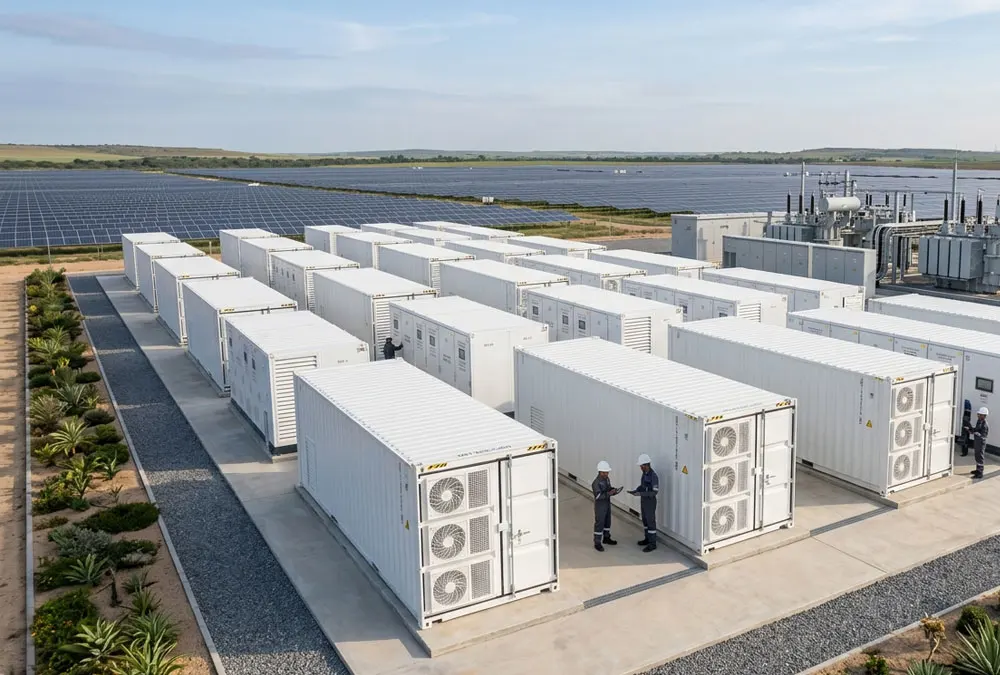
A Solar Farm Battery Storage system is a utility-scale electrochemical installation designed to capture massive electrical volumes directly from photovoltaic arrays. It safely anchors volatile current swings, holding megawatt-hours of energy within modular thermal-controlled enclosures until regional dispatchers call for immediate power injection.
How Does a Solar Farm Battery Storage System Work?
The operational workflow bridges generation peaks with real consumption curves through precise automated software directives:
- Daytime Storage and Nighttime Discharge: High-density cell blocks soak up excess solar generation when the sun hits peak noon saturation, avoiding local line overloads. The system then pumps this clean energy back into transmission lines during lucrative evening demand spikes.
- Peak-Valley Price Arbitrage: The local facility tracks automated utility pricing signals, charging assets during low-value generation periods and selling output when regional power rates skyrocket.
- Smoothing Photovoltaic Output: Rapidly passing cloud cover can drop a solar field’s output by megawatts within seconds. The battery system detects this voltage sag instantly, discharging power to maintain a flat, stable export line.
- Frequency and Voltage Regulation: Advanced active control logic injects or absorbs reactive power dynamically. This rapid action keeps localized grid frequency tightly within strict utility limits.
- EMS Coordinated Dispatch: An intelligent energy management system oversees entire subsystem arrays, continually matching battery states with complex utility grid demands.
Core Components of a Solar Farm Battery Storage System
Achieving high round-trip efficiency requires seamless hardware synchronization across the entire plant layout. Heavy-duty battery packs house the underlying electrochemical cells, which are wired in high-voltage series strings to reduce conduction line losses. Bi-directional Power Conversion Systems (PCS) handle immediate AC-to-DC rectification during charging and switch instantly to invert DC power back for grid export. A multi-tier Battery Management System (BMS) tracks individual cell temperatures and voltages, communicating directly with the centralized Energy Management System (EMS) to balance power limits. The physical infrastructure relies on specialized step-up transformers to match high-voltage transmission lines, while dedicated HVAC liquid-cooling manifolds control internal thermal environments. Integrated fire protection circuits monitor for early off-gas anomalies, sending real-time operational telemetry straight to the master plant SCADA network.
Why Utility-Scale Solar Projects Need Battery Energy Storage Systems
Solve Solar Curtailment Problems
When regional solar generation floods local distribution lines beyond safe thermal carrying limits, utility operators issue mandatory curtailment orders. For project owners, forcing inverters offline means wasting completely free solar energy. Integrating an automated Battery Energy Storage System absorbs this excess energy instead of dumping it, ensuring every captured kilowatt-hour eventually yields a financial return.
Improve Grid Stability and Reliability
Modern electrical grids fail without constant equilibrium between supply and demand. Massive, unbuffered photovoltaic farms introduce steep ramp-rate challenges that can destabilize local substations. A utility-scale energy storage asset responds within milliseconds to frequency drops, providing essential active spinning reserves and critical black-start capabilities during unexpected regional grid blackouts.
Shift Energy to Peak-Price Periods (Peak Shifting)
The financial value of electricity changes significantly throughout the day. Dumping all your solar generation into a mid-day market often yields low returns due to localized oversupply. Shifting energy to peak-price periods allows asset managers to hold electricity until evening demand spikes, driving much higher margins per megawatt-hour sold.
Unlock Multiple Revenue Streams
Modern battery assets generate strong financial returns through stacked operational services. Beyond basic energy arbitrage, facilities capture steady monthly revenues by participating in rapid frequency regulation and capacity markets. Operators also secure lucrative ancillary service contracts from regional utilities while accumulating valuable renewable energy credits across compliant regulatory zones.
Reduce Dependence on Fossil Fuel Backup
Historically, utilities fired up expensive, high-emission diesel generators or gas peaker plants to handle sudden solar drops. Large stationary battery containers replace these dirty legacy assets entirely. They deliver significantly faster response times, produce zero localized emissions, and lower ongoing operational and maintenance overhead costs across the project’s lifecycle.
Buyer’s Reality Check: The Interconnection Hold-up
Let’s look at real-world field development issues frankly.
Many procurement teams focus entirely on finding the cheapest battery container wholesale pricing available.
They completely overlook whether the supplier provides fully validated regional utility simulation models.
If your hardware lacks certified hardware-in-the-loop compliance files, local engineers will deny grid connection.
Do not allow missing modeling documentation to delay your project commissioning schedule for months.
Benefits of Solar Farm Battery Storage for Project Owners
Increase Project ROI
Adding energy storage assets significantly optimizes long-term capital performance. Capturing clipped solar power and maximizing overall plant capacity factors creates reliable new cash flows. These steady revenue streams quickly offset initial capital expenditures, accelerating overall project payback schedules.
Improve Project Bankability
Tier-1 infrastructure funds and conservative international banks avoid financing volatile, unbuffered solar assets today. Introducing a robust Solar Farm Battery Storage solution secures predictable long-term cash flows even during volatile merchant market pricing. This financial stability makes projects highly bankable, helping developers secure lower debt interest rates.
Meet Utility Grid Connection Requirements
Transmission operators worldwide are implementing strict power-quality grid codes. Independent projects must prove they can manage aggressive ramp-rate limits before securing interconnection approval. Deploying certified storage hardware guarantees full grid compliance, completely protecting your asset from expensive utility non-conformance fines.
Support ESG Goals
Commercial power buyers demand clean energy profiles that match their real-time consumption needs. Transitioning from variable generation to dispatchable green power helps corporate clients meet strict environmental tracking goals. This operational shift enhances your project’s market value, attracting premium power purchase agreement counter-parties.
Enable Future Capacity Expansion
Standardized, pre-engineered container blocks allow project managers to expand site capacities down the road. You can install a baseline battery system today and easily parallel extra storage units as local solar capacity or load demands grow over time. This modular approach keeps early capital costs highly optimized.
Solar Farm Battery Storage Applications
Utility-Scale Solar Farms
Large-scale, ground-mounted solar fields deploy containerized storage systems to stabilize regional transmission networks. These multi-megawatt installations buffer massive energy shifts, allowing clean power to replace traditional coal or gas base-load generation plants entirely.
Agricultural Solar Farms (Agrivoltaics)
Combining dual-use agricultural solar arrays with local storage opens up excellent operational advantages for modern farming zones. The stored energy powers high-voltage irrigation pumps, automated greenhouse climate controls, and large cold-chain refrigeration facilities directly on-site. This specialized setup establishes independent agricultural microgrids that protect delicate rural crops from local utility outages.
Independent Power Producers (IPP)
Private power producers utilize flexible Utility-Scale Energy Storage systems to maximize merchant market revenues. Storage assets allow IPPs to avoid selling power during afternoon price drops, holding capacity to capture premium prices when regional energy markets tighten.
Hybrid Renewable Energy Projects
Modern co-located power plants combine wind turbines, solar fields, and backup diesel generators into unified generation networks. Centralized battery banks act as the primary operational anchor for these complex hybrid systems, smoothly blending diverse generation profiles to ensure reliable, continuous industrial power output.
Solar Farm Battery Storage Technologies Compared
Selecting the right core cell chemistry directly shapes your project’s long-term financial performance and operational safety limits:
- Lithium-Ion (NMC): Delivers very high volumetric energy density but requires complex thermal safety monitoring due to potential thermal runaway risks under extreme conditions.
- LiFePO4 (Lithium Iron Phosphate): Has become the dominant industry standard for stationary utility plants. This chemistry provides excellent thermal stability, an exceptional cycle life, and low manufacturing costs without relying on scarce cobalt minerals.
- Flow Battery (Vanadium): Offers nearly unlimited cycle life without material degradation, making it ideal for long-duration storage needs. However, it requires a massive physical footprint and carries high initial capital costs.
- Sodium-Ion: An emerging alternative technology that utilizes abundant, low-cost raw materials and performs exceptionally well in freezing temperatures, though it currently exhibits lower energy density.
| Battery Technology | Capital Cost (CAPEX) | Expected Cycle Life | Thermal Runaway Safety | Strategic Advantage for Project Owners |
|---|---|---|---|---|
| Premium LiFePO4 (LFP) | Highly Competitive | 6,000+ Cycles | Excellent Stability | Maximizes long-term ROI by offering the lowest cost-per-cycle over extended lifespans. |
| Traditional NMC Lithium | Moderate to High | 3,500+ Cycles | Requires Intensive Cooling | Saves physical space on highly constrained urban sites due to dense footprints. |
| Vanadium Flow Systems | Very High Initial Cost | 20,000+ Cycles | Inherently Non-Flammable | Eliminates capacity degradation entirely for multi-decade, long-duration energy projects. |
How to Choose the Right Solar Farm Battery Storage System
Sizing high-capacity utility assets requires careful evaluation of several core engineering factors:
- Storage Capacity Requirements: Analyze your historical solar generation curves and grid connection limits to determine the ideal megawatt (MW) and megawatt-hour (MWh) metrics.
- Battery Duration Selection: Match system storage durations with target market opportunities, choosing 2-hour configurations for rapid frequency markets or 4-hour to 6-hour options for steady energy shifting.
- Round-Trip Efficiency (RTE): Prioritize systems that deliver high round-trip efficiency to minimize auxiliary power losses across internal transformers and inverters.
- Battery Lifetime and Degradation Curves: Insist on verified cell-level testing data to guarantee the asset retains adequate capacity over its 10-year to 15-year operational lifecycle.
- Scalability and Modular Design: Choose modular, factory-assembled enclosures that allow for straightforward capacity expansion without requiring complete system rewrites.
- Cooling Technology: Evaluate liquid-cooling systems over standard air fans to ensure uniform cell-to-cell temperatures and prevent premature hot-spot degradation.
- Safety Standards and Compliance: Verify full hardware compliance with critical international standards including IEC 62619, UL 9540, and NFPA 855 fire safety rules.
Solar Farm Battery Storage Costs and ROI
What Determines System Cost?
Total project capital expenditures extend well beyond the base battery modules. Final budgets depend on Power Conversion System capacities, integrated energy management software, specialized site civil works, concrete foundation pouring, heavy crane rentals, and utility-scale grid interconnection costs.
Typical Costs by Project Size
According to the 2025 BloombergNEF Energy Storage Cost Architecture Report, utility-scale turn-key pricing has stabilized, offering better economics through volume deployment. Large 20MW to 100MW installations leverage strong procurement advantages to reduce overall per-kilowatt-hour integration expenses compared to smaller local systems.
Expected ROI and Payback Period
Financial payback timelines typically range from 4 to 7 years, depending heavily on local market structures. Systems focused on self-consumption in high-tariff zones show rapid returns, while merchant-market assets optimize income by stacking capacity payments alongside active frequency regulation services.
Government Incentives
International clean energy frameworks offer substantial financial support for modern storage deployment. Project developers can leverage competitive capacity market payments, regional green infrastructure tax credits, and specialized renewable incentives to lower upfront asset costs.
Challenges of Solar Farm Battery Storage Projects
Deploying utility-scale energy projects introduces distinct technical and environmental hurdles, but partnering with AnengJi Power helps turn these potential risks into reliable advantages:
- High Upfront Investment: Large energy projects require significant initial capital outlays.How AnengJi Solves It: Our highly optimized, modular system architecture minimizes early installation expenses and helps lower overall deployment costs.
- Complex Grid Compliance Rules: Navigating strict utility interconnection demands can cause costly project delays.How AnengJi Solves It: We provide fully integrated hardware solutions complete with pre-validated grid simulation models to ensure smooth utility approvals.
- Extreme Environmental Stress: Operating hardware in harsh desert heat or humid coastal zones can accelerate cell degradation.How AnengJi Solves It: Our advanced liquid-cooling enclosures maintain uniform internal temperatures, fully protecting cells in extreme climates.
Why Choose AnengJi Power for Solar Farm Battery Storage?
AnengJi Power delivers premium hardware and software systems engineered for demanding utility-scale and industrial projects. Our turn-key solar-plus-storage solutions combine advanced LiFePO4 chemistry with high-efficiency liquid cooling to ensure reliable long-term performance and safety. From initial system layout design and detailed grid modeling to final on-site commissioning and automated preventative O&M services, our team handles the entire lifecycle to guarantee complete project compliance and optimize your clean energy investment.
Featured Solar Farm Battery Storage Solutions
We engineer a comprehensive line of pre-integrated energy storage systems tailored to match diverse operational profiles and project footprints:
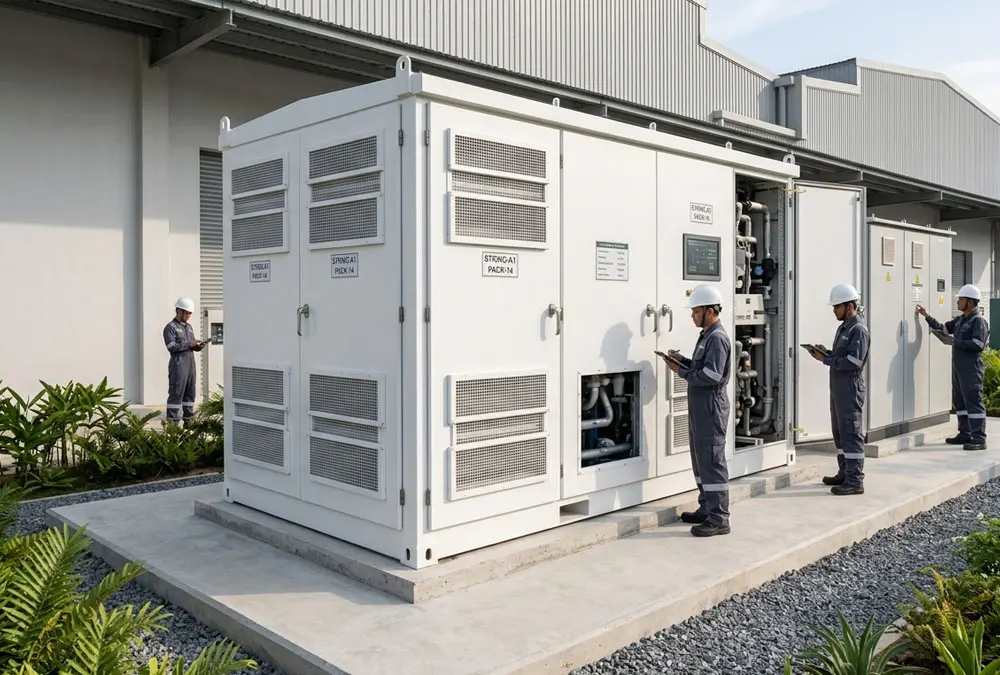
- 100kWh Industrial Energy Cabinet: Designed for small commercial solar arrays, featuring a compact, space-saving footprint and highly integrated plug-and-play connections.
- 261kWh Liquid-Cooling Battery Unit: Engineered for mid-sized industrial load shifting, utilizing precision liquid cooling to maximize cell lifetime and stability.
- 1MWh Containerized BESS Block: Ideal for community-scale solar farms, combining robust fire suppression and comprehensive multi-tier BMS protection into a durable weatherproof enclosure.
- 5MWh Utility-Scale Storage System: Our flagship high-density 20ft container solution designed for massive multi-megawatt generation plants, engineered to minimize land use and streamline grid substation integration.
Frequently Asked Questions About Solar Farm Battery Storage
How large should a battery be for a solar farm?
Sizing depends on your specific grid connection goals. Most utility-scale projects typically install battery capacities equal to twenty to fifty percent of the total solar farm megawatt rating, configured for two to four hours of continuous storage duration.
Is solar farm battery storage profitable?
Yes. By capturing inexpensive mid-day energy and discharging power during peak evening demand windows, systems generate strong returns while unlocking extra revenue through active participation in regional frequency regulation markets.
How does battery storage improve project ROI?
Storage prevents financial losses from mandatory utility curtailments. It allows independent power producers to shift energy sales to high-tariff periods, maximizing the overall financial yield for every megawatt-hour generated.
Can battery storage eliminate solar curtailment?
Yes. Instead of shutting down inverters when transmission lines face overload, the system automatically redirects excess solar generation into battery storage, preserving the clean energy for later use.
Which battery technology is best?
Lithium Iron Phosphate (LiFePO4) is highly recommended for utility applications. It delivers an optimal combination of excellent thermal safety, a long cycle life, and competitive production economics compared to alternative chemistries.
What is the lifespan of a utility-scale BESS?
Premium systems are engineered to deliver fifteen years of reliable field service. Maintaining stable cell environments through precision liquid cooling helps maximize overall system lifespan and minimize capacity degradation.
Get a Customized Solar Farm Battery Storage Solution
Ready to secure your utility interconnection approval and optimize your energy generation returns? Share your specific project capacity requirements, target installation country, grid type, and expected commercial operation date with our engineering team today. We will develop a comprehensive, pre-engineered technical proposal tailored to help you maximize your renewable asset investment.
Related Article
Related Posts
 https://anengjibattery.com/wp-content/uploads/2026/10/AnengjiBattery-Lithium-Battery-Management-in-Daily-Operation.webp
675
1000
Battery Expert Team
https://anengjibattery.com/wp-content/uploads/2025/06/logo2-300x138.png
Battery Expert Team2026-10-22 08:17:332026-10-22 08:17:44How Does a Lithium BMS Improve Battery Longevity?
https://anengjibattery.com/wp-content/uploads/2026/10/AnengjiBattery-Lithium-Battery-Management-in-Daily-Operation.webp
675
1000
Battery Expert Team
https://anengjibattery.com/wp-content/uploads/2025/06/logo2-300x138.png
Battery Expert Team2026-10-22 08:17:332026-10-22 08:17:44How Does a Lithium BMS Improve Battery Longevity? https://anengjibattery.com/wp-content/uploads/2026/10/AnengjiBattery-Industrial-Power-Under-Real-Load.webp
675
1000
Battery Expert Team
https://anengjibattery.com/wp-content/uploads/2025/06/logo2-300x138.png
Battery Expert Team2026-10-22 07:04:542026-10-22 07:05:30How Does a 48V LiFePO4 BMS Protect Industrial Power?
https://anengjibattery.com/wp-content/uploads/2026/10/AnengjiBattery-Industrial-Power-Under-Real-Load.webp
675
1000
Battery Expert Team
https://anengjibattery.com/wp-content/uploads/2025/06/logo2-300x138.png
Battery Expert Team2026-10-22 07:04:542026-10-22 07:05:30How Does a 48V LiFePO4 BMS Protect Industrial Power? https://anengjibattery.com/wp-content/uploads/2026/10/AnengJIBattery-Electric-Forklift-Battery-Buying-Decision.webp
675
1000
Battery Expert Team
https://anengjibattery.com/wp-content/uploads/2025/06/logo2-300x138.png
Battery Expert Team2026-10-21 06:22:222026-10-21 06:22:38Ready to Buy Battery for Electric Forklift? Use This Guide
https://anengjibattery.com/wp-content/uploads/2026/10/AnengJIBattery-Electric-Forklift-Battery-Buying-Decision.webp
675
1000
Battery Expert Team
https://anengjibattery.com/wp-content/uploads/2025/06/logo2-300x138.png
Battery Expert Team2026-10-21 06:22:222026-10-21 06:22:38Ready to Buy Battery for Electric Forklift? Use This Guide https://anengjibattery.com/wp-content/uploads/2026/10/AnengJIBattery-Diagnosing-Electric-Forklift-Runtime-Loss.webp
675
1000
Battery Expert Team
https://anengjibattery.com/wp-content/uploads/2025/06/logo2-300x138.png
Battery Expert Team2026-10-20 07:16:552026-10-20 09:59:05Electric Forklift Battery Life: How Can You Extend It?
https://anengjibattery.com/wp-content/uploads/2026/10/AnengJIBattery-Diagnosing-Electric-Forklift-Runtime-Loss.webp
675
1000
Battery Expert Team
https://anengjibattery.com/wp-content/uploads/2025/06/logo2-300x138.png
Battery Expert Team2026-10-20 07:16:552026-10-20 09:59:05Electric Forklift Battery Life: How Can You Extend It?


Leave a Reply
Want to join the discussion?Feel free to contribute!