
Forklift Battery Recycling: A Practical Disposal Guide
November 11, 2026 / Battery Expert Team / Battery Basics
Introduction
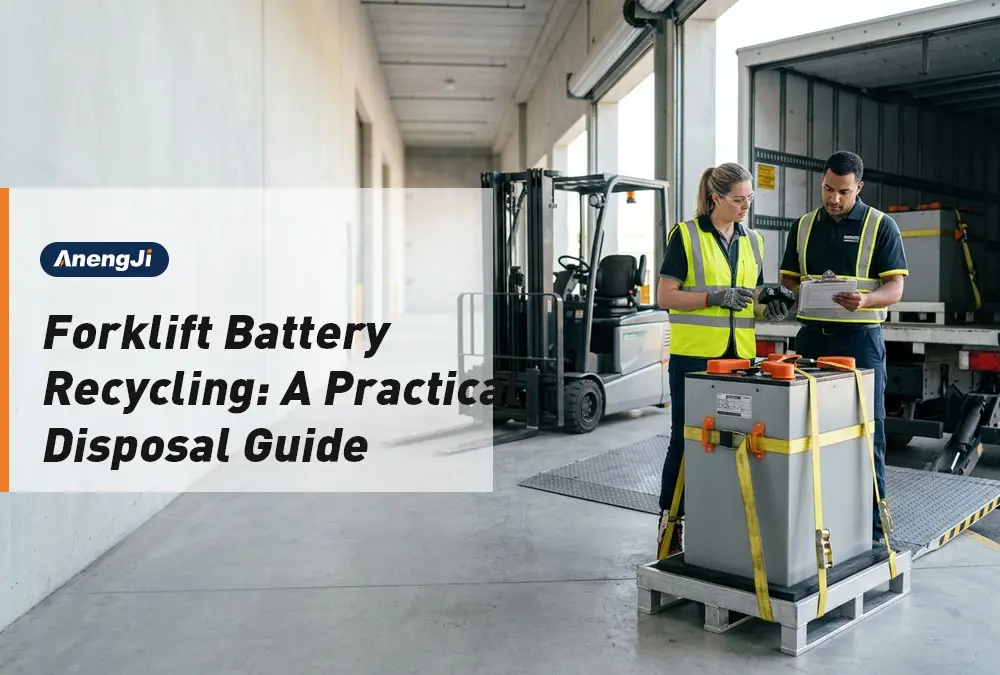
When an industrial battery reaches the end of its useful life, forklift battery recycling is not simply a matter of finding the nearest scrap buyer. The battery may weigh hundreds of kilograms, retain dangerous electrical energy, contain corrosive electrolyte or require regulated packaging and transport. A recycler may accept the chemistry but still refuse the collection because nobody has agreed who will remove the battery from the truck, prepare it for transport or load the collection vehicle.
This guide gives fleet, warehouse, maintenance, EHS and procurement teams a practical route from “we have an old battery” to a documented handover. It covers lead-acid and lithium-ion traction batteries, with Europe first, the United States second, and additional considerations for Central Asia, Africa and other markets. It is operational guidance, not country-specific legal advice; the qualified recycler, dangerous-goods carrier and local authority must confirm the final route.
Quick answer: First identify the battery chemistry, ownership and condition. Isolate a damaged unit, retain the nameplate and service records, and send the recycler a quote-ready data pack before moving anything. Do not dismantle, drain, crush or apply a universal “fully discharge it” rule. The accepted handler should define removal, packaging, loading and transport based on the exact battery and jurisdiction.
What Should You Do With an Old Forklift Battery First?
The most common early mistake is to ask only, “What is the scrap price?” A recycler cannot safely quote from voltage or a photo of the steel case alone. The same-looking tray could contain flooded lead-acid cells, a lithium pack, or a battery that has already been rebuilt. Condition also changes the route: an intact battery that has simply lost capacity is not the same collection job as a hot, swollen, leaking or impact-damaged pack.
- Stop using the battery if there is a safety trigger. Unusual heat, smoke, hissing, a strong odour, electrolyte leakage, deformation, fire exposure, impact damage or repeated protection events require the site’s emergency and isolation procedure. Do not move the battery merely to clear a work area.
- Identify the chemistry and battery. Record the manufacturer, model, serial number, chemistry, nominal voltage, rated capacity, mass and dimensions from the nameplate and available documentation. A connector style or outer case does not prove chemistry.
- Separate asset decisions from waste decisions. Decide whether the unit is being evaluated for continued use, professional repair, repurposing or recycling. Once it enters a waste route, different handling and documentation obligations may apply.
- Contact an appropriate industrial-battery route. Depending on location, this may be the producer or producer-responsibility organisation, distributor, forklift dealer, approved industrial-battery recycler or qualified waste contractor.
- Obtain written acceptance before collection. The acceptance should name the chemistry and condition, not merely say “battery,” and should assign removal, packaging, loading, transport and documentation responsibilities.
This order solves a familiar operational problem. A collection truck may arrive with a tail lift or crane but still be unable—or not contracted—to extract the battery from the forklift. If the facility cannot provide the approved handling equipment, the truck leaves, the loading bay stays blocked and the battery remains on site. Put extraction and loading responsibilities in the quotation rather than assuming “pickup” includes both.
Should the Battery Be Reused, Repaired, Repurposed or Recycled?
End of service in one forklift does not automatically mean end of technical life, but “it still shows voltage” is not evidence that a battery is suitable for another application. The decision should be supported by chemistry-appropriate testing, condition evidence and an accountable destination.
Continue using or professionally repair it when evidence supports the duty
A qualified assessment may support continued use or repair when the enclosure, terminals, cables and internal system are serviceable; the battery still passes an appropriate performance and safety assessment; and the repair has a defined procedure and final test. For lithium systems, review available BMS fault, cell-voltage and temperature records. For lead-acid units, the assessment may include maintenance history and controlled capacity testing. Never bypass a BMS, contactor, fuse or protection limit to make a weak battery appear usable.
Treat repurposing as a new engineering project
Second-life use requires more than moving a pack to a lighter job. State of health, electrical architecture, residual risk, enclosure, control interface, thermal behaviour, duty cycle and the receiving system must be evaluated. Ownership of the modified system and its documentation must also be clear. If no competent party will accept responsibility for evaluation and integration, the safer commercial route is controlled recycling.
Recycle it when continued service cannot be justified
Recycling is normally the appropriate route when condition is unsafe or unknown, the battery cannot meet the verified duty economically, repair lacks a controlled process, traceability is missing, or no suitable second-life application can be validated. Do not leave the unit indefinitely in a corner while ownership becomes unclear; storage time increases the chance that labels, records and responsible contacts disappear.
Why Lead-Acid and Lithium Forklift Batteries Need Different Recycling Routes
The two chemistries can both be recycled, but the hazards, residual value and downstream processes differ. This comparison is useful because a recycler qualified for one stream may not accept the other.
| Decision field | Lead-acid traction battery | Lithium-ion / LiFePO4 traction battery |
|---|---|---|
| Key hazards | Very high mass, corrosive sulfuric-acid electrolyte, short-circuit energy and lead exposure if handled or processed improperly | Residual electrical energy, short circuit, thermal event risk and special treatment of damaged, defective or recalled packs |
| Information the receiver needs | Flooded or sealed type, mass, electrolyte leakage, tray/case condition and accessibility for approved lifting | Exact chemistry, pack energy/capacity, BMS status if available, damage or recall status, terminal condition and transport classification inputs |
| Typical downstream focus | Controlled separation and recovery of lead-bearing material, plastic and electrolyte-related streams | Safe discharge or deactivation under an approved process, dismantling or size reduction, and recovery through mechanical, pyrometallurgical and/or hydrometallurgical steps |
| Do not do this | Drain electrolyte, open cells, improvise lifting or send to an informal processor | Open the enclosure, bypass protection, crush the pack, assume zero dashboard SOC means zero energy, or place it in a lead-acid stream |
The World Health Organization’s report on used lead-acid battery recycling explains that poorly controlled recycling can cause significant environmental contamination and human exposure to lead. That is why a high headline scrap price is not a reason to use an informal route. For lithium batteries, residual energy and condition drive the packaging and transport decision even when the pack no longer runs the forklift.
How Do You Decide Whether a Battery Is Safe for Routine Pickup?
An intact battery may enter a routine collection process defined by the accepted recycler and carrier. A battery with uncertain or abnormal condition requires a separate branch. Before requesting pickup, record whether there is:
- leakage, wetness, corrosion or damaged terminals;
- swelling, deformation, crushed areas or puncture;
- heat, smoke, hissing, venting, unusual odour or fire exposure;
- a recent collision, drop, overcharge, water exposure or electrical fault;
- a manufacturer recall or a safety-related “do not use” instruction;
- missing nameplate information or unknown chemistry.
If any item applies, stop treating the unit as a routine scrap pickup. Preserve the evidence, restrict access under the site’s emergency procedure and contact the manufacturer, qualified recycler and dangerous-goods specialist. Do not move a hot or unstable battery through an occupied warehouse just because the collection point is outside.
In the United States, the Pipeline and Hazardous Materials Safety Administration’s 2024 interpretation states that damaged or defective lithium batteries capable of dangerous heat, fire or short circuit must follow the requirements of 49 CFR 173.185(f). The EPA’s lithium-ion battery recycling guidance also notes that damaged, defective or recalled batteries may not be transported by air and points to the relevant DOT packaging requirements. This is why “send us a photo and put it on a pallet” is not an adequate damaged-pack procedure.
What Information Does a Recycler Need Before Quoting Pickup?
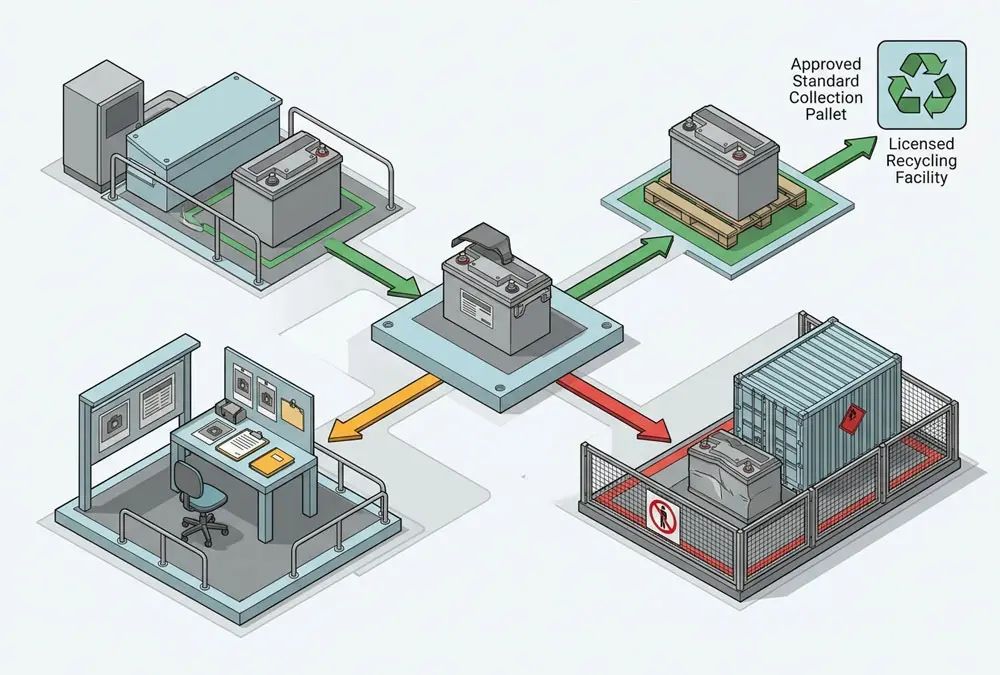
If a recycler stops replying after the first call, the problem may be missing intake data rather than unwillingness to collect. Send one structured pickup file instead of a series of partial messages. Include:
- Battery identity: manufacturer, model, serial number, chemistry and clear nameplate photographs.
- Electrical data: nominal voltage, rated Ah or kWh, connector condition and known state-of-charge information without presenting it as proof of zero energy.
- Physical data: actual or documented mass, dimensions, quantity, enclosure or tray condition and terminal protection status.
- Condition evidence: photographs from all accessible sides, description of leakage, swelling, heat, impact, water/fire exposure, alarms, recall status and last known use.
- Location and access: country, postal code, floor level, doorway and dock restrictions, truck access, indoor/outdoor location and required collection window.
- Handling capability: whether the battery is still installed, who is qualified to remove it, which approved lifting equipment is available and who will load the vehicle.
- Commercial and documentation request: collection charge, material credit, packaging, special handling, transporter, receiving facility and the completion documents to be supplied.
Industry detail that prevents failed pickups: ask two separate questions—“Who removes the battery from the forklift?” and “Who loads it onto the collection vehicle?” A provider may offer transport but not extraction, or may require the facility to present an accepted, packaged unit at the loading point.
If the battery is an AnengJi model and its product identity or documents are missing from the pickup file, request a model-specific documentation check before approaching the local recycling route.
Request a Product Documentation Check
How Should an Intact Forklift Battery Be Prepared for Collection?
Preparation must follow the written instructions of the accepted recycler and carrier. A useful site sequence is to secure the work area, shut down the truck under the approved procedure, retain labels, protect against short circuits using the accepted method, prevent movement or tipping and keep the battery away from impact, water, heat and ignition sources. Do not improvise packaging or lift points.
Forklift batteries are heavy enough to create a mechanical hazard before chemistry is even considered. OSHA’s electric powered-industrial-truck guidance instructs relevant US workplaces to use a lifting beam or equivalent material-handling equipment when lifting a battery and warns against using a two-hook chain because it can distort and internally damage the unit. Extraction should therefore be planned as a controlled handling job—not assigned to whoever happens to be near the loading dock.
For an intact lead-acid battery, check the accepted method for upright placement, tray condition, leak containment and terminal protection. For lithium, obtain chemistry- and condition-specific transport instructions. Do not copy a generic storage SOC or “fully discharge before recycling” rule from the internet; the safe route depends on pack design, BMS status, recycler process and transport rules.
What Forklift Battery Recycling Rules Apply in Europe?
In the European Union, forklift traction batteries generally fall within the industrial-battery framework, but the exact category and economic-operator responsibilities must be confirmed for the product and transaction. Under the EU Batteries Regulation (EU) 2023/1542, producers or appointed producer-responsibility organisations must take back relevant waste industrial batteries free of charge and without requiring the end user to buy a new battery. The rule applies within the territory where the producer first made that category available and operates alongside distributor and permitted-waste-operator routes.
The Regulation also establishes measurable recycling-efficiency and material-recovery targets. These are process-level legal targets—not a promise that the same percentage of every individual forklift battery will be returned as saleable material.
| EU target category | Deadline | Lead-acid / lead | Lithium-based / lithium | Other named materials |
|---|---|---|---|---|
| Recycling efficiency by average battery weight | 31 Dec 2025 | 75% | 65% | 80% nickel-cadmium; 50% other waste batteries |
| Recycling efficiency by average battery weight | 31 Dec 2030 | 80% | 70% | — |
| Material recovery | 31 Dec 2027 | 90% lead | 50% lithium | 90% cobalt, copper and nickel |
| Material recovery | 31 Dec 2031 | 95% lead | 80% lithium | 95% cobalt, copper and nickel |
Buyer implication: ask which producer-responsibility or permitted treatment route covers the battery, where the receiving facility is located, and which document will close the handover. A recycler’s marketing percentage should not replace evidence of the permitted route. The EU and the United Kingdom are separate jurisdictions, so a UK site requires its own current review.
What Changes for Forklift Battery Disposal in the United States?
The United States does not have one simple national rule that answers every generator, chemistry, condition and state. The generator must identify the waste correctly and check federal, state and local requirements. The EPA states that most discarded lithium-ion and lithium primary batteries in use today are likely to be hazardous waste because of ignitability and reactivity, while also noting that state rules may be more stringent.
Three questions should be answered in writing before shipment:
- How is the battery classified and managed at the generating site?
- Which DOT packaging and transport requirements apply to its chemistry, size and condition?
- Which transporter and receiving facility will accept it, and what records will they return?
A battery that is intact but depleted may follow a different route from one with breached cells or dangerous damage. The EPA also explains that certain activities may be performed by universal-waste handlers under defined conditions, but this should not be read as permission for untrained site personnel to open or process a forklift pack. Use the accepted handler’s written procedure and verify state requirements.
What Should Buyers Verify in Central Asia, Africa and Other Markets?
These regions contain many different legal systems, service networks and transport routes. Do not copy an EU take-back statement or a US universal-waste procedure into another country. Start with the national environmental authority, hazardous-waste rules, transport authority, customs requirements and the licences of the proposed collector and receiving facility.
Cross-border movement deserves particular attention. The Basel Convention framework addresses control of transboundary movements of hazardous wastes and provides country contacts, notification tools and import/export restriction information. Never assume that shipping an unwanted battery to another country is an ordinary product export.
Where formal infrastructure is limited, informal lead recovery may look faster or pay cash immediately. WHO’s evidence on lead exposure makes the trade-off clear: uncontrolled recycling can transfer the cost to workers, nearby communities and the environment. Ask for the collector’s licence, transporter details, receiving facility, accepted chemistry, downstream process and final receipt. If those cannot be supplied, a higher quoted scrap value is not adequate evidence of a responsible route.
How Do You Compare Forklift Battery Recycling Pickup Quotes?
Compare net value and responsibility, not just price per kilogram. The practical calculation is:
Net recovery value = documented material credit − extraction − approved packaging − transport − special handling − administration or testing charges
No universal forklift battery recycling price is responsible because market value changes with chemistry, recoverable materials, actual mass, condition, location, quantity, distance and current commodity terms. One lithium chemistry may contain a different mix of valuable materials from another; steel casing weight does not prove cell chemistry or recovery value.
Ask every bidder to price the same scope:
- Is the quote based on scale weight, nameplate weight or a fixed unit price?
- Does it include extraction from the truck, or only collection from the dock?
- Who supplies the approved container, pallet, restraint, terminal protection and labels?
- Are damaged-battery packaging and specialist handling included or conditional?
- Is transport charged by distance, vehicle, stop, quantity or weight?
- When is any material credit fixed, adjusted and paid?
- What acceptance receipt, weight record and recycling document will be returned?
This prevents the painful result in which an attractive gross credit disappears after the collector adds removal, packaging and failed-access charges. It also exposes quotes that are cheap only because the facility must perform work it cannot safely perform.
Which Documents Should You Receive After Pickup?
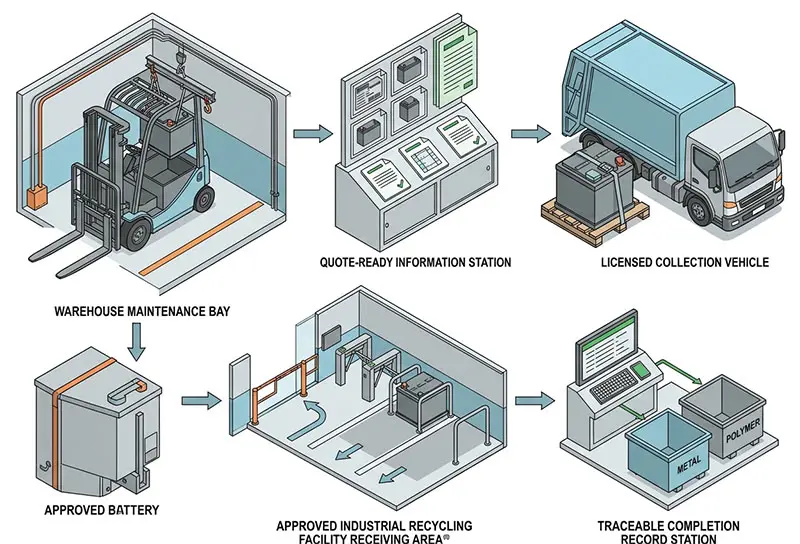
A cleared loading bay is not the end of the process. Procurement, EHS and audit teams should retain a record that connects the battery leaving the site with the accepted downstream route. Depending on jurisdiction and contract, the file may include:
- collection or acceptance receipt with date, site and quantity;
- battery chemistry/category and recorded weight;
- carrier and vehicle or shipment reference;
- applicable waste-transfer, manifest or consignment documentation;
- receiving facility identity and permit/licence information where relevant;
- certificate or statement of recycling, destruction or processing, with an explanation of what it actually certifies;
- commercial settlement showing material credit and deductions;
- internal asset-retirement record linking the serial number to the handover.
Do not treat the words “recycling certificate” as a universal standard. Ask who issued it, which battery or shipment it covers, what process it confirms and whether it identifies the receiving facility. A generic PDF with no traceable shipment reference provides little audit value.
What Happens to Forklift Batteries After Collection?
At a qualified facility, batteries are received, checked, sorted by chemistry and condition, and directed to an appropriate treatment process. Lead-acid batteries are commonly processed through controlled separation of lead-bearing components, plastics and electrolyte-related streams. Lithium-ion routes can include controlled electrical risk reduction, dismantling, mechanical processing and further thermal or chemical recovery steps. The exact route varies by chemistry, facility design and permitted process.
“Recycled forklift batteries” can also be an ambiguous commercial phrase. It may describe a battery containing recovered material, a repaired or rebuilt battery, or a used battery prepared for a second application. Buyers should ask for the actual scope: incoming inspection, components replaced, capacity-test method and result, warranty, remaining performance basis and destination application. The label alone does not establish safety, state of health or suitability for a truck.
Build End-of-Life Requirements Into the Next Forklift Battery Purchase
The easiest recycling job starts at procurement. Before approving a replacement battery, request the exact chemistry, battery mass and dimensions, model-specific safety and transport documents, removal method, diagnostic access, service path and end-of-life contact for the destination market. Clarify which economic operator carries local producer-responsibility obligations and whether any take-back promise is contractual, geographically valid and priced into the offer.
If an ageing lead-acid unit is being replaced, AnengJi’s forklift lithium battery range can be reviewed as a starting point for a new project. It is not a universal drop-in approval. Voltage window, current demand, battery-compartment dimensions, required counterweight, restraint, connector, charger profile, communication and vehicle acceptance must all be verified. A lower-mass lithium pack can affect forklift stability if the original battery is part of the counterweight design.
For a useful specification review, provide the truck data plate, existing battery nameplate, compartment measurements, required battery mass range, connector photographs, charger details, shift pattern, temperature range and destination country. Ask for model-specific documents rather than relying on a general website claim.
Planning a forklift battery replacement?
Send the truck, battery, charger, duty-cycle and destination details for a compatibility and documentation review. This consultation concerns a proposed battery solution; local recycling pickup must still be arranged through the responsible producer scheme or qualified recycler.
Frequently Asked Questions About Forklift Battery Recycling
Can forklift batteries be recycled?
Yes. Lead-acid and lithium-ion forklift batteries can enter controlled recycling routes, but they should be separated by chemistry and assessed by condition. The appropriate receiver, packaging, transport and documentation depend on the battery and local rules.
Who will pick up an old forklift battery?
Depending on the market, pickup may be arranged through a producer or producer-responsibility organisation, distributor, forklift dealer, industrial-battery recycler or qualified waste contractor. Confirm whether “pickup” includes removing the battery from the truck, preparing it and loading it onto the vehicle.
How much is a forklift battery worth as scrap?
There is no reliable universal price. Net value depends on chemistry, recoverable materials, accepted weight, condition, quantity, location, transport, packaging and handling charges. Compare written quotes with the same scope and settlement date.
Can a damaged lithium forklift battery be shipped for recycling?
Potentially, but not as a routine shipment. In the United States, damaged or defective batteries capable of dangerous heat, fire or short circuit must follow specific DOT requirements and may not be transported by air. Other jurisdictions have their own dangerous-goods rules. Obtain condition-specific instructions from a qualified party before moving the pack.
Should a lithium forklift battery be fully discharged before recycling?
Do not apply a universal DIY discharge rule. A displayed 0% state of charge does not prove the pack has no hazardous energy, and forced discharge can create risk if the battery is damaged or the process is not designed for that pack. Follow the written procedure of the manufacturer, accepted recycler and carrier.
What proof should a business keep after recycling?
Keep the collection receipt, battery identity and weight, transporter and receiving-facility details, applicable waste or shipping documents, commercial settlement and a traceable processing or recycling record. Required documents vary by country and contract.
The practical takeaway
Successful recycling forklift batteries depends on four things: identify the chemistry, separate routine from damaged units, define every pickup responsibility and close the process with traceable documents. Price matters, but a quote is not complete until the business knows who will extract, package, load, transport and receive the battery.
Related Articles
[post_navigation]
Related Posts
 https://anengjibattery.com/wp-content/uploads/2026/11/AnengjiBattery-Documented-Forklift-Battery-Recycling-Pickup.webp
675
1000
Battery Expert Team
https://anengjibattery.com/wp-content/uploads/2025/06/logo2-300x138.png
Battery Expert Team2026-11-11 06:57:582026-11-11 06:58:43Forklift Battery Recycling: A Practical Disposal Guide
 https://anengjibattery.com/wp-content/uploads/2026/11/AnengJIBattery-Battery-Swap-Bottleneck-at-Shift-Change.webp
675
1000
Battery Expert Team
https://anengjibattery.com/wp-content/uploads/2025/06/logo2-300x138.png
Battery Expert Team2026-11-06 07:07:072026-11-06 07:07:2810 Signs Your Forklift Fleet Is Ready for a Lithium Battery Upgrade
 https://anengjibattery.com/wp-content/uploads/2026/11/AnengJIBattery-Forklift-Battery-Purchase-Passport.webp
675
1000
Battery Expert Team
https://anengjibattery.com/wp-content/uploads/2025/06/logo2-300x138.png
Battery Expert Team2026-11-05 06:35:192026-11-05 06:35:53How Do Lithium-Ion Batteries Improve Warehouse Safety?
https://anengjibattery.com/wp-content/uploads/2026/11/AnengJIBattery-Forklift-Battery-Purchase-Passport.webp
675
1000
Battery Expert Team
https://anengjibattery.com/wp-content/uploads/2025/06/logo2-300x138.png
Battery Expert Team2026-11-04 06:47:322026-11-04 06:48:06How Do You Match Electric Fork Truck Batteries Correctly?



Leave a Reply
Want to join the discussion?Feel free to contribute!