
Top 10 Forklift Battery Manufacturers for U.S. Buyers in 2026
October 30, 2026 / Battery Expert Team / Battery Basics
Introduction
Two quotations can both specify a 48V forklift battery with similar amp-hour capacity and still represent very different purchases. One may include the correct tray mass, approved charger, truck communication, commissioning and local warranty labor. The cheaper quotation may describe only the battery pack. The difference becomes painfully clear when a loaded truck stops at a dock and the battery supplier, charger company and forklift dealer each says the problem belongs to someone else.
This guide compares 10 forklift battery manufacturers relevant to U.S. buyers. It is an editorial shortlist—not a sales-volume or market-share ranking. We evaluated whether each supplier can support the complete truck–battery–charger system, provide model-specific documentation and define who handles faults after installation. AnengJi publishes this guide and is included with that relationship disclosed; its verified capabilities and current evidence gaps are treated in the same way as those of the other companies.
Quick Comparison of Forklift Battery Manufacturers for U.S. Buyers
| Manufacturer | Main product direction | Best-fit buyer | Verify before purchase |
|---|---|---|---|
| EnerSys | Lithium, TPPL, chargers and monitoring | Large multi-site fleets | Exact truck, pack, charger and service scope |
| East Penn / Deka | Flooded lead-acid, fast charge and lithium | Mixed-chemistry fleets | Lithium model approval and local service |
| Stryten Energy | Lead-acid, lithium and charging systems | Buyers prioritizing U.S. production | Current certification status by model |
| Crown Battery Manufacturing | Lead-acid and Velocity lithium | Dealer-supported mid-size fleets | Dealer coverage and quoted-model evidence |
| Sunlight Batteries USA | Lead-acid, lithium, chargers and IoT | OEMs, dealers and mixed fleets | Quoted product, local stock and service scope |
| Flux Power | Industrial LiFePO4 and telematics | High-use warehouse fleets | OEM approval, UL scope and ballast |
| Green Cubes | SAFEFlex LFP, chargers and fleet data | Multi-shift opportunity charging | Pack family/listing and field serviceability |
| OneCharge | Class I–III lithium, chargers and ballast | Dealers needing many configurations | Local technician, parts and return process |
| ROYPOW | Broad LiFePO4 forklift range | Importers and distributors | Certificate model, U.S. stock and service |
| AnengJi Battery | Custom LiFePO4/NMC systems | OEM/ODM and non-standard projects | Model documents and U.S. service plan |
How We Evaluated Forklift Battery Manufacturers
A recognizable brand name was not enough. First, we looked for complete-system capability: battery, BMS, tray or ballast, connector, charger and communication must have a named owner. Second, the supplier had to provide evidence relevant to the U.S. market, including accessible product information and a plausible support route. Third, we separated company-level marketing from the exact model that would be delivered.
This distinction matters because a cell supplier, forklift OEM, battery pack manufacturer and local service dealer perform different jobs. A large cell company does not automatically provide the enclosure, counterweight, charger logic, truck integration and field warranty needed for a forklift project. Likewise, “UL components” do not prove that a complete battery pack is Listed for its intended use.
U.S. Motive-Power Manufacturers with Broad Product Coverage
1. EnerSys — Integrated Batteries, Chargers and Fleet Power Management
Company and product profile: Headquartered in the United States, EnerSys is an established industrial stored-energy company with motive-power manufacturing, distribution, parts and service infrastructure. Its forklift portfolio spans conventional lead-acid products, NexSys TPPL batteries, NexSys iON lithium-ion batteries, modular chargers and battery-monitoring or power-management tools. The official NexSys iON product information lists forklift, pallet-truck, AGV, floor-care and ground-support applications, with 24V–80V systems and CAN communication. Its Kentucky manufacturing and distribution site also supports motive-power batteries, chargers and parts for the Americas.
Where it fits: EnerSys is strongest for large, multi-site fleets that want a supplier to study energy use, size batteries and chargers, and support a mixed installed base. That system-level capability is more valuable than simply choosing the largest Ah option. Buyers should still obtain a truck-level proposal showing the exact battery model, usable energy, installed mass, charger allocation, communication functions, model-specific safety documentation and response coverage at every operating site.
2. East Penn Manufacturing / Deka — Broad Lead-Acid Range with Ready Power Lithium
Company and product profile: East Penn Manufacturing is a U.S. battery producer whose Deka industrial line covers far more than one flooded lead-acid design. Its industrial lift-truck portfolio includes D-Series, MaxPowr, HydraSaver, FastCharge, Dominator, MaintenanceSaver and related charger products, plus Deka Ready Power lithium-ion systems. Published application resources also cover AGVs, airline ground support, floor-care equipment and Class III trucks. East Penn states that its North American support route combines company sales branches, subsidiaries and an independent Deka dealer network.
Where it fits: This breadth suits fleets that want to keep conventional lead batteries in light-duty trucks while evaluating lithium for two- or three-shift equipment. It also gives dealers a familiar path for preventive maintenance and emergency support. The buying decision should identify which local organization will commission Ready Power, service the charger, interpret BDI behavior and pay warranty labor. A nationwide brand presence does not automatically mean identical lithium diagnostic capability at every dealer.
3. Stryten Energy — U.S. Lead, Lithium, Chargers and Energy Analytics
Company and product profile: Georgia-headquartered Stryten Energy builds on the North American industrial-battery assets formerly associated with Exide/GNB; the 2020 Exide Americas asset transaction record explains the formation of the battery-production business. Stryten’s motive-power offer includes flooded and low-maintenance lead batteries, M-Series lithium products, X-Series chargers and the inCOMMAND energy-performance platform. The new M-Series Li610 is a U.S.-assembled LFP battery for material-handling applications, with published charger matching, state-of-charge display, variable ballast and on-site service. The wider M-Series lithium range is presented for Class I–III lift trucks.
Where it fits: Stryten is relevant to U.S. buyers that want domestic manufacturing, established lead-battery knowledge and a gradual move toward connected lithium systems. One accuracy point cannot be skipped: the current Li610 page says it is designed to meet UL 2580 and that certification is in process. Procurement teams should request the updated certificate status for the exact quoted part number instead of treating “designed to meet” as a completed Listing.
4. Crown Battery Manufacturing — Motive-Power Lead Batteries and Velocity Lithium
Company and product profile: Crown Battery Manufacturing, based in Fremont, Ohio, traces its business to 1926 and supplies motive-power batteries, charging systems and support through representative and dealer channels. Its industrial portfolio serves electric forklifts and pallet jacks, AGVs, mining equipment and other heavy-duty applications. Alongside conventional motive-power batteries, its Velocity lithium-ion system offers forklift, pallet-jack and scissor-lift configurations. Crown’s product literature stresses that dimensions and installed weight must be confirmed before quotation or order—an important acknowledgement that battery mass may be part of the truck design.
Where it fits: Crown Battery can suit fleets that value a long-established motive-power supplier and want both conventional and lithium choices. It is not Crown Equipment Corporation, the forklift OEM; mixing those two companies creates incorrect compatibility assumptions. Ask which local representative owns installation and diagnostics, which Velocity family or lead model fits the truck, and which certification record applies to that exact voltage and configuration.
5. Sunlight Batteries USA — U.S. Production with Lead, Lithium, Chargers and IoT
Company and product profile: Sunlight Batteries USA is the North American operating arm of Sunlight Group. Its U.S. company page identifies facilities in North Carolina and Texas that manufacture, assemble and distribute battery systems for OEMs, forklift dealers, technicians and logistics operators. The portfolio covers tubular and other lead-acid motive-power batteries, LiONFORCE lithium systems, chargers, accessories and the KnoWi/GLocal monitoring environment. Applications extend from forklifts and pallet trucks to AGVs and automated systems, giving the company a credible mixed-fleet position rather than a lithium-only offer.
Where it fits: Sunlight is relevant when U.S. sourcing, product availability and a lead-to-lithium transition plan all matter. Its range can support single-shift conventional fleets as well as high-use lithium applications. Buyers should still match the quotation to a specific U.S. inventory or production route, local commissioning capability and the exact safety documents for the selected LiONFORCE or lead product; a group-level global portfolio does not prove that every option is stocked or serviced in the buyer’s state.
U.S. Lithium Specialists for High-Utilization Fleets
6. Flux Power — Class I–III Lithium Systems and Fleet Data
Company and product profile: California-based Flux Power develops lithium-ion systems for industrial equipment, with material-handling products organized around Class I counterbalance trucks, Class II narrow-aisle equipment and Class III pallet trucks. Its material-handling application page connects the battery offer to truck classes and highlights integrated BMS and data capabilities. The same industrial focus extends to adjacent ground-support applications. This makes Flux more comparable to a finished battery-system provider than to a cell company selling components to pack assemblers.
Where it fits: Flux is most relevant to high-throughput warehouses, manufacturing sites and 3PL operations that need opportunity charging and visibility into battery behavior. The important procurement task is to match every statement to the quoted model. “Designed to meet UL Listing requirements,” an OEM relationship or approval for one pack does not automatically cover another voltage, tray or truck. Ask for the applicable Listing, approved-truck evidence, weight adaptor, charger and service response for the precise configuration.
7. Green Cubes Technology — SAFEFlex LFP, Chargers and Serviceable Industrial Systems
Company and product profile: Green Cubes Technology focuses on industrial lithium systems rather than general consumer batteries. Its SAFEFlex line covers forklifts, reach trucks, pallet jacks, order pickers, tow tractors, AGVs/AMRs, industrial cleaning machines and airport ground-support equipment. The company publishes material-handling packs across common 24V–80V platforms, matching SAFEFlex chargers and IoT/data resources. Its newer SAFEFlex PLUS documentation emphasizes modular architecture, individual cell monitoring, data logging and improved access to service items.
Where it fits: Green Cubes deserves attention from multi-shift fleets and OEMs that need a configurable LFP platform, charger integration and remote diagnostics. Earlier marketing language about “UL-approved components” should not be confused with current family-level certification claims; the buyer must request the certificate and confirm the family, options and truck use included. Serviceability also needs a practical answer: identify which modules or wear parts a local technician can replace and what faults still require factory involvement.
8. OneCharge — Broad Model Coverage for Class I–III Forklifts
Company and product profile: OneCharge is a U.S.-focused lithium forklift battery specialist serving Class I, II and III material-handling equipment. Its published range includes battery configurations, compatible chargers, ballast solutions and application packages for demanding environments. The accessible official regional product catalogue shows the breadth of models and related equipment, while North American industry coverage has highlighted model count, OEM compatibility, CAN integration and service reach as the brand’s main comparison points.
Where it fits: OneCharge can be attractive to forklift dealers and fleets that need a lithium replacement for many different truck footprints rather than one standard pack. However, a large model catalogue does not answer the downtime question by itself. The quotation should identify the U.S. service company, diagnostic access, field-replaceable parts, loaner or replacement policy and dangerous-goods return process. The primary U.S. site was not consistently retrievable during this review, so current U.S. product and warranty documents should be attached to the RFQ response.
China-Based Forklift Battery Manufacturers Serving U.S. Buyers
9. ROYPOW — LiFePO4 Forklift Systems with a U.S. Operating Presence
Company and product profile: ROYPOW manufactures LiFePO4 motive-power systems in China and markets a broad material-handling range covering common 24V, 36V, 48V and 80V platforms, with higher-voltage projects also described in its product literature. The company’s forklift offer includes batteries, matched chargers, BMS functions and application-specific directions such as cold-storage and hazardous-environment products. Its official forklift brochure lists U.S. offices and service contacts, while its U.S.-oriented forklift page identifies specific product families described as UL 2580 certified.
Where it fits: ROYPOW provides a useful benchmark for importers and dealers comparing a China-based factory with a visible North American operating route. The strength is not simply lower factory cost; it is the combination of a wide catalogue and stated U.S. contacts. Buyers should nevertheless obtain the Listing record for the quoted model, confirm which U.S. entity signs the warranty, and document local stock, technician coverage, software access, spare parts and return-freight responsibility.
10. AnengJi Battery — Custom Forklift Batteries for Import and OEM/ODM Projects
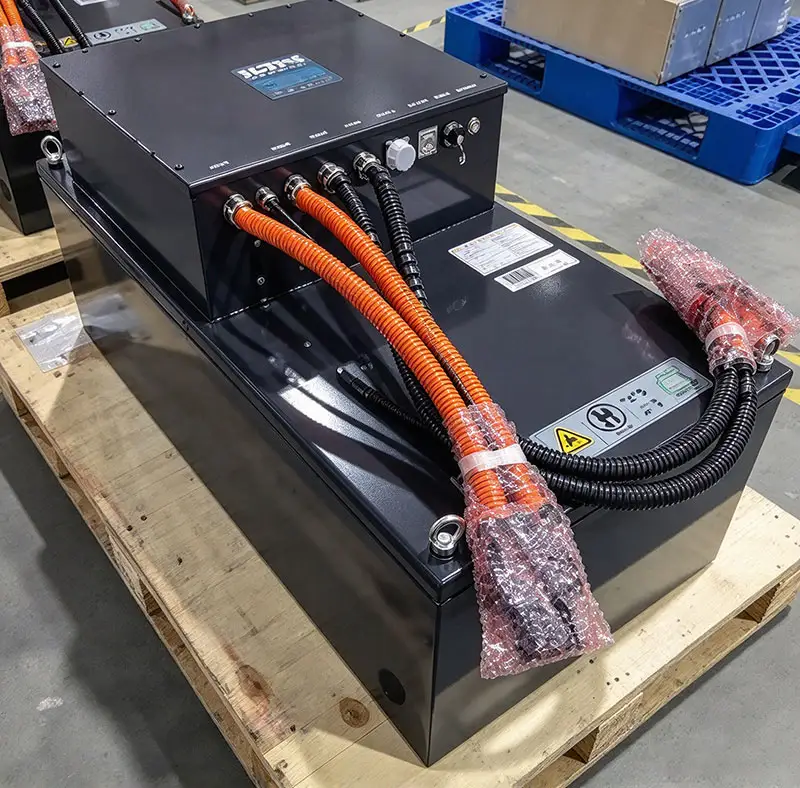
Company and product profile: AnengJi Battery is a China-based custom lithium battery manufacturer positioning its forklift solutions for U.S. importers, distributors and OEM/ODM projects. Its wider product work covers custom and standard-format LiFePO4 batteries, NMC packs, forklift batteries, golf-cart and light-electric-vehicle power, RV/outdoor products and energy-storage applications. For forklift buyers, the useful distinction is between a standard battery that still requires compatibility validation and an application-specific pack whose case, ballast, capacity, connector, cable route and BMS/charger communication are engineered around the truck.
Product examples and buyer fit: AnengJi’s forklift project specifications include 51.2V 277Ah and 412Ah options and 76.8V 280Ah and 412Ah options. Current project inputs include continuous charge/discharge values of 200A at 25°C, REMA connector selections and different case formats. Example installed masses range from 210kg for some counterbalance or conversion projects to 1,200kg for a reach-truck configuration, demonstrating why a “48V 412Ah” request is not enough to manufacture the correct assembly. AnengJi is best considered where non-standard packaging, mass, connector, communication or batch customization matters.
What a U.S. buyer must establish: The proposal should include the approved drawing, tolerance and restraint details, continuous/peak current with duration, regenerative-current limit, charger/BMS protocol, test plan, golden-sample control, UN 38.3 test summary and the model-specific safety evidence required by the project. No blanket U.S. forklift certification or public nationwide AnengJi service network is asserted here; the quotation must name the U.S. support, spare-parts and dangerous-goods return arrangement.
Why Some Familiar Names Are Not in This Top 10
Other ranking pages frequently mention Exide, GS Yuasa, HOPPECKE, Trojan, U.S. Battery, Storage Battery Systems, Electrovaya and several large Asian cell companies. Their absence here is not a quality verdict. This shortlist gives greater weight to a currently verifiable U.S. forklift-system offer, product-level information and a service or import path that a buyer can investigate.
- Exide/GNB: Many lists still present Exide as a separate major U.S. motive-power manufacturer. The operating assets of Exide Americas were acquired in 2020 and the battery-production business became Stryten Manufacturing; Stryten now maps legacy GNB products into its M-Series/E-Series portfolio. Counting both without explaining that history would overstate the number of independent U.S. options.
- CATL, EVE, Gotion and other cell producers: A cell maker may supply high-quality cells yet not deliver the forklift tray, ballast, BMS software, charger, CAN integration, truck approval and field warranty. Cell supplier and complete forklift battery manufacturer are different purchasing categories.
- Crown Equipment and integrated OEM batteries: A forklift OEM can offer a strong factory-integrated power system, but that is different from comparing independent replacement-battery manufacturers. Crown Equipment is also a different company from Crown Battery Manufacturing.
- Electrovaya and other specialists: Electrovaya’s Infinity low-voltage systems remain relevant for heavy-duty Class I–III projects, and its New York manufacturing plan is advancing. It moved outside this ten-company editorial cut because the list now gives Sunlight Batteries USA’s active U.S. production and broad lead/lithium portfolio more weight. Buyers with demanding NMC-based or OEM applications should still compare it.
The Compatibility Check Most Manufacturer Lists Miss
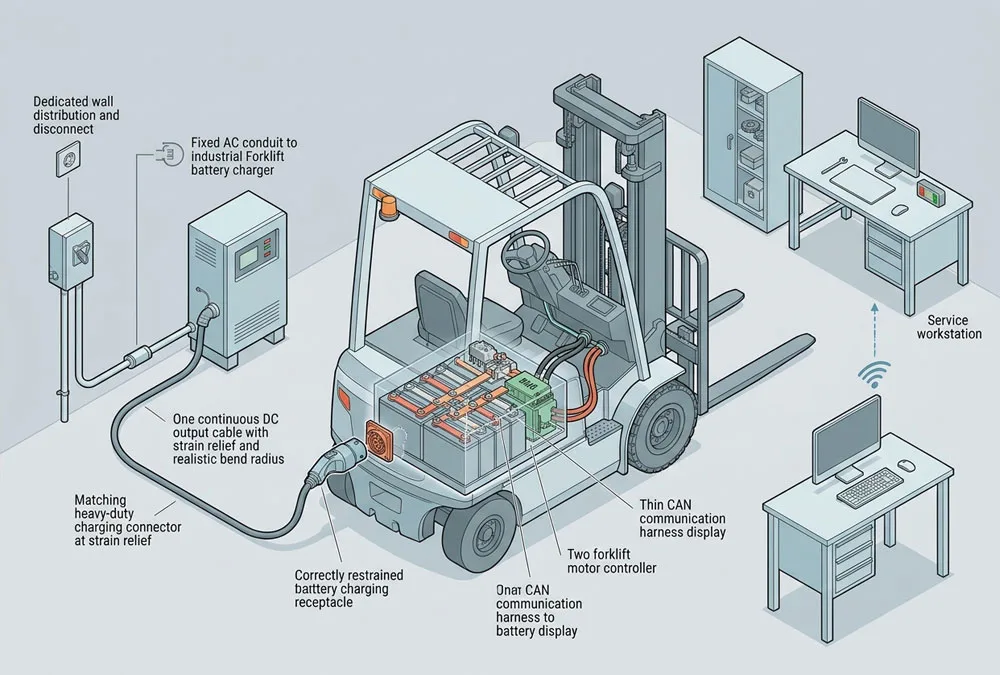
A battery can fit inside the compartment and move the truck, yet remain unsuitable. A common failure pattern appears only late in the shift: the battery reaches a low state of charge, the operator lifts a heavy load, current spikes, and the BMS disconnects. The cause may be an underspecified peak-current duration, low-SOC derating or an inaccurate SOC display—not insufficient nominal amp-hours.
Ask every supplier to verify compartment dimensions, restraint, cable exit, connector and polarity; complete installed mass; continuous and peak current with duration; regenerative current; charger curve and maximum current; CAN/BDI functions; and the truck controller’s low-energy behavior. Battery mass can be part of the truck’s counterweight and stability design, so verify the battery, tray and ballast as one installed assembly.
U.S. Compliance and Documentation to Request
The OSHA powered-industrial-truck standard states in 1910.178(a)(4) that modifications affecting capacity or safe operation require the manufacturer’s prior written approval and corresponding updates to plates or instructions. Its battery section also addresses designated charging areas and safe battery handling. These rules make truck approval and installation controls procurement issues, not paperwork to consider after delivery. This is a general purchasing reminder, not legal advice.
For safety evidence, ask whether the exact battery model—not merely its cells or components—is covered for the intended industrial application. UL Solutions explains UL 2580 as an evaluation framework for rechargeable battery systems used in electric vehicles and industrial equipment. The relevant evidence must match the delivered model and scope.
Transport evidence is separate from product-use approval. The U.S. Department of Transportation’s PHMSA lithium battery test-summary guidance explains that lithium battery designs undergo the tests in UN Manual of Tests and Criteria subsection 38.3 and addresses the test-summary requirement. Request the summary for the quoted design, plus the applicable shipping declaration, packaging information and SDS.
How to Compare U.S. and Chinese Suppliers Fairly
Do not compare a Chinese factory price with a fully installed U.S. quotation. Put battery, charger, tray or ballast, freight, duties and taxes, installation, commissioning, training, spares, warranty labor and return logistics on the same worksheet. For a deeper budget model, compare the complete installed cost rather than the pack price.
An importer should also lock the approved cell, BMS, contactor and connector into a change-control agreement; keep a signed golden sample; define FAT and site-acceptance tests; and identify the legal party responsible for U.S. service. This prevents a successful sample from being followed by a production batch with undocumented component changes. A lower landed cost only creates value if faults can be diagnosed and parts supplied before downtime erases the saving.
12 Questions for Every Forklift Battery RFQ
- Which exact truck models and serial ranges have been validated?
- What compartment, restraint and cable-exit dimensions are required?
- What is the complete installed mass including tray, ballast and connector?
- What are the continuous and peak discharge limits and durations?
- How much regenerative current can the pack accept?
- What usable energy and low-SOC derating policy apply?
- Which chargers are approved, and how do they communicate?
- What CAN/BDI, SOC display, lift-lockout and fault functions are supported?
- Which safety and transport documents cover the quoted part number?
- Who commissions the system and trains operators and technicians?
- Who owns remote diagnosis, parts and on-site warranty labor?
- What is the process and cost if the pack must return as dangerous goods?
Regional Buying Notes Beyond the United States
European buyers should separately verify the EU Battery Regulation, CE-related technical documentation, economic-operator obligations and destination-country service; U.S. evidence does not automatically complete a European compliance file. Buyers in Central Asia and Africa should check local input voltage and frequency, generator or weak-grid conditions, heat, dust, connectivity, customs, language training and dangerous-goods routes country by country. No supplier’s “global coverage” claim should replace a named local support path.
Frequently Asked Questions
Who manufactures forklift batteries for the U.S. market?
Relevant manufacturers in this editorial shortlist include EnerSys, East Penn/Deka, Stryten, Crown Battery Manufacturing, Sunlight Batteries USA, Flux Power, Green Cubes, OneCharge, ROYPOW and AnengJi. Electrovaya and several established global motive-power suppliers also deserve project-specific consideration. The right shortlist depends on the truck model, duty cycle, chemistry, documentation and service location; this is not a market-share ranking.
Which manufacturers offer both lead-acid and lithium options?
EnerSys, East Penn, Stryten, Crown Battery Manufacturing and Sunlight Batteries USA publish both established lead-based motive-power products and lithium options. Availability, service and approved models vary, so verify the local quotation rather than assuming every branch supports every product.
Are Chinese forklift battery manufacturers suitable for U.S. fleets?
They can be suitable for distribution, OEM/ODM and custom projects when the buyer verifies model-level documents, truck and charger compatibility, import responsibility, spare parts and U.S. service. A pilot deployment with written acceptance criteria is safer than moving directly from a sample quotation to a fleet-wide order.
Does a lithium forklift battery need a special charger?
It needs a charger, profile and communication method approved for that battery system. Matching connectors do not prove electrical or communication compatibility. Confirm voltage window, current, CAN behavior, interlocks and temperature limits.
What certifications and documents should a U.S. buyer request?
Depending on the project, request model-specific NRTL/UL evidence, the UN 38.3 test summary, SDS, transport documents, product drawings, manuals and the truck manufacturer’s approval where required. A certification logo on a company page does not prove coverage of the delivered model.
How should forklift battery warranties be compared?
Compare covered years and throughput or cycle conditions, permitted hours per day, temperature limits, charging practices, data access, maintenance duties, parts, labor, travel, freight and exclusions. Also verify who makes the decision when the truck, charger and BMS report different faults.
Choose the Manufacturer That Owns the Whole Result
A top-10 list is useful for discovering suppliers, but it cannot select the battery. The strongest manufacturer is the one that can prove mechanical fit, electrical performance, truck and charger communication, model-level documents and a workable service path for your location. Make each candidate quote the same system boundary and assign fault responsibility before price negotiations begin.
Request a Forklift Compatibility Review
Send the truck data plate, current battery label, compartment dimensions, required mass, connector and charger photos, shift profile and destination. AnengJi can return a configuration checklist showing the remaining fit, performance and document questions before quotation.
Related Articles
Related Posts
 https://anengjibattery.com/wp-content/uploads/2026/10/AnengJIBattery-U.S.-Forklift-Battery-Supplier-Evaluation.webp
675
1000
Battery Expert Team
https://anengjibattery.com/wp-content/uploads/2025/06/logo2-300x138.png
Battery Expert Team2026-10-30 03:16:252026-10-30 03:16:42Top 10 Forklift Battery Manufacturers for U.S. Buyers in 2026
 https://anengjibattery.com/wp-content/uploads/2026/10/AnengJIBattery-Lithium-Ion-Power-in-Industrial-Operation.webp
675
1000
Battery Expert Team
https://anengjibattery.com/wp-content/uploads/2025/06/logo2-300x138.png
Battery Expert Team2026-10-29 03:43:242026-10-29 03:46:52How Does a Lithium-Ion Battery Work and Stay Protected?
 https://anengjibattery.com/wp-content/uploads/2026/10/AnengjiBattery-Is-a-Lithium-Ion-Battery-for-3PL-the-Right-Fleet-Choice.webp
675
1000
Battery Expert Team
https://anengjibattery.com/wp-content/uploads/2025/06/logo2-300x138.png
Battery Expert Team2026-10-28 07:16:182026-10-28 07:17:07Is a Lithium-Ion Battery for 3PL the Right Fleet Choice?
 https://anengjibattery.com/wp-content/uploads/2026/10/AnengjiBattery-Forklift-Battery-Weight-in-a-Working-Warehouse.webp
675
1000
Battery Expert Team
https://anengjibattery.com/wp-content/uploads/2025/06/logo2-300x138.png
Battery Expert Team2026-10-27 02:59:132026-10-27 02:59:15How Does Forklift Battery Weight Affect Stability and Fit?



Leave a Reply
Want to join the discussion?Feel free to contribute!