
How Do You Size a Battery Storage System? A Complete BESS Guide
July 11, 2026 / Battery Expert Team / battery energy storage
Introduction
Global storage deployments are moving at lightning speed through 2026. Distributed generation, commercial microgrids, and utility-scale installations are hitting record counts across every major electrical market. Yet, behind these impressive deployment statistics lies a costly reality for engineering procurement teams. A massive percentage of enterprises purchasing a modern Battery Storage System still make severe configuration errors during the early planning stages. They either massively oversize their assets, leaving expensive capital sitting idle, or fall critically short on vital backup capacity.
Sizing your electrical infrastructure correctly is not a simple matter of selecting a premium tier-one hardware brand. It requires a meticulous, multi-variable engineering analysis to match your specific daily operational curves with the right electrochemical framework. This comprehensive guide breaks down the complex mathematics of capacity planning into a clear, actionable roadmap for your next industrial deployment.
The core challenge stems from the inherent variability of modern energy usage. A factory running heavy heavy-duty CNC machinery presents an entirely different electrical demand signature than a multi-family commercial real estate complex or a high-volume electric vehicle fast-charging hub. Attempting to deploy a one-size-fits-all container block without historical load data typically results in poor financial performance, high utility penalties, and accelerated cell degradation. By understanding how system footprint parameters interact with local tariff structures, developers can convert a volatile operational expense into a highly stable, completely dispatchable financial asset class.
How Do You Size a Battery Storage System?
Executing an effective, field-ready Battery Storage System Sizing project relies on balancing six distinct technical inputs simultaneously. Overlooking even a single variable in this engineering matrix can lead to frequent safety trips, grid non-compliance fines, or premature system replacement:
- Daily Energy Consumption: The total cumulative kilowatt-hours (kWh) passing through your facility circuits over a standard twenty-four hour period.
- Peak Power Demand: The absolute maximum instantaneous electrical draw measured in kilowatts (kW), which dictates the required size of your switching hardware.
- Required Backup Duration: The exact number of continuous hours the facility must remain operational during an unexpected utility grid blackout event.
- Depth of Discharge (DoD): The chemical operating limit configured to prevent cells from draining down to empty, protecting long-term structure stability.
- Primary Charging Source: The incoming generation profile, whether it relies on localized solar arrays, variable wind turbines, or standard off-peak grid power.
- Future Expansion Sizing: Anticipating structural facility load changes, equipment upgrades, or fleet electrification projects over the next ten years.
Balancing these core factors guarantees that your initial capital expenditures remain lean while keeping your internal rate of return exceptionally high throughout the lifecycle of the asset.
What Is Battery Storage System Sizing?
From an EPC project consultant perspective, sizing is essentially architectural engineering for electrons. You are not simply purchasing a collection of generic lithium-ion batteries from a wholesale supplier catalog. Instead, you are building a custom-tailored, multi-component Battery Energy Storage System that must function in perfect harmony with existing grid infrastructure. Sizing defines the boundaries where chemical capacity meets mechanical thermal management and high-power power electronics.
What Does Battery Capacity Mean?
In simple terms, capacity represents the total volume of electrical energy that your asset can store and discharge. Think of it as a water tank analogy: a hundred-gallon tank can supply a steady stream of water for a much longer period than a simple five-gallon bucket. In electrochemical terms, this capacity is measured in kilowatt-hours (kWh) or megawatt-hours (MWh), defining how long you can sustain a specific electrical load profile before the cells are completely depleted.
Why Correct Battery Sizing Matters
Getting the numbers wrong carries immediate, painful financial consequences. When an EPC firm oversizes an industrial installation, the buyer pays a massive premium for cell modules that simply sit idle inside the enclosure. These unused modules never generate active market returns, yet they still degrade over time due to calendar aging. On the flip side, undersizing the installation is equally disastrous. An undersized system cannot absorb sudden high-current spikes, forcing the plant to pull expensive peak power from the utility grid or triggering total system shutdowns due to inverter thermal overload.
Common Battery Sizing Mistakes
Even seasoned procurement managers frequently fall into predictable traps during the early system specifications phases:
- Fixating strictly on kWh capacity: Focusing entirely on total energy storage hours while completely ignoring the peak power delivery rating (kW) of the bi-directional inverter.
- Neglecting cell C-rate limits: Choosing a slow-discharging chemistry for a dynamic application like EV fast-charging, which requires massive, instantaneous bursts of electrical current.
- Disregarding local ambient temperatures: Failing to adjust capacity assumptions for extreme winter freezing or intense summer heat, both of which alter internal chemical reaction speeds.
- Omitting auxiliary load consumption: Forgetting that the internal liquid-cooling pumps, HVAC units, and control circuits consume a steady stream of power directly from the battery racks.
Battery Storage System Capacity Requirements by Project Type
Electrical configuration needs shift dramatically based on your underlying business case and facility envelope. The following framework outlines typical baseline dimensions across different commercial and industrial application sectors:
| Project Classification | Typical Capacity Range | Typical Power Rating | User & Strategic Benefit |
|---|---|---|---|
| Commercial Buildings | 100 kWh – 300 kWh | 50 kW – 150 kW | Lowers expensive time-of-use demand spikes while providing clean backup power for server infrastructure. |
| Manufacturing Plants | 500 kWh – 2 MWh | 250 kW – 1 MW | Shaves heavy machinery startup peaks, protecting the facility from steep utility demand penalties. |
| EV Charging Stations | 200 kWh – 1 MWh | 150 kW – 500 kW | Buffers localized distribution transformers against simultaneous multi-vehicle fast-charging draws. |
| Utility-Scale Solar Farms | 2 MWh – 10 MWh+ | 1 MW – 5 MW+ | Prevents costly midday solar curtailment by capturing clipped power for lucrative evening grid dispatch. |
*Note: Data represents verified 2025-2026 industrial benchmarks. Every site requires an independent load curve verification step.*
Understanding kW vs kWh in Battery Storage Systems
Confusing these two electrical metrics causes nearly half of all project sizing failures globally. Let’s state it as clearly as possible: kW (Kilowatt) is a measure of instantaneous power capacity—it dictates the size of the pipe through which electrical current flows. On the other hand, kWh (Kilowatt-hour) is a measure of total energy capacity—it defines the volume of the reservoir supplying that pipe over time. If your bi-directional inverter is rated for 500kW but your battery bank only stores 250kWh, you can only sustain your maximum discharge rate for exactly thirty minutes before running dry.
Simple Battery Sizing Formula
For initial feasibility assessments, engineers utilize a straightforward mathematical baseline to establish preliminary project scopes:
Required Nameplate Capacity (kWh) = [Load Demand (kW) × Run Time (Hours)] / [DoD (%) × Inverter Efficiency (%)]
Let’s look at a concrete engineering example. Consider a medium-sized plastic injection molding facility that pulls a continuous baseline load of 250kW. The plant owners require exactly 4 hours of uninterrupted operation during local rolling brownouts. Multiplying 250kW by 4 hours reveals a raw usable energy requirement of 1,000kWh. However, you cannot design an electrochemical system to run down to absolute zero without destroying the cell active materials. Assuming a safe industrial Depth of Discharge (DoD) of 90% and an aggregate Power Conversion System inverter efficiency of 92%, the math resolves as follows: 1,000 divided by 0.828 equals roughly 1,208kWh of total nameplate capacity. Therefore, the procurement agent must specify a system of at least this size to guarantee the target 4-hour runtime.
Industrial Component Matching: The AnengJi 418kWh Liquid-Cooled Module
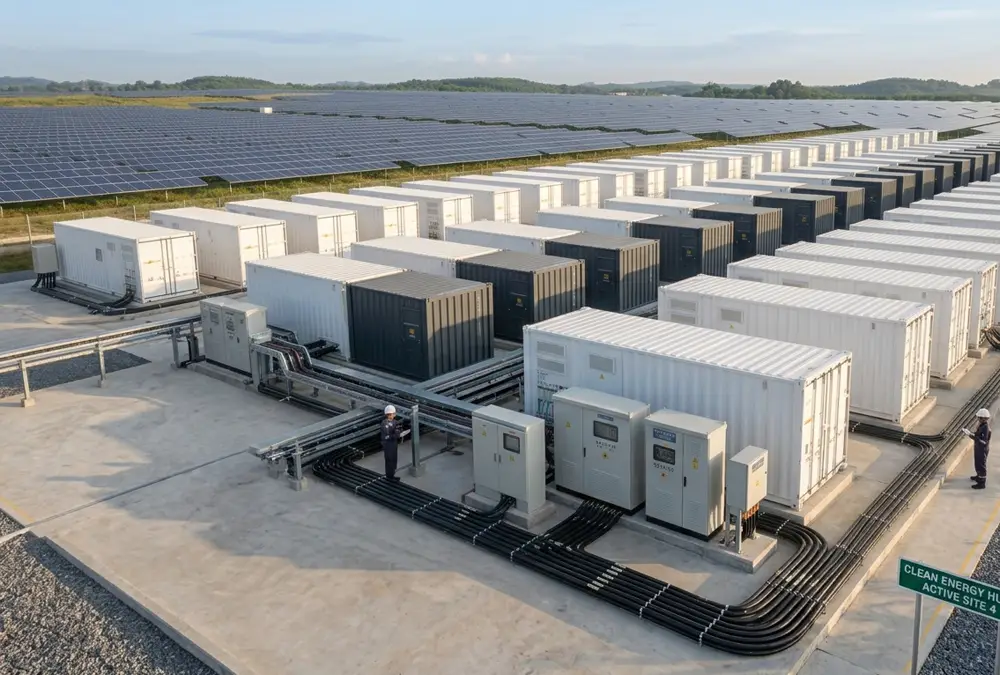
To fulfill a 1,208kWh industrial project capacity requirement seamlessly, building the layout with three parallel units of our premium 418kWh outdoor battery cabinets represents the most efficient design route. This modular combination yields 1,254kWh of nominal capacity, providing a safe operational buffer while maintaining a compact physical footprint.
Determine the Purpose of Your Battery Storage System
The specific economic application you target dictates the entire operational calculus of your system design. A containerized asset configured for emergency backup power requires completely different internal architecture than a system running high-frequency market arbitrage cycles every single day.
Backup Power Applications
Here, the system operates primarily as an electronic insurance policy. The battery packs sit fully charged at 95% capacity for days at a time, waiting for an unexpected upstream grid failure. The core engineering priority is long calendar life and high discharge reliability. For instance, a data center requiring a 500kW backup cushion for 2 hours will deploy a dedicated 1,000kWh block tuned specifically for instant black-start grid isolation.
Peak Shaving and Demand Charge Reduction
Many commercial utilities bill industrial customers based on their highest single fifteen-minute power spike of the month. These demand fees can represent up to half of an industrial facility’s total monthly utility invoice. A peak shaving setup monitors incoming building circuits continuously. The moment a heavy stamping machine draws high current, the localized commercial battery storage system discharges immediately to damp down the spike. In this scenario, capacity sizing is calculated by mapping the area of the load curve that exceeds the target utility threshold.
Time-of-Use Energy Arbitrage
This strategy relies on buying power when it is cheapest and using or selling it when utility rates peak. In regions with aggressive time-of-use (TOU) pricing frameworks, industrial plants charge their modular storage blocks during low-cost midnight hours. They then switch off utility inputs during premium mid-afternoon operational periods, running the entire facility directly off the stored energy. Sizing for arbitrage requires a precise analysis of your local tariff windows to ensure you have enough capacity to cover the entire peak pricing duration.
Key Factors That Affect Battery Storage System Sizing
Daily Energy Consumption and Load Curves
You cannot effectively size an asset using an aggregated monthly utility bill. You must extract high-resolution, fifteen-minute interval data directly from your master building meters. Plotting this data over a consecutive twelve-month window reveals your true minimum, maximum, and average electrical usage patterns. This step ensures that the final equipment configuration handles real-world seasonal shifts without unexpected system trips.
Depth of Discharge (DoD) Mechanics
Depth of discharge defines the boundary limit for active energy extraction. Running a lithium-ion system from 100% down to 0% every day will cause rapid degradation, killing cell capacity within a few years. Industrial operators configure safe limits, typically keeping operations between 90% and 10% capacity. This design cushion must be factored into your early calculations so you purchase enough physical nameplate blocks to deliver the required usable energy output.
Battery Round-Trip Efficiency (RTE)
No electrical process is perfectly efficient. When you push power into a battery block and pull it back out through an inverter, energy is lost as heat. Standard industrial lithium systems deliver an average round-trip efficiency of eighty-five to ninety-two percent. Sizing calculations must account for this systematic loss factor, or your solar array will undercharge the storage reservoirs during short winter daylight windows.
Future Site Expansion Planning
A fatal mistake in many long-term infrastructure designs is treating current power demand as static. Over the next decade, your facility may add extra assembly automation, expand production floor square footage, or install a large employee EV charging fleet. Selecting a flexible, modular system design from day one allows engineers to scale up the site’s capacity smoothly, stacking extra cell modules without forcing a complete rewrite of the master electrical distribution boards.
Battery Chemistry and System Design Considerations
The raw chemical components housed inside your battery enclosures dictate your system’s real-world footprint, safety limits, and lifetime asset returns. Understanding these technologies prevents expensive procurement missteps.
Lithium Iron Phosphate (LFP) vs Alternatives
LiFePO4 (Lithium Iron Phosphate) has become the absolute dominant standard for global stationary applications through 2026. LFP chemistry offers excellent safety metrics and handles thousands of high-intensity operational cycles before experiencing significant capacity drop-offs. In contrast, older lithium chemistries like NMC deliver higher energy density but carry much higher thermal runaway risks. For large, long-duration utility projects, flow battery systems offer an alternative with virtually zero cell degradation over decades, though they require massive spatial footprints and carry high initial capital integration costs.
System Integration and Component Matching
A reliable Battery Storage System requires far more than just standard cell racks. The entire architecture relies on careful hardware balancing. The internal cell strings must be accurately matched with the voltage limits of your bi-directional Power Conversion System (PCS). Multi-tier Battery Management Systems (BMS) track individual cell health, communicating with the master Energy Management System (EMS) to balance power limits across the site grid.
Buyer’s Reality Check: The Oversizing Financial Trap
Procurement teams frequently assume that adding a massive extra safety cushion to their capacity calculations is smart engineering.
In reality, buying far more capacity than your facility can actively discharge simply kills your project’s financial payback timeline.
That unutilized storage space represents dead capital, sitting inside the enclosure while degrading slowly through calendar aging.
Trust high-resolution interval data rather than emotional safety guesses to keep your project returns optimized.
Battery Storage System Cost by System Size
What Determines Capital Expenditure (CAPEX)?
Total turnkey deployment costs extend far beyond the base factory price of the battery modules. Your master project budget must include the heavy-duty bi-directional inverters, structural outdoor enclosures, advanced HVAC liquid-cooling manifolds, and integrated fire suppression hardware. Furthermore, soft costs like civil engineering foundation work, high-voltage transformer integration, transport permits, and utility interconnection studies can make up thirty percent of the total project expenditure.
Why Larger Installations Offer Lower Unit Costs
Utility-scale projects leverage significant economies of scale during manufacturing and procurement phases. Purchasing a massive 5MWh containerized block reduces the individual per-kilowatt-hour integration expense significantly compared to acquiring a small 100kWh commercial cabinet. This unit cost reduction stems from spreading fixed system costs, like master EMS software and primary grid switchgear, across a much larger capacity block.
Total Lifecycle Costs and Payback Metrics
Focusing entirely on the lowest initial hardware price is a recipe for long-term project failure. The critical metric to track is Levelized Cost of Storage (LCOS), which accounts for cell degradation rates and ongoing operation and maintenance costs over a fifteen-year timeframe. A system that costs ten percent more upfront but delivers a twenty percent longer cycle life will consistently yield a far better long-term return on investment.
How Long Will a Properly Sized Battery Storage System Last?
Modern stationary energy assets are engineered to provide ten to fifteen years of reliable field operations, provided the system layout is maintained within proper thermal limits.
Cycle Life vs Calendar Life
Cycle Life defines how many complete charge and discharge actions the system can execute before nominal capacity drops to eighty percent of its original day-one rating. High-grade LFP cells routinely deliver six thousand cycles under controlled conditions. Calendar Life, on the other hand, tracks the natural chemical degradation that occurs over time, regardless of how often the system is used. Even if an asset sits completely idle, chemical aging will slowly reduce performance over a fifteen-year window.
Factors That Accelerate System Degradation
Operating batteries outside of their designed parameters dramatically reduces their useful service life. Allowing internal cell temperatures to consistently climb past thirty-five degrees Celsius causes permanent lithium loss within the cell structure. Similarly, running aggressive high-current discharge cycles without adequate thermal control, or leaving the system parked at one hundred percent state-of-charge indefinitely, will accelerate capacity fade and compromise your long-term warranty coverage.
Scalable Battery Storage Solutions for Future Expansion
As international energy markets evolve, modern site layouts utilize modular building blocks to facilitate straightforward capacity adjustments over time:
- Commercial Battery Cabinets (100kWh – 418kWh): Compact, highly integrated outdoor units designed to handle localized peak shaving for commercial real estate and mid-sized manufacturing plants.
- Containerized BESS Blocks (1MWh – 5MWh): Pre-engineered, factory-assembled twenty-foot and forty-foot transportable enclosures built for large industrial facilities and grid-scale solar farms.
By deploying modular hardware architectures, asset managers can scale site capacities from a few dozen kilowatt-hours up to multi-megawatt-hour installations seamlessly as regional power demands expand.
Frequently Asked Questions About Battery Storage System Sizing
How do I calculate battery storage size?
Determine your target critical load rating in kilowatts and multiply that value by the required backup time in hours. Finally, adjust this raw number upward to account for your safe depth of discharge and total inverter efficiency losses.
How many kWh of battery storage do I need?
The required capacity depends entirely on your specific operational goals. A typical commercial building focused on basic peak shaving can often manage with 100kWh to 300kWh, whereas a heavy manufacturing plant running continuous machinery requires multiple megawatt-hours of storage capacity.
What is the difference between kW and kWh?
kW measures the maximum instantaneous power rate the system can deliver at any given moment. kWh measures the total cumulative volume of electrical energy stored within the battery modules over time.
Can I expand my battery system later?
Yes, provided your initial deployment utilizes modular, factory-integrated cabinet or container designs that support parallel electrical configuration without requiring a complete redesign of your master grid connection switchgear.
How long will a battery storage system last?
Premium industrial installations built with advanced liquid-cooling hardware are engineered to deliver fifteen years of reliable operational service, assuming they are operated within normal thermal limits and standard depth of discharge profiles.
Is bigger always better when sizing?
No. Purchasing excess capacity beyond what your real-world load curves can utilize simply increases your upfront capital expenditures unnecessarily, dragging down your overall project ROI and extending your financial payback timeline.
Why Choose AnengJi Power for Battery Storage Solutions?
AnengJi Power delivers premium, expert-led Battery Storage System Sizing and turnkey system integration for demanding industrial and utility projects worldwide. Our comprehensive system portfolio ranges from compact 100kWh and 261kWh commercial cabinets to high-density 1MWh and 5MWh containerized blocks, all utilizing premium LiFePO4 chemistry and advanced liquid-cooling systems. Our engineering team manages the entire project lifecycle—from detailed interval load analysis and certified grid simulation modeling to final on-site EPC commissioning and predictive maintenance. We ensure your system is perfectly sized to match your operational realities, fully protecting your investment and maximizing your long-term energy returns.
Conclusion: Proper Battery Storage System Sizing Is the Key to Project Success
Accurate capacity planning is ultimately far more critical to your long-term project success than simply choosing a popular equipment brand name. A perfectly sized asset keeps initial capital costs highly optimized, guarantees stable grid compliance, protects internal cells from accelerated wear, and secures a rapid financial payback timeline. Partnering with a certified, experienced systems provider ensures your storage infrastructure is accurately matched with your unique electrical load profiles, delivering reliable performance and maximum financial returns over the life of your asset.
Related Posts
 https://anengjibattery.com/wp-content/uploads/2026/10/AnengjiBattery-Cell-to-Pack-Energy-Density-Comparison.webp
675
1000
Battery Expert Team
https://anengjibattery.com/wp-content/uploads/2025/06/logo2-300x138.png
Battery Expert Team2026-10-23 06:58:392026-10-23 06:58:41What Does Lithium-Ion Battery Energy Density Really Mean?
https://anengjibattery.com/wp-content/uploads/2026/10/AnengjiBattery-Cell-to-Pack-Energy-Density-Comparison.webp
675
1000
Battery Expert Team
https://anengjibattery.com/wp-content/uploads/2025/06/logo2-300x138.png
Battery Expert Team2026-10-23 06:58:392026-10-23 06:58:41What Does Lithium-Ion Battery Energy Density Really Mean? https://anengjibattery.com/wp-content/uploads/2026/10/AnengjiBattery-Lithium-Battery-Management-in-Daily-Operation.webp
675
1000
Battery Expert Team
https://anengjibattery.com/wp-content/uploads/2025/06/logo2-300x138.png
Battery Expert Team2026-10-22 08:17:332026-10-23 06:58:57How Does a Lithium BMS Improve Battery Longevity?
https://anengjibattery.com/wp-content/uploads/2026/10/AnengjiBattery-Lithium-Battery-Management-in-Daily-Operation.webp
675
1000
Battery Expert Team
https://anengjibattery.com/wp-content/uploads/2025/06/logo2-300x138.png
Battery Expert Team2026-10-22 08:17:332026-10-23 06:58:57How Does a Lithium BMS Improve Battery Longevity? https://anengjibattery.com/wp-content/uploads/2026/10/AnengjiBattery-Industrial-Power-Under-Real-Load.webp
675
1000
Battery Expert Team
https://anengjibattery.com/wp-content/uploads/2025/06/logo2-300x138.png
Battery Expert Team2026-10-22 07:04:542026-10-22 07:05:30How Does a 48V LiFePO4 BMS Protect Industrial Power?
https://anengjibattery.com/wp-content/uploads/2026/10/AnengjiBattery-Industrial-Power-Under-Real-Load.webp
675
1000
Battery Expert Team
https://anengjibattery.com/wp-content/uploads/2025/06/logo2-300x138.png
Battery Expert Team2026-10-22 07:04:542026-10-22 07:05:30How Does a 48V LiFePO4 BMS Protect Industrial Power? https://anengjibattery.com/wp-content/uploads/2026/10/AnengJIBattery-Electric-Forklift-Battery-Buying-Decision.webp
675
1000
Battery Expert Team
https://anengjibattery.com/wp-content/uploads/2025/06/logo2-300x138.png
Battery Expert Team2026-10-21 06:22:222026-10-21 06:22:38Ready to Buy Battery for Electric Forklift? Use This Guide
https://anengjibattery.com/wp-content/uploads/2026/10/AnengJIBattery-Electric-Forklift-Battery-Buying-Decision.webp
675
1000
Battery Expert Team
https://anengjibattery.com/wp-content/uploads/2025/06/logo2-300x138.png
Battery Expert Team2026-10-21 06:22:222026-10-21 06:22:38Ready to Buy Battery for Electric Forklift? Use This Guide


Leave a Reply
Want to join the discussion?Feel free to contribute!