
What is a LiFePO4 Battery? Definition and Top 10 Advantages
October 31, 2025 / Battery Expert Team / News
Introduction
Energy is changing the way we live.
From solar panels on rooftops to electric cars zipping through city streets, from portable power stations on camping trips to off-grid telecom towers in the mountains—how we store and use electricity shapes modern life.
But have you ever wondered:
- Which battery stays stable even in extreme weather?
- Which energy storage technology is safe enough for indoor use?
- Which battery lasts for years, needs almost no maintenance, and is 100% recyclable?
Among all the modern energy technologies, the LiFePO4 battery (Lithium Iron Phosphate battery) stands out quietly.
It’s not flashy. It doesn’t chase the highest energy density.
But it’s the most reliable, safest, and most sustainable energy storage choice available today.
Leading EV makers, solar system providers, and backup power brands across the world are moving to LiFePO4 technology.
This isn’t a passing trend—it’s an energy revolution.
In this guide, we’ll break down what a LiFePO4 battery really is, how it differs from other battery types, and the 10 key advantages that make it the smarter choice for homes, businesses, and off-grid systems alike.
Definition of Lithium Iron Phosphate Battery
1. What Is a LiFePO4 Battery?
A LiFePO4 battery (Lithium Iron Phosphate Battery) is a type of rechargeable lithium-ion battery that uses lithium iron phosphate as its cathode material.
It operates through the same basic lithium-ion process of charge and discharge—ions moving between electrodes—but with a far more stable crystal structure.
Because of the strong P–O bond in its cathode, it resists decomposition under high temperature or overcharge.
That means excellent thermal stability, making it one of the safest lithium battery chemistries available today.
2. LiFePO4 vs. Other Cathode Materials
Common lithium battery materials include lithium cobalt oxide (LiCoO₂), lithium manganese oxide (LiMn₂O₄), nickel-based compounds (NCM/NCA), and lithium iron phosphate (LiFePO₄).
While cobalt-based batteries have high energy density, they’re prone to overheating and are expensive to produce.
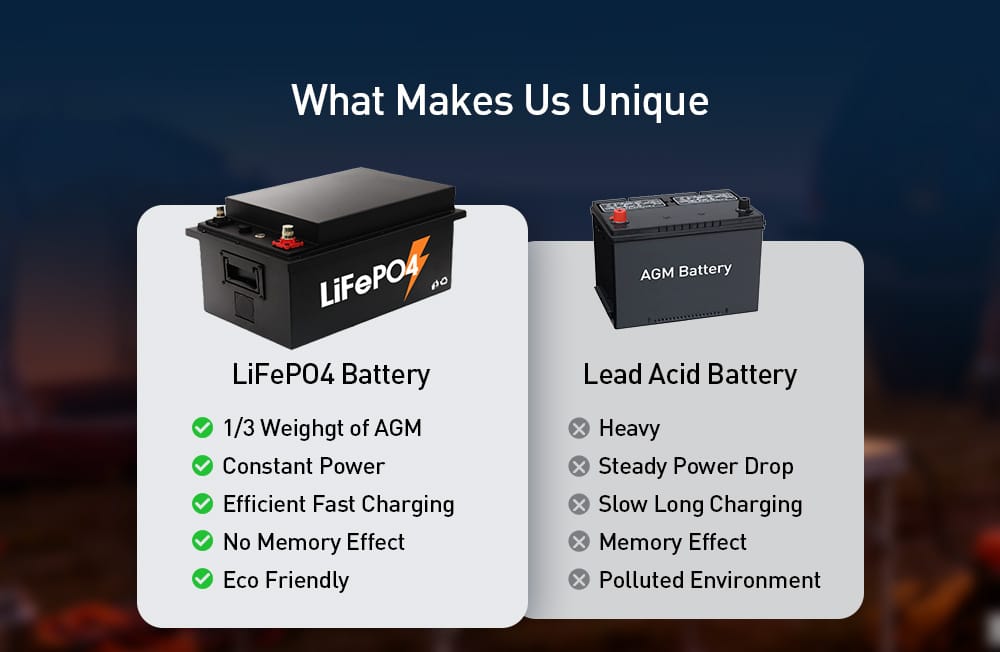
In contrast, LiFePO4 batteries deliver superior safety, longer cycle life, and lower overall cost, making them ideal for electric vehicles and energy storage systems.
Even though LiFePO4 has slightly lower energy density, its durability and low maintenance make it the preferred choice for long-term, stable power applications.
LiFePO4 vs. Other Battery Types
| Feature | LiFePO4 Battery | Lead-Acid Battery | NCM Battery | LiCoO₂ Battery |
|---|---|---|---|---|
| Cycle Life | 2,000–5,000 cycles | 300–500 | 1,000–2,000 | 500–800 |
| Energy Density | 130–140 Wh/kg | 30–40 Wh/kg | 150–250 Wh/kg | 150–200 Wh/kg |
| Safety | Very high (no fire or explosion) | Moderate | Medium | Low |
| Operating Temp | -20°C to +60°C | 0°C–40°C | -20°C–45°C | 0°C–45°C |
| Environmental | Non-toxic, recyclable | Contains lead | Contains cobalt/nickel | Contains cobalt |
Conclusion:
When it comes to safety, lifetime value, maintenance, and eco-friendliness, LiFePO4 batteries clearly lead the pack—making them the ideal mid- to long-term energy storage solution.
The Top 10 Advantages of LiFePO4 Batteries
1. Long Cycle Life = More Value
A quality LiFePO4 battery can handle 2,000–5,000 charge cycles while maintaining over 80% of its capacity.
That’s 4–5 times longer than traditional lead-acid batteries, which often fail after 300–500 cycles.
Under normal conditions, an LFP battery can last 7–10 years—delivering unmatched value per charge.
2. Outstanding Safety, Zero Fire Risk
Thanks to its stable chemical structure, LiFePO4 is resistant to thermal runaway.
Even when punctured, overcharged, or exposed to extreme heat, it won’t explode or catch fire—just release minimal smoke.
Its thermal stability threshold reaches up to 500°C, far higher than NCM batteries, making it the safest lithium battery chemistry on the market.
3. Reliable in Extreme Temperatures
LiFePO4 performs steadily in both cold and hot environments, from -20°C to +60°C.
That’s why it’s trusted in solar farms, telecom towers, and outdoor systems where reliability matters most.
4. High Charging Efficiency
With a charging and discharging efficiency above 90%, LiFePO4 batteries waste less energy than lead-acid types.
They’re perfect for solar energy storage systems and off-grid setups, where every watt counts.
5. Fast Charging Capability
A LiFePO4 battery can reach 80% charge in just 30 minutes with proper equipment.
This saves hours compared to lead-acid batteries, keeping your systems ready when you need them.
6. Lightweight and Compact
At equal capacity, a LiFePO4 battery weighs about one-third as much as a lead-acid one.
Its modular design also simplifies installation in RVs, boats, and portable energy systems.
7. No Memory Effect
You can recharge a LiFePO4 battery anytime—no need to wait until it’s fully drained.
That flexibility makes it ideal for frequent-use devices like golf carts, mobility scooters, or backup generators.
8. Eco-Friendly and Compliant
LiFePO4 batteries are free of lead, cadmium, and cobalt, making them non-toxic and recyclable.
They meet RoHS and REACH standards and don’t rely on conflict minerals.
That makes them the green choice for sustainable and ethical energy storage.
9. Low Self-Discharge Rate
Even after months of storage, a LiFePO4 battery retains most of its charge—with a self-discharge rate as low as 2–3% per month.
This makes it ideal for standby power systems, emergency backup, and seasonal equipment.
10. Maintenance-Free and Smart
Unlike lead-acid batteries that require topping up and frequent checks, LiFePO4 units are completely maintenance-free.
They include a BMS (Battery Management System) that monitors voltage, temperature, and current to prevent overcharge or short circuit—ensuring long-term, reliable performance.
Common Applications of LiFePO4 Batteries
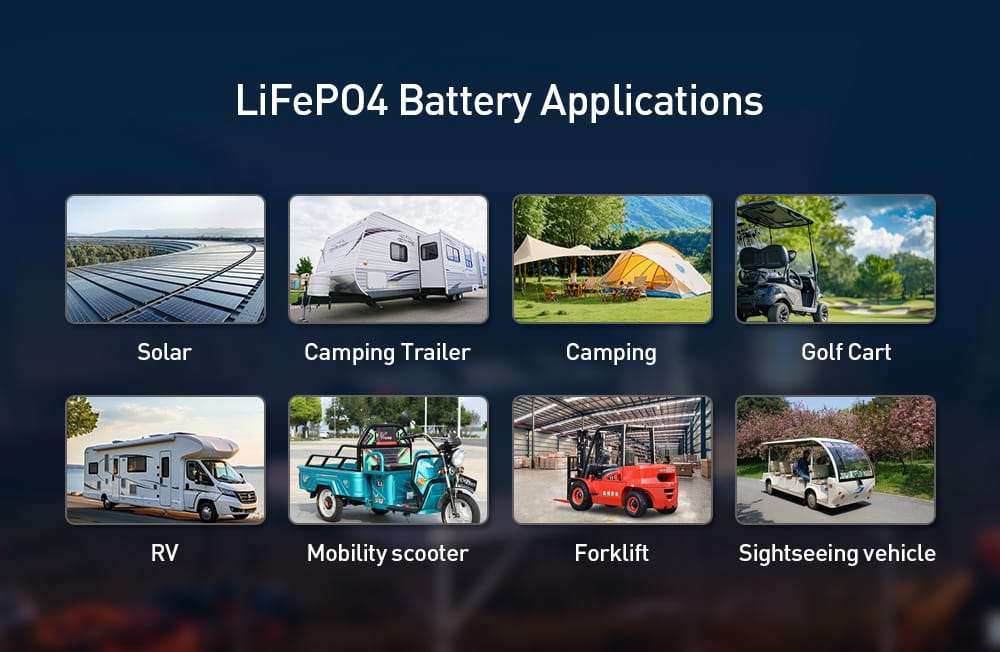
Home Solar Storage – Pair with rooftop PV for energy independence
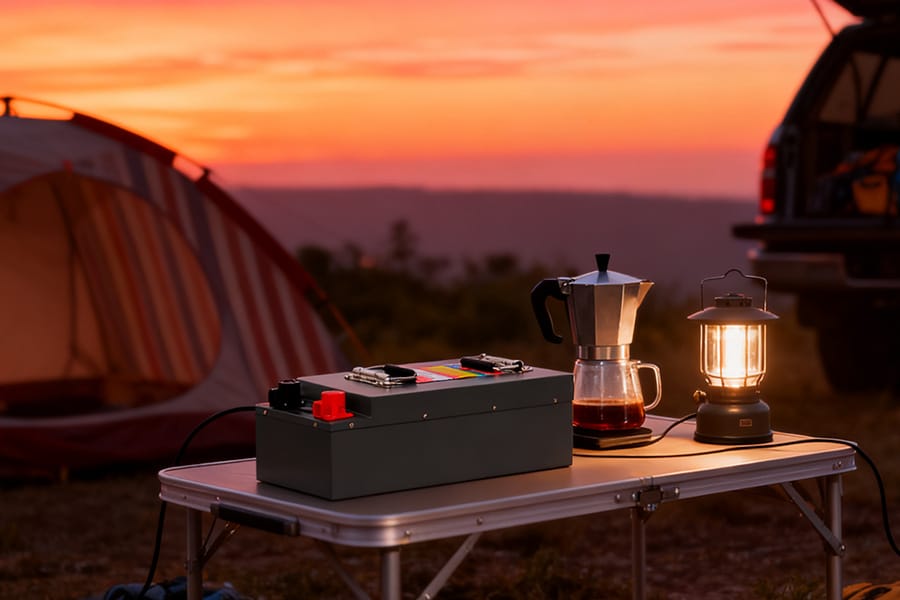
Portable Power Stations – Reliable energy for camping, outdoor work, or emergencies
RVs and Marine Use – Lightweight and solar-compatible for off-grid adventures
Electric Vehicles & Forklifts – Long cycle life and high discharge performance
Industrial Backup Power – UPS systems, data centers, and telecom towers
Off-grid Microgrids – Remote regions, agriculture, and backup communications
Moving Toward a Safer, Cleaner Future
The LiFePO4 battery isn’t just a product—it’s part of a movement toward cleaner, safer, and smarter energy.
With long life, zero maintenance, and unmatched safety, it’s redefining how we power homes, businesses, and vehicles.
At AnengJi New Energy, we design and manufacture advanced LiFePO4 batteries for home energy storage, solar systems, and portable power stations.
Our products are trusted across Europe, Southeast Asia, Central Asia, and Russia.
When you choose LiFePO4, you’re choosing a reliable, efficient, and eco-friendly future.
Ready to upgrade your energy system? Contact us today for custom battery solutions and expert support.
FAQ – LiFePO4 Battery Questions People Ask
1. What is the difference between LiFePO4 and lithium-ion batteries?
LiFePO4 batteries are a type of lithium-ion battery but use iron phosphate instead of cobalt or nickel. They’re safer, last longer, and cost less to maintain.
2. Is a LiFePO4 battery better than a lead-acid battery?
Absolutely. LiFePO4 offers longer life, faster charging, and no maintenance. It’s also much lighter and eco-friendly.
3. How long do LiFePO4 batteries last?
Typically 7–10 years or up to 5,000 cycles, depending on use and temperature conditions.
4. Can LiFePO4 batteries be used for solar systems or RVs?
Yes. They’re ideal for home solar energy storage, off-grid setups, RVs, and boats thanks to their lightweight and high efficiency.
5. Are LiFePO4 batteries environmentally friendly?
Yes. They contain no cobalt or toxic heavy metals, and are fully recyclable, making them one of the most eco-friendly lithium batteries available.
Related Posts
 https://anengjibattery.com/wp-content/uploads/2025/10/12V-LiFePO4-Battery-Powering-RV-and-Camping-Equipment-Outdoors.jpg
600
900
Battery Expert Team
https://anengjibattery.com/wp-content/uploads/2025/06/logo2-300x138.png
Battery Expert Team2025-10-31 08:44:092025-10-31 09:28:427 Reasons to Choose a 12V LiFePO4 Battery for Solar, RV, and Off-Grid Power
https://anengjibattery.com/wp-content/uploads/2025/10/12V-LiFePO4-Battery-Powering-RV-and-Camping-Equipment-Outdoors.jpg
600
900
Battery Expert Team
https://anengjibattery.com/wp-content/uploads/2025/06/logo2-300x138.png
Battery Expert Team2025-10-31 08:44:092025-10-31 09:28:427 Reasons to Choose a 12V LiFePO4 Battery for Solar, RV, and Off-Grid Power https://anengjibattery.com/wp-content/uploads/2025/10/lifepo4-battery-outdoor-evening-power-supply.jpg
600
900
Battery Expert Team
https://anengjibattery.com/wp-content/uploads/2025/06/logo2-300x138.png
Battery Expert Team2025-10-31 06:15:172025-10-31 06:58:29What is a LiFePO4 Battery? Definition and Top 10 Advantages
https://anengjibattery.com/wp-content/uploads/2025/10/lifepo4-battery-outdoor-evening-power-supply.jpg
600
900
Battery Expert Team
https://anengjibattery.com/wp-content/uploads/2025/06/logo2-300x138.png
Battery Expert Team2025-10-31 06:15:172025-10-31 06:58:29What is a LiFePO4 Battery? Definition and Top 10 Advantages https://anengjibattery.com/wp-content/uploads/2025/09/72V-Lithium-Battery-The-Ultimate-2025-User-Guide.jpg
600
900
Battery Expert Team
https://anengjibattery.com/wp-content/uploads/2025/06/logo2-300x138.png
Battery Expert Team2025-09-19 09:38:452025-10-31 06:16:2672V Lithium Battery: The Ultimate 2025 User Guide
https://anengjibattery.com/wp-content/uploads/2025/09/72V-Lithium-Battery-The-Ultimate-2025-User-Guide.jpg
600
900
Battery Expert Team
https://anengjibattery.com/wp-content/uploads/2025/06/logo2-300x138.png
Battery Expert Team2025-09-19 09:38:452025-10-31 06:16:2672V Lithium Battery: The Ultimate 2025 User Guide https://anengjibattery.com/wp-content/uploads/2025/09/Best-Choice-for-Energy-Storage-100Ah-Lithium-Battery-vs-200Ah-Lithium-Battery.jpg
600
900
Battery Expert Team
https://anengjibattery.com/wp-content/uploads/2025/06/logo2-300x138.png
Battery Expert Team2025-09-12 09:00:562025-10-31 06:59:05Best Choice for Energy Storage: 100Ah vs 200Ah Lithium Battery
https://anengjibattery.com/wp-content/uploads/2025/09/Best-Choice-for-Energy-Storage-100Ah-Lithium-Battery-vs-200Ah-Lithium-Battery.jpg
600
900
Battery Expert Team
https://anengjibattery.com/wp-content/uploads/2025/06/logo2-300x138.png
Battery Expert Team2025-09-12 09:00:562025-10-31 06:59:05Best Choice for Energy Storage: 100Ah vs 200Ah Lithium Battery


Leave a Reply
Want to join the discussion?Feel free to contribute!