
Best Choice for Energy Storage: 100Ah vs 200Ah Lithium Battery
September 12, 2025 / Battery Expert Team / News
Introduction
When designing an energy storage system—whether for solar panels, RVs, marine use, or industrial equipment—the choice of battery capacity matters.
A common question comes up: is it better to use two 100Ah lithium batteries in parallel, or a single 200Ah battery?
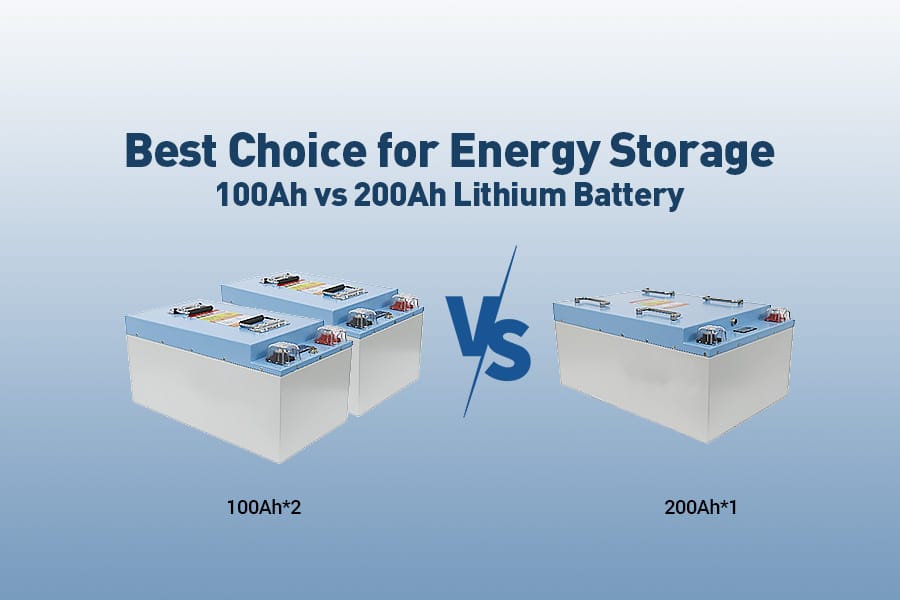
At first glance, both give you 200Ah total. But in practice, they behave differently. From stability and installation to long-term cost and lifespan, the differences are clear. Let’s compare them in detail so you can make the right call for your setup.
Capacity and Performance: Same Numbers, Different Behavior
On paper, two 100Ah lithium batteries wired in parallel equal the same total capacity as one 200Ah battery. In normal use, both give similar runtime.
But under heavy loads, dual 100Ah packs often perform better. Because the current is shared between two batteries, each unit handles less stress. That means less heat, smoother operation, and better stability when facing high surge power—like starting motors or running an inverter with sudden demand.
A single 200Ah battery has its own advantages. It usually shows slightly higher charging efficiency, less self-discharge, and simpler charge management. For users who want a clean, straightforward system, one 200Ah pack can be the easier choice.
Flexibility and System Expansion: Dual Batteries Win
If you think you’ll expand later, two 100Ah batteries offer more options. You can connect them in parallel for more capacity, or in series to step up voltage (12V to 24V). This makes them versatile for different equipment.
There’s also redundancy. If one 100Ah battery fails, the other can still keep the system running. That’s a big plus in critical systems like off-grid solar, UPS backups, telecom stations, or emergency gear where uptime matters.
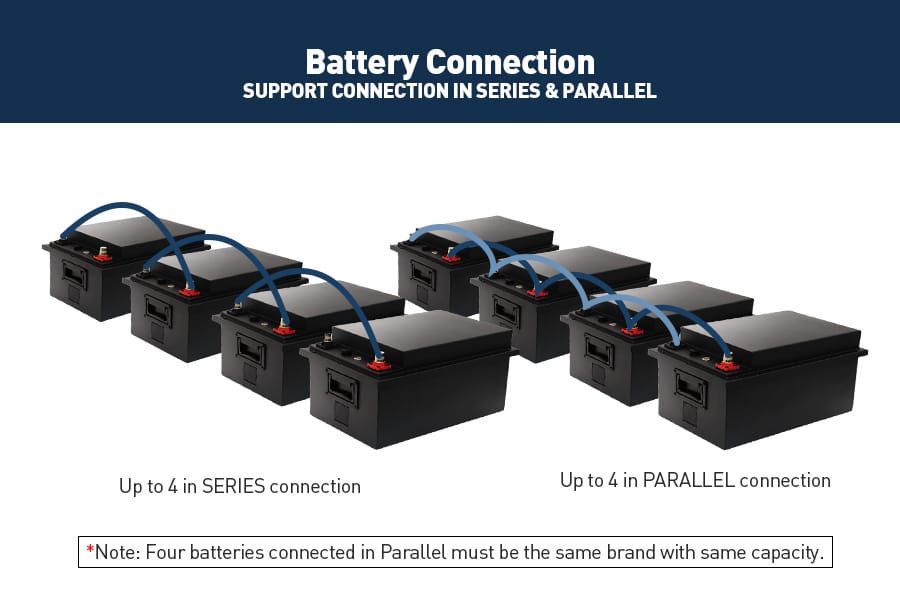
With a single 200Ah battery, you face a single point of failure. If it goes down, the whole system loses power.
Installation and Space: One Battery Is Simpler
Space matters. A 200Ah battery takes less room, requires fewer cables, and has only one set of terminals to wire. This reduces the risk of wiring mistakes.
Two 100Ah batteries need extra parallel cables, fuses, and connectors. They take up more space overall. Before going this route, you’ll need to check if your RV, boat, or battery bay has enough room.
That said, dual batteries can sometimes make installation more flexible. For example, in an RV or boat, you can mount each 100Ah pack in different spots to balance weight or fit tight compartments.
Maintenance and Replacement: Simplicity vs Lower Cost
Managing one 200Ah battery is straightforward. You only monitor one unit for state of charge, temperature, and health. It’s a plug-and-play approach that appeals to many users.
Two 100Ah batteries take a little more attention. Their voltage and capacity should stay balanced. Over time, if one ages faster than the other, it can cause uneven charging or discharging. Regular checks may be needed.
But here’s the tradeoff: if one 100Ah fails, you just replace that one. With a single 200Ah pack, if it fails, the whole unit needs replacement—which can be more expensive.
Cost Comparison: Upfront vs Long-Term
Up front, two 100Ah lithium batteries usually cost slightly more than one 200Ah pack. And when you add cables, fuses, and connectors, the dual-battery setup can be pricier.
But over the long run, the ability to replace just one unit can save money. Also, some 200Ah batteries use larger cells, giving them a longer cycle life than smaller 100Ah packs. This can pay off if you cycle the system daily.
So it comes down to balance: initial cost vs replacement cost, and daily use vs occasional use.
Recommended Use Cases
Two 100Ah Batteries Work Better If:
-
You need high reliability in solar, UPS, or telecom systems.
-
You expect to expand capacity or voltage in the future.
-
Your devices draw high surge currents and need better cooling.
-
You want flexible installation in an RV, camper, or boat.
One 200Ah Battery Works Better If:
-
You have limited installation space.
-
You want simple wiring and easy monitoring.
-
You’re on a budget and don’t plan to expand later.
Frequently Asked Questions (FAQ)
Q1: What’s the main difference between a 100Ah and 200Ah lithium battery?
Capacity and size. A 200Ah battery lasts about twice as long under the same load. For example, a 100Ah battery running a 10A load lasts ~10 hours, while a 200Ah lasts ~20 hours. But it’s heavier and takes more space.
Q2: Can I connect a 100Ah and 200Ah battery in parallel?
Not recommended. Different capacities have different internal resistance and discharge curves. Mixing them can cause overheating, faster wear, and safety risks. Always use the same brand, capacity, and model in parallel.
Q3: Which is better: two 100Ah batteries or one 200Ah battery?
It depends. Two 100Ah packs offer redundancy, flexibility, and easier replacement. One 200Ah pack saves space, wiring, and monitoring effort.
Q4: How long does a 200Ah battery last with a 1000W inverter?
At 12V, a 200Ah battery holds about 2400Wh. A 1000W inverter would drain it in about 2 hours at full load. Real-world time is usually shorter due to efficiency loss.
Q5: Is a 200Ah LiFePO4 battery better for RV solar systems?
For tight spaces and simple installation, yes. But many RV owners prefer two 100Ah packs for easier handling and backup.
Q6: What products does AnengJi recommend?
We offer 100Ah and 200Ah LiFePO4 batteries with 3000+ cycles, built-in BMS, lightweight design, and wide temperature range. We also provide custom solutions for RV, marine, and off-grid solar systems.
Conclusion: No Absolute Winner, Only the Right Choice for You
Both setups have clear strengths. Two 100Ah batteries give flexibility, redundancy, and easier maintenance. A single 200Ah battery saves space, wiring, and effort.
The best choice depends on your needs: available space, budget, daily usage, and future expansion.
👉 Still unsure? Contact the AnengJi team. We’ll help design a custom lithium battery solution for your RV, solar system, or off-grid project.
tags: Energy Storage, lithium battery
Related Posts
 https://anengjibattery.com/wp-content/uploads/2026/09/AnengJIBattery-Best-LiFePO4-Battery-How-to-Choose-the-Right-One.webp
675
1000
Battery Expert Team
https://anengjibattery.com/wp-content/uploads/2025/06/logo2-300x138.png
Battery Expert Team2026-09-17 08:52:142026-09-18 09:19:29How to Choose the Best LiFePO4 Battery
https://anengjibattery.com/wp-content/uploads/2026/09/AnengJIBattery-Best-LiFePO4-Battery-How-to-Choose-the-Right-One.webp
675
1000
Battery Expert Team
https://anengjibattery.com/wp-content/uploads/2025/06/logo2-300x138.png
Battery Expert Team2026-09-17 08:52:142026-09-18 09:19:29How to Choose the Best LiFePO4 Battery https://anengjibattery.com/wp-content/uploads/2026/09/anengjiBattery-lifepo4-battery-cell-packaging-wholesale.webp
675
1000
Battery Expert Team
https://anengjibattery.com/wp-content/uploads/2025/06/logo2-300x138.png
Battery Expert Team2026-09-16 09:52:342026-09-18 09:20:12LiFePO4 Battery Wholesale Guide: Best Suppliers in Spain
https://anengjibattery.com/wp-content/uploads/2026/09/anengjiBattery-lifepo4-battery-cell-packaging-wholesale.webp
675
1000
Battery Expert Team
https://anengjibattery.com/wp-content/uploads/2025/06/logo2-300x138.png
Battery Expert Team2026-09-16 09:52:342026-09-18 09:20:12LiFePO4 Battery Wholesale Guide: Best Suppliers in Spain https://anengjibattery.com/wp-content/uploads/2026/09/anengjibattery-Top-Lithium-Ion-Battery-Producers-for-Spain-Market-Growth.webp
675
1000
Battery Expert Team
https://anengjibattery.com/wp-content/uploads/2025/06/logo2-300x138.png
Battery Expert Team2026-09-16 01:13:392026-09-16 01:14:05Top Lithium Ion Battery Producers for Spain’s Market Growth
https://anengjibattery.com/wp-content/uploads/2026/09/anengjibattery-Top-Lithium-Ion-Battery-Producers-for-Spain-Market-Growth.webp
675
1000
Battery Expert Team
https://anengjibattery.com/wp-content/uploads/2025/06/logo2-300x138.png
Battery Expert Team2026-09-16 01:13:392026-09-16 01:14:05Top Lithium Ion Battery Producers for Spain’s Market Growth https://anengjibattery.com/wp-content/uploads/2026/09/Bulk-Lithium-Ion-Battery-Cells-Procurement-Guide-B2B-Sourcing.webp
675
1000
Battery Expert Team
https://anengjibattery.com/wp-content/uploads/2025/06/logo2-300x138.png
Battery Expert Team2026-09-14 09:47:322026-09-14 09:47:48Bulk Lithium-Ion Battery Cells Procurement Guide | B2B Sourcing
https://anengjibattery.com/wp-content/uploads/2026/09/Bulk-Lithium-Ion-Battery-Cells-Procurement-Guide-B2B-Sourcing.webp
675
1000
Battery Expert Team
https://anengjibattery.com/wp-content/uploads/2025/06/logo2-300x138.png
Battery Expert Team2026-09-14 09:47:322026-09-14 09:47:48Bulk Lithium-Ion Battery Cells Procurement Guide | B2B Sourcing


Leave a Reply
Want to join the discussion?Feel free to contribute!