
How to Customize a Lithium-ion Battery Pack for Your Application
April 17, 2018 / Battery Expert Team / Battery Basics, News
Introduction
Lithium-ion battery packs are at the heart of today’s electric mobility and energy storage systems. From electric bikes and golf carts to solar storage and industrial backup power, every application has its own requirements—voltage, discharge rate, space constraints, operating temperatures, and lifespan expectations. That’s why custom lithium battery packs are no longer a luxury—they’re a necessity for performance, safety, and ROI.
At AnengJi, we specialize in designing and building tailor-made lithium battery solutions. In this article, we’ll walk you through the key parameters involved in customization, the typical workflow, certification requirements, and what you can expect from investing in a custom battery pack.
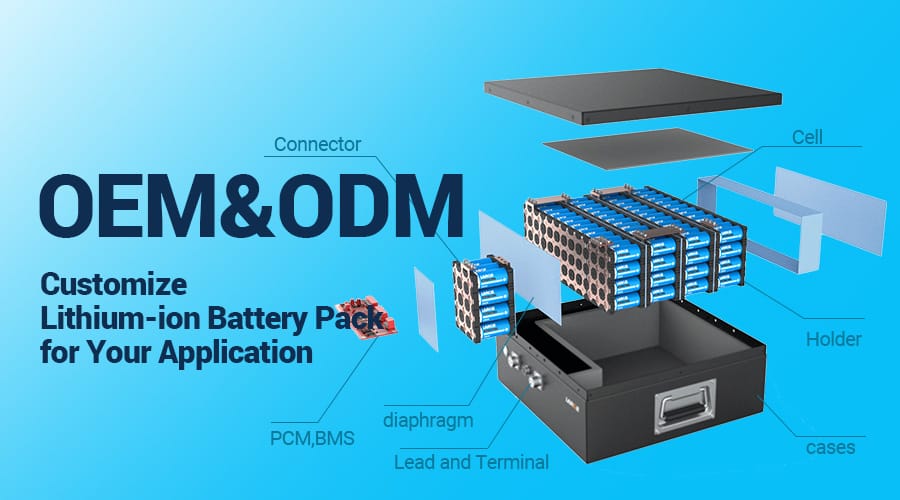
Key Parameters in Lithium Battery Pack Customization
Whether you’re developing a new electric scooter battery or a stationary energy storage pack, a successful custom battery design starts with aligning the technical parameters to your real-world needs.
1.Cell Chemistry & Performance
Discharge Rate: High-speed EVs or power tools require ≥3C cells, while stationary storage systems are fine with 0.2C discharge rates.
Battery Chemistry:
- NCM (Nickel Cobalt Manganese, 3.7V) offers higher energy density, ideal for space-limited applications like e-bikes.
- LFP (Lithium Iron Phosphate, 3.2V) delivers longer cycle life and thermal stability, perfect for AGVs or golf carts.
Cell Format:
- Cylindrical/soft pouch cells offer flexible design, used in compact systems like 36V15Ah e-bikes.
- Prismatic cells provide structural stability and are preferred in large battery assemblies like 72V200Ah golf cart batteries.
2.Electrical Configuration
Voltage & Capacity: Define system performance. For instance, a 72V60Ah battery will provide twice the runtime of a 72V30Ah under similar conditions.
Motor Power: Both nominal and peak power ratings are needed to calculate continuous and surge discharge current, which affects the selection of BMS and wiring gauge.
3.Physical & Environmental Considerations
Installation Space: Custom battery housing must fit the allotted space. For irregular geometries, CAD drawings are often required.
Operating Temperatures: While typical ranges are 0–45°C (charging) and -20–55°C (discharging), applications in extreme environments—like snowmobiles—may require built-in heating systems.
4.Interfaces & Communication Protocols
Connectors: Define input/output port types—2-pin, Anderson, Molex, etc.—and ensure compatibility with your system.
Communication: For smart systems, support for CAN, RS485, RS232, or SMBus is essential to integrate with controllers or external monitoring devices.
5.Mechanical, Aesthetic & Functional Requirements
Custom outer shell materials (metal, ABS plastic), color preferences, branding elements, IP rating for water/dust resistance, and other special features can all be tailored to your application.
When Is a Custom Lithium Battery Pack Worth the Investment?
While off-the-shelf batteries may seem cost-effective, they rarely deliver optimal value over time in demanding use cases. A well-designed custom lithium battery pack may have a higher upfront cost—but it pays off quickly.
- Cycle Life: Custom LFP packs can exceed 3,000 cycles—double that of many standard batteries.
- Efficiency: Charging efficiency up to 96% compared to 75% for conventional lead-acid systems.
- Maintenance: No watering, balancing, or terminal cleaning needed—saving time and labor.
- Cost of Ownership: Over an 8-year service life, battery costs can be reduced by up to 56%.
For industrial, commercial, or mission-critical use cases, customization often pays for itself within 2–4 years.
What Is the Custom Battery Pack Development Process Like?
1.Standard Customization (30-day turnaround)
We offer a streamlined custom solution for most projects with a rapid 4-step cycle:
- Requirement Analysis (3–4 days): You provide your specifications, we evaluate and offer a detailed quote.
- Design & Validation (3–6 days): Our engineers design the pack, validate the structure and performance in simulation.
- Production & Testing (5–7 weeks): Upon payment, manufacturing begins. Every pack goes through 100% quality control.
- Delivery (3–5 days): Safe packaging and shipment to your location.
This option is ideal for modifications to standard packs or repeat models with known configurations.
2.Advanced Custom Development (Longer cycle)
For highly customized needs (e.g., entirely new form factors, communication protocols, or battery housing), expect extended lead times:
- Mechanical Design: 4–6 weeks
- BMS Software/Firmware: 4–5 weeks
- 3D Prototyping: 5–10 days
- Injection Mold Tooling: 8–10 weeks for ABS enclosures
- Sample Production: 10–20 weeks depending on cell availability
- Mass Production: ≥10 weeks (delays may occur due to custom parts)
For new product development, we recommend planning at least 6–8 months ahead.
Certifications Required Before Deployment
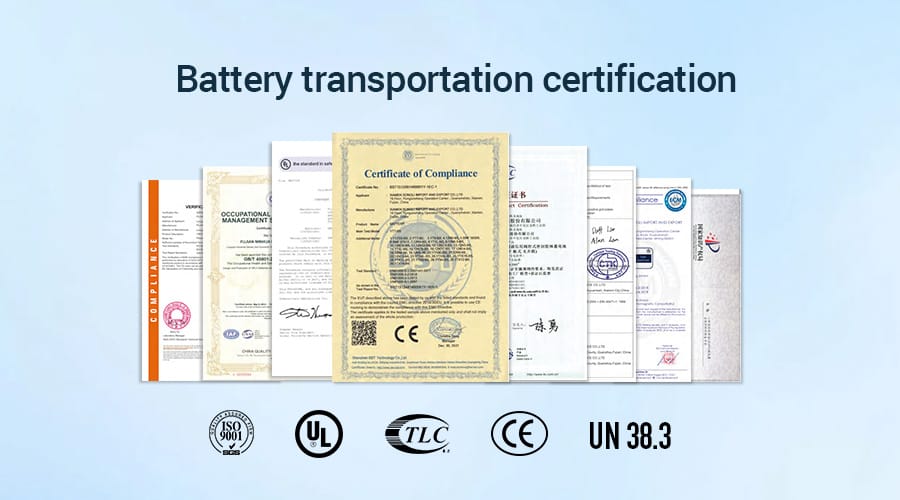
To comply with global shipping and safety regulations, battery packs often require third-party testing and certification:
- UN 38.3 (Mandatory for international transport): Includes tests for altitude simulation, thermal, vibration, shock, short circuit, impact, overcharge, and forced discharge. Requires 17 test samples, 6–8 weeks, costs $460–$7,000.
- UL 2054 (U.S. safety standard for household/commercial batteries): Requires 55 samples, 12–14 weeks testing, total cycle 20–24 weeks.
- IEC 62133 (Global rechargeable battery safety standard): Requires 33 samples, 8–10 weeks.
These certifications can be time-consuming and costly but are essential for entering regulated markets or working with large OEMs.
FAQs About Custom Battery Packs
Q: Is there a mold cost?
Metal case: No mold cost.
ABS plastic case: May require mold development; we cover the cost after a minimum order quantity is reached.
Q: Are CE or other certifications available?
We maintain full certifications for our battery cells. However, because every custom battery pack can differ in structure, connector, BMS, or communication protocol—even with the same voltage/capacity—we cannot pre-certify every configuration.
If you require CE, UN38.3, or other certifications, we can provide full support within 7–21 business days upon request.
Why Work with AnengJi?
We are more than just a battery assembler—we’re your development partner from concept to mass production.
What We Offer:
- End-to-end Services: From engineering consultation to full-scale manufacturing and after-sales support.
- Global Reach: Serving clients across Europe, North America, Southeast Asia, and China.
- Design Expertise: 3D design support, in-house BMS programming, and protocol compatibility including CAN, RS485, RS232, SMBus, and I2C.
- Efficiency & Flexibility: Our early-stage engineering support helps you pick the optimal path—balancing performance, cost, and compliance.
By combining cost control, advanced technical support, and fast lead times, AnengJi helps B2B clients deliver smarter, safer, and more competitive products to the market.
Ready to Build Your Custom Battery Pack?
Contact our team today to begin your custom battery project—from electric vehicles to solar systems, we help you power the future with precision.
Related Article
Related Posts
 https://anengjibattery.com/wp-content/uploads/2026/09/AnengJIBattery-Best-LiFePO4-Battery-How-to-Choose-the-Right-One.webp
675
1000
Battery Expert Team
https://anengjibattery.com/wp-content/uploads/2025/06/logo2-300x138.png
Battery Expert Team2026-09-17 08:52:142026-09-18 09:19:29How to Choose the Best LiFePO4 Battery
https://anengjibattery.com/wp-content/uploads/2026/09/AnengJIBattery-Best-LiFePO4-Battery-How-to-Choose-the-Right-One.webp
675
1000
Battery Expert Team
https://anengjibattery.com/wp-content/uploads/2025/06/logo2-300x138.png
Battery Expert Team2026-09-17 08:52:142026-09-18 09:19:29How to Choose the Best LiFePO4 Battery https://anengjibattery.com/wp-content/uploads/2026/09/anengjiBattery-lifepo4-battery-cell-packaging-wholesale.webp
675
1000
Battery Expert Team
https://anengjibattery.com/wp-content/uploads/2025/06/logo2-300x138.png
Battery Expert Team2026-09-16 09:52:342026-09-18 09:20:12LiFePO4 Battery Wholesale Guide: Best Suppliers in Spain
https://anengjibattery.com/wp-content/uploads/2026/09/anengjiBattery-lifepo4-battery-cell-packaging-wholesale.webp
675
1000
Battery Expert Team
https://anengjibattery.com/wp-content/uploads/2025/06/logo2-300x138.png
Battery Expert Team2026-09-16 09:52:342026-09-18 09:20:12LiFePO4 Battery Wholesale Guide: Best Suppliers in Spain https://anengjibattery.com/wp-content/uploads/2026/09/anengjibattery-Top-Lithium-Ion-Battery-Producers-for-Spain-Market-Growth.webp
675
1000
Battery Expert Team
https://anengjibattery.com/wp-content/uploads/2025/06/logo2-300x138.png
Battery Expert Team2026-09-16 01:13:392026-09-16 01:14:05Top Lithium Ion Battery Producers for Spain’s Market Growth
https://anengjibattery.com/wp-content/uploads/2026/09/anengjibattery-Top-Lithium-Ion-Battery-Producers-for-Spain-Market-Growth.webp
675
1000
Battery Expert Team
https://anengjibattery.com/wp-content/uploads/2025/06/logo2-300x138.png
Battery Expert Team2026-09-16 01:13:392026-09-16 01:14:05Top Lithium Ion Battery Producers for Spain’s Market Growth https://anengjibattery.com/wp-content/uploads/2026/09/Bulk-Lithium-Ion-Battery-Cells-Procurement-Guide-B2B-Sourcing.webp
675
1000
Battery Expert Team
https://anengjibattery.com/wp-content/uploads/2025/06/logo2-300x138.png
Battery Expert Team2026-09-14 09:47:322026-09-14 09:47:48Bulk Lithium-Ion Battery Cells Procurement Guide | B2B Sourcing
https://anengjibattery.com/wp-content/uploads/2026/09/Bulk-Lithium-Ion-Battery-Cells-Procurement-Guide-B2B-Sourcing.webp
675
1000
Battery Expert Team
https://anengjibattery.com/wp-content/uploads/2025/06/logo2-300x138.png
Battery Expert Team2026-09-14 09:47:322026-09-14 09:47:48Bulk Lithium-Ion Battery Cells Procurement Guide | B2B Sourcing


Leave a Reply
Want to join the discussion?Feel free to contribute!