
7 Reasons to Choose a 12V LiFePO4 Battery for Solar, RV, and Off-Grid Power
October 31, 2025 / Battery Expert Team / News
Introduction
As clean energy keeps evolving, the 12V LiFePO4 battery is quickly replacing old lead-acid designs in solar systems, RVs, boats, and backup power setups. Known for its long life, high safety, and reliable performance, this 12V lithium iron phosphate battery has become a favorite among users looking for durable off-grid power. If you care about energy efficiency and long-term value, it’s time to see why this deep-cycle lithium battery is redefining modern energy storage.
If you’re building an off-grid setup, powering mobile equipment, or just want reliable backup energy, understanding the benefits of LiFePO4 deep cycle batteries will help you make a smarter long-term investment.
1. Exceptional Cycle Life — Built to Last
LiFePO4 batteries stand out for their impressive durability. A typical 12V lithium iron phosphate battery can handle 3,000 to 7,000 full charge cycles at 80% depth of discharge (DoD), and high-end models can even reach 10,000 cycles.
In comparison, most lead-acid batteries (AGM or gel) last only about 300–500 cycles before losing capacity.
That means one 12V LiFePO4 battery can last as long as several lead-acid batteries combined — fewer replacements, less downtime, and lower maintenance costs.
Under normal use, you can expect 8–10 years of service life from a quality 12V lithium battery, while lead-acid batteries typically degrade after 3–5 years. Over time, that difference adds up to significant cost savings and system reliability.
2. Deeper Discharge, More Usable Energy
Unlike lead-acid batteries, which can only safely discharge about 50% of their capacity, LiFePO4 deep cycle batteries can discharge up to 80–100% without damage.
| Battery Type | Recommended Max DoD | Usable Capacity (100Ah Battery) |
|---|---|---|
| LiFePO4 Battery | 80–100% | 80–100Ah |
| Lead-Acid Battery | 50% | 50Ah |
That’s nearly double the usable energy for the same rated capacity. In real-world terms, you can power more devices or run your system longer with fewer batteries — saving both space and upfront cost.
3. Safer Chemistry, Peace of Mind Anywhere
Safety is one of the biggest advantages of a LiFePO4 battery. Thanks to its stable chemical structure and strong P–O bond, it resists thermal runaway even under extreme conditions like overcharging, short circuits, or high temperatures.
LiFePO4 cells stay stable up to 350°C–500°C, far above the ~200°C limit for most lithium-ion chemistries. In stress tests such as nail penetration or crushing, they might smoke — but they don’t catch fire or explode.
Unlike lead-acid batteries, they contain no corrosive acid and don’t emit hydrogen gas during charging. That makes them ideal for RVs, boats, and enclosed installations — safe, clean, and low-maintenance.
4. Lightweight and Compact Design
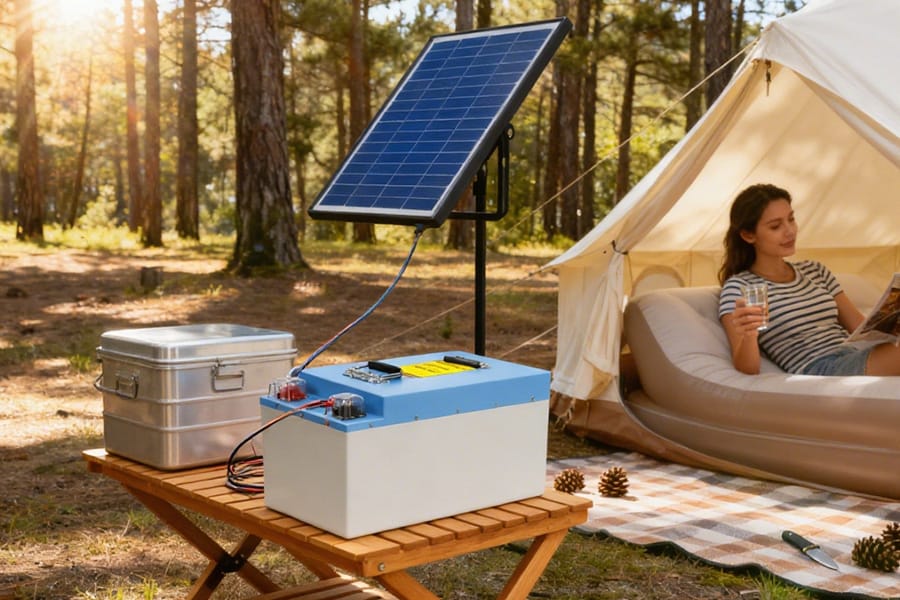
LiFePO4 batteries pack more power into a smaller, lighter body. Their energy density is significantly higher, offering the same capacity in about two-thirds the volume of a lead-acid battery.
A 100Ah lead-acid battery can weigh around 25–30 kg, while a similar LiFePO4 battery weighs just 10–12 kg.
That’s a huge benefit for RVs, campers, marine vessels, or mobile systems:
- Less overall weight for better fuel efficiency
- Easier installation and transport
- Improved handling and mobility
Lighter weight means more flexibility — and more room for what really matters.
5. Higher Efficiency and Faster Charging
Efficiency defines how much of your stored energy you can actually use. LiFePO4 batteries deliver up to 95–98% round-trip efficiency, compared to 70–85% for lead-acid batteries.
So for every 100Wh of solar energy you capture, LiFePO4 gives you back 95Wh or more — while lead-acid might waste up to 30Wh. Over time, that translates into noticeably better system output, especially for solar and off-grid systems.
They also support 1C–2C fast charging, meaning they can recharge in as little as 1–2 hours with the right charger. Lead-acid batteries, on the other hand, can take 6–8 hours to top off.
You can charge a LiFePO4 battery via solar panels, grid power, vehicle alternators, or DC fast chargers, making it a flexible choice for fleet operations, mobile setups, or emergency power use.
6. Stable Voltage Output for Reliable Power
One thing users love about LiFePO4 batteries is their steady voltage curve. From 100% down to 80% charge, voltage stays around 13.2V–12.8V, keeping your devices powered consistently.
This stability protects sensitive electronics — like inverters, refrigerators, and lighting systems — from voltage dips that can cause shutdowns or reduced performance.
By contrast, lead-acid voltage drops continuously as it discharges, meaning your system might “feel” empty even when there’s energy left inside. LiFePO4 delivers steady, predictable power — the way reliable energy should feel.
7. Lower Total Cost of Ownership
Yes, LiFePO4 batteries cost more upfront. But look beyond the price tag — you’ll quickly see how they save money over time.
They last up to 4–6 times longer than lead-acid, require no maintenance, and maintain efficiency across thousands of cycles. With no water refills, acid checks, or equalization charges needed, they’re truly maintenance-free batteries.
Add in fewer replacements, less downtime, and higher solar efficiency, and your total cost of ownership drops dramatically over the battery’s lifespan.
In short, LiFePO4 isn’t just a battery upgrade — it’s a smarter, long-term investment for energy independence and reliability.
FAQ: Common Questions About 12V LiFePO4 Batteries
Q1: What makes the 12V LiFePO4 battery better than a lead-acid battery?
A 12V LiFePO4 battery offers longer cycle life, faster charging, and stable voltage. It’s lighter, safer, and maintenance-free compared to lead-acid alternatives.
Q2: How long does a 12V LiFePO4 battery last?
With proper care, a quality 12V lithium iron phosphate battery can last 8–10 years or more, even under frequent deep-cycle use.
Q3: Can I use a LiFePO4 battery for solar power storage?
Absolutely. A 12V lithium battery for solar storage works perfectly for off-grid and renewable energy systems thanks to its high efficiency and reliability.
Q4: Is it safe to use a LiFePO4 battery indoors or in an RV?
Yes. LiFePO4 batteries are thermally stable, non-toxic, and emit no harmful gases, making them safe for enclosed spaces like homes, RVs, or boats.
Q5: What’s the best way to charge a 12V LiFePO4 battery?
Use a dedicated LiFePO4 charger or a smart charger with a lithium mode to ensure balanced cells and extend battery life.
Final Thoughts — The Smarter Power Choice
From longer lifespan and higher efficiency to outstanding safety and stability, a 12V LiFePO4 battery is far ahead of lead-acid technology.
As the International Energy Agency (IEA) notes, the falling cost and improving performance of lithium batteries are transforming how we store and use energy.
If you’re aiming for long-term reliability, low maintenance, and sustainable energy independence, a LiFePO4 battery is the smart choice.
About AnengJi Energy
At AnengJi New Energy, we specialize in designing and manufacturing 12V LiFePO4 batteries for solar storage, RVs, marine systems, and emergency power.
All products are certified to CE, RoHS, UN38.3, and MSDS standards and are trusted by customers across Europe, North America, and Southeast Asia.
📞 Contact us today to get your customized energy storage solution.
Related Posts
 https://anengjibattery.com/wp-content/uploads/2025/10/12V-LiFePO4-Battery-Powering-RV-and-Camping-Equipment-Outdoors.jpg
600
900
Battery Expert Team
https://anengjibattery.com/wp-content/uploads/2025/06/logo2-300x138.png
Battery Expert Team2025-10-31 08:44:092025-10-31 09:28:427 Reasons to Choose a 12V LiFePO4 Battery for Solar, RV, and Off-Grid Power
https://anengjibattery.com/wp-content/uploads/2025/10/12V-LiFePO4-Battery-Powering-RV-and-Camping-Equipment-Outdoors.jpg
600
900
Battery Expert Team
https://anengjibattery.com/wp-content/uploads/2025/06/logo2-300x138.png
Battery Expert Team2025-10-31 08:44:092025-10-31 09:28:427 Reasons to Choose a 12V LiFePO4 Battery for Solar, RV, and Off-Grid Power https://anengjibattery.com/wp-content/uploads/2025/10/lifepo4-battery-outdoor-evening-power-supply.jpg
600
900
Battery Expert Team
https://anengjibattery.com/wp-content/uploads/2025/06/logo2-300x138.png
Battery Expert Team2025-10-31 06:15:172025-10-31 06:58:29What is a LiFePO4 Battery? Definition and Top 10 Advantages
https://anengjibattery.com/wp-content/uploads/2025/10/lifepo4-battery-outdoor-evening-power-supply.jpg
600
900
Battery Expert Team
https://anengjibattery.com/wp-content/uploads/2025/06/logo2-300x138.png
Battery Expert Team2025-10-31 06:15:172025-10-31 06:58:29What is a LiFePO4 Battery? Definition and Top 10 Advantages https://anengjibattery.com/wp-content/uploads/2025/09/72V-Lithium-Battery-The-Ultimate-2025-User-Guide.jpg
600
900
Battery Expert Team
https://anengjibattery.com/wp-content/uploads/2025/06/logo2-300x138.png
Battery Expert Team2025-09-19 09:38:452025-10-31 06:16:2672V Lithium Battery: The Ultimate 2025 User Guide
https://anengjibattery.com/wp-content/uploads/2025/09/72V-Lithium-Battery-The-Ultimate-2025-User-Guide.jpg
600
900
Battery Expert Team
https://anengjibattery.com/wp-content/uploads/2025/06/logo2-300x138.png
Battery Expert Team2025-09-19 09:38:452025-10-31 06:16:2672V Lithium Battery: The Ultimate 2025 User Guide https://anengjibattery.com/wp-content/uploads/2025/09/Best-Choice-for-Energy-Storage-100Ah-Lithium-Battery-vs-200Ah-Lithium-Battery.jpg
600
900
Battery Expert Team
https://anengjibattery.com/wp-content/uploads/2025/06/logo2-300x138.png
Battery Expert Team2025-09-12 09:00:562025-10-31 06:59:05Best Choice for Energy Storage: 100Ah vs 200Ah Lithium Battery
https://anengjibattery.com/wp-content/uploads/2025/09/Best-Choice-for-Energy-Storage-100Ah-Lithium-Battery-vs-200Ah-Lithium-Battery.jpg
600
900
Battery Expert Team
https://anengjibattery.com/wp-content/uploads/2025/06/logo2-300x138.png
Battery Expert Team2025-09-12 09:00:562025-10-31 06:59:05Best Choice for Energy Storage: 100Ah vs 200Ah Lithium Battery


Leave a Reply
Want to join the discussion?Feel free to contribute!